
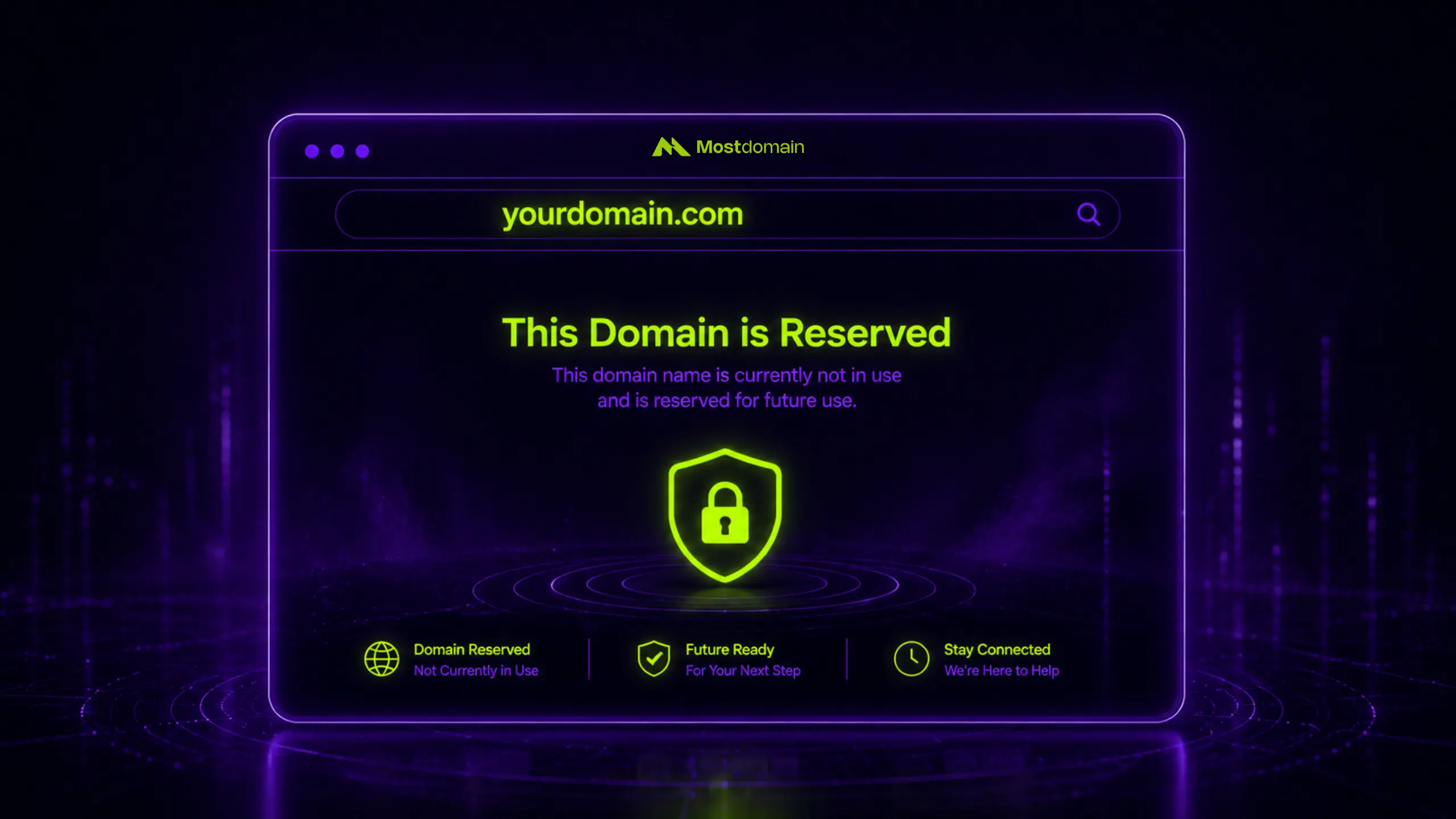
Domain parking is when a domain gets registered but never turned into a real website. It sits on a placeholder page while the owner figures out the next move. A holding pattern, nothing more.
Whether that parking actually serves its purpose, depends less on the decision to park and more on how it’s done.
What Is Domain Parking?
Domain parking means holding a registered domain without attaching it to a live website. Leaving it on a placeholder page until the owner decides what comes next. The practice is the decision. The resulting page is just the byproduct.
There’s nothing to browse on a parked page, no products, no articles, nothing pulling a visitor deeper in. Occupying the address is the whole job. Serving an actual visitor was never really the point.
- Keeping a brand name, or an easy misspelling of it, out of a competitor’s hands
- Buying time while the actual website gets designed and built
- Sitting on an asset that could be worth considerably more in a few years, especially if the niche around it heats up
How Does Domain Parking Work?
Setting up domain parking doesn’t take much:
- Register the domain
- Point its nameservers at a parking provider
- The landing page appears on its own
No code, no hosting account, no developer required.

| Step | What Happens |
| Registration | Same as buying any domain, nothing special |
| Nameserver setup | DNS gets pointed at a parking provider instead of a hosting account, which is really the only technical step involved |
| Landing page | Auto-generated the moment the nameservers propagate |
| Optional monetization | Ads can run on the page for click revenue, a route that got a lot less useful after 2026 |
Types of Domain Parking
Domain parking falls into four main types, and the type in use says a lot about what the owner actually wants from the domain.
Defensive Parking
No revenue goal here. The domain sits parked purely to keep a brand name, or close variations of it, out of a competitor’s hands.
Monetized Parking
The page displays ads, and the owner earns a small amount whenever a visitor clicks one. This is the type that took the biggest hit from Google’s 2026 policy change, covered further down.




Speculative Parking
Investors hold short, memorable, or keyword-rich domains here, betting that someone will eventually pay a premium to buy them. The bet doesn’t always land, plenty of speculative names just sit there for years without a serious offer.
Developmental Parking
A temporary state. The domain is parked only until a real website is designed, built, and ready to launch.
Why Do People Choose to Park a Domain?
People park domains for three main reasons: protecting a brand, reserving a name during development, or holding an asset for future resale. Which reason applies usually depends on who owns the domain.
| Who’s Parking | Main Reason | Typical Holding Period |
| Brand or startup founder | Keeping the name out of a competitor’s or squatter’s hands | Weeks, sometimes a couple months |
| Domain investor | Building value in an aged or brandable name before selling it | Months, occasionally years |
| Web developer or agency | Just a placeholder while the real build happens | A few days at most, sometimes longer if the project stalls |
Investors tend to treat this the most seriously out of the three, since a parked domain is essentially inventory sitting on a shelf, and shelf inventory only appreciates if it’s looked after.
Is Domain Parking Good or Bad for SEO?
A parked page itself carries almost no ranking power, since there’s no real content for Google to evaluate. That’s different from saying domain parking permanently damages a domain’s underlying SEO potential.
| Parking Type | Indexability | Link-Equity Risk |
| Sales-lander (HTTPS, unique description) | Tends to stay at least partly indexable | Fairly low, assuming the description isn’t copied from a template |
| Ad-feed / PPC monetized | Gets filtered out of the index sooner or later | Meaningfully higher, and it compounds the longer the hold drags on |
Here’s a data point worth sitting with: research from Ahrefs on ranking timelines puts the average top-10 page at well over two years old. Age isn’t actually the cause, though. It’s a proxy for backlinks and topical authority that built up over that time, and neither of those evaporates just because a domain spent part of that stretch parked. For a closer look at why the underlying signals outweigh the registration date, our piece on the SEO value of aged domains goes into more depth. It’s also worth understanding the difference between domain authority and domain rating before treating a parked domain’s metrics as gospel.
Domain Parking and Monetization: What Changed in 2026
Ad-driven domain parking took a real hit in 2026. Google pulled Parked Domains, better known as AdSense for Domains or AFD. Google pulled them from its Search Partner Network on February 10 of that year. Cutting off the main way monetized parking pages made money.
| Date | What Happened |
| March 2025 | New Google Ads accounts got defaulted out of parked domain inventory, officially because of weak conversion rates |
| February 10, 2026 | The AFD ad surface disappeared entirely, opt-in included |
None of this happened in isolation, either. It’s part of a wider pattern of Google cracking down on low-value, thin-content domains, a trend that shows up again in our coverage of the Google Spam Update June 2026. Parking purely for ad clicks just doesn’t pencil out anymore. The other three types, defensive, speculative, developmental, barely notice the change, since ad revenue was never really the point for them.
Best Practices When Parking a Domain
Getting the most out of a parked domain comes down to picking the right setup, keeping it secure, and knowing when to stop parking and build.
- A sales-lander page beats a generic ad-feed template almost every time, mainly because it’s far more likely to stay indexable
- HTTPS should stay on for the whole parking period, not just once the site goes live
- Before deciding how long to hold a domain, it’s worth confirming its real registration history and backlink trail first. Our guide on how to check domain age covers three methods that actually work for this
- Guessing at a domain’s worth is risky. Running it through an actual valuation framework, like the one in how to value an aged domain, gives a far more reliable number
- For anyone specifically after an aged domain, sourcing one where the backlink profile is already documented saves a lot of guesswork. Marketplaces built around niche-relevant aged domains, including inventory available while browsing premium domains for sale on Mostdomain, make that part considerably easier
Parking Isn’t the Risk, Neglect Is
Most of the mistakes covered above don’t come from parking a domain in the first place. They come from parking it and forgetting about it. A sales-lander setup left unmonitored can quietly slide toward an ad-feed template when a provider auto-upgrades it for more revenue. HTTPS certificates lapse without anyone noticing. A domain with real backlink equity sits untouched for three years while its authority erodes for reasons nobody bothered to check. Domain parking, done deliberately, protects value. Left on autopilot, it slowly gives that value away.
FAQ
Is domain parking free?
Usually, yes. At least at the registrar level. Registering the domain costs the standard renewal fee, and most registrars park new domains by default at no extra charge. Premium parking services with monetization tools or custom sales-lander designs sometimes charge a fee or take a revenue share instead.
Can a parked domain still rank on Google?
Search engines find almost nothing worth ranking on a parked page. So the honest answer is rarely, and only marginally when it does happen. Whatever authority the domain built up before being parked generally stays intact for later, once it becomes a real site again.
How long can I park a domain before it starts losing SEO value?
There’s no fixed deadline here. The parking method matters more than the clock. A well-configured sales-lander page can hold up for a long stretch without much erosion. While an aggressive ad-feed setup can start hurting indexability within months.
What’s the difference between domain parking and a 301 redirect?
A parked page stands alone under its own name. Showing a placeholder rather than sending anyone anywhere. A 301 redirect, by contrast, sends visitors and search engines to a completely different URL, actively passing link equity to that destination instead of just holding it in place.
Do I need a paid parking service, or does my registrar handle it?
Most registrars. Including GoDaddy and Namecheap, park new domains automatically the moment they’re registered. At no added cost. A dedicated parking service adds monetization tools or a custom sales-lander design, but it isn’t required just to hold a domain in place.
References
- Google Ads Help, “Parked Domain Site”
- Search Engine Roundtable, “Google Stops Parked Domains (AFD) On Search Partner Network”
- Ahrefs, “How Long Does It Take to Rank in Google?”
- Wikipedia, “Domain Parking”
- NamePros Community, “Does Parking Affect Your Domain SEO?”