Mostdomain – .com dominates nearly every website you visit. That’s not an accident. The 5 most common domain extensions control roughly half of all domains ever registered. This guide ranks them with real 2026 data. It also breaks down gTLDs versus ccTLDs. Then it helps you pick the right one for your own project.
What Is a Domain Extension?
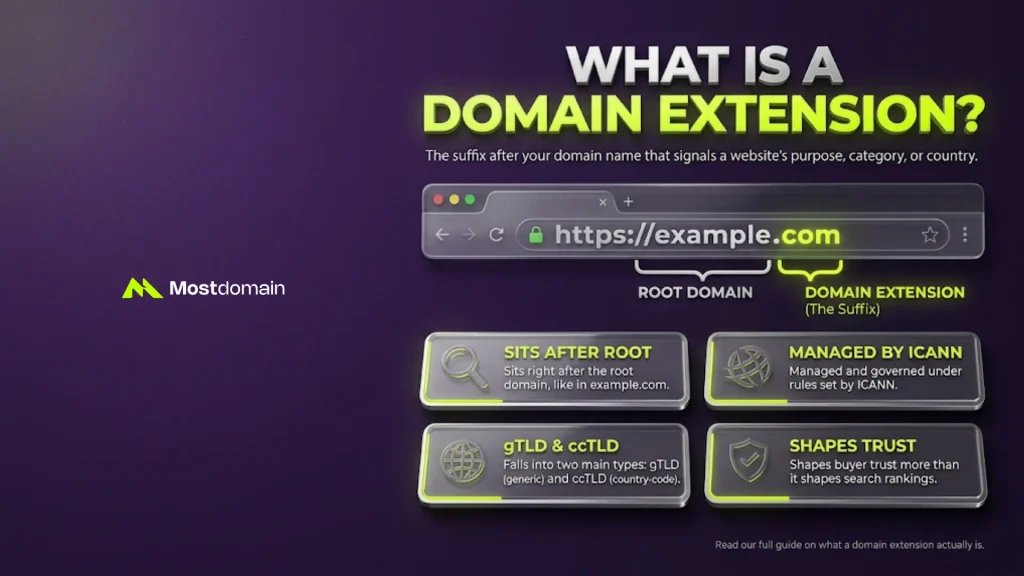
A domain extension is the suffix after your domain name. Think .com, .org, or .io. It signals a website’s purpose, category, or country.
- Sits right after the root domain, like in example.com
- Managed under rules set by ICANN
- Falls into two main types: gTLD and ccTLD
- Shapes buyer trust more than it shapes rankings
For the full breakdown, read our guide on what a domain extension actually is.
The 5 Most Common Domain Extensions Right Now
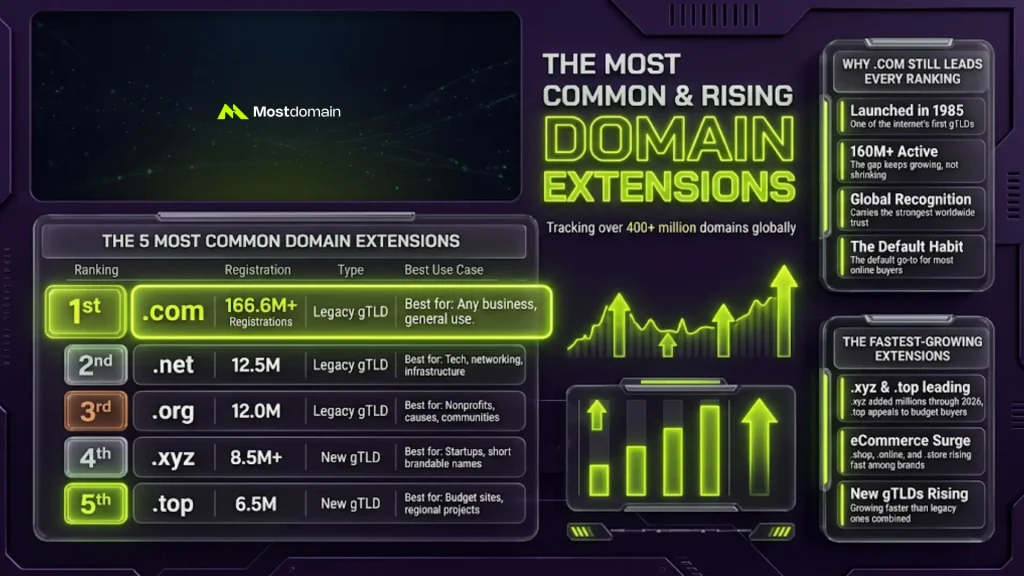
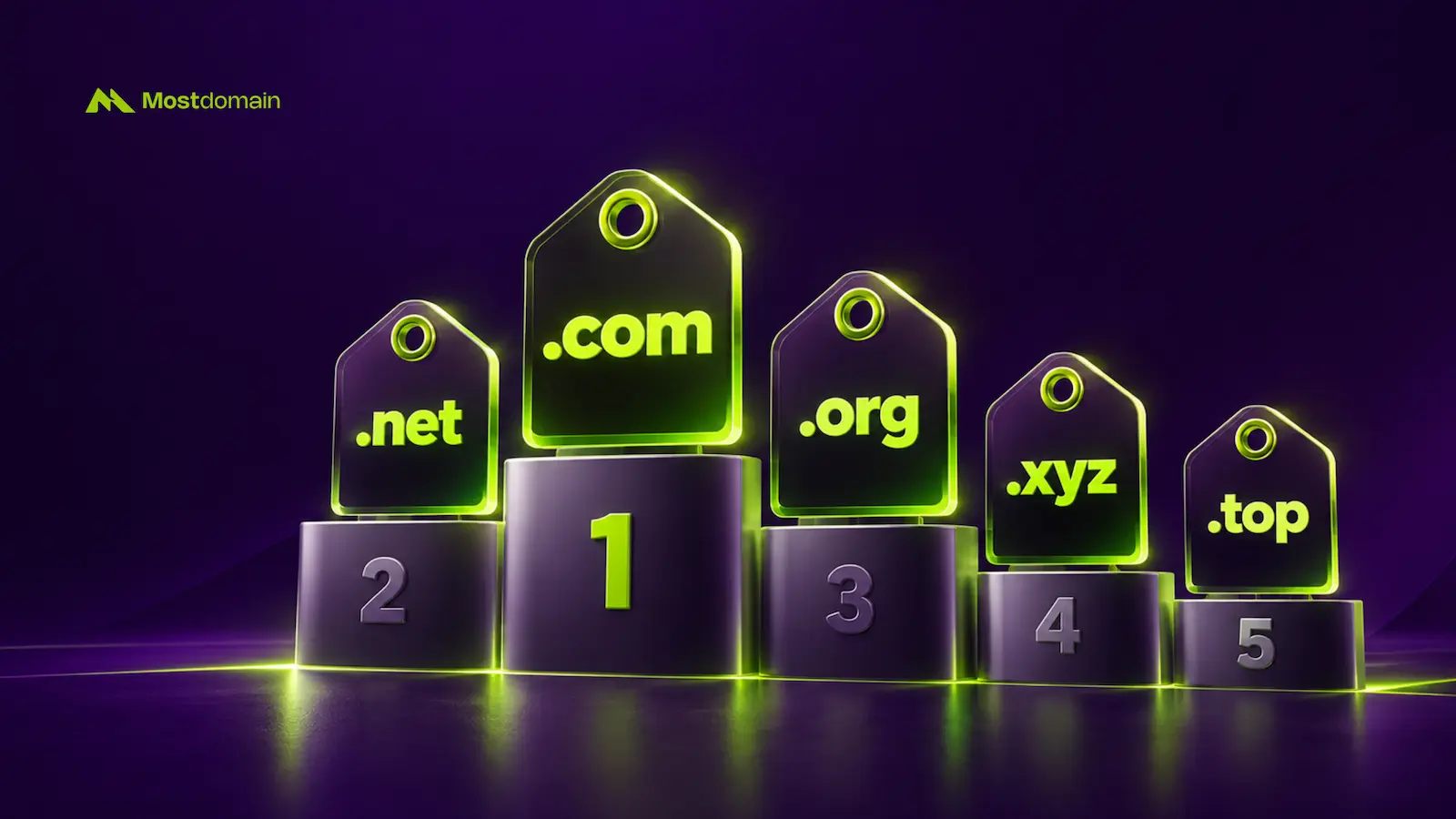
The five most common extensions are .com, .net, .org, .xyz, and .top. They’re ranked here by total registrations. Together they cover a huge share of the web’s 400-plus million domains.
| Rank | Extension | Reported Registrations | Type | Best For |
|---|---|---|---|---|
| 1 | .com | 166.6 million+ | Legacy gTLD | Any business, general use |
| 2 | .net | 12.5 million | Legacy gTLD | Tech, networking, infrastructure |
| 3 | .org | 12.0 million | Legacy gTLD | Nonprofits, causes, communities |
| 4 | .xyz | 8.5 million+ | New gTLD | Startups, short brandable names |
| 5 | .top | 6.5 million | New gTLD | Budget sites, regional projects |
Why .com Still Leads Every Ranking
No other extension comes close to .com. The gap keeps growing, not shrinking.
- Launched in 1985, one of the internet’s first six gTLDs
- Holds over 160 million active registrations today
- Carries the strongest brand recognition worldwide
- Stays the default habit for most buyers, even careless typers
The Fastest-Growing Domain Extensions
.xyz and .top are growing faster than any legacy extension. Newer doesn’t mean smaller forever.

- .xyz added millions of new registrations through 2026
- .top appeals heavily to budget-conscious, regional buyers
- .shop, .online, and .store are rising fast among ecommerce brands
- New gTLDs now grow faster than most legacy ones combined
Common TLDs vs Popular TLDs: What’s the Difference?
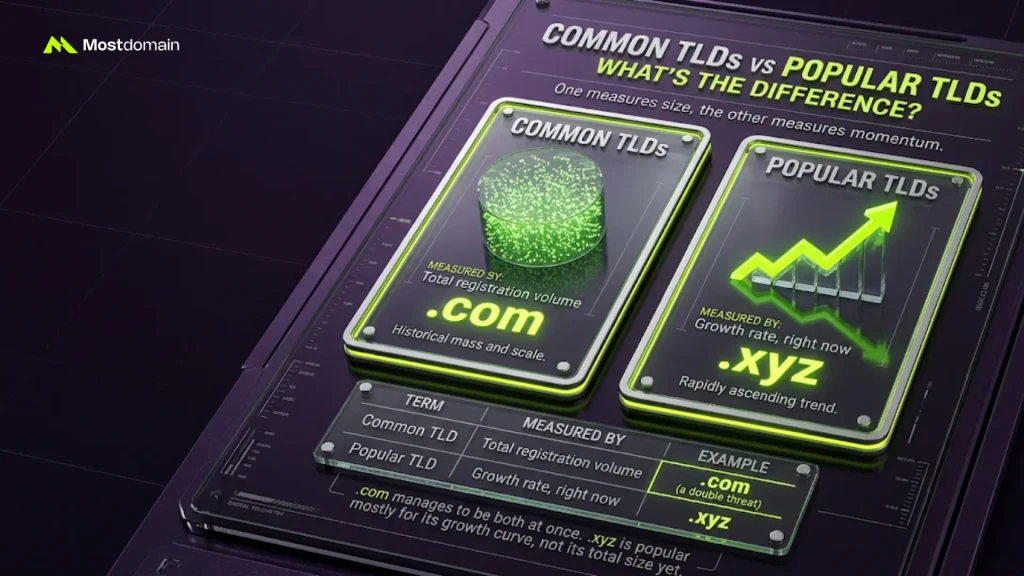
Common TLDs and popular TLDs aren’t actually the same thing. One measures size, the other measures momentum.
| Term | Measured By | Example |
|---|---|---|
| Common TLD | Total registration volume | .com |
| Popular TLD | Growth rate, right now | .xyz |
.com manages to be both at once. .xyz is popular mostly for its growth curve, not its total size yet.
gTLD vs ccTLD: Where These Extensions Fit
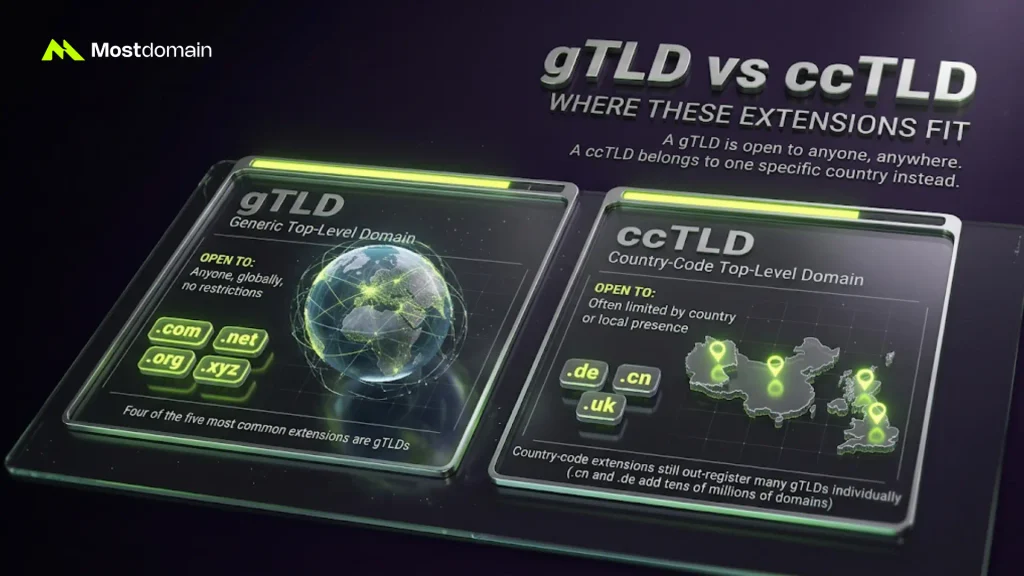
A gTLD is open to anyone, anywhere. A ccTLD belongs to one specific country instead.




| Type | Examples | Open To |
|---|---|---|
| gTLD | .com, .net, .org, .xyz | Anyone, globally, no restrictions |
| ccTLD | .de, .cn, .uk | Often limited by country or local presence |
Four of the five extensions above are gTLDs. Country-code extensions still out-register many gTLDs individually. .cn and .de alone add tens of millions of domains between them. Our ccTLD domains guide covers country-code options in depth, and the ICANN lifecycle of a gTLD explains how new extensions get approved.
Best Domain Extension for Business and Websites
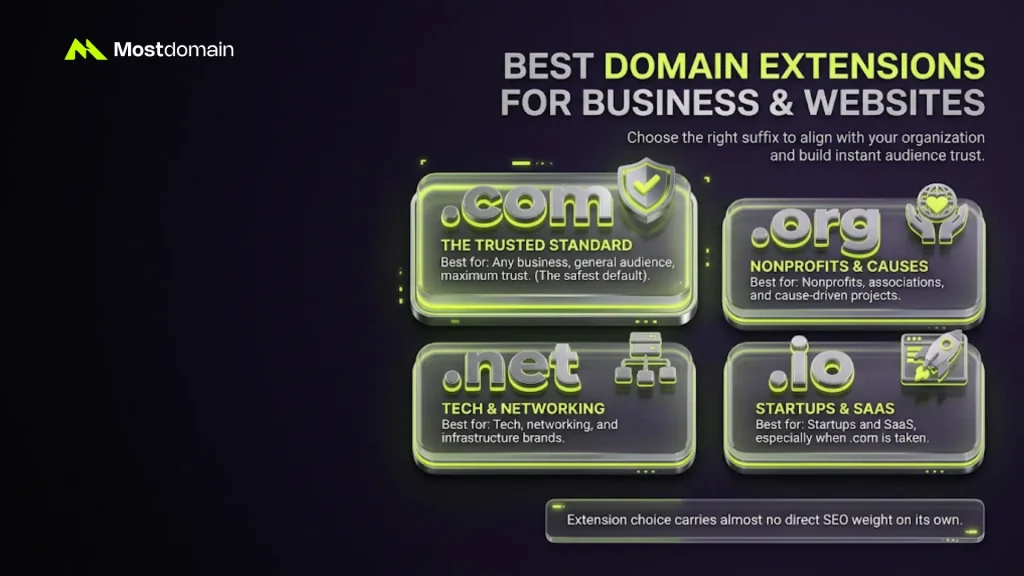
.com remains the safest default for most businesses. It just carries the widest trust.
| Extension | Best For |
|---|---|
| .com | Any business, general audience, maximum trust |
| .org | Nonprofits, associations, cause-driven projects |
| .net | Tech, networking, infrastructure brands |
| .io | Startups and SaaS, especially when .com is taken |
Tech founders increasingly lean toward .io domains for this exact reason. Extension choice carries almost no direct SEO weight on its own. Our guide on TLDs and SEO rankings explains what actually moves rankings instead.
How to Choose the Right Domain Extension
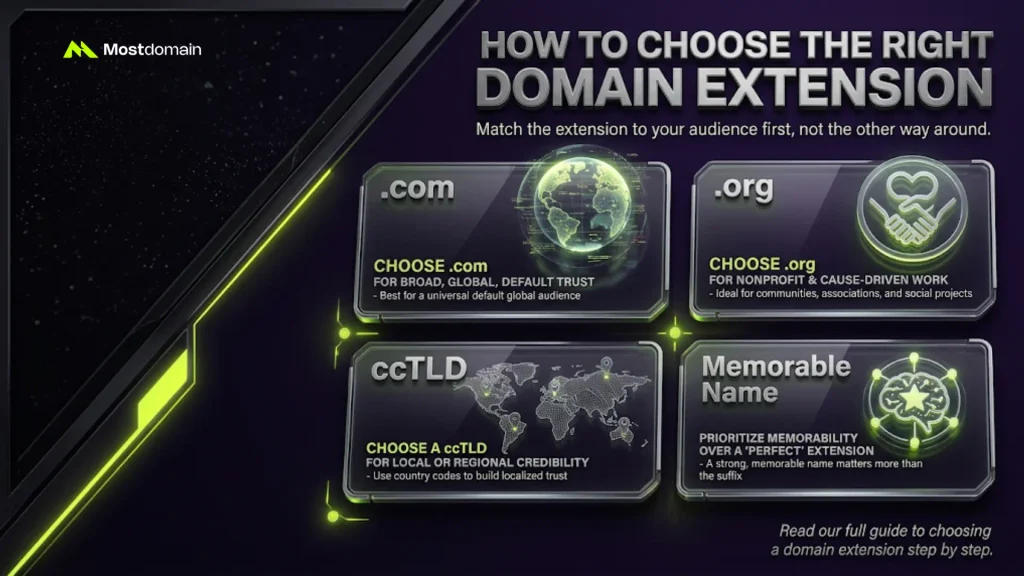
Match the extension to your audience first, not the other way around.
- Choose .com for broad, global, default trust
- Choose .org for nonprofit or cause-driven work
- Choose a ccTLD for local or regional credibility
- Prioritize a strong, memorable name over a “perfect” extension
Our full guide to choosing a domain extension walks through every factor step by step.
Domain Extension Comparison at a Glance
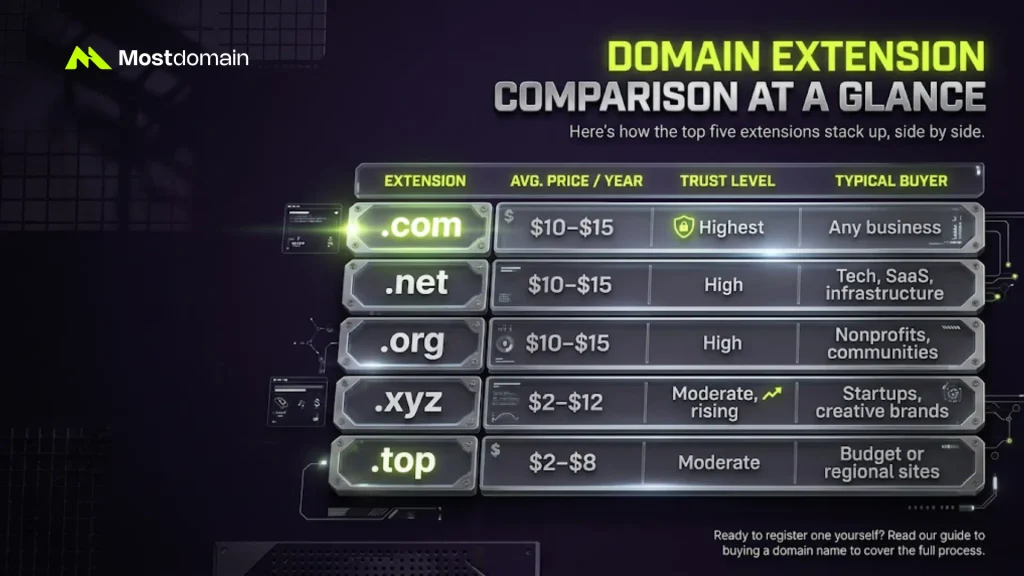
Here’s how the top five extensions stack up, side by side.
| Extension | Avg. Price/Year | Trust Level | Typical Buyer |
|---|---|---|---|
| .com | $10–15 | Highest | Any business |
| .net | $10–15 | High | Tech, SaaS, infrastructure |
| .org | $10–15 | High | Nonprofits, communities |
| .xyz | $2–12 | Moderate, rising | Startups, creative brands |
| .top | $2–8 | Moderate | Budget or regional sites |
Ready to register one yourself? Our guide to buying a domain name covers the full process.
FAQ
What is a TLD?
A TLD is the part after the final dot in a web address. .com, .org, and .de all count. It differs from a subdomain, which sits before the main name. See our What is a TLD guide and our top level domain vs subdomain comparison for more.
What are some domain extension examples?
Common examples include .com, .net, .org, .io, .ai, and .shop. Each one signals a different purpose or audience. Our guide to types of domain names covers more examples by category.
Is .com always the best choice?
Not always, just usually the safest default. Pick something else when it fits your audience better, like .io for a tech product.
Do domain extensions affect SEO rankings?
Barely, and only indirectly. Google treats most extensions equally in rankings. User trust matters far more than the suffix itself.
How many domain extensions exist today?
Over 1,200 generic extensions exist, plus roughly 250 country-code ones. New gTLDs keep launching, so that number keeps climbing.
References
- Hostinger, How Many Domains Are There in 2026? Global Statistics and Industry Insights
- Hostinger, Most Popular Domain Extensions in 2026: Statistics and Complete Guide
- Instant Domain Search, Most Popular Domain Extensions in 2026
- Truehost, The Most Popular Domain Extensions in 2026 (TLDs)
- IANA, Root Zone Database