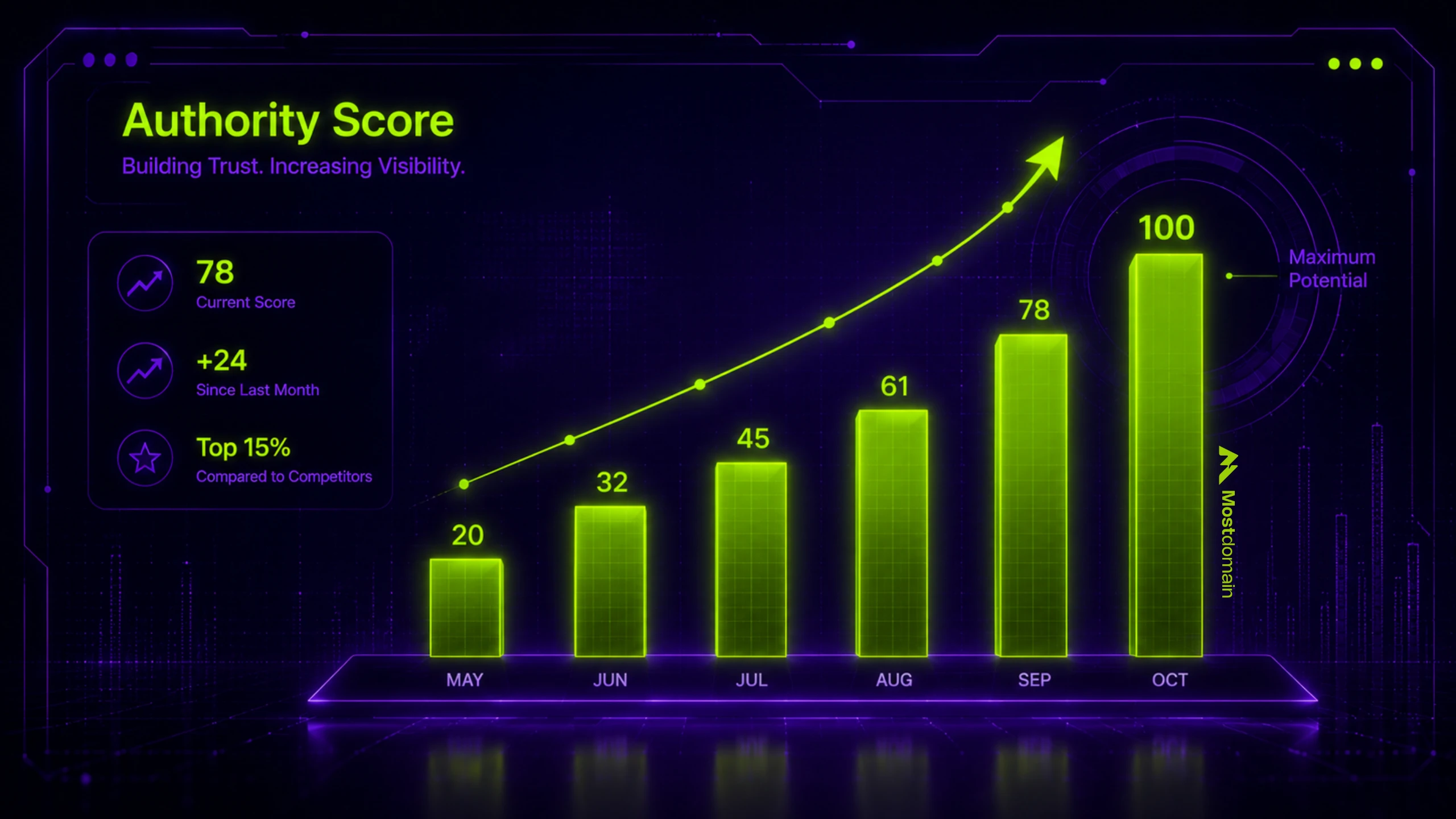
Nudge domain authority the wrong way and the number climbs while nothing else does. Five things move it in a way that actually sticks: new referring domains, a cleaner backlink profile, internal linking that pulls its weight, a site Google can actually crawl, and content worth citing. No shortcuts on that list. Here’s the version that holds up.
Domain Authority Growth: Don’t Expect This to Move Fast
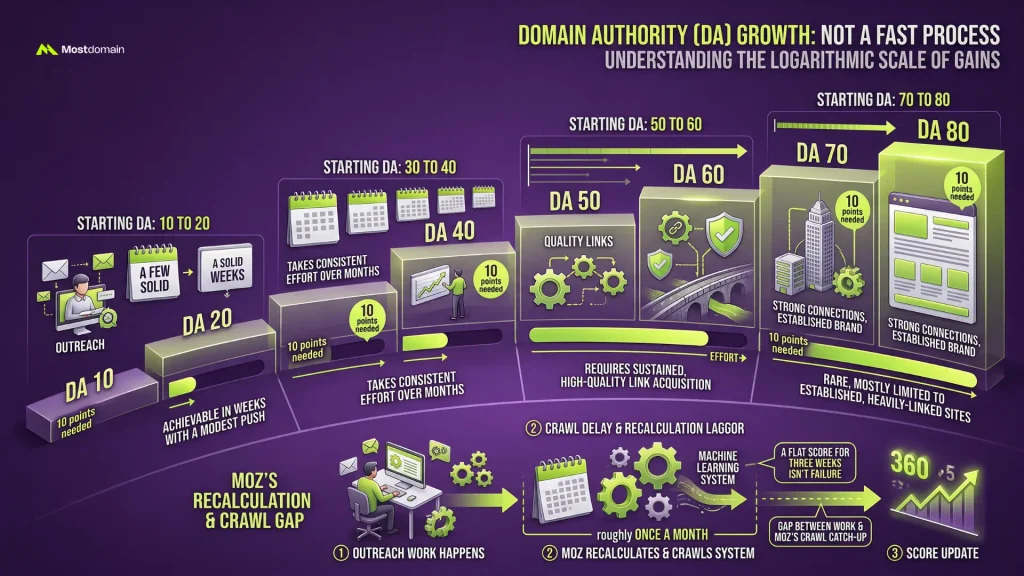
Ten points at DA 15 costs a few solid weeks of outreach. Ten points at DA 65 can cost the better part of a year. Domain Authority runs on a logarithmic scale, and that gap is the entire reason why.
| Starting DA | Points needed to gain 10 | Relative difficulty |
| 10 to 20 | 10 points | Achievable in weeks with a modest push |
| 30 to 40 | 10 points | Takes consistent effort over months |
| 50 to 60 | 10 points | Requires sustained, high-quality link acquisition |
| 70 to 80 | 10 points | Rare, mostly limited to established, heavily-linked sites |
Moz’s model recalculates roughly once a month, running a machine-learning system trained against real Google search results rather than a fixed formula. A flat score for three weeks straight isn’t a failure signal. It’s just the gap between when the work happens and when Moz’s crawl catches up to it.
Referring Domain Diversity Beats Raw Link Volume
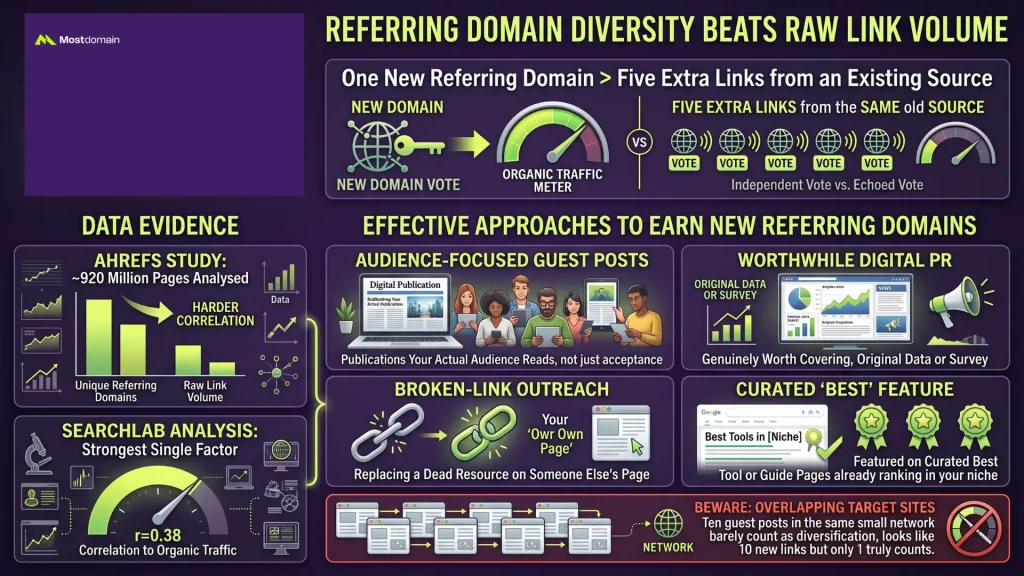
One new referring domain moves the needle more than five extra links from a site that’s already linking to you. Google and Moz’s model both read a brand new domain as an independent vote. A fifth link from the same old source just echoes a vote already counted.
Ahrefs put this to the test across close to 920 million pages, and unique referring domains came out correlating with organic traffic harder than raw link volume did. Searchlab ran a separate analysis and landed on r=0.38 for that relationship, the strongest single factor in their entire study.
A few approaches consistently produce new referring domains rather than more links from old ones:

- Guest posts on publications your actual audience reads, not wherever happens to accept a pitch
- Digital PR built around something genuinely worth covering, ideally original data or a survey
- Broken-link outreach, replacing a dead resource on someone else’s page with your own
- Getting featured on curated “best tools” or “best guides” pages already ranking in your niche
None of this works if the target sites overlap heavily with each other. A batch of ten guest posts on ten sites in the exact same small network barely counts as diversification, even though it looks like ten new links on paper.other. A batch of ten guest posts on ten sites in the exact same small network barely counts as diversification, even though it looks like ten new links on paper.
Cleaning Out the Bad Links Actively Dragging the Score Down
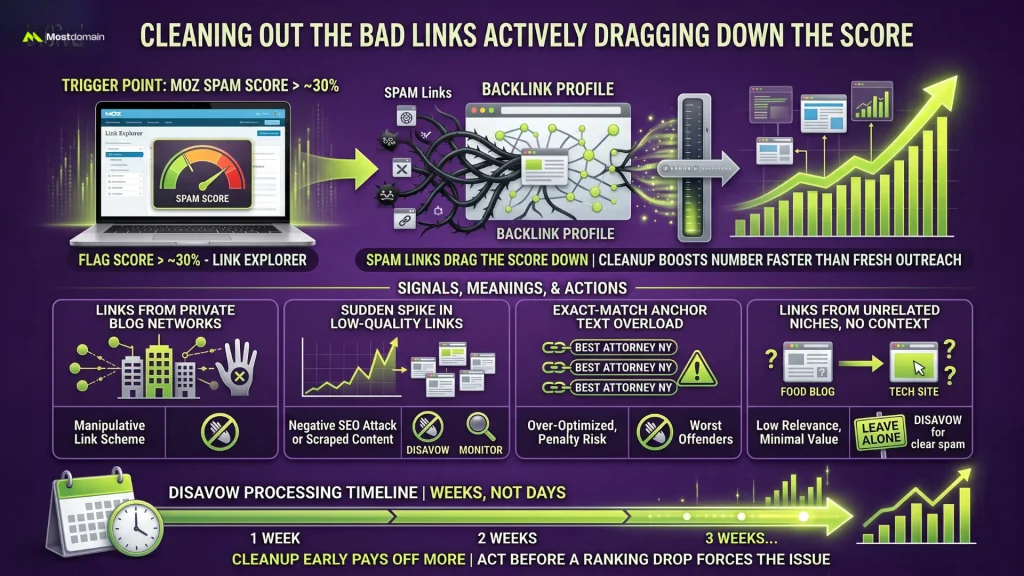
A backlink profile loaded with spam doesn’t sit neutral. It drags the score down actively, and cleaning that up alone can move the number faster than a fresh outreach campaign ever would.
Most SEOs flag a Moz Spam Score above roughly 30%, a number Moz’s own Link Explorer surfaces without any extra digging.




| Signal | What it usually means | Action |
| Links from private blog networks | Manipulative link scheme | Disavow |
| Sudden spike in low-quality links | Negative SEO attack or scraped content | Disavow and monitor |
| Exact-match anchor text overload | Over-optimized, penalty risk | Disavow the worst offenders |
| Links from unrelated niches, no context | Low relevance, minimal value | Leave alone unless clearly spammy |
Disavow files take weeks to process through Google’s system, not days. That timeline is exactly why cleanup pays off more when it happens early, well before a ranking drop forces the issue.
Moving Domain Authority Through Internal Linking
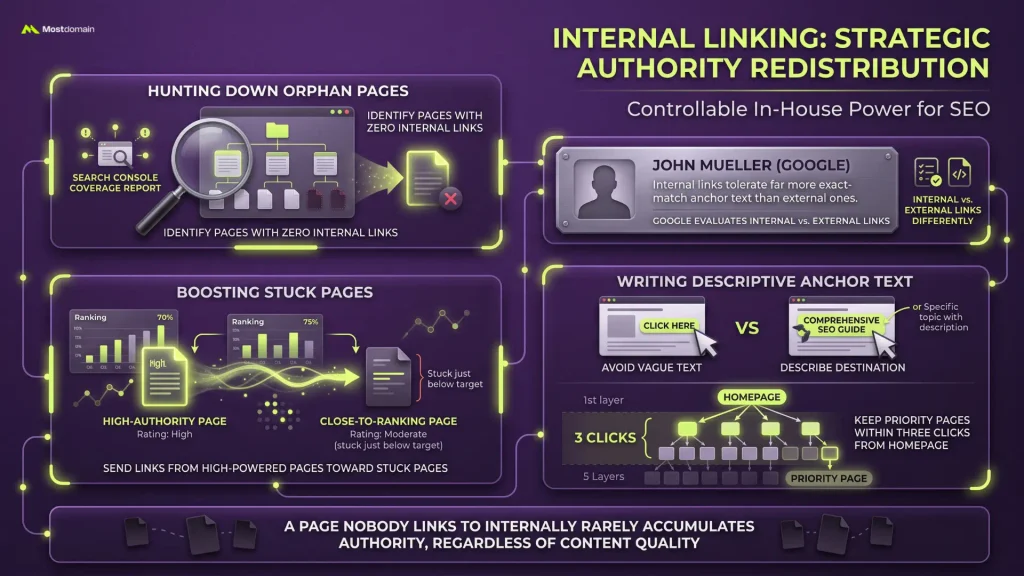
Internal linking is the one lever a site controls entirely in-house, since it redistributes authority already earned toward the pages that need it most, without asking anyone else’s permission first.
Google’s John Mueller has noted that internal links tolerate far more exact-match anchor text than external ones, mainly because Google evaluates the two under different rules entirely. Where this usually pays off first:
- Hunting down orphan pages, the ones with zero internal links pointing to them, through Search Console’s coverage report
- Sending links from the highest-authority pages toward whatever’s close to ranking but stuck just below it
- Writing anchor text that actually describes the destination instead of “click here” on repeat
- Keeping priority pages within three clicks of the homepage, not buried five layers deep in a category structure
A page nobody links to internally rarely accumulates authority, regardless of how good the writing on it is.
Fixing the Technical Debt Capping Everything Else
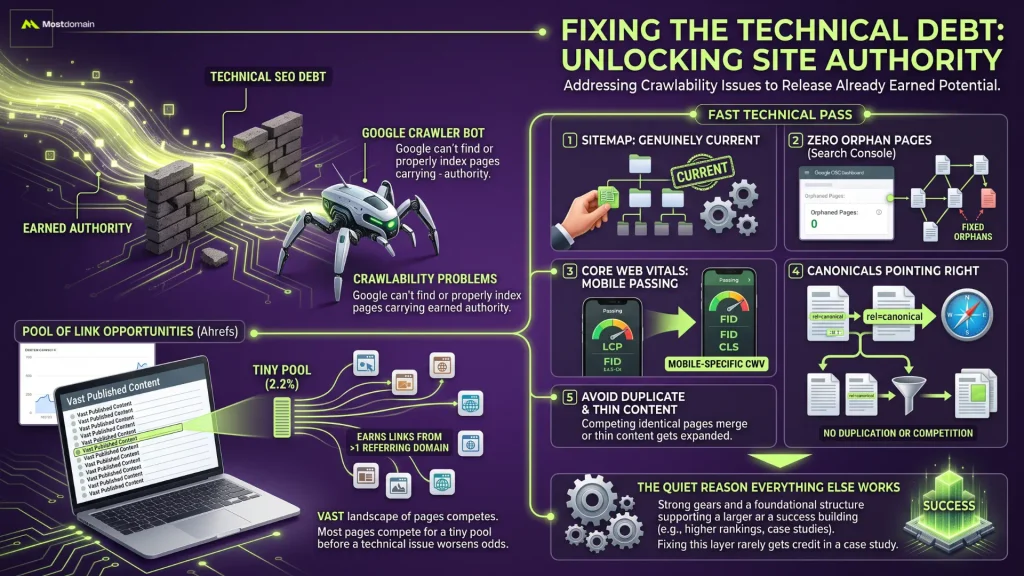
Crawlability problems quietly cap authority a site has already earned, mainly because Google can’t find or properly index the pages carrying it in the first place.
Ahrefs’ Content Explorer puts the number at roughly 2.2% of published content ever earning links from more than one referring domain. Most pages are already competing for a tiny pool of link opportunities before a single technical issue makes the odds worse still.
A fast technical pass covers:
- Sitemap that’s genuinely current, not uploaded once and forgotten
- Zero orphaned pages showing up in Search Console
- Core Web Vitals passing on mobile specifically, since that’s where most traffic comes from
- Canonicals pointing where they actually should
- Nothing duplicated or thin enough to compete against the site’s own pages for the same query
Fixing this layer rarely gets credit in a case study, but it’s often the quiet reason everything else on this list is able to work at all.
Not All Content Earns a Link
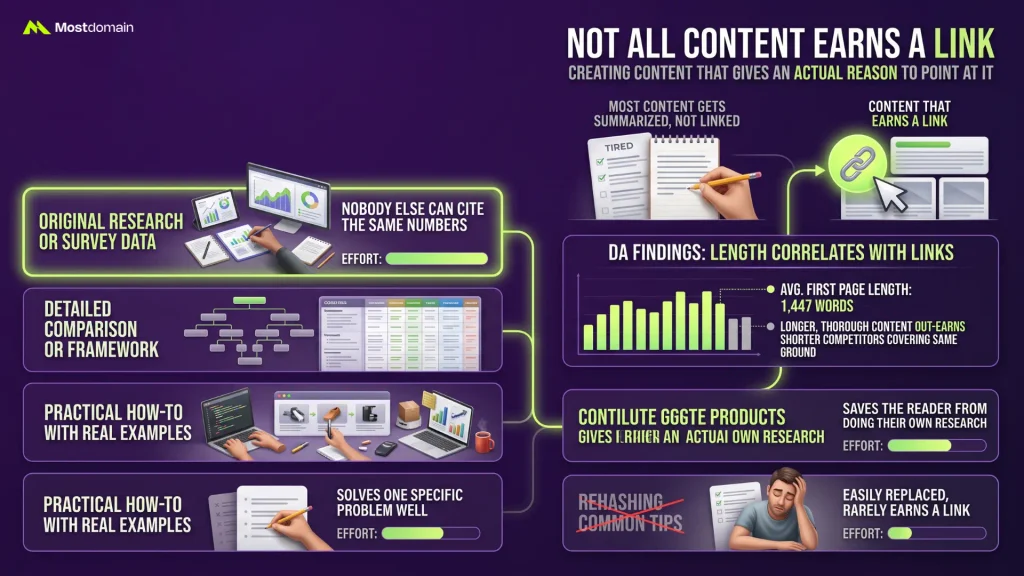
Most content gets summarized, not linked. The stuff that does earn a link gives someone an actual reason to point at it instead of paraphrasing it and moving along.
Length correlates with that. Backlinko dug through 11.8 million search results and found 1,447 words as the average among first-page pages, with the longer, more thorough entries out-earning shorter competitors covering the same ground.
| Content type | Why it attracts links | Effort level |
| Original research or survey data | Nobody else can cite the same numbers | High |
| Detailed comparison or framework | Saves the reader from doing their own research | Medium |
| Practical how-to with real examples | Solves one specific problem well | Medium |
| Generic listicle rehashing common tips | Easily replaced, rarely earns a link | Low |
Authority Metrics: Different Math, Same Verdict
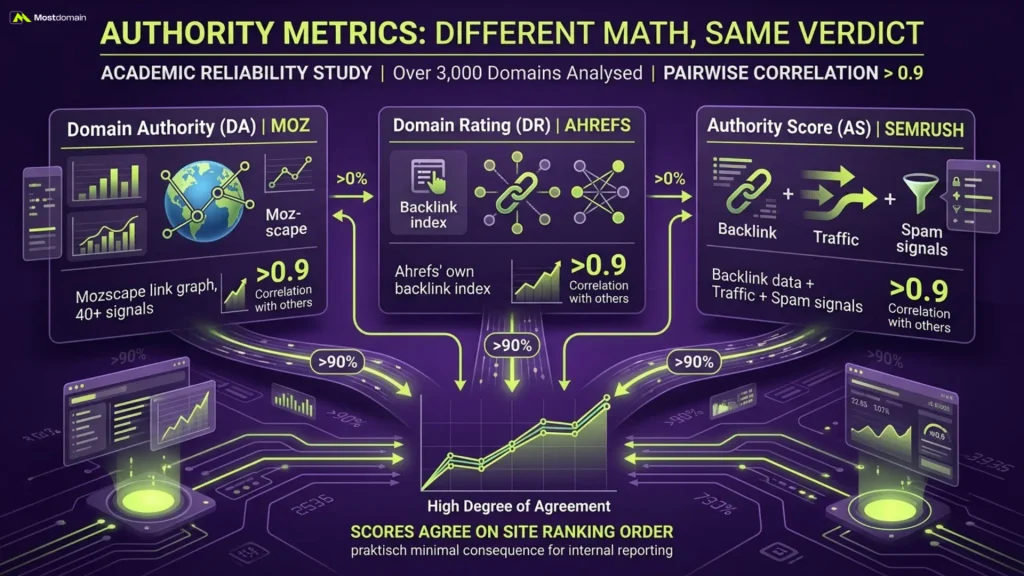
Three companies. Three separate machine-learning models. Nearly the same answer every time: an academic reliability study spanning over 3,000 domains found Moz Domain Authority, Ahrefs Domain Rating, and Semrush Authority Score agreeing above 0.9 in every pairwise comparison.
| Metric | Built by | Primary input | Correlation with the other two |
| Domain Authority (DA) | Moz | Mozscape link graph, 40+ signals | Above 0.9 |
| Domain Rating (DR) | Ahrefs | Ahrefs’ own backlink index | Above 0.9 |
| Authority Score (AS) | Semrush | Backlink data blended with traffic and spam signals | Above 0.9 |
That number matters more than the debate it settles. A site owner agonizing over which tool’s score to report internally is spending time on a decision with almost no practical consequence, since all three tools tend to agree on the ranking order of sites even when their raw numbers differ. The methodology varies. The verdict, in practice, mostly doesn’t.
Link Building Priority Order
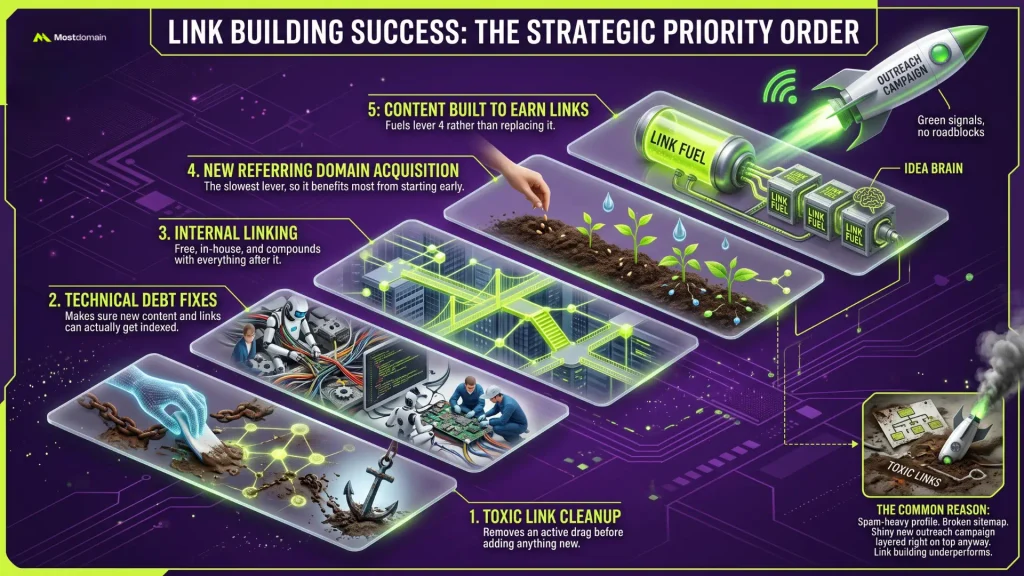
Toxic link cleanup and technical fixes usually outrank new link building in priority, since both remove a ceiling on results the outreach work would otherwise run into.
| Priority | Lever | Why it goes here |
| 1 | Toxic link cleanup | Removes an active drag before adding anything new |
| 2 | Technical debt fixes | Makes sure new content and links can actually get indexed |
| 3 | Internal linking | Free, in-house, and compounds with everything after it |
| 4 | New referring domain acquisition | The slowest lever, so it benefits most from starting early |
| 5 | Content built to earn links | Fuels lever 4 rather than replacing it |
A spam-heavy profile left untouched. A broken sitemap nobody fixed. Then a shiny new outreach campaign layered right on top anyway. That combination is probably the single most common reason link building underperforms.
Check the Score, But Don’t Obsess Over It
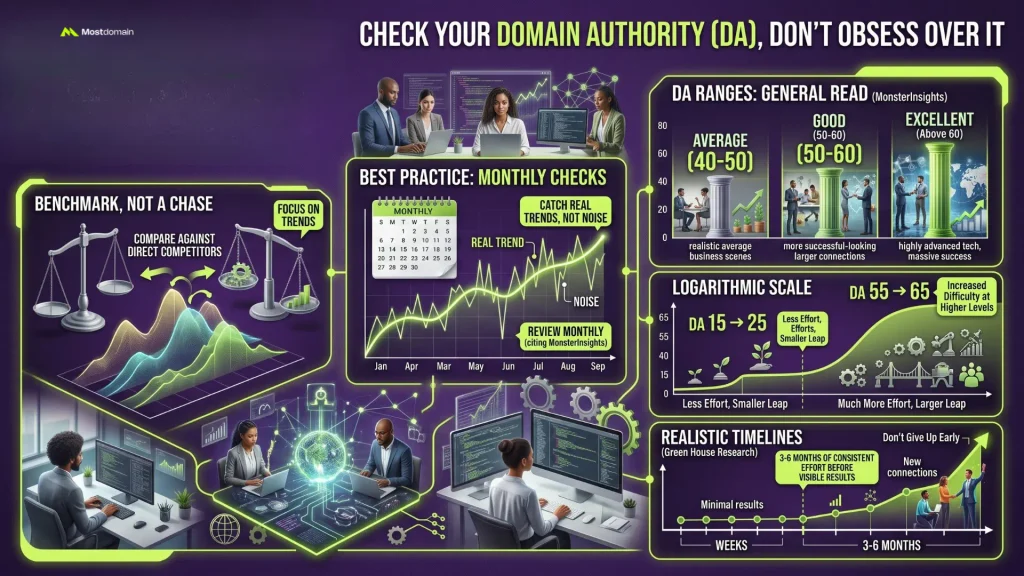
The score works best as a benchmark against direct competitors, not as a number worth chasing for its own sake.
Running the domain through a DA checker once a month is usually enough to catch a real trend instead of noise. MonsterInsights places the industry rule of thumb at:
| DA Range | General Read |
| 40 to 50 | Average |
| 50 to 60 | Good |
| Above 60 | Excellent |
The scale is logarithmic underneath all this, so a jump from 15 to 25 says a lot less about SEO health than a jump from 55 to 65 does. Green House’s research puts realistic timelines at three to six months of consistent effort before anything becomes noticeable, worth remembering before writing off an effort to increase domain authority after just a couple of weeks.
Not Every Fix Here Moves Rankings, Some Just Move the Number
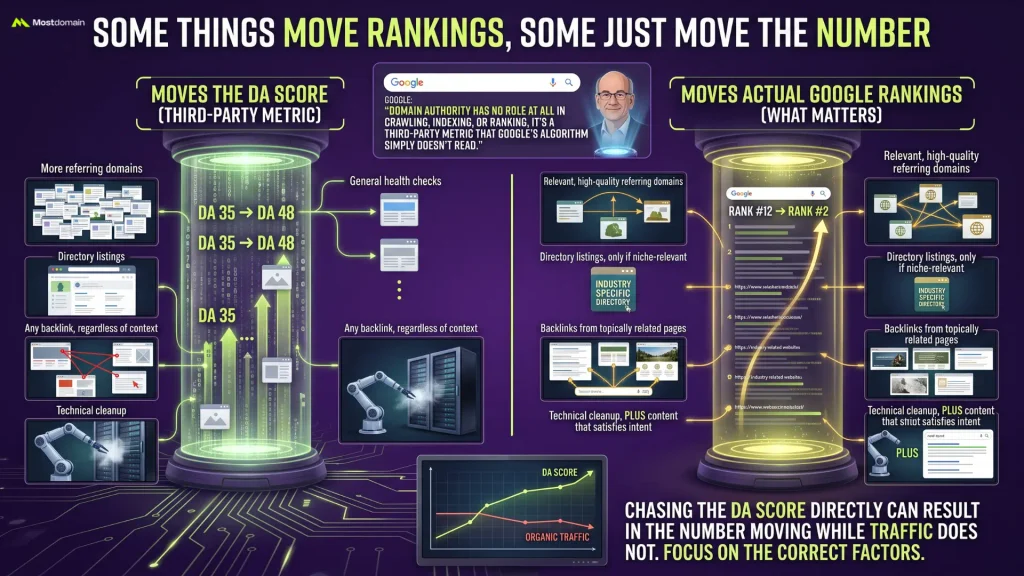
Google has said plainly, through John Mueller. Domain Authority plays no role at all in crawling, indexing, or ranking. It’s a third-party metric that Google’s algorithm simply doesn’t read.
| Moves the DA Score | Moves Actual Rankings |
| More referring domains | Relevant, high-quality referring domains |
| Directory listings | Directory listings, only if niche-relevant |
| Any backlink, regardless of context | Backlinks from topically related pages |
| Technical cleanup | Technical cleanup, plus content that satisfies intent |
Chase the score directly, through link schemes or low-quality directory spam, and the number might move while traffic doesn’t. That’s exactly backwards.
FAQ
How Long Does Raising Domain Authority Actually Take?
Most sites notice real movement within three to six months of steady link building and technical cleanup, according to Green House’s research. A site sitting near a DA of 60 moves slower than one starting under 20. Its purely because the scale is logarithmic.
Does a Higher Domain Authority Score Guarantee Better Rankings?
Not directly, and Google has said so outright. The correlation exists because the work behind a higher score happens to overlap with the work that actually moves rankings.
What’s a Good Domain Authority Score to Aim For?
There isn’t a universal number. A score in the 40s is roughly average. 50 to 60 reads as good, and anything above 60 is strong. Though the more useful comparison is against the two or three sites actually competing for the same rankings.
Can an Aged or Expired Domain Raise DA Faster Than Link Building Alone?
Often, yes. Since the domain shows up with a backlink profile already attached instead of one built from nothing. A niche mismatch or a spam-heavy history can erase that advantage fast. Which is why vetting the domain matters more than the purchase itself.
How Often Is It Worth Checking Domain Authority?
About once a month. Which lines up with how often Moz recalculates it. Checking weekly mostly just adds noise, since short-term swings rarely reflect a real shift in the link profile.
Is Domain Authority the Same Thing as Domain Rating?
No. Domain Authority belongs to Moz. Domain Rating is Ahrefs’ version of the same idea. Both run on a 0 to 100 scale and estimate link-profile strength. But the underlying math differs enough that the two numbers rarely match for the same site.
References
- Ahrefs, Website Authority Checker: Check the Authority of Any Domain
- Searchlab, Link Building Statistics 2026
- Backlinko, We Analyzed 11.8 Million Google Search Results
- WordStream, The Right Way to Increase Domain Authority
- MonsterInsights, Domain Authority: What It Is and How Can You Boost It
- Green House, How to Increase Your Domain Authority (And Why It Matters)