Let’s clear something up: the actual registration date on a WHOIS lookup means absolutely nothing for SEO. If an old domain is actually worth buying, it’s strictly because someone else already did the heavy lifting.
You’re basically taking over their backlink profile and jumping on a site that Googlebot already knows and crawls regularly. A brand-new domain just doesn’t have that foundation yet.
Are Aged Domains Good For SEO?
Aged domains are good for SEO when their history stays clean and topically relevant, and the real SEO value comes from inherited signals rather than the age number itself. This part gives the straight verdict, points to where that indirect value actually sits, and flags the age-versus-quality trap before the detailed breakdown further down.
Google has repeated that domain age on its own is not a ranking factor, which means the benefit lands indirectly, in a few concrete places:
- A backlink profile built up over years, the sort of links from real publishers that a day-old domain simply cannot fake.
- Content already sitting in Google’s index, which hands you crawl history and recognition instead of a cold start.
- A standing reputation as a legitimate, non-throwaway site, the trust piece most people wrongly chalk up to age alone.
Worth flagging before anything else: age and quality are not the same animal. A ten-year-old domain packed with dead spam loses to a sharp three-month-old site every time, and the deeper teardown of why the calendar gets overrated sits in the breakdown of domain age myths.
Where the SEO Value Actually Comes From
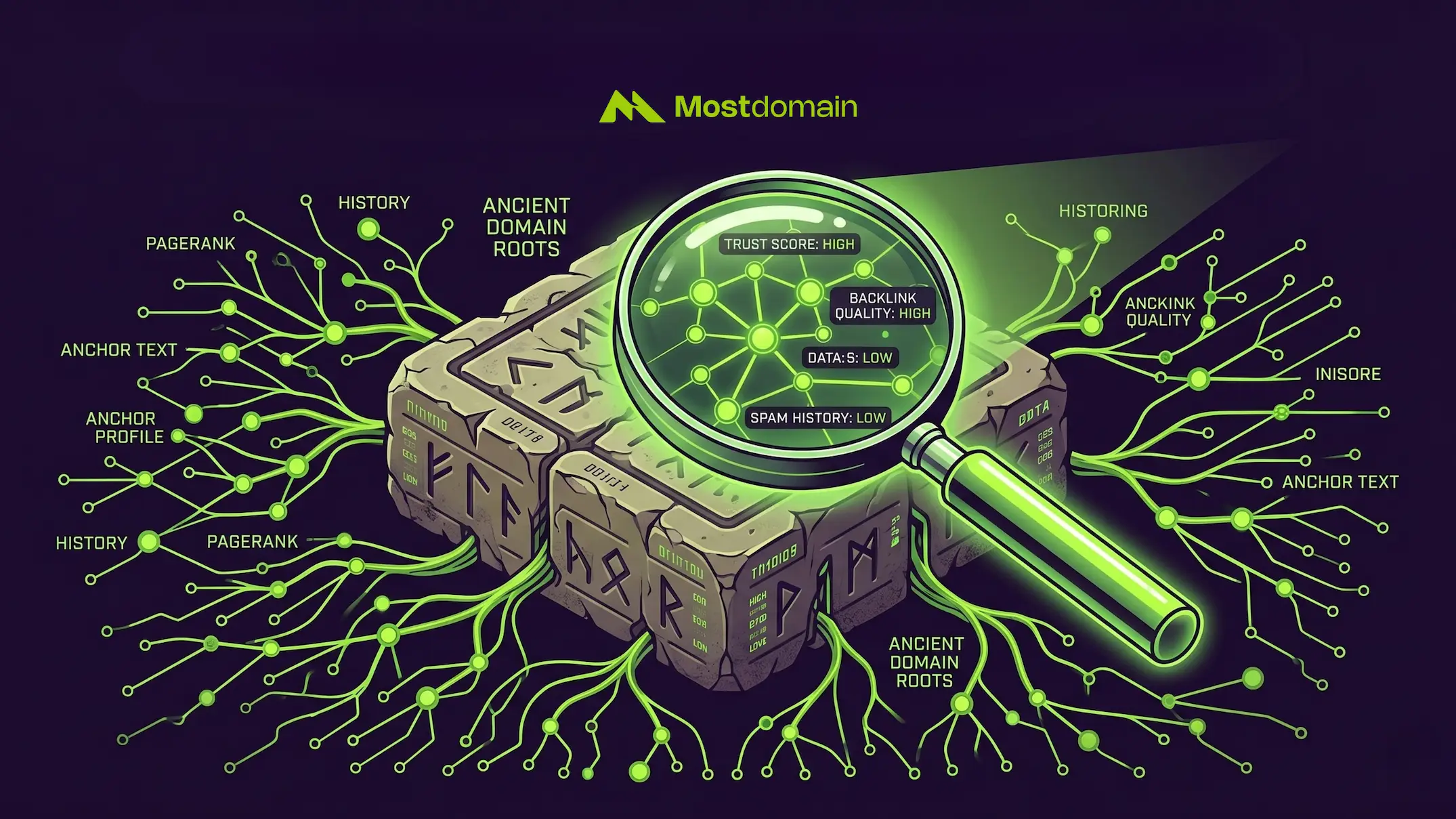
The real SEO value of aged domains is a bundle of inherited signals, each one earnable the slow way on a new site or bought as a shortcut on an old one. Four signals do most of the heavy lifting. Not one of them is “age.”

Inherited Link Equity and Backlink History
The backlink profile is basically the whole point of buying an aged domain. You’re paying to inherit links from news outlets or big industry players, links that would normally swallow a massive budget and years of link building to replicate.
However, that “inherited trust” only transfers over if the old links actually make sense for your new niche. Try to force irrelevant links to your new pages, and the SEO value basically vanishes. For a deeper dive into how this works, check out our full guide on aged domain link equity to see exactly what passes trust and what gets ignored by Google.
Faster Indexing and the Sandbox Question
Fresh content on an established domain tends to get crawled and indexed quicker than the same content would on a new registration. Then there is the sandbox, an observed period commonly pegged at three to eight months, during which new domains struggle to rank no matter how tidy their setup.




The 2024 Google API leak surfaced a “hostAge” attribute pointing to a sandbox-like filter aimed mostly at spam, which fits the pattern of a trusted older domain sometimes skipping the wait. The mechanics get their own treatment in the article on whether aged domains rank faster.
Cutting the Line in Cutthroat Niches
In brutal YMYL niches (like finance or health), fresh domains can easily spend up to a year getting zero organic traction. An aged domain with relevant history lets you bypass a lot of that waiting period because the credibility is already baked in.
It turns an impossible uphill battle into a manageable fight. But remember, this advantage is highly specific. You only get that head start if the domain’s past niche tightly aligns with whatever you’re building right now.
Stability Through Core Updates
Domains with a long, consistent record often ride out broad core updates with less whiplash than thin new sites. The logic runs that established trust signals give Google more to weigh, so any single update is less likely to erase visibility overnight. This is a tendency, not a promise, and it certainly doesn’t make a site update-proof.
When an Aged Domain Delivers No SEO Value
Aged domains offer zero SEO value if the history is spammed out, totally irrelevant, or already blacklisted. Honestly, almost every horror story of someone burning cash on a bad domain boils down to three specific mistakes. Below, we’ll look at those three traps and how they turn what looks like a strong domain into pure dead weight. Skipping the audit and buying blindly is the fastest way to inherit a massive Google penalty instead of actual trust.
| Failure mode | Why the inherited value collapses |
| Toxic backlink profile | The links you inherit read as spam, so the “trust” transfers as risk instead. This is the one that can drag an actual penalty across with the domain. |
| Niche switch | A former pet-supply domain turned fintech blog no longer matches its own backlinks, and Google can discount or reset most of the old link value once the context stops lining up. |
| Long dormancy | Sit idle for years and the domain gets treated almost like a fresh registration, its earned authority quietly clawed back. |
Vetting catches all three before money changes hands, and the full checklist lives in the evaluation hub.
Weighing SEO Value Against Cost
Let’s be real: aged domains aren’t cheap. You’re essentially buying an established foundation so you don’t have to sit around waiting for months in the Google Sandbox. But since you’re paying a premium upfront, the ROI actually has to make sense.
| What you’re weighing | Aged domain | Fresh registration |
| Time to first real rankings | Possibly weeks, assuming the history is clean and on-topic | Usually several months while trust accumulates |
| Upfront cost | A premium, sometimes steep for genuinely authoritative names | Just the registration fee |
| Main risk | Inheriting hidden penalties, or a past niche that no longer fits your plan | A slow start, but a blank slate with no baggage |
| Where it shines | Competitive niches, brand revivals, anything needing speed | Personal brands, concept tests, patient long-horizon builds |
Look at the numbers: Ahrefs pointed out that roughly 5.7% of top-ranking pages are under a year old. Fresh domains can definitely rank. Domain age isn’t some magic bullet, it just tilts the odds in your favor assuming everything else on your site is fully optimized.
From Value to Execution
Knowing an aged domain has SEO value is only half the job done. The other half is deployment, the redirects and migration and rebrand handling, plus the call on whether it becomes a standalone money site or feeds a wider setup. Those mechanics form a separate discipline, walked through in the aged domain deployment guide. Value tells you whether to buy. Execution decides whether that value survives its first contact with a live site, which is where a surprising number of promising domains quietly go to waste.
FAQ
Are aged domains worth it for SEO?
Only if the history is clean. Think of a good domain with relevant backlinks as an express ticket to higher rankings. It will saves a ton of time. The flip side is ugly, though. Get stuck with a spammed-out domain or one from a weird niche, and you’ll spend more time playing digital janitor than actually growing your traffic.
Does buying an aged domain guarantee higher rankings?
No such guarantee exists. The domain hands you inherited signals, but rankings still ride on content quality, technical health, and the links you keep earning. Age opens a door; it won’t walk you through it.
Which ranks better, an aged domain or a new one?
That hinges entirely on history. A new site with strong content and clean links can outrank a neglected old domain without much drama. Where the aged option pulls ahead is speed, and only when its past is genuinely relevant.
Is domain age a confirmed Google ranking factor?
It isn’t. Google’s representatives have repeated, more than once, that age by itself triggers no algorithmic boost. The ranking benefits people pin on age actually come from the signals a domain collects across its lifetime.
How can I tell if an aged domain has real value?
Run the backlink profile for spam, confirm the previous niche sits near yours, and look for stretches where the domain went dark. Three clean answers there, and the inherited value is far more likely to hold up.
References
- Google Search Central, official guidance on domain age and ranking signals
- Ahrefs, 2023 study on the age of top-ranking pages
- Outerbox, analysis of domain age, history, and continuity in SEO
- Search Engine Journal, coverage of the 2024 Google API documentation leak