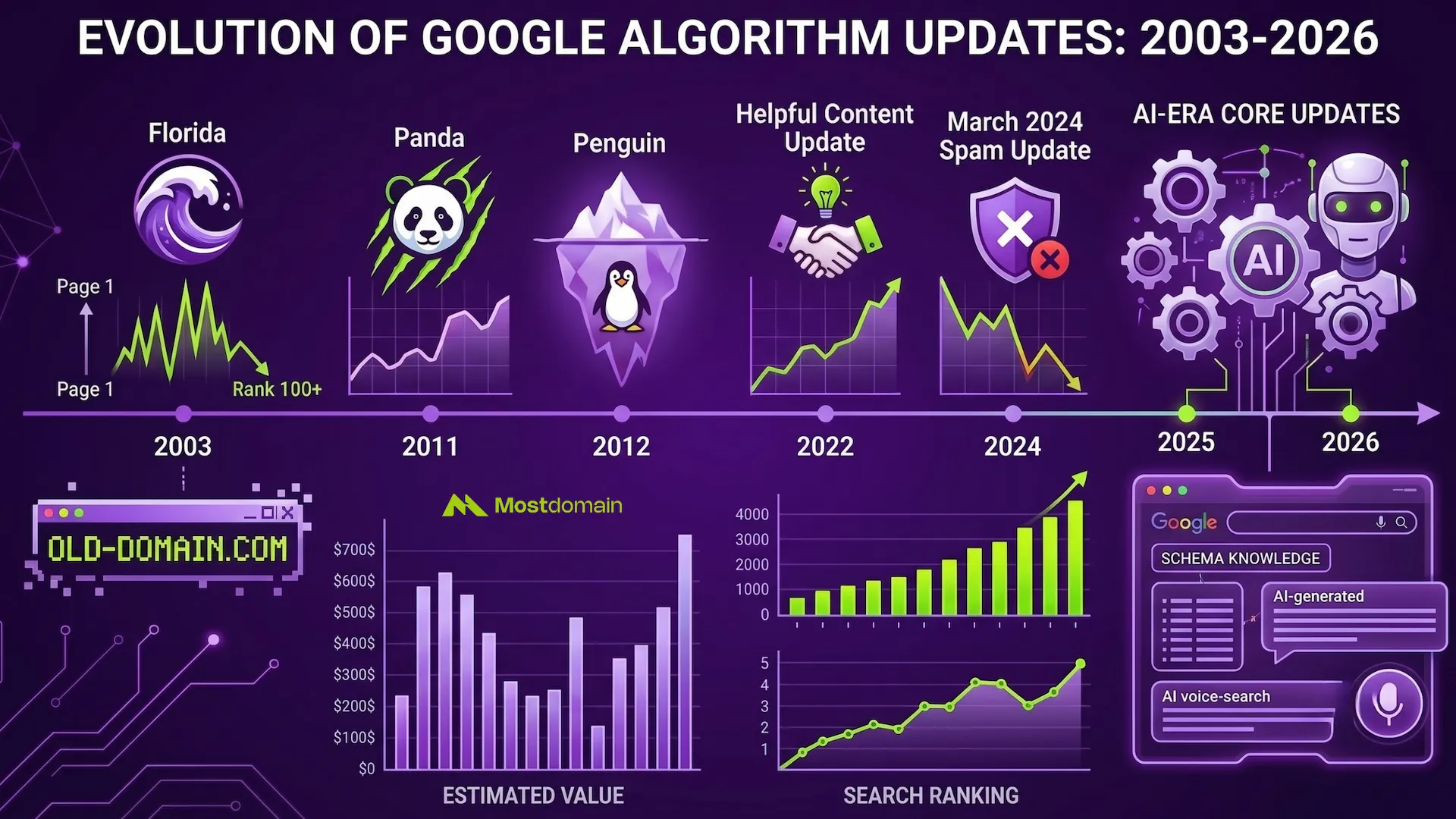
The Every ranking move on a domain has a cause, and usually that cause has a name and a date. Strip the jargon and a Google update is just any change Google makes to how it ranks pages. This page lines them up in order, from the first named update back in 2003 to the latest 2026 core update, oldest first. The audience is narrow on purpose: people buying and rebuilding aged domains. So each entry asks one thing, what the update did to domain value, and leaves the broad SEO takes to everyone else.
Two ways to use it. Read top to bottom and you watch two decades of Google’s priorities stack up. Or skip straight to one update when you need its full impact and how recovery actually played out.
How to Read a Google Update
Three labels do most of the work here. A core update re-scores quality across the whole web, and it is not a penalty even when it stings. A spam update is narrower and can be over in a day, going after one manipulative tactic at a time. Then there are systems, the machinery like SpamBrain or Helpful Content that updates keep sharpening rather than replacing. Almost every Google update is one of those three.
| Type | What it does | Typical rollout |
| Core Update | Broad re-evaluation of quality, relevance, and trust across the whole index | 12 to 20 days |
| Spam Update | Demotes sites breaking one specific spam policy | Hours to a few days |
| System | Underlying tech that updates refine over time | Always running |
The Foundational Era, 2003 to 2019
This is the stretch that built the rules everything else runs on. Most of these no longer fire as separate events. Their logic just lives inside the core algorithm now, running every day. A few also shaped how Google treats domains specifically, which is where you should slow down and read.
Update |
Year |
What it changed |
| Florida | 2003 | The one that started it all. Keyword-stuffed sites vanished overnight, and the timing right before holiday shopping made it brutal for a lot of small stores. |
| Jagger | 2005 | Reciprocal links, paid links, link farms. All devalued. |
| Big Daddy | 2005 to 2006 | Plumbing, not ranking. Google rebuilt how it handled redirects and canonical URLs. |
| Vince | 2009 | Big brands got a quiet lift on competitive terms. Small sites felt it. |
| Caffeine | 2010 | A faster index, not a new rule. Fresh content started showing up in hours instead of days. |
| Panda | 2011 | Thin and duplicate content got crushed, around 12% of all queries moved. This is still what people mean when they say “quality update”. |
| Page Layout | 2012 | Too many ads above the fold? Down you went. |
| Penguin | 2012 | The link-spam crackdown. This is the one that turns a domain’s old backlinks into a possible liability, not a freebie. |
| Pirate | 2012 | Repeat copyright complaints, lower rankings. |
| EMD | 2012 | The first time a domain got punished just for being a keyword-match shell with nothing behind it. Domain buyers, read this row twice. |
| Hummingbird | 2013 | A ground-up rewrite. Google began reading meaning instead of matching strings, and semantic search started here. |
| Pigeon | 2014 | Local results got pulled into line with the main algorithm. |
| HTTPS | 2014 | Encryption became a signal. A light one, but real. |
| Mobilegeddon | 2015 | Mobile-friendly pages won on mobile. The name was scarier than the rollout. |
| RankBrain | 2015 | Machine learning entered the stack, mostly to make sense of queries Google had never seen before. |
| Possum | 2016 | More local recalibration. |
| Fred | 2017 | Thin, ad-stuffed sites built for revenue took the hit. Sound familiar? It is the classic bad-flip profile. |
| Medic | 2018 | Expertise and trust, hard. Health and money sites with no real authority behind them got hollowed out. |
| BERT | 2019 | Context, finally. Google learned to read word order and meaning inside a query, not just keywords. |
Pause on three of those rows if you buy domains for a living. EMD first. Back in 2012 Google decided an exact-match domain with thin content under it deserved nothing, so a name still coasting on its keyword is exposed the second quality gets re-checked. Penguin is the backlink one. Whatever the last owner built, clean or junk, you inherit, and the junk can sit there pulling you down for years. Then Fred, the quiet warning. Monetize-first sites got flattened, and that is the shape of nearly every flip done badly.
The Core Update Era, 2020 to 2023
By 2020, Google had settled into the rhythm it still keeps. Frequent broad core updates, plus a handful of systems that quietly rewrote what “quality” even means.

| Update | When | What it changed |
| Core Updates | 2020 to 2023 | Several broad updates a year, each reshuffling the deck on quality and trust. The cadence we still live with. |
| Page Experience | 2021 to 2022 | Core Web Vitals, speed, layout stability. Mobile first, desktop later. |
| MUM | 2021 | A multimodal system, mostly behind the scenes, built to read across formats and languages. |
| Product Reviews | 2021 to 2023 | A long run that rewarded reviews from people who actually tested the thing. Affiliate filler lost. |
| Helpful Content | 2022 | The people-first signal. Stood on its own for two years, then got pulled into core in 2024. |
| Link Spam | 2022 | SpamBrain took over here, quietly cancelling manipulative links instead of just slapping the site that built them. |
2024 Updates
March 2024 Core Update
March 5, 2024. The rollout dragged on for 45 days before closing April 19, one of the longest Google has ever run. Two things mattered for domain buyers here. Google folded the Helpful Content System into core, and it deindexed hundreds of sites built to rank rather than to help anyone.
Google Documentation of March 2024 Core Update
March 2024 Spam Update
This is the one to internalize before you buy anything. Alongside it Google published three new policies in Google’s official spam policies: expired domain abuse, scaled content abuse, and site reputation abuse. Reuse an old domain for a fresh, original, people-first site and you are fine. Strip it for its old reputation and pile on thin content, and you are exactly who this targets.




Google Documentation of March 2024 Spam Update
May 2024 AI Overviews
AI-generated summaries landed in US results, running on a search-specific Gemini model. Less a ranking shift than a traffic one. It changed how often a click ever reaches the page sitting under the answer.
June 2024 Spam Update
A quieter entry. Started June 20 and wrapped in about a week.
July 2024 Explicit Fake Content Update
Narrow and specific: non-consensual explicit imagery, with AI-generated deepfakes the real target.
August 2024 Core Update
August 15 to September 3. The aim was familiar, reward useful content and pull down low-value SEO pages, but it carried one notable confirmation. AI Overviews move with core updates too.
Google Documentation of August 2024 Core Update
November 2024 Core Update
Three weeks, November 11 to December 5. Calmer than August. The kind of core update that reshuffles without much drama.
Google Documentation of November 2024 Core Update
December 2024 Core Update
December 12 to 18, barely a week after November wrapped. Google explained the back-to-back timing by saying the two touched different core systems. Take that at face value or not.
Google Documentation of December 2024 Core Update
December 2024 Spam Update
Right on its heels, December 19 to 26, applied globally across languages. The year closed on a spam sweep.
Google Documentation of December 2024 Spam Update
2025 Updates
June 2025 Core Update
A big one, June 30 to July 17. The focus landed on supporting pages, and filler that existed only to push traffic somewhere else got demoted.
Google Documentation of June 2025 Core Update
August 2025 Spam Update
Long rollout, 26 days from August 26. Search quality and low-value pages, the usual suspects.
Google Documentation of August 2025 Spam Update
November 2025 Site Reputation Abuse Enforcement
Here is where parasite SEO stopped being a manual problem. Google switched to algorithmic enforcement, automatically demoting third-party content that borrows a host domain’s authority. Worth a close look if a domain you are eyeing once rented out its reputation.
December 2025 Core Update
18 days, December 11 to 29. Same themes that ran all year: usefulness, intent, trust. Brand-led pages picked up ground on comparison and best-of queries.
Google Documentation of December 2025 Core Update
2026 Updates
February 2026 Discover Core Update
A different target this time. The update touched only the Discover feed, not general Search, starting February 5 for US English users. It leaned toward local, original reporting and cut back on clickbait, and a fair number of local publishers lost reach in the process.
Google Documentation of Febuary 2026 Discover Core Update
March 2026 Spam Update
Blink and you missed it. Roughly a day, March 24 to 25, aimed at manipulative tactics outside of links and site reputation.
Google Documentation of March 2026 Spam Update
March 2026 Core Update
March 27 to April 8, about 12 days, and data providers called it one of the most volatile core updates ever measured. Thin and templated content took the worst of it.
Google Documentation of March 2026 Core Update
May 2026 Core Update
The broad Google update, live from May 21 across roughly two weeks. Second core update of the year, and it arrived just days after Google rebuilt Search around AI at I/O 2026. The weekends that followed were rough, with heavy volatility reported. If a rebuilt domain of yours moved in late May or early June, start here.
June 2026 Spam Update
The June 2026 spam update is officially finished, targeting manipulative tactics across the board. Google just dropped this major algorithm shift to clean up the SERPs globally, hitting all languages without exception. If your portfolio still relies heavily on spun content, renting shady links, or letting bots write your articles, you’re going to have a rough week. The tolerance for low-effort SEO is practically zero today. You either build real trust, or you lose your traffic entirely.
August 2026 Spam Update
The August 2026 spam update is officially rolling out, targeting manipulative tactics across the board. Google just dropped this major algorithm shift to clean up the SERPs globally, hitting all languages without exception. If your portfolio still relies heavily on spun content, renting shady links, or letting bots write your articles, you’re going to have a rough week. The tolerance for low-effort SEO is practically zero today. You either build real trust, or you lose your traffic entirely.
FAQ
How many Google updates are there each year?
Thousands, technically. Most are tiny and nobody notices. The ones that count, the confirmed major updates, have recently meant two or more broad core updates a year plus a handful of spam and feature updates, and Google has hinted core updates will come more often from here.
Do older Google updates like Panda and Penguin still affect rankings?
They do, just not as standalone events. Both were folded into the core algorithm years ago and now run continuously. So a domain carrying a thin-content or spammy-link history is judged on those terms every single day, not only when an update happens to drop.
Does a drop during a Google update mean my domain was penalized?
Usually not. A core update re-scores the whole web at once, so a fall can simply mean someone else now answers the query better than you do. Penalties look different. They show up as a manual action notice in Search Console, which a core update never sends.
Which Google update matters most when buying an aged domain?
For recent policy, the March 2024 spam update, because it introduced expired domain abuse. For the older foundation, EMD and Penguin still set the terms: a domain that leans on its name or its inherited backlinks instead of real content stays exposed.
How long should I wait before reacting to a Google update?
Until Google marks the rollout complete. Rankings swing while an update is still moving, and a core update can run 12 to 20 days, so reacting to a Google update mid-rollout is how people end up fixing the wrong thing.
Can a clean aged domain still get hit by a core update?
Yes, and that catches people off guard. A core update re-ranks on relative quality and intent match, history or no history. The only real defense is content that genuinely helps. Age alone protects nothing.
References
- The Google Search Central Blog, March 2024 core update and new spam policies
- Google Search Central, Spam policies for Google web search
- Google Search Status Dashboard, Ranking incident history