Mostdomain – Domain migration can increase SEO traffic. It can also cut it in half. Nobody can promise which one happens to you. Execution decides the outcome, not luck. Most sites dip first. Google needs time to recrawl and re-trust the new domain. That dip can turn into a gain, or a long slump. A few specific factors decide which way it goes. This guide breaks those factors down, with real recovery data. You’ll also see documented case studies from actual migrations. Read it before you flip the switch, not after.
Does Domain Migration Affect SEO Traffic?
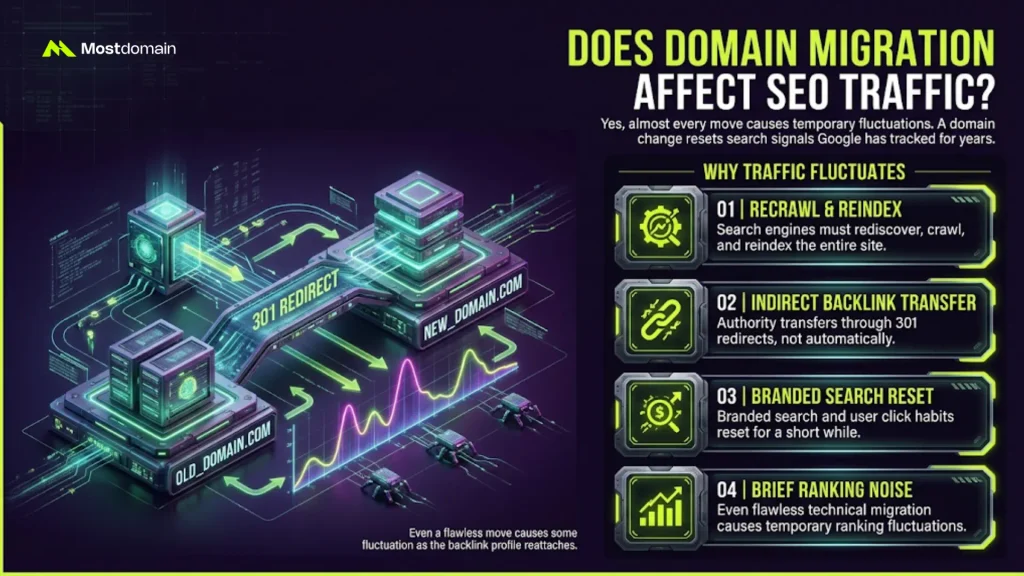
Yes, domain migration affects SEO traffic almost every time. Even a flawless move causes some fluctuation.
A domain change resets signals Google has tracked for years. The backlink profile has to reattach through redirects. Crawlers need to rediscover and re-trust every page. None of this happens instantly. A short adjustment period is completely normal.
- Search engines must recrawl and reindex the whole site
- Backlink authority transfers through redirects, not automatically
- Branded search and click habits reset for a while
- Even clean technical work still causes brief ranking noise
Will Traffic Go Up or Down After Changing Your Domain?

Traffic usually dips first, then settles up, down, or flat. The direction depends on how well the move was planned.
No single factor decides this alone. A few variables, stacked together, usually explain the result.
- How accurately old URLs map to new ones
- Whether content and site structure stayed the same
- The authority gap between the old domain and the new one
- The reason behind the move: rebrand, consolidation, or TLD switch
- Timing relative to seasonal or industry traffic peaks
Why Most Migrations Cause a Temporary Traffic Drop
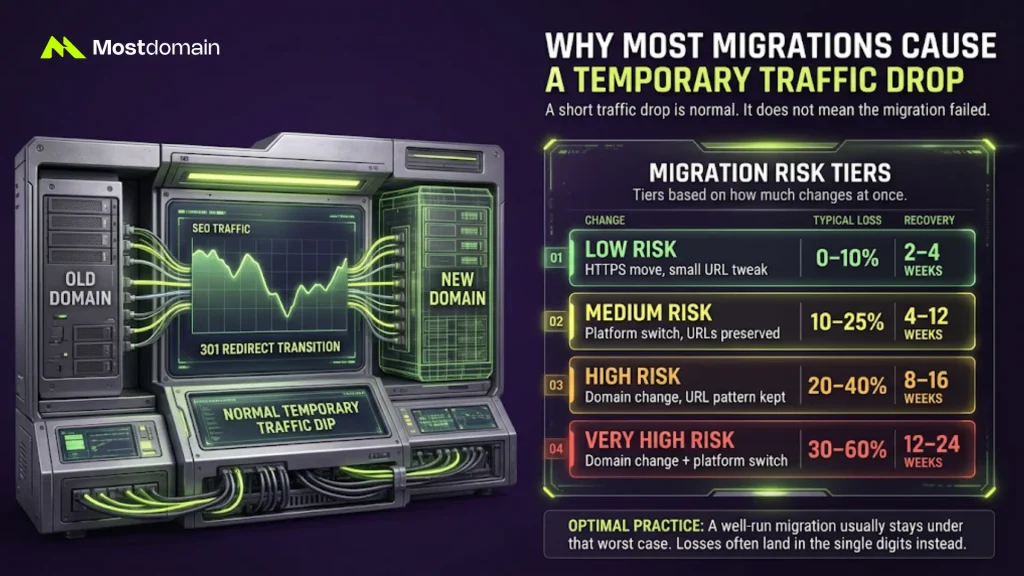
A short traffic drop is normal. It does not mean the migration failed.

Industry data groups migrations into risk tiers. Tiers are based on how much changes at once. A domain-only move sits in the higher-risk band, since Google treats it as a different entity. Bundling a platform switch with it raises that risk further.
| Migration Risk | What Changes | Typical Loss | Recovery Window |
| Low | HTTPS move, small URL tweak | 0–10% | 2–4 weeks |
| Medium | Platform switch, URLs preserved | 10–25% | 4–12 weeks |
| High | Domain change, URL pattern kept | 20–40% | 8–16 weeks |
| Very high | Domain change plus platform switch | 30–60% | 12–24 weeks |
A well-run migration usually stays under that worst case. Losses often land in the single digits instead.
When Domain Migration Actually Increases Traffic
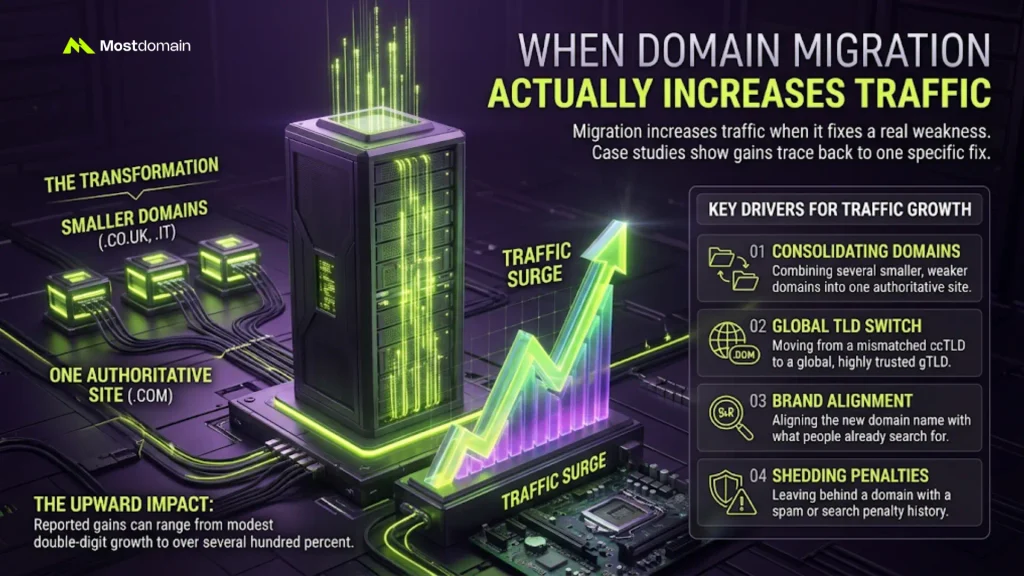
Migration increases traffic when it fixes a real weakness. It rarely helps a site with no underlying problem.




Case studies share one clear pattern here. The gain usually traces back to one specific fix. The domain change alone rarely explains it.
- Consolidating several smaller domains into one authoritative site
- Switching from a mismatched ccTLD to a global gTLD
- Aligning the domain with a brand name people already search for
- Leaving behind a domain with a spam or penalty history
Reported gains range widely across these cases. Some see modest double-digit growth. Others report several hundred percent once things stabilize. The common thread is a genuine upgrade, not just new letters.
How Long Does SEO Recovery Take After a Domain Migration?
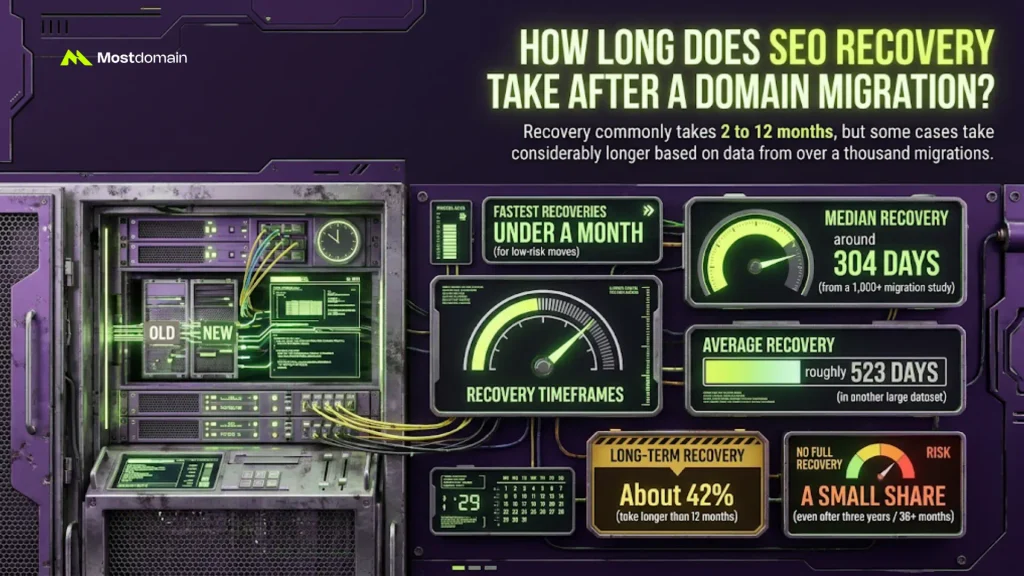
Recovery commonly takes two to twelve months. Some cases take considerably longer.
Large studies tracking over a thousand migrations clarify this.
- Median recovery time: around 304 days in one 1,000+ migration study
- Average recovery in another large dataset: roughly 523 days
- Fastest documented recoveries: under a month, for low-risk moves
- About 42% of migrations take longer than 12 months
- A small share show no full recovery even after three years
How to Recover Lost Traffic After a Domain Migration
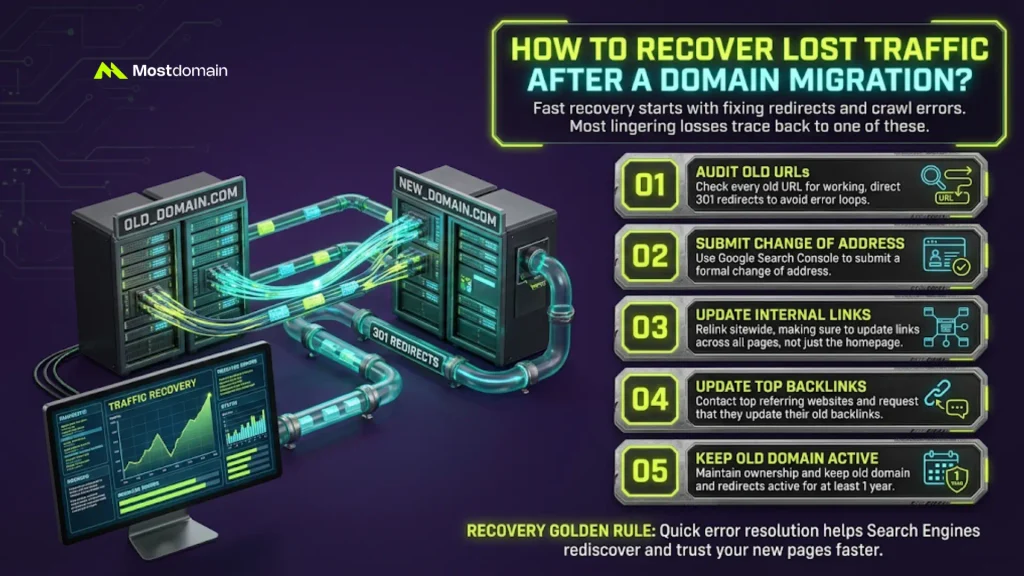
Fast recovery starts with fixing redirects and crawl errors. Most lingering losses trace back to one of these.
- Audit every old URL for a working, direct redirect, see how redirecting a URL affects SEO
- Submit a formal change of address inside Search Console
- Update internal links sitewide, not only on the homepage
- Contact top linking sites and ask them to update old links
- Keep the old domain and its redirects active for a year
Domain Migration Link Equity and Authority Transfer
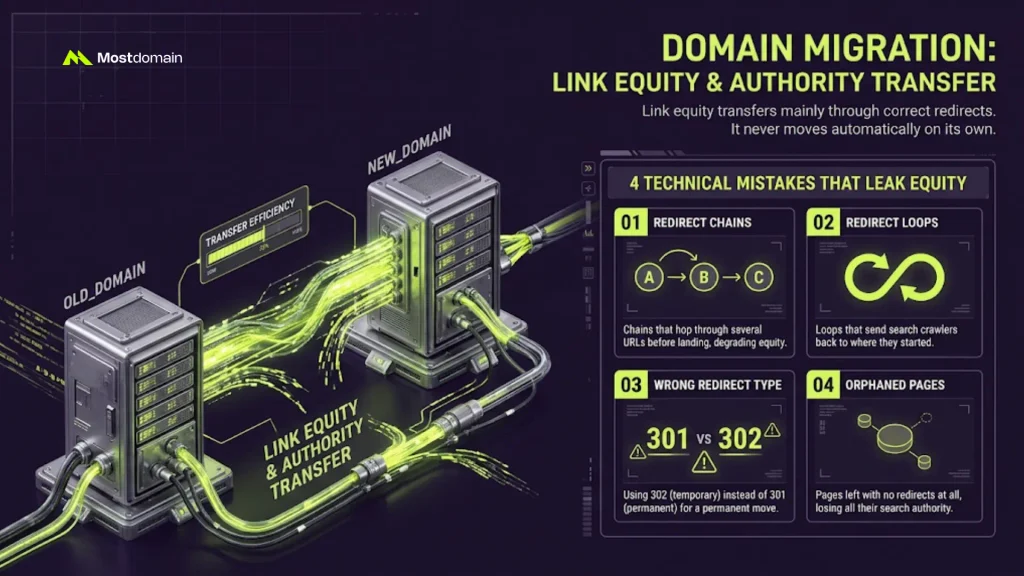
Link equity transfers mainly through correct redirects. It never moves automatically on its own.
Several technical mistakes leak that equity along the way.
- Redirect chains that hop through several URLs before landing
- Redirect loops that send crawlers back to where they started
- Using the wrong redirect type for a permanent move, see 301 vs 302 redirects
- Orphaned pages left with no redirect at all
Picking the right redirect type matters more than people expect.
Using Google Search Console to Track a Domain Migration
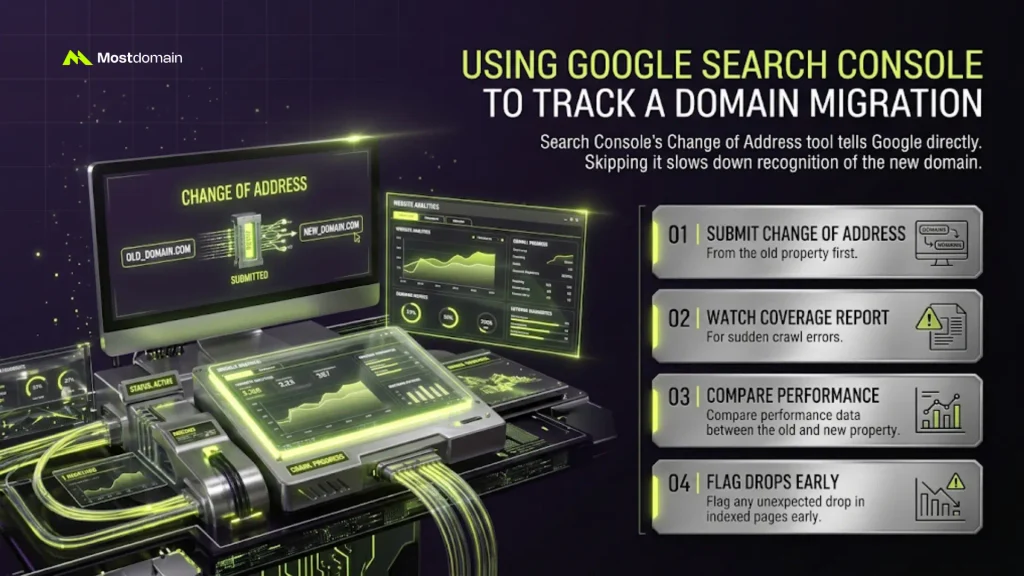
Search Console’s Change of Address tool tells Google directly. Skipping it slows down recognition of the new domain.
- Submit the change of address from the old property first
- Watch the Coverage report for sudden crawl errors
- Compare Performance data between the old and new property
- Flag any unexpected drop in indexed pages early
A Domain Migration SEO Checklist to Reduce Risk
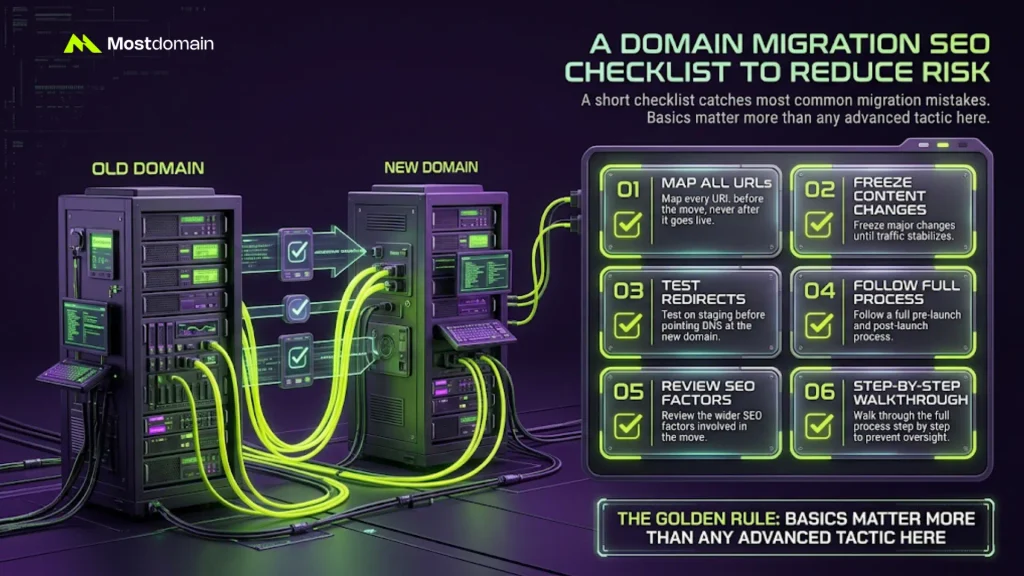
A short checklist catches most common migration mistakes. Basics matter more than any advanced tactic here.
- Map every URL before the move, never after it goes live
- Freeze major content changes until traffic stabilizes
- Test redirects on staging before pointing DNS at the new domain
- Follow a full pre-launch and post-launch process, see the complete domain migration checklist
- Review the wider SEO factors involved in the move, read SEO when changing a domain name
- Walk through the full process step by step, see how to change a domain name of an existing website
FAQ
Will domain migration increase SEO traffic?
Only when the move fixes a real weakness. Think fragmented domains, or weak branding. Otherwise, expect a dip before anything improves.
Does changing a domain name hurt rankings permanently?
Rarely, if redirects and technical setup are correct. Most lost rankings return within a few months.
How long before SEO fully recovers after migration?
Usually a few months, sometimes closer to a year. Larger sites can take meaningfully longer.
Can a domain migration backfire completely?
It can. Large studies show roughly one in seven never recovers fully. Planning is the best protection you have.
Does moving to a better TLD alone boost traffic?
It can help, especially leaving a mismatched ccTLD behind. Execution still matters more than the extension itself.
References
- SALT Agency, Domain Migration Recovery: What 1,052 Migrations Reveal
- Search Engine Journal, How Long Should an SEO Migration Take?
- CTO Migrations, Recovering SEO Traffic After a Website Migration
- Candour, Ryno Systems Site Migration Case Study
- Kolonell, Website Migration Without SEO Loss in 2026
- DEV Community, The Canonical 2026 Reference for SEO Safe Website Migrations
- JumpFly, GigaOM Site Migration Case Study