
Choosing a web address is a lot more important than people think. It is the bedrock of your entire corporate identity. Your digital address determines if customers can find you and if your partners have confidence in you. It also affects the the authority you have in the eyes of search engines. Paying for a subpar address is asking for endless suffering for your growth and for your IT.
Every successful business has a web address that is strategically advantageous. Think of your business web address as real estate in a prime metropolitan location. A good web address makes people want to visit your business, and gives instant prestige. A good web address is easy to remember, and a bad one makes you have to spend money and effort for people to visit your business. Your web address is good if it has people visiting.
This is the reason why considering this step as a minor task, or simply going for the cheapest option, backfires miserably. By choosing the best option and following a strict methodology, your web address will not limit your ability to grow your business for the long term.
Strategic Brand Considerations When You Buy a Domain Name
Evaluating structural components ensures your asset accrues equity rather than becoming a bottleneck for your expansion efforts.
| Brand Criterion | Strategic Importance | Implementation Protocol |
| TLD Priority | Signals immediate legitimacy and stops traffic leakage. | Default to .com. Users reflexively type this suffix; it is the global standard. |
| Length & Complexity | Dictates memory retention and prevents input errors. | Prioritize brevity. Excise hyphens, numerals, and repetitive characters that confuse typists. |
| The “Radio Test” | Confirms phonetic clarity and aids word-of-mouth. | Articulate the name aloud. If a stranger cannot transcribe it accurately upon hearing it, discard it. |
| Keyword Integration | Provides instant context and builds baseline trust. | Embed a high-intent industry term so visitors grasp your value proposition instantly. |
Assessing Aged vs. Fresh Registrations
Structural nuances directly determine how long you must endure the search engine “sandbox” before achieving visibility.
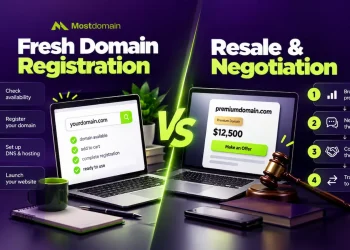
Fresh Registrations
These provide a clean slate, free from past baggage. They are cost-effective but possess zero authority. You will spend months grinding through content and backlink generation to earn rankings.

Aged / Aftermarket Assets
These carry pre-existing backlink profiles and established domain authority. Provided you conduct intense due diligence to avoid spam penalties, these assets allow you to skip the early, stagnant growth phase. While premium inventory is expensive, it accelerates your market entry significantly.
Navigating the Aftermarket: Where to Secure Your Asset
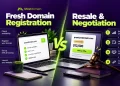
The domain ecosystem is fractured. Some platforms serve bargain hunters, while others act as elite brokerages for high-value assets. You must prioritize transaction security and historical transparency to avoid purchasing a “poisoned” asset.
Marketplace Comparison



| Platform | Best For | Risk Profile |
| Mostdomain | Curated, high-authority, pre-vetted assets. | Minimal; curated quality. |
| GoDaddy | High-volume auction browsing. | High; requires manual vetting. |
| Sedo | Large-scale, cross-border negotiations. | Moderate; professional escrow. |
| Afternic | Rapid listing distribution. | Moderate; requires vigilance. |
| Namecheap | Budget-conscious, new registrations. | Low; standardized. |
For organizations demanding maximum reliability, Mostdomain offers a superior, quality-focused selection for Asia-Pacific buyers who prefer curated inventory over chaotic auction houses.
Steps to Protect Your Asset
These steps will help prevent ownership disputes and exposure to technical weaknesses.
- Availability Audit: Check the name in WHOIS to confirm the registration.
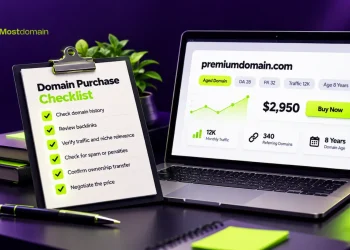
- Historical Forensic Check: Check the domain’s history to see if it was used for spam, abuse, or a search engine ban.
- Credential Security: Use a registrar that is certified and requires multi-factor authentication.
- Transaction Security: Use an escrow service for all private, backdoor deals.
- Ownership Verification: Confirm the details of the legal entity are accurate in the registry.
- Privacy Shielding: Enable WHOIS protection to guard against the collection of your identity.
- Transfer Execution: Collect your EPP code and complete the transfer via your registrar.
- DNS Integration: Configure your nameservers to the production infrastructure.
Critical Acquisition Pitfalls
- Trademark Negligence: Ignoring global IP databases, will invite expensive UDRP litigation.
- Phonetic Complexity: Obscure spellings destroy your word-of-mouth potential.
- Renewal Lapses: Failure to enable auto-renew allows predators to “drop-catch” your name the second it expires.
- Toxic Backlink Profiles: Buying an aged domain with a “dirty” history permanently cripples your organic search potential.
- Fragmented Ownership: Always register assets under the corporate entity, never a personal employee account.
FAQs
What is the normal price for a domain name?
For normal domain names, the registration typically costs about $10-$20 per year. An exceptional domain name may cost several hundreds to several thousands of dollars. An exceptional domain name is typically one that has a short length, has a keyword that is of high value to a lot of people, and is not newly registered.
Is domain ownership permanent?
Not indefinitely. You are essentially leasing the name. You have to pay the renewal fee per year to keep exclusive ownership of the domain name.
Best TLD?
The safest TLD is the .com, but if you are a local business, you may consider using a local country code top-level domain (cTLD) such as .sg for Singapore, but you should try .com.
Are private aftermarket purchases safe?
They may be safe, but only if you require the use of a professional escrow service. You should never pay for the domain to an unknown seller directly.
How to check if a domain is owned?
You can visit a registrar and use a WHOIS lookup.
Why are aged domains so desirable?
They are typically trusted more by the search engines and inherit that trust. You can skip the waiting period of ranking in the search engines using a brand new domain.
How to check the value of an aged domain?
Be sure that it is indexed on a search engine and check the quality of the domain’s links, and view past content of the domain.
Your Digital Foundation
Finalizing your online identity is crucial to your business growth. Look at this step as a key business investment rather than an easy choice to make. With focus on high-authority, data-oriented assets, you make a competitive barrier that protects your business. Do you want to obtain a high-quality, trusted asset that offers an instant strategic benefit? Take a look at the selected list at Mostdomain.
References
- Backlinko. (2023, May 9). Google’s ranking factors: The complete list. Backlinko.
- HubSpot. (2024, November 14). How to buy a domain name (and what to do if it’s taken). HubSpot Blog.
- Moz. (2023, June 20). What is domain authority? How is it calculated? Moz.
- Search Engine Journal. (2024, February 18). The complete guide to choosing a domain name for SEO. Search Engine Journal.
- Search Engine Journal. (2025, January 10). Aged domains vs. new domains: Which is better for SEO? Search Engine Journal.
- Search Engine Land. (2024, August 22). How domain history can quietly ruin your new website’s SEO. Search Engine Land.
- Search Engine Land. (2026, April 14). The radio test: Why pronounceable, intuitive domain names win the branding war. Search Engine Land.