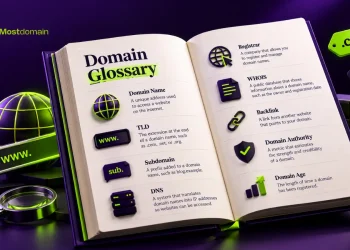
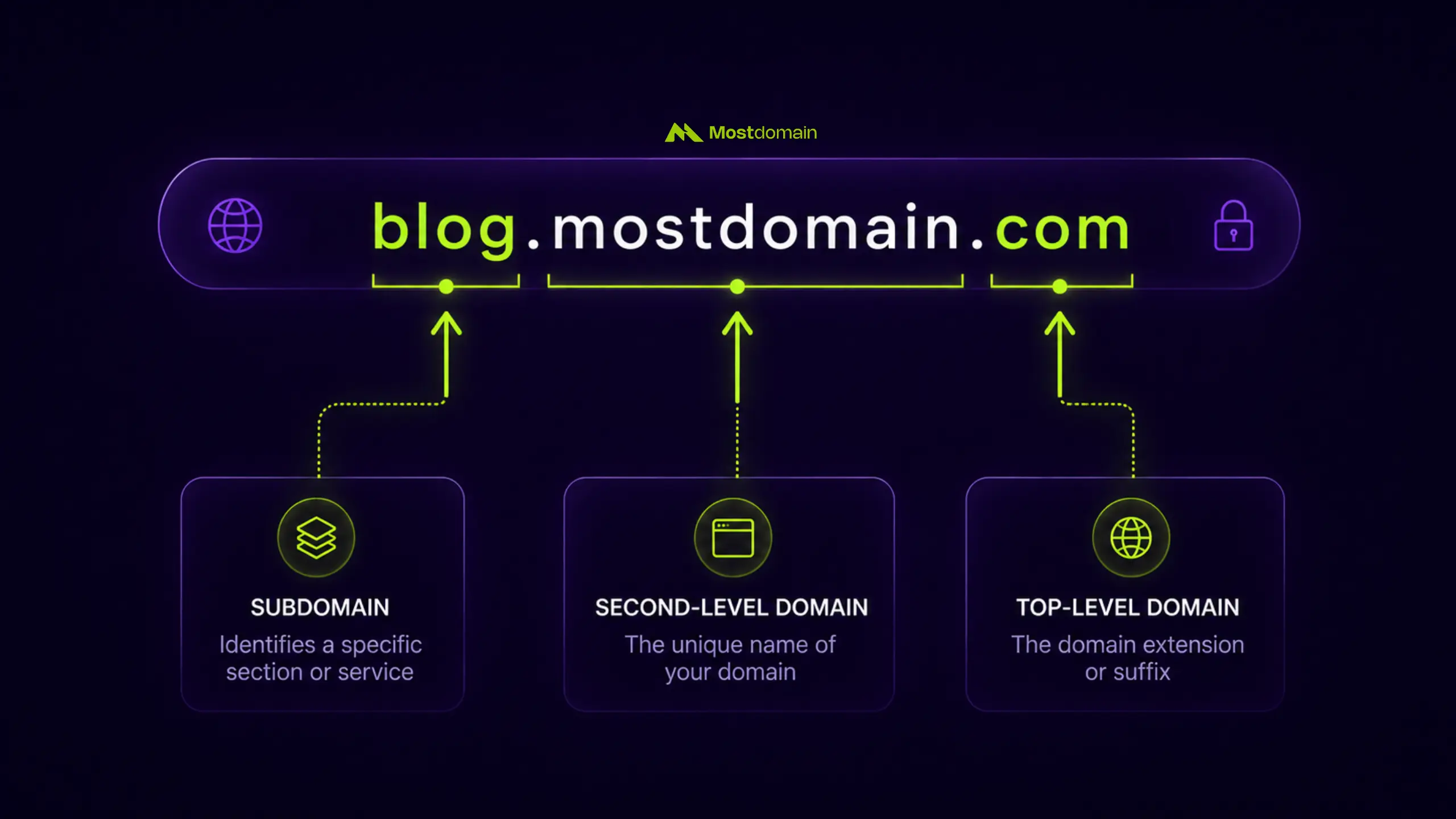
A top level domain and a subdomain don’t sit on the same layer of an address. Not even close. The TLD is the suffix a registry controls under an ICANN contract, think .com or .io, while a subdomain is a free DNS label any domain owner bolts onto a domain they already control, blog.example.com being the obvious case.
People start mixing the two up the moment they search “subdomain or new TLD,” as if choosing one rules out the other. It doesn’t. Buying a TLD happens once, at registration. Setting up a subdomain happens whenever, for nothing, and confusing the timing of those two decisions is usually where the actual headache starts.
What a Top-Level Domain Actually Controls
Only an ICANN-accredited registry can sell names under a given top level domain. Nobody else gets a vote. Not a domain owner, not a hosting company, not even a determined registrar rep.
- Generic TLDs (gTLDs), .com, .org, .net, plus newer entrants like .shop or .tech, are open to anyone on the planet. No eligibility check, no waiting period
- Country-code TLDs (ccTLDs) like .uk, .de, or .id tie to a specific territory. And some come with local-presence rules a foreign registrant can’t route around
- Sponsored and restricted TLDs (.gov, .edu, .bank) sit behind verification no registrar can waive, though a few sponsored TLDs quietly relax that gate for certain professional categories, worth checking case by case
Anyone eyeing a niche TLD instead of a familiar one, building a startup brand say, might want to skim MostDomain’s take on .io domains for startups first.
What Makes a Subdomain Structurally Different
Nobody registers a subdomain. There’s no registrar step, no ICANN fee, nothing to renew. It’s just a DNS record. Usually a CNAME or an A record, that a domain owner adds or deletes in minutes.
- No fee, ever. Nothing gets purchased in the process, so there’s nothing to charge for
- Format runs subdomain.domain.tld, and one domain can carry dozens of them at once, no technical ceiling in sight
- RFC 1034 technically defines a subdomain as any domain contained within another, complete with its own zone file and SOA record. Most people, honestly, just call a bare CNAME entry a subdomain too, zone file or not, and the distinction barely matters outside a DNS admin’s world
Those records look pretty abstract until you’ve actually seen one. MostDomain’s guide on how to read DNS lookup results walks through it line by line for anyone who wants the visual.

Where Each One Sits in the Domain Hierarchy
Read a web address right to left and the whole hierarchy falls into place. Root zone, then the top level domain, then the second-level domain that’s actually registered and paid for. Then whatever subdomain sits on top of that.
- Root zone sits at the very top, invisible in a normal browser bar. Managed by IANA
- Top level domain: .com, .io, .id. Controlled by whichever registry ICANN contracted for that string
- Second-level domain is the part someone actually registers and renews year after year. “Example” in example.com, to use the obvious case
- Subdomain, when one exists, gets layered on after all that. Free. Unlimited. Added or removed by whoever runs that domain’s DNS
Top-Level Domain vs Subdomain at a Glance
Line them up side by side and a top level domain and a subdomain disagree on almost every structural point, sharing really just one thing: both end up inside the same web address.
| Aspect | Top-Level Domain | Subdomain |
| Position | After the final dot | Comes before the registered domain, right up front |
| Who creates it | An ICANN-accredited registry | The domain owner, whenever they feel like it |
| Registration needed | Yes, through a registrar | No |
| Governed by | ICANN contract and registry policy, enforced top-down | Whoever controls the parent domain’s DNS settings |
| Limit per domain | One | Unlimited, DNS doesn’t care how many |
What It Costs to Get Each One
Ten to twenty dollars a year covers an existing TLD registration. A subdomain costs nothing at all. Creating a brand-new TLD string, becoming the registry behind it, lands in a completely different category: $227,000, flat, before anything else gets added on.




- Existing TLD registration: $10 to $20 per year, no application, live the same day
- Subdomain creation: $0, capped only by how many DNS records someone bothers setting up
- New TLD application: $227,000 flat evaluation fee under ICANN’s New gTLD Program 2026 round. Which opened its window on April 30, 2026 and closed it on August 12, 2026. Legal fees and backend registry infrastructure sit on top. And neither of those comes cheap either
- For scale: the 2012 round drew close to 1,930 applications and delivered 1,241 TLDs into the root. A decade later, the process still isn’t getting any less selective
Does Google Treat a Subdomain as a Separate Website
Google has said, more than once. They said that a subdomain and its root domain get treated as connected for ranking when the same owner controls both. Matt Cutts said it in 2012. John Mueller said it again in 2017.
| Owner-Controlled Subdomain | Public Suffix List Subdomain | |
| Example | blog.example.com, same owner as example.com | jane.blogspot.com, hosted by Google, owned by nobody but Jane |
| Ranking treatment | Connected to the root domain’s signals | Its own site, essentially, independent |
| Who can create it | Only the domain’s owner | Anyone with a free platform account, no vetting |
| Cookie scope | Shared across subdomains by default | Isolated, subdomain by subdomain |
There’s a wrinkle here most competing guides skip. Google’s developer documentation notes that Search supports only one site name per domain or subdomain, not at the subdirectory level, which is Google quietly confirming a subdomain counts as its own unit even while sharing most ranking signals with the parent. Small detail. Matters more than it sounds like it should.
For the deeper ranking-factor debate itself, MostDomain’s guide on how TLDs affect SEO rankings goes further than fits here, and for how a subdomain’s authority stacks up against its root domain specifically, that’s covered in MostDomain’s domain authority guide.
Security and Management Differences Worth Knowing
A TLD has no real equivalent to subdomain takeover, the risk where an abandoned DNS record still points to a cloud resource somebody else can claim. That’s a subdomain problem specifically, not a domain-level one.
- Subdomain takeover happens when a CNAME record outlives the hosting resource it once pointed to. Whoever grabs that resource name next inherits the subdomain, sometimes for phishing, not fun to discover after the fact
- Wildcard SSL certificates cover a domain plus every subdomain under it. But only at Domain Validation or Organizational Validation, never Extended Validation
- No wildcard cert means separate SSL setup per subdomain, which adds up fast past a handful
- Forgotten subdomains rarely surface in a routine audit unless someone checks DNS records directly. A common blind spot, and an avoidable one
Free subdomains handed out by page builders carry their own separate tradeoffs too, the kind MostDomain’s guide to securing a domain name for free gets into.
When to Choose a Subdomain Instead of a New Domain
Shared audience and brand equity point toward a subdomain. A genuinely different audience or business points toward a separate domain, with its own TLD decision to make from scratch.
| Situation | Better Fit |
| Documentation or a help center for an existing product | Subdomain |
| A blog meant to build the main domain’s authority | Subfolder, usually |
| A new brand with a genuinely different audience | New domain, own TLD |
| Regional storefront under an established brand | Subdomain |
MostDomain’s domain SEO guide goes deeper into the subdomain-versus-subfolder tradeoff, including why subfolders tend to edge out subdomains for shared ranking signals. One thing that guide skips: launching a genuinely new brand on its own TLD tends to move faster from an aged domain with existing history than from a bare, brand-new registration.
Picking the Right One Without Overthinking It
None of this has to be complicated. A top level domain is a one-time purchase, locked in for as long as it’s renewed. A subdomain is free and reversible, undoable in an afternoon if it stops making sense.
Here’s the part that’s easy to miss: migrating a live subdomain into a subfolder later, once it’s picked up its own backlinks and cached URLs, gets messier than getting the structure right the first time. Decide early. There’s a lot less untangling to do later.
FAQ
Is a subdomain part of my main domain for SEO purposes?
Functionally, yes, provided one owner controls both. Google links the ranking signals between subdomain and root domain. Though Search Console still wants separate verification for each.
Can I create a subdomain without buying a new TLD?
Yes, easily. A subdomain is just a DNS record added to a domain that’s already owned. No registrar step, no ICANN fee. Or nowhere in the process.
How much does it cost to register a completely new top-level domain?
$227,000, flat, as the ICANN evaluation fee for the 2026 New gTLD Program round. Legal counsel, backend registry infrastructure, and ongoing operations all sit on top of that number. Not folded into it.
What’s the difference between a subdomain and a subdirectory?
Mostly position. A subdomain sits in front of the registered domain, blog.example.com, and counts as its own site name in Google’s system. A subdirectory sits after it, example.com/blog, inheriting the domain’s existing signals directly.
Is blog.example.com the same registrable domain as example.com?
Same registrable domain, same owner, in the typical case. The exception: if example.com happens to sit on the Public Suffix List, the subdomain functions as its own independent entity instead.
References
- ICANN, New gTLD Program: 2026 Round
- Gilbert + Tobin, ICANN’s New gTLD Program 2026 Round: What You Need to Know
- Google for Developers, Site Names in Google Search
- Visual SEO Studio, Subdomains and SEO
- Wikipedia, Subdomain
- NameSilo, Public Suffix List 101: Cookies, Subdomains, and Why co.uk Behaves Differently