
Type any web address and look at the last piece after the final dot, .com, .org, .io, and that’s the domain extension. Small string. Big implications: it marks where a name sits in the internet’s naming hierarchy, and it quietly decides who governs it, what it costs over time, and how much risk rides along.
Most explanations stop at “it’s the part after the dot,” which is accurate but thin. The sharper question is why one extension runs two dollars while its neighbor renews at sixty, and why certain suffixes turn up in phishing reports so much more than others. Cost and risk, not spelling, are what actually separate one extension from the next, and that’s the ground this guide covers.
What ia a Domain Extension?
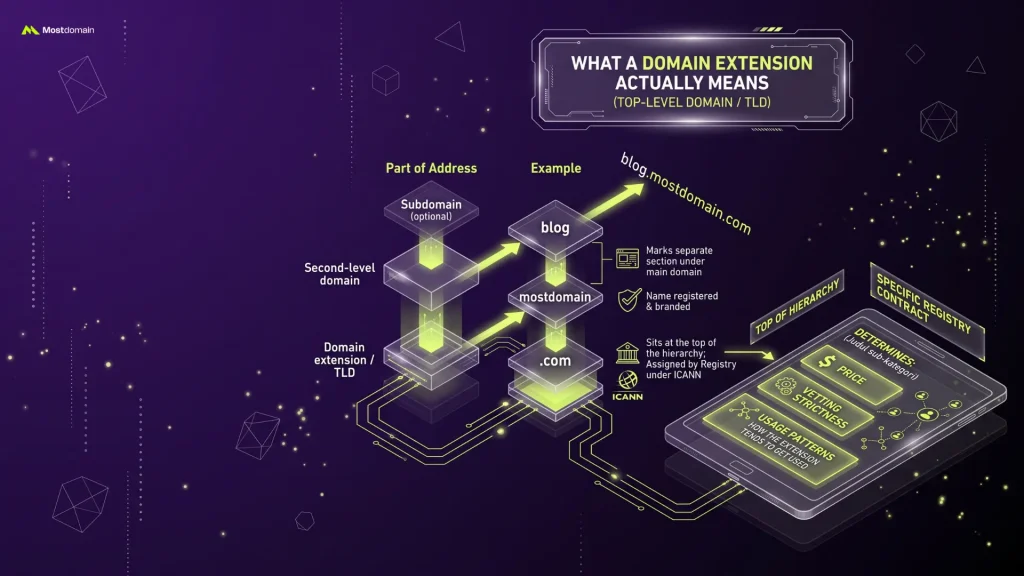
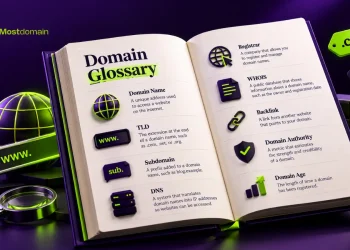
Also known as a top-level domain (TLD), a domain extension is the suffix a registry assigns under ICANN’s oversight, sitting at the very top of the domain name system’s hierarchy.
Break any web address into layers and the extension sits at the top rung. mostdomain.com works as a clean example of how those layers actually stack:
| Part of the Address | Example | What It Does |
| Subdomain (optional) | blog | Marks a separate section under the main domain |
| Second-level domain | mostdomain | The name you actually register and brand |
| Domain extension / TLD | .com | Sits at the top of the hierarchy; assigned by a registry under ICANN |
The extension isn’t decorative. Each one is tied to a specific registry contract, and that contract, not the letters themselves, is what ends up determining price, vetting strictness at registration, and, as it turns out, how the extension tends to get used by everyone else registering under it.
The Three Established Categories of Domain Extensions
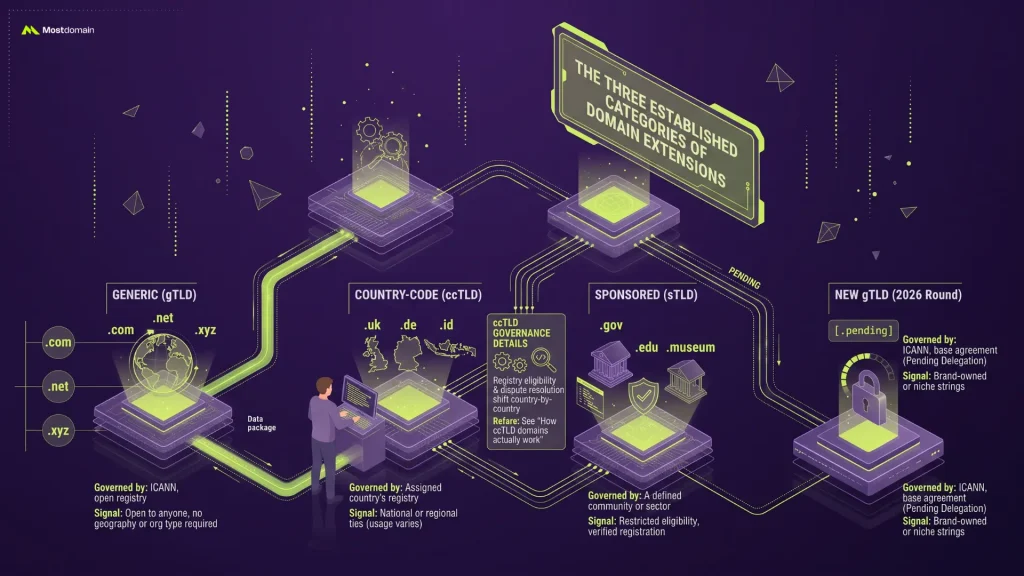
Three governance categories cover almost every domain extension in use today, generic (gTLD), country-code (ccTLD), and sponsored (sTLD), with a fourth wave now moving through evaluation from the 2026 ICANN application round.

| Category | Governed By | Examples | What It Signals |
| Generic (gTLD) | ICANN, open registry | .com, .net, .xyz | Open to anyone, no geography or org type required |
| Country-code (ccTLD) | The assigned country’s own registry | .uk, .de, .id | National or regional ties, though usage varies a lot |
| Sponsored (sTLD) | A defined community or sector | .gov, .edu, .museum | Restricted eligibility, verified before registration |
| New gTLD (2026 Round) | ICANN, base registry agreement | Pending delegation | Brand-owned or niche strings not yet public |
ccTLD governance is its own rabbit hole, honestly. Country to country, the rules shift on who’s even allowed to register and how disputes get settled, and cramming all that into a general overview would flatten it into something less useful. For the fuller picture, how ccTLD domains actually work walks through the governance mechanics and a few real registration cases.
Why the Namespace Is Expanding
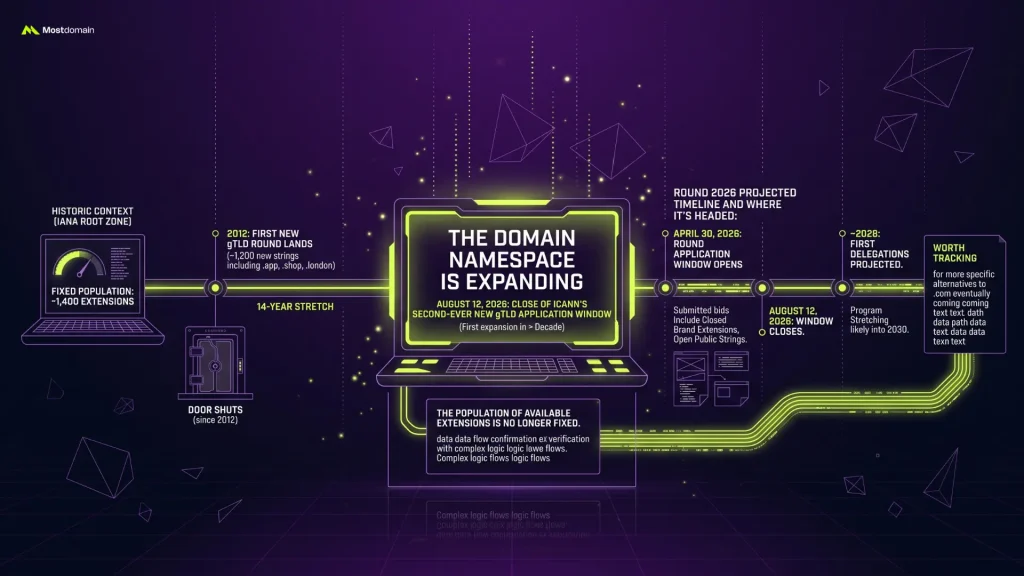
August 12, 2026 marked the close of ICANN’s second-ever New gTLD application window, the first expansion of the domain namespace in more than a decade.
Fourteen years is a long stretch to have the same roughly 1,400 extensions in the IANA root zone stand in as more or less the whole picture. Here’s the timeline that got things here, and where it’s headed:




- 2012: The first New gTLD round lands, roughly 1,200 new strings including .app, .shop, and .london. Then the door shuts.
- April 30, 2026: The 2026 Round application window opens. First shot at a new top-level domain since 2012.
- August 12, 2026: Window closes. Businesses, cities, and communities have now submitted their bids, some for closed brand extensions, others for open, publicly registrable strings.
- ~2028: ICANN’s own projections put the first delegations from this round here, with the full program likely stretching into 2030.
So nothing changes at the registrar checkout tomorrow. But for the first time since most current internet users started registering domains, the population of available extensions is no longer fixed. Worth tracking if you’re wondering where a more specific alternative to .com might eventually come from.
The Security Profile
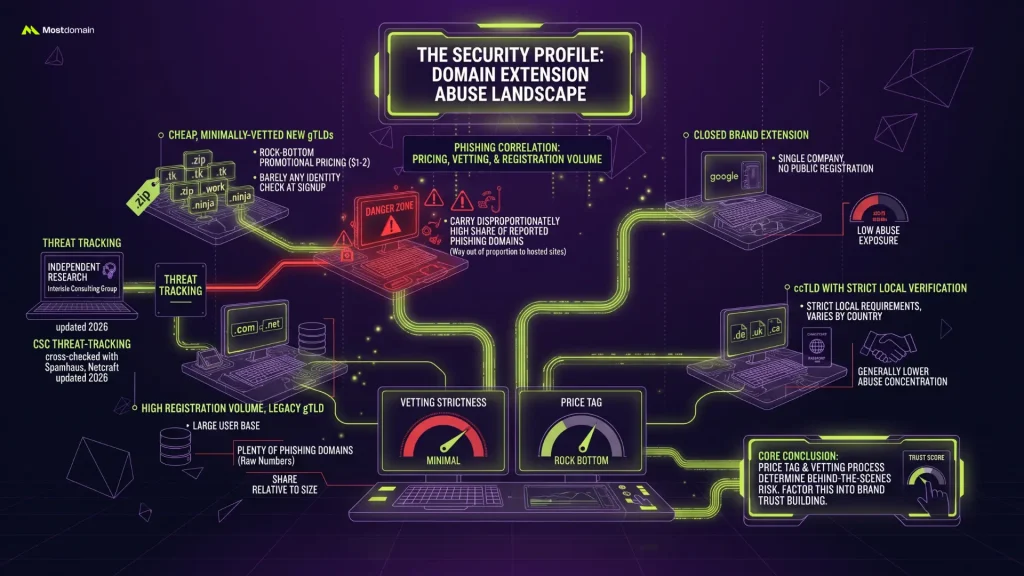
Cheap, minimally-vetted new gTLDs show up disproportionately often in phishing data, a pattern independent trackers keep confirming against legacy gTLDs and most ccTLDs.
Almost nobody writing about domain extensions brings this up. It’s more concrete than most branding advice, too. Interisle Consulting Group’s Phishing Landscape research, updated through 2026, keeps finding the same pattern year after year: a small cluster of new gTLDs, priced at a dollar or two with barely any identity check at signup, ends up carrying a share of reported phishing domains way out of proportion to how many sites they actually host. CSC’s own threat-tracking, cross-checked against Spamhaus and Netcraft data, lands on more or less the same conclusion.
| Signal | What It Usually Means |
| Rock-bottom promotional pricing, little to no identity check | Attracts bulk registration by bad actors chasing cheap, disposable domains |
| Closed brand extension (single company, no public registration) | Low abuse exposure; nobody outside the brand can register there |
| High registration volume, legacy gTLD | Carries plenty of phishing domains in raw numbers, but a lower share relative to its overall size |
| ccTLD with strict local verification requirements | Generally lower abuse concentration, though this varies by country |
None of this makes a cheap extension automatically dangerous. It just means the price tag and the vetting process are doing more work behind the scenes than the checkout page lets on, and that’s worth factoring in if brand trust is part of what you’re building.
Why Extension Pricing Isn’t Regulated
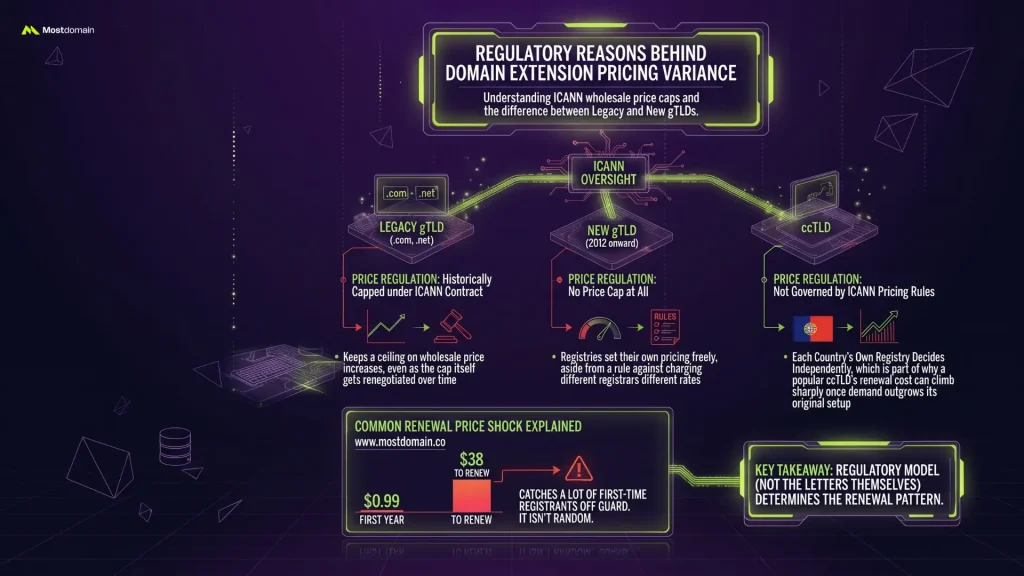
Legacy extensions such as .com have historically operated under ICANN wholesale price caps; every extension delegated from 2012 onward has never had one, which is the main reason renewal pricing swings so widely.
This is what actually explains the “$0.99 first year, then $38 to renew” pattern that catches a lot of first-time registrants off guard. It isn’t random.
| Category | Price Regulation | Why It Matters |
| Legacy gTLD (.com, .net) | Historically capped under ICANN’s registry contract | Keeps a ceiling on wholesale price increases, even as the cap itself gets renegotiated over time |
| New gTLD (2012 onward) | No price cap at all | Registries set their own pricing freely, aside from a rule against charging different registrars different rates |
| ccTLD | Not governed by ICANN pricing rules | Each country’s own registry decides independently, which is part of why a popular ccTLD’s renewal cost can climb sharply once demand outgrows its original setup |
For actual dollar figures by extension type, and the hidden fees that show up after year one, MostDomain’s breakdown of real domain pricing and renewal costs covers that ground directly. What matters here is understanding the regulatory reason behind the pattern before you get to the numbers.
SEO and Brand Trust
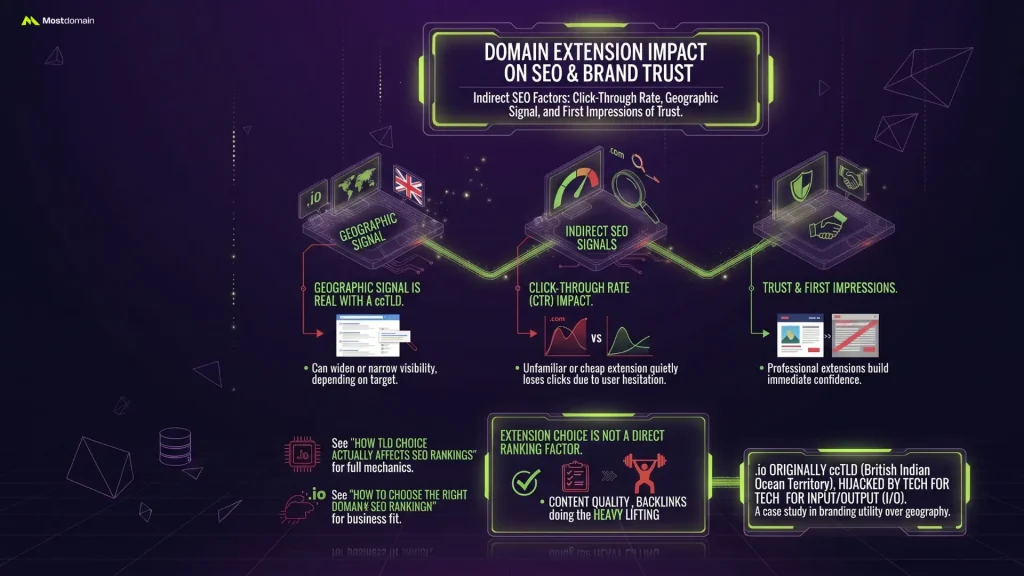
Rankings don’t move because of a domain extension choice directly, but click-through rate, geographic targeting signals, and first impressions of trust all shift with it, and those three feed into SEO indirectly.
- Extension choice isn’t a ranking factor on its own, Google has said this plainly, with content quality and backlinks doing that heavy lifting instead.
- Geographic signal is real with a ccTLD. It can widen or narrow visibility, depending on whether the target is one country or the whole map.
- Then there’s click-through rate: an extension that feels unfamiliar or cheap quietly loses clicks, purely because people hesitate on what looks unfamiliar or spammy, no algorithm required.
For the full mechanics, including how Google actually treats geo-targeted extensions in practice, how TLD choice actually affects SEO rankings goes deeper. Deciding which specific extension fits a business right now is a separate question, one how to choose the right domain extension for your business answers in full. Worth a quick side note: .io began life as a ccTLD for the British Indian Ocean Territory before tech founders hijacked it as shorthand for input/output, a case why .io became the go-to pick for tech startups covers in more depth.
FAQ
Is a domain extension the same thing as a TLD?
Pretty much, yes. Most registrars and business owners just say “domain extension”; “TLD” is the stiffer, more technical label for the exact same thing.
How many domain extensions currently exist?
More than 1,400, active in the IANA root zone as of 2026 and spread across generic, country-code, and sponsored categories. More are on the way, courtesy of the current ICANN application round.
Can I register a new gTLD from the 2026 Round right now?
Not yet, no. The window closed on August 12, 2026, and right now it’s applicants going through evaluation, not the general public. Public registration only opens once approved strings actually get delegated, and ICANN isn’t expecting that before roughly 2028.
Why do some domain extensions feel less trustworthy even when nothing is technically wrong with them?
Partly reputation, partly real data. Extensions with minimal registration vetting and rock-bottom pricing genuinely do carry higher concentrations of abuse, so the hesitation isn’t purely psychological.
Does a country-code extension limit my website to that one country?
No. A ccTLD signals geographic relevance to search engines and visitors, but the site itself stays fully viewable and indexable worldwide.
Will extension pricing ever get regulated the way .com pricing is?
Unlikely for anything delegated since 2012. ICANN’s base registry agreement, the contract template used for that entire generation of extensions, was built without price caps from the start, and there’s no sign that’s changing.
References
- ICANN, ICANN Opens Application Window for New Generic Top-Level Domains
- Interisle Consulting Group, Phishing Landscape 2026: Phishing Activity in Top-Level Domains
- Com Laude, ICANN Renewal of Legacy TLD Contracts
- CSC, The Highest Threat TLDs, Part 2
- Wikipedia, List of Internet Top-Level Domains