A premium domain name is a short, memorable name that many buyers want. Good names run out, so the price climbs above a standard domain’s. Sometimes that price is smart. Sometimes it is a trap. This guide helps you work out which one you’re looking at.
Here’s what the guide covers:
- Registry-flagged premiums versus aftermarket names, and why renewals differ.
- Age, backlinks, authority scores, and history as proof of value.
- Registration fees against what the market would actually pay.
- How to rank your shortlist with a 100-point scorecard.
- Finally, the practical part: where to look, how to pay, and how transfers work.
What Is a Premium Domain Name?
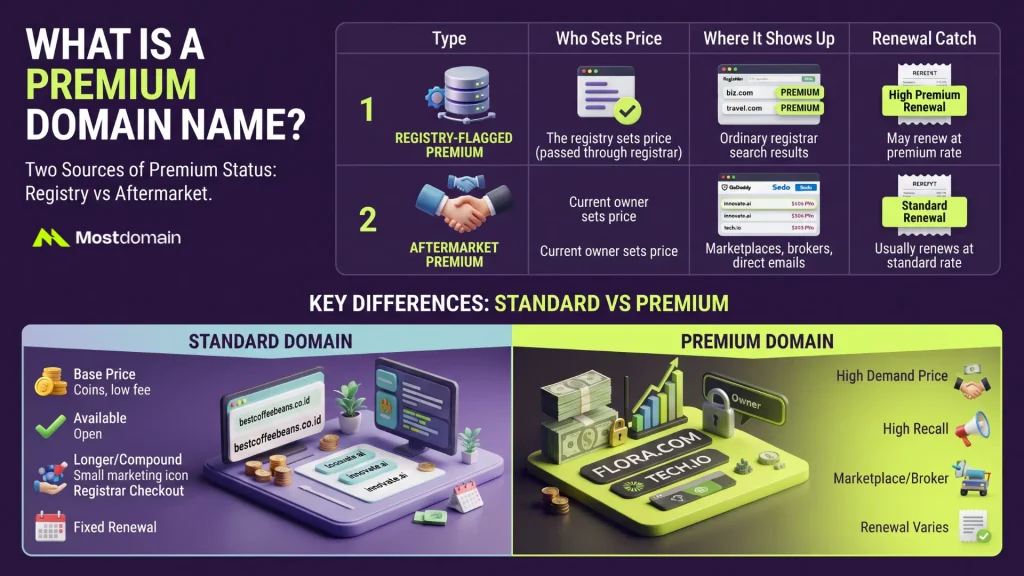
Premium names are priced by demand, so they sit well above registration fees. Buyers mix up the two sources of that status all the time.
Premium Domain Meaning: Registry-Flagged vs Aftermarket Names
“Premium” can mean two things, and your renewal bill depends on which.
| Type | Who sets the price | Where it shows up | Renewal catch |
| Registry-flagged premium | The registry, passed through your registrar | Ordinary registrar search results, tagged “premium” | May renew at the premium rate instead of the base fee |
| Aftermarket premium | Whoever owns it now | Marketplaces, brokers, direct emails | Usually the registrar’s standard rate once it’s yours |
Our guide to the primary market and aftermarket explains the split in detail.
Premium Domain vs Standard Domain
A standard domain sells at base price. A premium domain does not.

| What you compare | Standard domain | Premium domain |
| Price | Base registration fee | Set by demand, or by the registry’s price tier |
| Availability | Open to anyone | Often already owned, or reserved by the registry |
| Typical shape | Compound words | Short, a single word, or a sharp keyword |
| Brand effect | Needs marketing to stick | Easier recall |
| Where you buy | Registrar checkout | Registrar, marketplace, or broker, depending on the name |
| Renewal | Fixed fee | Can vary. Check first. |
Price is the visible gap. Renewal terms are the hidden one.
What Makes a Domain Name Premium?
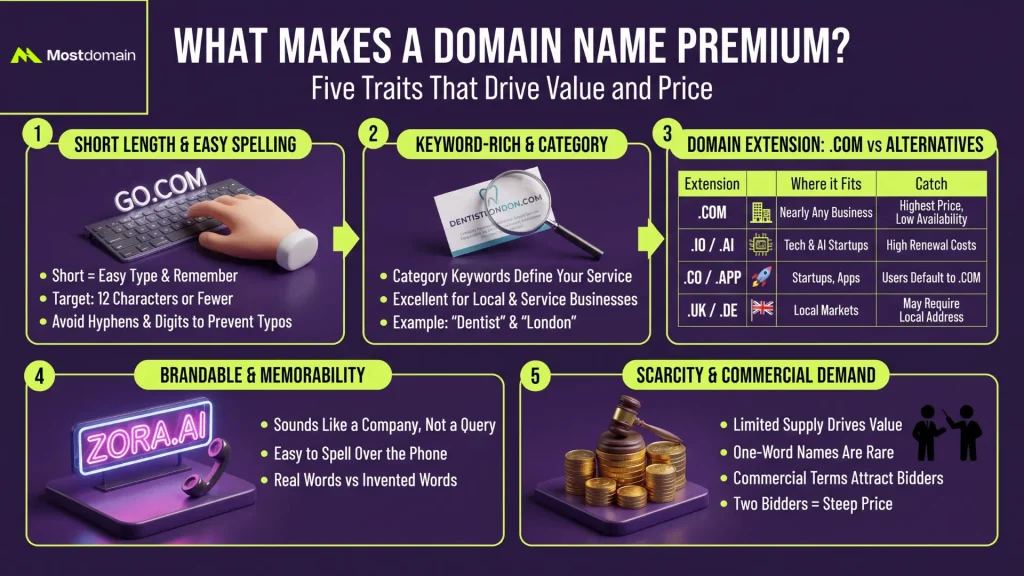
Length, keywords, extension, brandability, scarcity: five traits do most of the work. A name rarely needs all five. Two or three strong ones can carry the price.
Short Domain Length and Easy Spelling
Short wins, mostly because people can type and remember it.



- Twelve characters or fewer makes a decent target, though nothing magic happens at 12.
- Hyphens and digits? Buyers tend to avoid both, since they invite typos.
- A friend who hears it once and types it wrong has told you something.
Keyword-Rich and Category Domain Names
A category keyword tells visitors what you do before they click.
- A name saying “dentist” and “London” needs little explanation.
- Strong fit for local and service businesses.
- Weaker fit if your offer may change later.
Domain Extension: .com vs Alternatives
Most general audiences still trust .com first.
| Extension | Where it fits | Catch |
| .com | Nearly any business | Highest prices, and few good names are left |
| .net or .org | Tech brands and nonprofits | People may type .com by mistake |
| .io or .ai | Tech and AI startups | Renewals can run much higher than .com |
| .co or .app | Startups, apps | Some visitors default to .com |
| Country codes like .co.uk or .de | Local markets | Some require a local address or company |
Brandable Domain Names and Memorability
Brandable names sound like companies rather than search queries.
- Picture reading it over the phone. Nobody should have to ask, “How do you spell that?”
- Invented words start from zero, which means a bigger launch budget.
- Real words with a twist often stick faster.
Domain Scarcity and Commercial Demand
Few names exist, and many people want them. That gap is the price.
- One-word names are limited in every extension.
- Commercial terms attract many bidders.
- Two motivated bidders can turn a fair price into a steep one.
Premium Domain Value: How to Tell If a Name Is Worth the Price
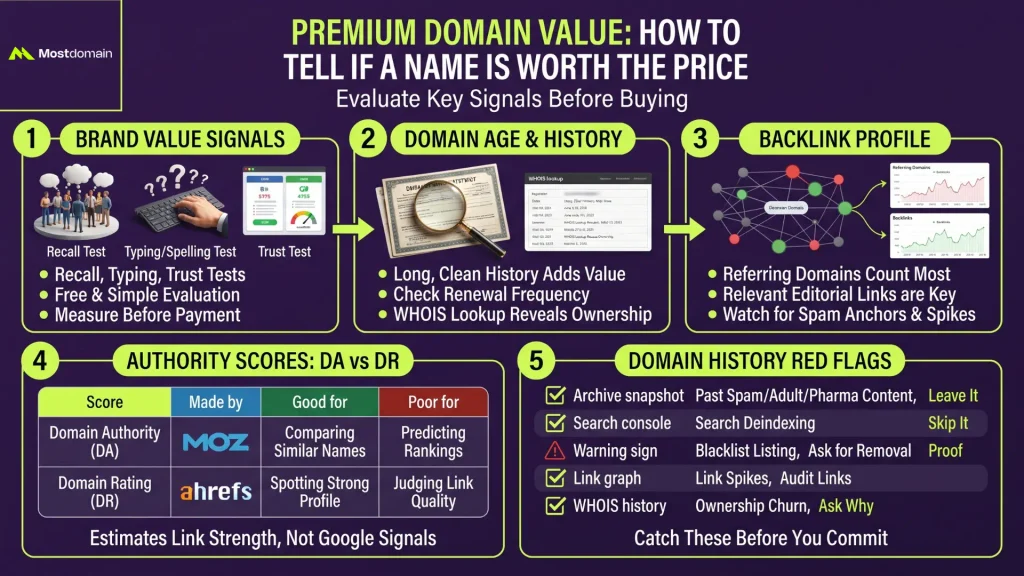
Value is real when evidence supports the brand story you’re telling yourself. Short version first, in the table below. Then dig into each signal.
| Signal | What you’re asking | Where to look |
| Brand fit | Will strangers remember and trust it? | Quick tests with real people |
| Domain age | How long has it existed? | Registration records |
| Registration history | Gaps, spam, or a long list of owners? | Archive snapshots and history tools |
| Backlinks | Do credible sites link to it? | A backlink checker |
| Authority scores | Roughly how strong is the link profile? | DA or DR tools |
| Comparable sales | What did similar names fetch? | Public sales databases |
Brand Value Signals Buyers Can Measure
Brand value shows up in three small tests: recall, typing, and trust.
- A day later, how many of ten people can repeat the name?
- Say it once and watch their fingers. Misspellings tell you plenty.
- Trust test: show it beside your offer. Ask which feels credible.
- All three tests cost nothing. Run them before any payment.
Domain Age and Registration History
A long, clean history can add value, though age alone proves little.
- Google has said age is not a direct ranking factor.
- Lapsed twice? That reads worse than a name renewed every year without fail.
- Frequent ownership changes deserve questions. The quickest first look is a WHOIS lookup.
- History deserves a look regardless of age, so check domain history before buying.
Backlink Profile and Referring Domains
Raw link totals mislead. Referring domains tell you who actually vouches for the name.
- Fifty links from one site can still count as roughly one vote.
- Relevant editorial links beat directory or comment links.
- Pills or casino terms in the anchor text? Bad sign.
- Sudden spikes or drops? Dig into why before you buy.
- Read referring domains versus backlinks to interpret the numbers.
- Several free backlink checker tools can handle a first pass.
Domain Authority and Domain Rating: What They Show
These scores estimate link strength, but Google doesn’t use them.
| Score | Made by | Good for | Poor for |
| Domain Authority (DA) | Moz | Comparing two similar names | Predicting rankings |
| Domain Rating (DR) | Ahrefs | Spotting a strong link profile quickly | Judging brand value or link quality |
The scores often disagree, so compare Domain Authority and Domain Rating. Neither is a ranking signal Google uses.
Domain History Red Flags
A single red flag can sink an otherwise strong name. Check these first.
| Red flag | How to spot it | Your move |
| Past spam, adult, or pharma content | Archive snapshots | Leave it |
| Search deindexing | A site: search returns nothing | Skip the name |
| Blacklist listing | Safe Browsing and spam blocklist lookups | Ask for proof it was removed |
| Link spikes | Backlink growth charts | Audit the links before you buy |
| Ownership churn | WHOIS history | Ask why it changed hands so often |
A full domain health check catches most of these before you commit.
Premium Domain Pricing: Registration Fees vs Marketplace Value
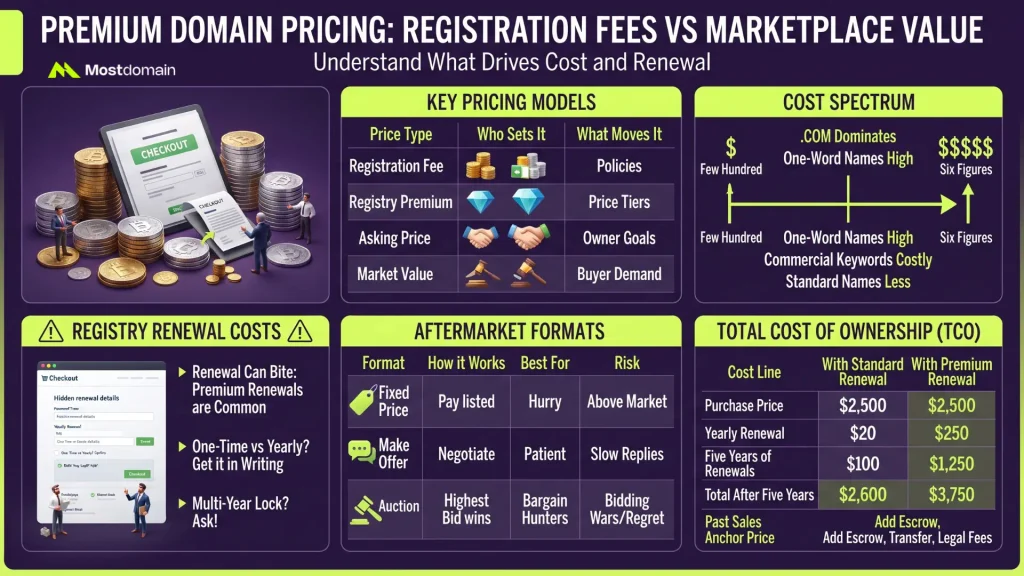
Registration pricing is a fee. Marketplace value is a negotiated price. Mixing them up leads to overpaying.
| Price type | Who sets it | What moves it |
| Registration fee | Registry and registrar | Policy and wholesale cost |
| Registry premium | Registry | The price tier it assigns the name |
| Asking price | Current owner | Their goals, their patience, and what they paid |
| Market value | Buyers and past sales | How hard buyers are chasing it, plus recent comparable sales |
How Much Do Premium Domains Cost?
Some cost a few hundred dollars. Others cost six figures.
- .com names usually cost the most.
- One-word names command top prices.
- Commercial keywords cost more than vague ones.
- Brokers and registries don’t price the same way.
- Standard names cost far less.
Registry Premium Pricing and Renewal Costs
Renewal can bite: some registry premium names renew at the premium rate yearly.
- Checkout pages often bury the renewal line, so hunt for it before paying.
- One-time fee or yearly? Get that in writing.
- Does a multi-year registration lock today’s rate? Worth asking too.
- Surprise bills are avoidable.
Aftermarket Price: Fixed Price, Make Offer, and Auction
Fixed price, make offer, or auction: each format favors a different buyer.
| Format | How it works | Best for | Risk |
| Fixed price | You pay what’s listed | People in a hurry | The price may sit above market value |
| Make offer | You negotiate | Patient buyers | Slow replies |
| Auction | Highest bid wins | Bargain hunters | Bidding wars, and sometimes regret |
Comparable Sales and Total Cost of Ownership
Past sales anchor the price. Add ownership costs and you see the real figure.
- NameBio and DNJournal publish past sale prices.
- Match on extension, length, and category, or the comparison means little.
- Escrow, transfer fees, renewals, and legal checks all belong in the total.
- Automated domain valuation tools give a rough second opinion at best.
Renewals can change the real price. This example uses hypothetical numbers.
| Cost line | With a standard renewal | With a premium renewal |
| Purchase price | $2,500 | $2,500 |
| Yearly renewal | $20 | $250 |
| Five years of renewals | $100 | $1,250 |
| Total after five years, before fees | $2,600 | $3,750 |
Check your own quote. That renewal gap could swallow a discount you fought hard for.
How to Choose a Premium Domain Name for Your Project
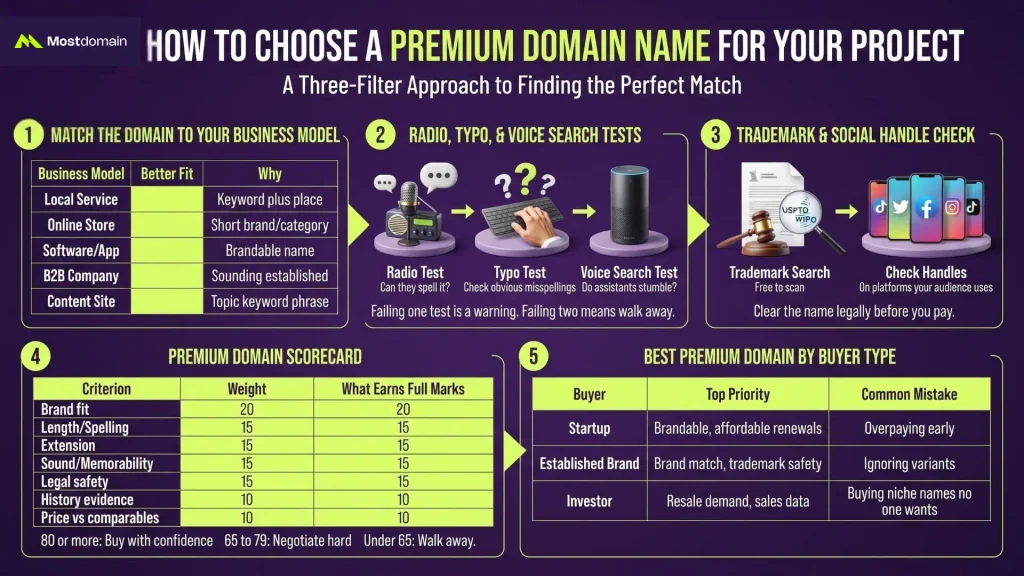
Three filters narrow the field: business fit, practical tests, and legal clearance.
Match the Domain to Your Business Model
Your business model decides between a keyword name and a brand name.
| Business model | Better fit | Why |
| Local service | Keyword plus place | Searchers see the answer instantly. |
| Online store | Short brand or category name | Easy recall, and a tidy checkout URL. |
| Software or app | Brandable name | Survives pivots |
| B2B company | A brand name that sounds established | Buyers vet vendors, so a credible name carries weight. |
| Content site | Topic keyword phrase | Signals focus |
Radio Test, Typo Test, and Voice Search Test
Three cheap tests will catch most naming problems before money changes hands.
- Could a radio listener spell it after hearing it once?
- Type the obvious misspellings into a browser. Someone else may own them.
- Voice assistants stumble on odd spellings, so give one a go.
- Failing one test is a warning. Failing two means walk away.
Trademark and Social Handle Check
Clear the name legally before you pay. Trademark conflicts can cost you the domain.
- USPTO and WIPO records are free to search and quick to scan.
- Check handles on the platforms your audience uses.
- Trademark disputes over domains usually land in the UDRP process.
- On a big purchase, an hour with a trademark attorney costs little by comparison.
Premium Domain Scorecard
Scores keep feelings out of it: rate every candidate out of 100.
| Criterion | Weight | What earns full marks |
| Brand fit | 20 | Matches your offer and audience |
| Length and spelling | 15 | Short, with one obvious spelling |
| Extension | 15 | .com or a respected niche extension |
| Sound and memorability | 15 | Passes radio and recall tests |
| Legal safety | 15 | No trademark conflict |
| History evidence | 10 | Clean history and sound links |
| Price vs comparables | 10 | At or below comparable sales |
- 80 or more: buy with confidence.
- 65 to 79: negotiate hard.
- Under 65: walk away.
Best Premium Domain by Buyer Type
Who’s buying changes how the same name should be judged.
| Buyer | Top priority | Common mistake |
| Startup | A brandable name with affordable renewals | Overpaying early. |
| Established brand | Brand match and trademark safety | Ignoring close variants |
| Investor | Resale demand backed by comparable sales | Buying niche names no one wants. Whether domain investing is profitable depends on skill. Many start with domain flipping. |
Where to Find Premium Domain Names for Sale
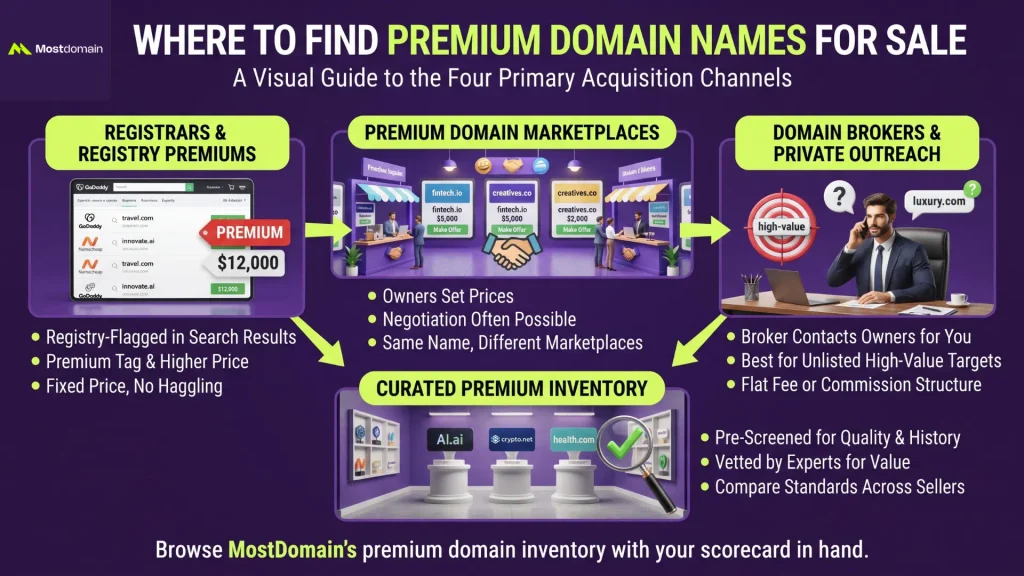
Four channels carry most premium names: registrars, marketplaces, brokers, and curated inventories. This section maps the channels. For a fuller list, read our premium domains for sale guide.
Registrars and Registry Premium Lists
Registrars show registry premiums right inside normal domain search.
- A “premium” tag and a bigger price are the giveaways.
- Checkout works exactly like buying any ordinary domain.
- Haggling rarely works because registry premium prices tend to be fixed.
Premium Domain Marketplaces
On a marketplace, owners set the price and buyers make offers.
- Because owners set prices, negotiation is often possible.
- The same name can appear on several sites at different prices.
- MostDomain runs its own premium domain marketplace too.
Domain Brokers and Private Outreach
A broker contacts owners on your behalf, handy when a name isn’t listed.
- Some brokers bill a flat fee. Others take a commission.
- Mostly worth it for one-word names and other high-value targets.
- Your price ceiling should be fixed before the first email goes out.
- Occasionally the owner’s email is sitting on the website itself.
Curated Premium Domain Inventory
Curated inventory saves time, since someone has already screened the names.
- How does the seller screen history and links? Ask.
- Compare screening standards across sellers.
- Browse MostDomain’s premium domain inventory with your scorecard in hand.
How to Buy a Premium Domain Name Step by Step
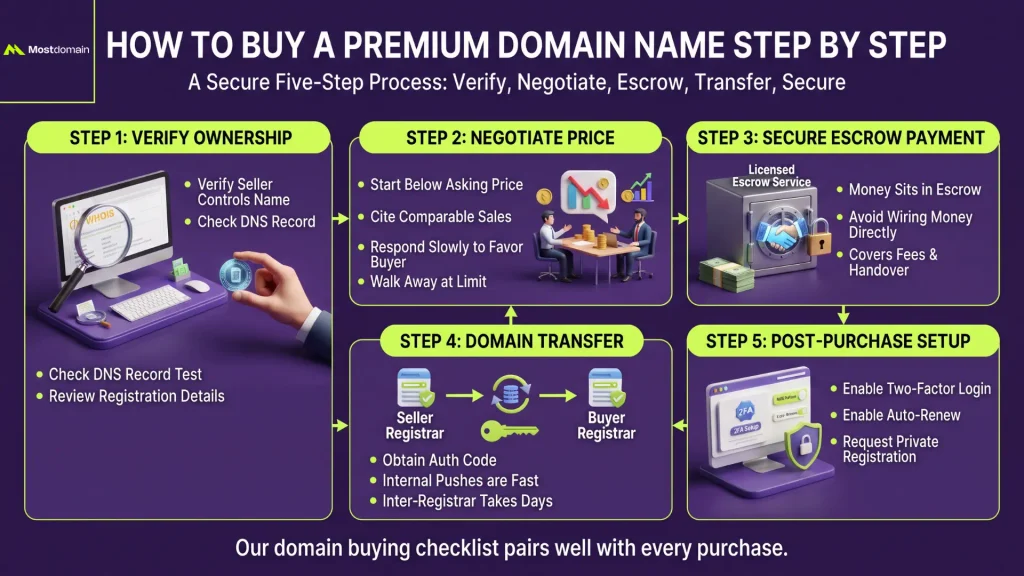
Five steps keep a purchase safe: verify, negotiate, escrow, transfer, secure. Skip none.
Verify Ownership and Negotiate the Price
Before talking price, make sure the seller actually controls the name.
- One common test has the seller add your code to a DNS record.
- Check registration details with a lookup.
- Open below the ask and cite comparable sales.
- Respond slowly. Urgency favors the seller.
- Walk away at your scorecard limit.
Escrow, Payment, and Installment Options
Money should sit with a licensed escrow service until the domain arrives.
- Wiring money straight to a seller is a classic scam setup.
- Fees and handover steps are covered in domain escrow services.
- Installment plans spread cost. Check who holds the name until final payment.
- Short on budget? Consider premium brandable domains for lease.
- Our domain buying checklist pairs well with every purchase.
Domain Transfer and Post-Purchase Setup
Moving the name to your registrar account requires an authorization code.
- Pushes within one registrar can finish in hours.
- Transfers between registrars often take up to five days.
- Some registrars lock a name for a while after registration or ownership changes.
- Switch on two-factor login and auto-renew the day the name arrives.
- Contact details deserve protection too; ask about private registration.
Are Premium Domain Names Worth It?
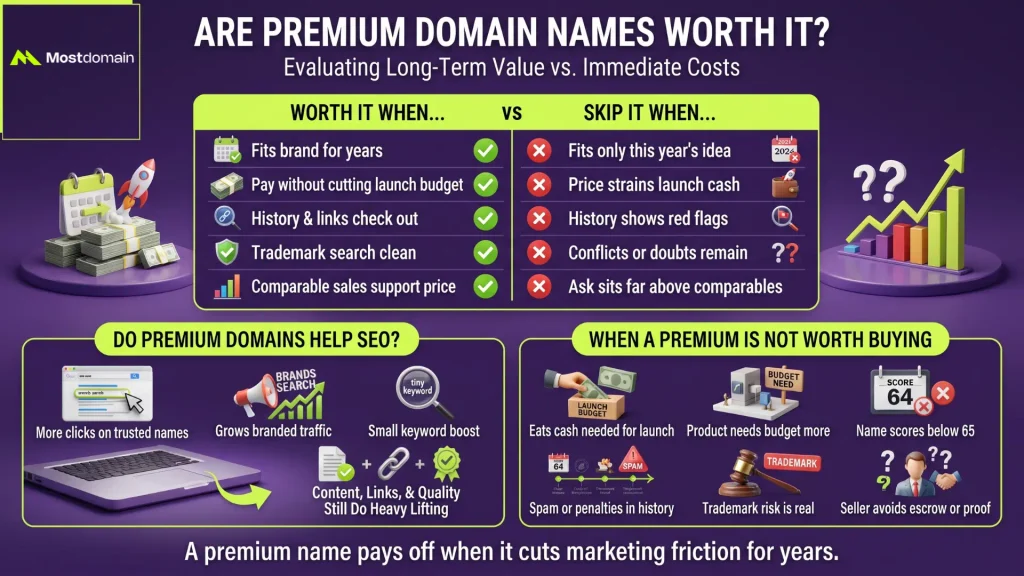
It pays off when the name will cut your marketing friction for years.
| Worth it when | Skip it when |
| The name fits your brand for years | The name fits only this year’s idea |
| You can pay without cutting launch budget | The price strains launch cash |
| History and links check out | History shows red flags |
| Trademark search comes back clean | Conflicts or doubts remain |
| Comparable sales support the price | The ask sits far above comparables |
Do Premium Domains Help SEO?
Not directly, but a premium name can help indirectly.
- Short, trusted names often earn more clicks.
- People who remember a name search for it, which grows branded traffic.
- A keyword in the domain matters, but only a little.
- Content, links, and overall site quality still do the heavy lifting.
When a Premium Domain Is Not Worth Buying
Skip it when the price eats cash you need for launch.
- Product or content needs that budget more.
- The name scores below 65.
- Spam or penalties show up in its history.
- Trademark risk looks real.
- The seller dodges escrow or can’t prove ownership.
Key Takeaways
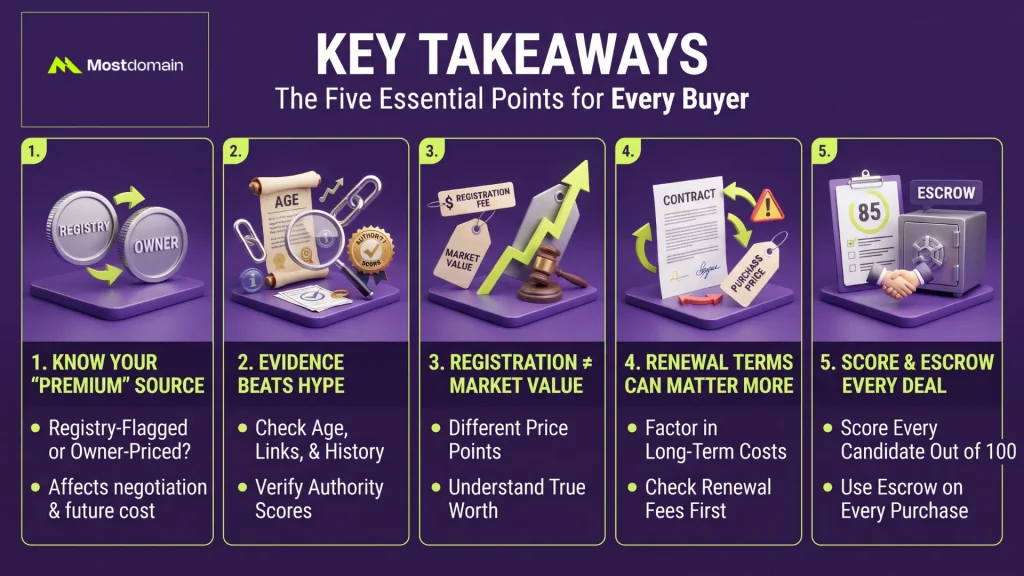
If you remember five things, make them these.
- “Premium” can mean registry-flagged or owner-priced. Know which one you’re facing.
- Evidence beats hype: age, links, history, and authority scores.
- A registration fee and a market value are two different numbers.
- Renewal terms can matter more than the purchase price.
- Score every candidate. Use escrow on every deal.
FAQ
How much does a premium domain name cost?
Anywhere from a few hundred dollars to six figures. Extension, length, and demand set the range. Always read the live quote and the renewal fee.
Are premium domains worth buying for a new business?
Yes, if the name will carry your brand for years. Not if the price drains your launch budget.
Can you negotiate a premium domain price?
Often, on aftermarket listings. Registry premiums are usually fixed. Cite comparable sales, and stay ready to walk away.
Do premium domains renew at the same price?
Not always. A registry premium may renew at the premium rate. Aftermarket names usually renew at the standard rate after transfer.
Does a premium domain improve rankings?
On its own, no. Google doesn’t rank sites by what the domain cost. Content, links, and trust still decide.
What is the safest way to buy a premium domain?
Verify ownership first. Check history and trademarks. Then pay through a licensed escrow service.
How long does a premium domain transfer take?
Within one registrar, hours. Between registrars, often up to five days. Locks can add delay.
References
- GoDaddy, What Are Premium Domain Names and Are They Worth It?
- Hostinger, What Is a Premium Domain Name?
- Verpex, What Are Premium Domains?
- Themeisle, Premium Domain Names for Sale
- WPBeginner, 7+ Best Places to Find Premium Domain Name for Sale (+ Expert Tips)
- GeekChamp, 7+ Best Places to Find Premium Domain Name for Sale
- Name Experts, Premium Domain for Sale