
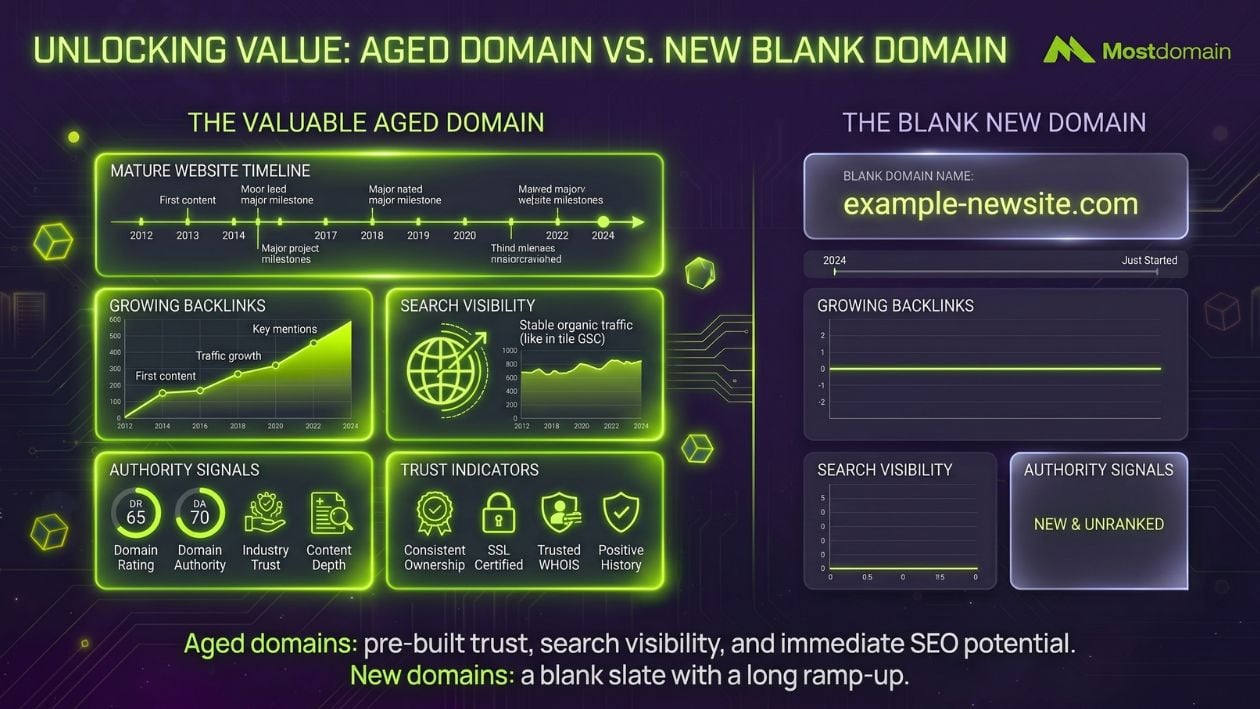
Compare two web addresses side-by-side and the valuation gulf becomes glaring. One fetches spare change; the other demands a small fortune. The discrepancy ignores the linguistic branding. Understanding What Is an Aged Domain explains this massive price hike. Simply stated, these are digital assets with multi-year histories and documented online activity. They possess verifiable registration records, active traffic history, and established backlink profiles. You pay for the proven authority accumulated over years of indexing. This primer serves as the bedrock for our comprehensive manual, providing a direct, no-nonsense definition before we break down the tactical execution.
What Makes a Domain “Aged”
An aged domain is a domain registered years ago that has maintained a continuous active history, accumulating backlinks, indexation, and trust.
That definition has two moving parts, and they do not carry equal weight. Pulling them apart is the fastest way to see why two domains born in the same year can be worlds apart in value. Here is what actually goes into the label:
Registration age
how long ago the domain was first registered. This is the part most people fixate on, but on its own it proves very little.
Continuous active history
the ingredient that does the heavy lifting. Inbound links, indexed pages, and the signals of a site that behaved like a legitimate business rather than a placeholder. A domain registered in 2009 but parked on a blank page for fifteen years has age on paper and almost nothing else; one registered the same year that hosted a real, indexed website earning links the whole time is a different animal entirely.
What search engines actually reward
the history, not the birthdate. Google’s John Mueller has been blunt about it, saying flatly that domain age on its own. The registration date is necessary but not sufficient.

The simplest way to picture it
an established business versus an empty storefront. Both might hold a lease dated a decade ago, but only one has customers walking in, a reputation in the neighborhood, and suppliers who vouch for it. Age is the lease; active history is the reputation.
So when someone calls a domain “aged” in any meaningful SEO sense, they mean the second thing. The domains worth talking about are the ones where the years were actually used.
How Aged Domains Come to Exist
Domains accumulate longevity through two distinct paths, appearing vastly different to the casual observer. One relies on grueling persistence over decades, while the other stems from strategic procurement. Regardless of the origin, the result remains identical: a digital asset fortified with a verifiable track record.




What Is an Aged Domain if not an engine for authority? Consider these two specific trajectories:
Simple longevity (held in place)
Understand What Is an Aged Domain through the lens of pure persistence. A registrant secures a web address, constructs a digital asset, and refuses to let the registration lapse. Think of a persistent blog, a corporate portal active since the dawn of the 2010s, or some forgotten initiative that pushed out content without pause. No acquisitions occurred here. The asset matured through unbroken stewardship, steadily fortifying its historical profile throughout that entire duration.
Dropped and re-registered (history intact)
Market participants frequently pursue this path. A domain possessing a storied background hits the open market once a prior registrant fails to pay renewal fees. Subsequently, a fresh buyer claims the asset. Search engines typically preserve the existing backlink profile, while historical trust markers and indexed status often migrate to the new owner. You bypass the grueling “sandbox” phase entirely, hijacking pre-existing authority instead of starting from scratch.
Understanding What Is an Aged Domain becomes difficult here, as people often conflate it with generic expired domains. They differ fundamentally. A domain might lapse into expiration without possessing a shred of utility. Conversely, an aged domain implies a legacy worth acquiring. We dissected the precise variances between these two categories in our comprehensive guide on aged vs expired domain; a simple summary fails to capture the technical nuance.
What Is NOT an Aged Domain
Clearing up what the term excludes is half the definition, because most overpaying and bad buys trace back to one of a few mislabels. Three things in particular get called “aged” when they have not earned it. Here is what each one actually is, and why it falls short:
| Often mistaken for “aged” | Why it does not qualify |
| An old registration date, on its own | The single most common misunderstanding. A 2008 registration on a domain that never hosted a functioning site means nothing that matters: no history, no inheritance. |
| An expired or premium domain | An expired domain merely lapsed; whether it counts as aged depends entirely on the history it carries. A premium domain is priced for its name, brandability, or keyword, a separate axis altogether. A short, memorable name can sell for a fortune while carrying no SEO history at all. |
| A particular extension or type | “Aged” is not reserved for .com addresses or certain categories. A .org, a country-code domain, or a niche extension can all be aged if they carry the registration history and active track record. The label describes the history, not the format. Our guide to types of domains lays out the full landscape. |
The thread running through all three is the same. “Aged” describes a domain’s lived history, not its birthdate, its sale price, or its file extension.
Why People Care About Aged Domains, Briefly
Here is the part everyone is really circling: the practical reason aged domains attract buyers at all. The short answer is that you inherit something rather than build it from scratch. Before the list, one boundary worth setting: this section names the appeal, it does not unpack the mechanics behind it. Here is what the draw actually comes down to:
You inherit existing assets
The backlinks the domain earned, the recognition it built with search engines, and a baseline of trust and authority that a brand-new registration simply does not have on day one.
A head start a fresh domain cannot fake
A new domain begins as an unknown and has to earn every signal from zero, while an aged domain with clean history arrives with a reputation already attached. There is real SEO value in that head start, which is why the most prized, highest-priced names in the market tend to be aged ones rather than freshly minted. Our roundup of the most valuable domain names shows what that looks like at the top end.
Scope, set deliberately
We are naming the value, not explaining the machinery. Why aged domains can rank and perform better, and the conditions where that advantage holds or evaporates, is a topic in its own right and lives elsewhere in this guide. The same goes for topical authority, a concept you will hear constantly here that deserves a proper definition rather than a passing mention, which is why we cover what is topical authority separately.
The value is conditional, not a guarantee
A domain’s history can be clean or contaminated, relevant to your niche or wildly off-topic. The head start is real, but whether it pays off depends on what you are inheriting, and evaluating that is a skill of its own.
For now the takeaway is narrow and clear. People care about aged domains because trust and authority can be inherited rather than built from nothing.
FAQ
How old does a domain need to be to count as aged?
Forget arbitrary numbers. If someone claims a specific year threshold defines maturity, they lack experience. Industry veterans generally apply the label once a registration spans several years. Regardless, temporal duration ranks lower than operational history. Three years of consistent, indexed content creation dwarfs a decade of empty, parked stagnation. Perceive age strictly as a preliminary screening tool rather than an absolute indicator of authority. When investigating What Is an Aged Domain, prioritize performance data over birth dates.
Is an aged domain the same as an expired domain?
These concepts frequently intersect, yet they represent entirely different mechanisms. Expiration signifies an administrative failure where the registrant abandoned the property. Conversely, the term aged denotes a deep repository of historical data and backlink equity. An expired URL might be digital trash; an aged asset inherently possesses a track record. Countless domains sit idle after expiration while others retain value across multiple ownership cycles. Distinguish between these states clearly before committing your capital to any acquisition.
Does the registration date alone make a domain aged?
On its own, no. The date is just one input. What turns age into something useful is the active history layered on top: links earned, pages indexed, trust signals built up through real use. Google has been clear that raw age contributes little by itself. A domain that aged while parked on a blank page has the birthdate without the substance.
Can a brand-new registration ever be considered aged?
No, by definition. A freshly registered domain has no history to inherit, no matter how good the name is. It might be premium, brandable, or expensive, but it starts its SEO life at zero. Those are different qualities, and conflating “valuable name” with “aged” leads people to overpay for the wrong thing.
What makes one aged domain more useful than another?
Scrutinize the backlink profile. Performance hinges on the pedigree of those historical connections. Two web addresses might share an identical birth year, yet their market worth diverges violently based on their previous operational footprints. Discerning What Is an Aged Domain requires looking past the registration date.
Putting the Definition to Work
Forget the technical gibberish. What Is an Aged Domain? It represents a digital asset defined by its verified performance record rather than just its age on a registrar’s ledger. Mere years sitting idle mean nothing. Real authority demands consistent, authentic engagement over time. That specific metric dictates the gap between a high-value powerhouse and a stagnant, worthless address masquerading as a premium asset.
Rigorous vetting forms your primary defense against wasted capital. Never gamble on unverified history. At MostDomain, our team scrutinizes every listing to ensure the backlink profile and operational history remain intact. We eliminate the guesswork. You select the perfect match for your specific venture without wasting energy verifying if the asset actually holds the weight it claims.
References
- Google Search Central, Creating Helpful, Reliable, People-First Content
- Search Engine Journal, Google Answers If Domain Age Impacts Rankings
- Backlinko, Google’s 200 Ranking Factors: The Complete List
- Moz, The Beginner’s Guide to Link Building
- DomCop, Expired Domain vs Aged Domain