Novices frequently conflate these concepts. They are wrong. Distinguishing between an aged vs expired domain dictates your entire SEO trajectory.
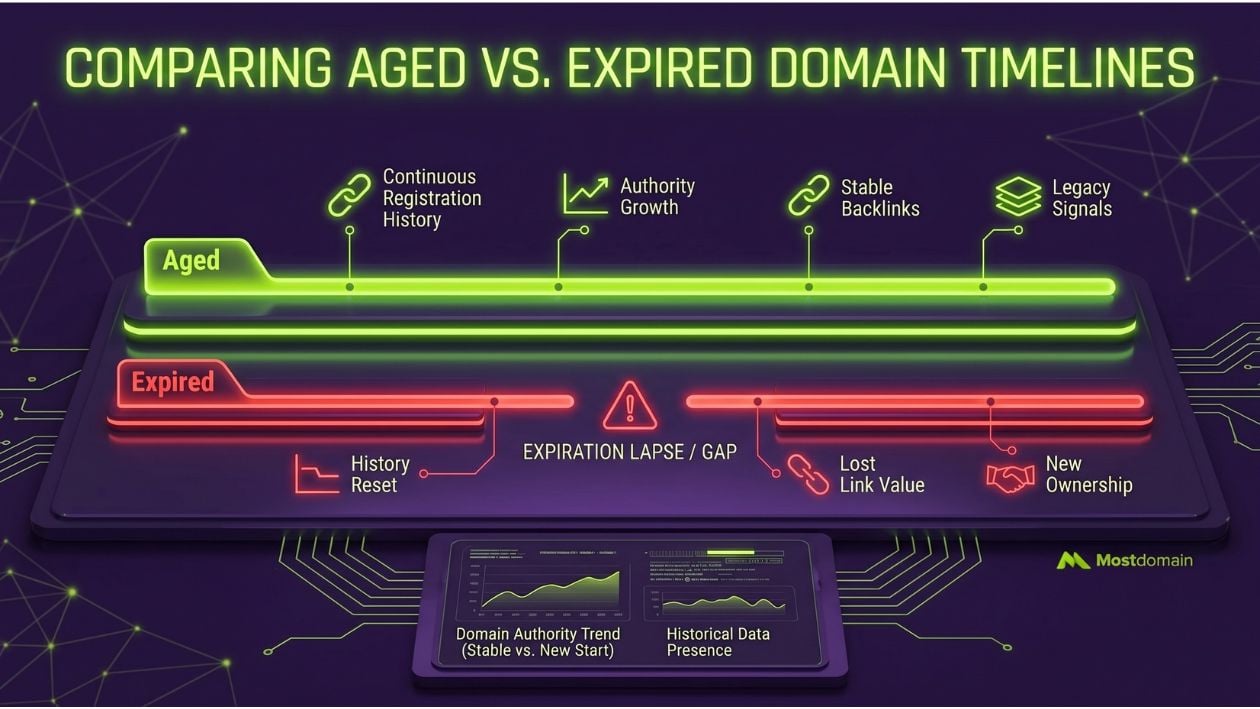
Registration continuity determines the actual value of a web address. An aged domain maintains a steady, unbroken link to its initial creation date, whereas an expired domain signifies a lapse in ownership where the previous entity relinquished control.
Stop guessing. Mastering this distinction prevents expensive mistakes during your next asset procurement. Four specific industry terms plague the community with ambiguity; we strip away the nonsense to reveal exactly which technical status carries weight for your growth.
Why These Four Terms Create So Much Confusion
The domain industry uses these four terms loosely and often interchangeably, which creates real consequences for buyers who take the labels at face value. Here is where the inconsistency shows up most:
- Marketplaces apply “aged” without checking registration continuity. A domain registered in 2012 that dropped and was re-registered in 2019 gets listed as “aged” simply because of its original creation date.
- “Expired premium” is treated as a single category. Some platforms bundle the two qualities as if a domain being expired and being premium are the same dimension. They are not; one describes history, the other describes value.
- Research tools report age from the first registration date, not from the last continuous registration. This makes a dropped-and-reregistered domain appear older than it functionally is for SEO purposes.
- First-time buyers inherit the confusion. Mismatched expectations lead to overpaying for domains with hidden risk or dismissing genuinely clean expired domains because they assumed “expired” always means penalized.
Getting the definitions right before you buy is not optional. It is the first filter.
What Is an Aged Domain
An aged domain functions as a digital asset possessing an unbroken lineage of registration and active deployment. It remains untouched by periods of dormancy. Distinguishing these assets from typical web addresses involves three rigid pillars:

Continuous Registration Tenure.
This domain avoided the lapse of expiration. It bypassed the chaotic cycles of public auctions or deletions. Google observes a seamless timeline of ownership updates, confirming that the entity never vanished from the registry.
Organic Trust Accumulation.
Search crawlers favor stability. These domains display persistent indexation, a history of natural incoming links, and predictable crawl behavior. Imagine a physical storefront that operated for two decades without ever locking its doors. When debating the nuance of aged vs expired domain metrics, remember that consistent longevity signals authority to algorithms.
Scarcity-Driven Valuation.
A clean, continuous record stretching back 8 to 20 years commands significant capital. Depending on the strength of its backlink graph and the specific industry, these assets often trade for thousands of dollars. Professional brokers or exclusive secondary marketplaces facilitate these high-stakes transactions.




What Is an Expired Domain and an Expiring Domain
Distinguishing these two assets dictates your success in the aftermarket. They occupy distinct phases within a web address’s lifespan. Grasping the nuances of aged vs expired domain mechanics prevents costly acquisition mistakes.
Expired domain
Definition
The registrant abandoned the asset. It cleared a 30 to 45-day grace period. Now, it drifts within the public drop pool.
Residual Value
Don’t dismiss these immediately. Robust backlink portfolios and historical search traffic often endure long after the contract lapses. A registration hiatus induces ambiguity, yet it rarely obliterates established site authority.
The Hidden Trap
Abandonment frequently masks a sinister reality. Many owners drop sites to evade Google manual actions or algorithmic penalties. These sanctions haunt the domain record, remaining invisible to standard SEO software. Rigorous investigation is mandatory before you commit.
Expiring domain
Definition
The site currently functions, yet the expiration deadline looms. It occupies the narrow sliver of time between active registration and the moment it officially lapses.
Strategic Timing
Speed wins here. Strike while the domain remains active. Utilize backorder platforms or pre-drop bidding wars to secure ownership before it hits the public marketplace.
Preserving Authority
Acquiring an asset before it hits the drop ensures a near-seamless transition for its link equity. Since the registration remains continuous, you bypass the volatility of a true lapse. Regardless, recognize that this does not match the pedigree of a pristine, non-interrupted aged domain.
What Is a Premium Domain
Unlike the previous three terms, “premium domain” describes perceived value rather than registration history. It is a label applied by sellers and marketplaces, which makes it the most misunderstood of the four. Here is what actually sits behind it:
It describes value, not history
A domain earns the premium label through a combination of factors: strong keywords, memorability, a clean backlink profile, and strong market demand. None of those factors require the domain to have an unbroken registration record.
It can apply to both aged and expired domains
A premium domain can be one that has never lapsed. It can equally be a high-quality expired domain whose metrics survived the drop intact. The label “premium expired domain” is not a contradiction.
“Premium” is a seller’s claim, not a verified standard
There is no industry body that certifies a domain as premium. Two domains with very different risk profiles can both carry the label. Verification is always the buyer’s responsibility.
Comparison
| Term | Registration Status | Ownership Gap | SEO Risk | Typical Price |
| Aged domain | Continuously active | None | Low | High |
| Expired domain | Previously lapsed/dropped | Yes | Medium to High | Variable |
| Expiring domain | Nearing expiration | Not yet | Depends on acquisition timing | Depends on timing |
| Premium domain | Either of the above | May or may not exist | Depends on history | High |
Worth noting: these four terms are not mutually exclusive categories. A domain can be both aged and premium. An expired domain can be marketed as premium. The table above provides a thinking framework, not a rigid taxonomy.
FAQ
Can an expired domain and an aged domain ever be the same thing?
They remain distinct entities. A domain demands a continuous, uninterrupted registration timeline to earn the aged title. Once that registration lapses, the status vanishes instantly, regardless of the site’s previous tenure. Marketing platforms frequently conflate these labels, yet anyone analyzing aged vs expired domain risks must recognize that their underlying authority profiles diverge sharply.
How long does a domain need to be registered to count as “aged”?
Rigid industry standards do not exist. Professionals typically demand at least three to five years of continuous activity. Truly elite assets, however, boast eight to twenty years of pristine history paired with high-caliber backlinks. Forget obsession with mere age. Real power stems from a stable, consistent history and the caliber of sites linking back to you.
Is expiring domain better than an expired domain for SEO?
Targeting a domain nearing its registration cutoff frequently outperforms the alternative. Secure the asset prior to the registration lapse to bypass the destructive vacuum of abandoned ownership. You maintain continuity. This strategy prevents the catastrophic loss of indexing data and backlink authority that plagues assets released into the wild.
Why is “premium domain” not a technical category?
“Premium” acts as a marketing adjective, not a measurable historical metric. Vendors slap this label on anything they hope to sell at a markup. Ignore these superficial sales tags. Instead, perform an audit based on cold, hard data: registration continuity, Domain Rating, and the specific composition of the backlink profile.
Does Google actually treat aged domains and expired domains differently?
Google keeps its ranking algorithms secret. Still, field observations prove that domains maintaining constant ownership retain trust signals far better than those subjected to registration drops. An ownership gap triggers algorithmic uncertainty regarding the site’s continuity. That silence in the records inevitably strips away layers of previously accumulated authority.
Which One Do You Actually Want for SEO
Specific buyer profiles, financial constraints, and appetite for risk dictate your domain selection. Neglect these variables, and you waste capital. The following breakdown categorizes every label by its optimal application while highlighting the primary factor defining whether a specific aged vs expired domain warrants your investment.
| Domain Type | Best For | Key Condition | Watch Out For |
| Aged domain | Competitive niches, long-term SEO projects | Uninterrupted registration history with clean backlinks | Overpriced domains with strong age but weak or irrelevant link profiles |
| Expired domain | Budget-conscious buyers willing to vet thoroughly | Clean backlink profile, consistent niche, no penalty signals | Hidden Google penalties not visible in any backlink tool |
| Expiring domain | Buyers who can move fast on a known target | Acquisition before the domain officially drops | Losing the auction or backorder race; no guarantee the owner won’t renew |
| Premium domain | Any of the above, if metrics are verified | Independently verified DR, backlink quality, and registration history | Paying a premium price for a label with no standardized definition |
Choosing between these four domain types connects directly to how you approach sourcing and evaluation, both of which are covered in dedicated sections of this aged domain guide.
References
- Moz. Domain Authority
- Domcop. Expired Domain vs Aged Domain
- WebAcquisition. Beginner’s Guide to Aged Domains
- StreamSEO. Expired vs Aged Domains
- AiMetros. Aged Domain vs Expired Domain 2026