
Starting a brand-new website often means waiting months for Google to take you seriously. Aged domains offer a shortcut: instead of building trust from zero, you inherit a domain that already has years of history, backlinks, and credibility behind it. Think of it as moving into a building with foot traffic already on the street, rather than opening on an empty road and hoping people show up.
This guide is your foundation. You will get a clear definition, the real reasons these domains hold an SEO edge, who actually benefits from owning one, and a high-level map of how to find, evaluate, and deploy them. Each topic links out to a deeper hub when you are ready to go further.
What is aged domains?
An aged domain is a domain name that has been registered and continuously active for several years, accumulating real history, backlinks, and search-engine trust over that time. That single sentence holds the whole idea, but one word inside it does the heavy lifting: active.
Picture two shops on the same street. One has been open for a decade, with regular customers, a known name, and a reputation. The other is an empty unit with a freshly painted sign. Same square footage, completely different starting position. An aged domain is the established business; a brand-new domain is the empty storefront.
Here is the problem that most people miss. Age is not just about a registration date sitting in a database. A domain registered ten years ago that sat parked and empty the whole time carries far less weight than a five-year-old domain that hosted a real, indexed website with genuine links. Continuous, meaningful activity is what builds the equity you are actually paying for. If you want the precise line between an aged domain and lookalike categories, the difference between aged domains vs expired domains is worth understanding before you buy.
Why aged domains are an SEO advantage
The appeal comes down to inherited trust, and it shows up in a few concrete ways. None of these are magic, but together they explain why experienced operators keep coming back to aged inventory.
Pre-built backlinks.
A domain with real history usually arrives with an existing backlink profile. Those links took years and effort to earn, and you are stepping into them on day one instead of starting a link-building campaign from scratch.

Skipping the slow start.
New sites typically endure a long stretch of low visibility while Google gathers signals. An established domain with accumulated trust tends to bypass much of that early limbo.
Faster indexing and trust.
Search engines already recognize the domain, so fresh content published on it often gets crawled and ranked noticeably quicker than the same content on an unknown name.
A SERP edge.
The data backs this up. According to Ahrefs, 72.9% of pages in Google’s top 10 are more than three years old, and the average page sitting at position one is around five years old. Only a tiny fraction of newly published pages crack the top 10 within their first year. Older properties dominate, plain and simple.




A fair caveat
Age itself is not a confirmed ranking factor. Google’s John Mueller has long maintained that domain age has little to no direct effect. The advantage is indirect, flowing from the trust and links that accumulate over time. For the full mechanism behind this, see the aged domain SEO value.
Who actually needs an aged domain?
Aged domains are not for everyone, but a few groups lean on them heavily, and for good reason.
SEO professionals
Use them to accelerate client results, launch niche sites that rank sooner, or build out a network of trusted properties. Waiting a year for traction is a hard sell to a client, and an aged domain compresses that timeline.
Affiliate marketers
care about speed to revenue. Every month a money site spends invisible is lost commission, so starting from an established base is a calculated head start.
Agencies
Agencies managing many clients value predictability. An aged domain reduces the uncertainty of a cold launch and gives teams a stronger footing to deliver on tight timelines.
Founders and businesses
Founder and businesses sometimes acquire an aged domain to anchor a new brand, secure a memorable name, or absorb the authority of a relevant defunct site. If you are weighing whether it fits your situation, the who needs aged domains hub breaks down each profile in detail.
How to find and buy an aged domain
At a high level, aged domains come through three main channels, each with its own trade-offs.
Curated marketplaces
Marketplaces are the simplest entry point. These platforms hand-pick and pre-vet inventory, so you browse domains that have already cleared a quality bar. Mostdomain operates in exactly this space, offering a curated selection of premium aged domains for buyers who would rather start from a clean shortlist than dig through raw listings.
Auctions
Auctions are where expiring and expired domains get bid on, often at platforms tied to registrars. Prices can be excellent, but competition and the need to act fast make this the more advanced route.
Expired drops
Drops involve catching domains the moment their registration lapses and they become available again. It is the cheapest channel in theory, and the most labor-intensive in practice.
Each channel rewards a different level of experience and patience. For a full walkthrough of platforms, bidding, and the buying process, head to how to find aged domains.
How to evaluate one before you buy
Not every old domain is a good domain. A history can be valuable or it can be a liability, so a quick quality screen matters before money changes hands. At minimum, run an aged domain past this checklist:
- Domain age and activity: real, continuous use rather than years parked.
- Backlink quality: authoritative, relevant links instead of spam.
- Content history: what the site actually published, and in what niche.
- Penalty and red flags: any sign of past manipulation or bans.
- Price sanity: does the asking price match the genuine value on offer?
These are headlines, not the full method. Each one has tools, thresholds, and judgment calls behind it, which is exactly what the how to vet an aged domain hub covers step by step.
How to put it to work
Once you own an aged domain, two big decisions shape what you do with it.
The first is strategic
aged versus new. Does this project genuinely benefit from inherited trust, or would a fresh domain serve the brand better long term? Speed is the usual reason to choose aged, but it is not automatic.
The second is structural
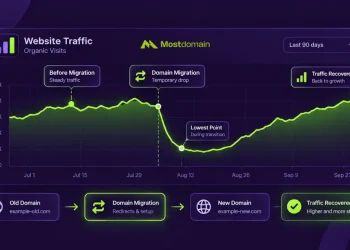
Many buyers use an aged domain as a standalone site, while others fold its authority into an existing project through a redirect or migration. Both paths can work, and both can go wrong if handled carelessly.
These are framing questions only. The decision logic, the migration mechanics, and the timing all live in the when to use an aged domain hub.
Real-world case study
Consider a realistic, illustrative scenario from the affiliate world. An operator acquires an aged domain in the home-improvement niche for around $1,200. The domain is roughly eight years old, hosted a genuine review site in its earlier life, and carries a modest but clean backlink profile from relevant industry blogs.
Rather than rebuilding from scratch, the operator publishes a small cluster of well-researched buyer guides aligned with the domain’s original topic. Within the first 30 days, several of those pages begin appearing on page two and three for mid-competition keywords, far sooner than a brand-new domain would typically surface. Early indexing is fast because Google already trusts the property.
By the six-month mark, with steady content additions and a handful of new links, a few of those guides reach the top five for their target terms. The site starts generating consistent affiliate commissions, and the operator estimates the domain paid back its purchase price within the first quarter of meaningful traffic.
What made it work was not the age alone. It was the match between the domain’s existing history and the new content built on top of it, plus realistic keyword targeting. A spammy or off-topic domain at the same price could easily have underperformed a fresh registration.
One honest disclaimer: results vary widely. This scenario is illustrative, not a promise. Outcomes depend on the specific domain, the niche, the quality of execution, and a fair amount of factors outside anyone’s control.
FAQ
How old does a domain need to be to count as “aged”?
There is no official cutoff, but most practitioners consider a domain aged once it has several years of continuous, real activity behind it. Many treat the three-year mark as a practical floor, since that is roughly where accumulated trust starts to show up in the data. What matters more than the raw number is whether those years involved a genuine, indexed site rather than a parked page.
Are aged domains safe and legal to buy?
Buying and using aged domains is completely legal; it is simply acquiring an asset that already exists. The safety question is about the individual domain’s history, not the practice itself. A domain with a clean past is low-risk, while one with spam or penalties can drag down a new project, which is why evaluation matters before purchase.
How fast will I see results with an aged domain?
Faster than a brand-new domain, in most cases, though it is not instant. Established trust tends to speed up indexing and early ranking, but content quality, competition, and link profile still drive the timeline. Anyone promising guaranteed overnight rankings is overselling.
Does Google penalize using aged domains?
No, not for the simple act of using one. Google penalizes manipulative behavior, such as abusing a domain’s authority with low-quality or deceptive tactics. A clean aged domain used to publish genuinely useful content carries no inherent penalty risk.
What is the difference between an aged domain and an expired one?
They overlap but are not identical, and the distinction affects how you source and price them. The short version is that “aged” describes the history, while “expired” describes the registration status. The Fundamentals hub linked earlier breaks down the full comparison.
Is buying an aged domain worth the cost?
For the right project, often yes, because the time saved can outweigh the upfront price. For others, a new domain is the smarter call. The detailed cost-versus-benefit math lives in the Aged Domain Investing.
Is an aged domain worth it?
For anyone who values time, an aged domain is frequently worth serious consideration. You are paying to skip the slow, uncertain early months and to inherit trust that would otherwise take years to build. The catch is that the value is only as good as the domain’s history, so quality and careful selection decide whether the investment pays off.
If a curated, pre-vetted starting point sounds like the right fit, browse the Mostdomain inventory to see what clean, aged domains are available right now. Start there, evaluate carefully, and let the existing trust do part of the work for you.
References
- Ahrefs: How Long Does It Take to Rank in Google? And How Old Are Top Ranking Pages? (2025 study)
- Google Search Central / John Mueller statements on domain age and rankings