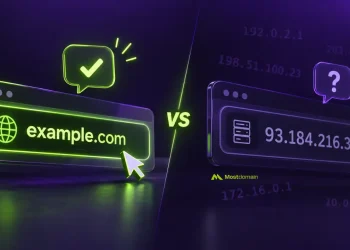

For anyone wanting to understand how influence impacts search algorithms, understanding what domain authority is is the place to start. You can spend countless hours creating content only to watch those efforts go to waste as you see no organic growth. Domain owners get fixated on keyword density. It is, however, more important to understand your primary filter, which determines the order your domain is found in search queries, respectively.
Many domain owners implement and approach SEO as a system of step-by-step tasks. This is the primary reason why optimized pages appear on the third search results page. The systems evaluate reputation. That leaves search engines prioritizing and using authority as the most significant gate. Understanding how authority is structured within your domain means you can make a more accurate assessment of your growth goals.
You can now stop guessing your domain score. Understand how these scores are derived and ranked to discover how to engage third parties and the search engines in ways that reward you with compounding returns. Think outside your SEO black box and begin auditing your competitors carefully.
Pinpointing Domain Authority
Disregarding forum hearsay and assessing search analytics intent are key steps to arrive at a fair judgment on this metric. Domain Authority (DA) is a predictive simulation from Moz, which will let you know how probable it is for your pages to show up in search results. It is crucial to understand that DA reflects a third-party benchmark, and is in no way a Google traffic signal. Therefore, the DA score must be taken at face value. The score will give you an adequate comparison of your website’s backlink profile in the global context.
Benchmarking Authority Software
To solve the same problem, software companies develop different models. For measuring Domain Authority, Moz uses its own evaluation while Ahrefs comes up with its Domain Rating (DR), and Semrush uses its Authority Score. Each company uses its own crawling technology and proprietary weighted mathematics to build their own interpretation of a link graph. Moz’s focus is link equity, Ahrefs concerns itself with the number of unique referring domains, and Semrush incorporates traffic data. Given the differences of the tools, it is expected to see discrepancies because their raw datasets never align.
The following tiers categorize your competitive standing:

| DA Score Range | Classification | Strategic Context |
| 1–20 | Nascent Authority | Typical for fresh domains or local entities lacking active link-building campaigns. |
| 21–40 | Emerging Authority | Signifies a growing organic footprint with a modest collection of earned backlinks. |
| 41–60 | Solid Authority | Competitive territory; capable of ranking for mid-tier industry keywords. |
| 61–80 | Established Authority | Reserved for industry heavyweights, media outlets, and major e-commerce players. |
| 81–100 | Pinnacle Authority | Global titans like Wikipedia and government portals dominate this elite bracket. |
Navigating these metrics often triggers confusion regarding their relationship to historical algorithms. Is domain authority equivalent to Google PageRank? Absolutely not. PageRank remains a foundational, proprietary signal for measuring link importance. Domain Authority is merely an external estimation of how search engines value sites. It reflects the outcome, not the mechanism.
The Reasoning Behind the Calculation
Moz calculates its DA scores by utilizing machine learning to analyze how domains perform in search engine results. To do this, Moz scrapes its Link Explorer index. The Link Explorer index is balanced among the total number of backlinks, the total number of unique root domains, and the quality of those referring domains.
Understanding Logarithmic Scaling
When a domain’s score is calculated, growth is expected to follow a logarithmic curve. In this case, movement from a score of 10 to a score of 20 is very small. However, a movement from a score of 70 to 80 is a significant jump and requires a disproportionately large amount of link equity. This model is similar to how authority is distributed on the internet.




A score can drop even with no changes made to your domain. The reason is that everything is relative. If a significant number of links suddenly point to Facebook, the entire internet shifts. Your DA score is a moving number based on the entire internet’s performance.
Why Authority Matters (Even Without Direct Connection to Google)
The Moz DA ranking has significance because Google employees say they don’t rely on it when ranking, and a high Moz DA review demonstrates thorough, successful Search Engine Optimization (SEO) for sites. Backlinking is a critical pillar in the ranking system and helps websites bring value.
Auditing Your Competition
Authority metrics allow conflict avoidance. If your targeted keyword’s search engine results page has DA 70+ scores, your new blog will likely not succeed in ranking. On the other hand, high-search volume terms that target keywords with low DA scores represent opportunities.
Do higher DA scores equate to ranking at the top? Not necessarily. A DA 30 site can outperform a DA 50 site when a DA 30 site has an extensive topic depth, a better user experience, and superior page optimization. Authority can show the direction, but it doesn’t guarantee the win.
Factors that Determine Administration Score
Authority Scores evaluate the usefulness of a website for potential clients. Manipulative techniques such as concern based marketing or creating ad-link farms will not work. Meta-gaming manipulation does not lead to improvement. Use machine learning to analyze back-link structures and organic success metrics. Use the following structural pillars to create links:
Backlink Quality
A link from a major company or trusted source has far more value than links from a business directory.
Unique Referring Domains
Provide links from 100 different sources rather than from the same source repeatedly.
Internal Architecture
Tie together your high-valued pages and content to connect the value throughout your site.
Toxic Profiles
Link farms, purchased links, and SEO injections will ruin the integrity of your link.
Content Scope
Using research to publish articles online can attract links to your website.
Technical Foundations
Short loading pages and a well-structured mobile web can help crawlers index your pages.
So how many links do you need? When it comes to links the most important factor is the quality of the link rather than quantity. You will be far better off with only one link from a major publication than a large number of links from an automated source.
Walking Towards Greater Authority
There are no shortcuts to earning your place among white-hat link acquisition and technique masters. Sustainable brand growth comes from building your digital reputation over a long period.
Establishing Linkable Assets
It is time to stop producing generic, unoriginal, and quick content. Instead, make the time-intensive and costly commitment to your own original, proprietary content. In doing so, your content will become the source of value that others will cite.
Fixing Technical Debt
Take the time to perform regular audits on your profile. Clear your outdated disavow list and remove unearned links. Your link equity will only strengthen your architecture if site construction is clean and prevents broken redirects and 404s.
What is a realistic time estimate to see the value of your backlog decrease? Expect to wait several months to over a year as third-party indexes reward your patience. Think of it as an investment in your brand’s visibility.
Debunking Common Myths
Misinformation is prevalent because marketers repeat older methods. With realistic expectations, you won’t pursue false metrics.
DA (Domain Authority) doesn’t defend against checks by algorithms. It’s a cumulative score so a high authority rating does not equal good user retention. Bad user retention will kill traffic. Can low DA ranked sites make it to page 1? Yes. Niche content that’s high quality is often more valuable than large scale content or pages by corporations that are ranked high for DA.
The Future: Authority in 2026
With the web being reimagined through generative AI and search overviews, the importance of authority signals cannot be overstated. New systems based on E-E-A-T (Experience, Expertise, Authoritativeness, Trustworthiness) are used to remove hallucinated content. These systems rely on third-party scores to stand in for them.
Even with AI overviews, domain authority is important. AI systems will only trust content from solid, well-structured, and trustworthy domains. Content that lacks the underlying link authority to support it will be ignored by generative models.
Trust and reputation should be the cornerstone of your web property. Daily estimated scores should mean nothing to your strategy. Authentic relationships, trust, and reputation rely on a stable and secure web architecture. Trust and reputation should be the priority over scores which can be easily manipulated.
References
- Font-Julián, C. I. (2026). SEO metrics for enhanced academic research visibility: A comparative study of global and country-level traffic.
- Jacques, E. (2026). Authority signals in AI cited health sources: A framework for evaluating source credibility in ChatGPT responses.
- Król, K. (2025). Get found: global metrics for assessing the position of geoportals in the online ecosystem.
- Mahmutović, K. (2024). The state of SEO of e-commerce websites that sell electronics in Bosnia and Herzegovina and the impact of SEO factors on traffic and revenue.
- Moz. (2024). Domain Authority: What is Domain Authority? Moz SEO Learning Center.
- Pachauri, S. (2026). Analysis of digital performance metrics in central universities of North India: A webometric study.
- Prasenjit, D., & Gayan, M. A. (2022). A webometric study of selected international library association websites: An evaluative study.
- Reyes-Lillo, D., Morales-Vargas, A., & Rovira, C. (2023). Reliability of domain authority scores calculated by Moz, Semrush, and Ahrefs.
- Sitorus, R. S. (2023). Digital marketing strategy for lead generation in B2B service industry: Domain analysis via Moz.com (Corporate Case Studies)
- Trillo-Domínguez, M., Salaverría, R., Codina, L., & De-Moya-Anegón, F. (2023). SCImago Media Rankings (SMR): Situation and evolution of the digital reputation of the media worldwide.