
This is important find aged domains. You have three practical routes. And also one non-negotiable finish line: curated marketplaces, live auctions, and expiring-domain drops, then a clean, escrow-backed transfer. Each route trades price against effort in its own way. Pick the wrong one and you either overpay or lose weekends chasing junk.
This page is the map. The deeper territory lives in the linked guides. It sits under our wider walkthrough on aged domains and points you toward each channel once you know which door to open. Choose your lane first. Then start driving.
The three channels where aged domains come from
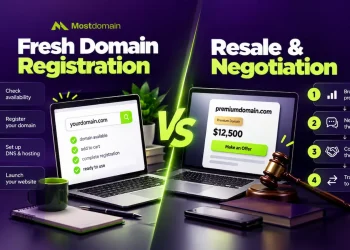
Aged domains reach buyers through three channels: hand-vetted marketplaces, open auctions, and expiring-domain drops, running from most convenient and priciest to most manual and cheapest.
| Channel | What you actually get | The catch |
| Curated marketplaces | Pre-screened names with history already checked and a fixed buy-it-now price | You pay a markup for someone else’s vetting and time |
| Domain auctions | Expiring names sold to the highest bidder, sometimes far below marketplace rates | You bid against investors, agencies, and automated bots |
| Expired drops and automation | Raw access to everything releasing back to the public, filtered by your own tools | Enormous volume, and most of it is worthless |
Free aggregators list well over 200,000 dropping domains on a typical day, so the bottleneck was never supply. It is filtering. A curated marketplace like MostDomain handles that sifting for you, screening names for history and authority before they ever reach a listing, while auctions and drops hand you the raw feed and your own patience. Where you land usually comes down to a single question: is your scarcest resource money, or time?
Why the best aged domains are usually already gone
The strongest aged domains rarely surface on public lists. Because marketplaces, investors, and drop-catching bots all watch the same expiry feeds and grab quality names in the narrow window before they release to the public.
| Lifecycle stage | Rough duration | What is happening |
| Grace period | Up to about 30 days after expiry | The original owner can still renew at the normal price, and nothing is available yet |
| Redemption | Roughly 30 days | The owner can reclaim it at a steep fee, and this is where marketplaces and catchers start queuing |
| Pending delete | 5 days | Nobody can register it, the name is locked and counting down toward release |
| Drop | A single moment | The name releases, and whoever is fastest, usually a bot, wins it |
A name with a strong backlink history rarely just sits there waiting. By the time a domain looks obviously good, several automated services have already backordered it. The affordable finds tend to be slightly imperfect names the crowd overlooked, so aim there rather than at the trophy names everyone can already see.

Matching an aged domain to your niche
A niche-relevant aged domain almost always beats a higher-authority. But unrelated one, since topical continuity preserves the trust and relevance signals that gave the domain its value in the first place.
- A name that spent a decade covering personal finance carries finance context you can build on. Point that same name at a pet-supplies blog, and much of the inherited relevance quietly evaporates.
- Raw authority numbers tempt beginners hardest. Relevance is the slower, more durable signal, and it is the one that actually survives a change of owner.
- Filtering by niche also shrinks a bloated shortlist fast, which is a feature rather than a limitation.
For the full framework on pairing a domain’s past to your project type, see our guide to niche-relevant aged domains.
Securing the transfer without getting scammed
Closing an aged domain purchase safely comes down to two habits, paying through escrow and confirming a clean ownership transfer, because the real sourcing risk is usually a bad transaction rather than a bad domain.




- Use escrow for anything beyond pocket change. It holds your money until the domain lands in your account, which shuts down the most common private-sale scam outright.
- Expect a 60-day transfer lock. After a fresh registration or a change of registrant, ICANN rules keep the domain from moving again for roughly two months. So build that wait into your plan.
- Watch a rushed seller closely. Pressure to skip escrow or wire funds directly is the single clearest warning sign in the whole process.
The step-by-step mechanics, including auth codes and the registrar handoff, live in our walkthrough on domain escrow services. Buying through a curated marketplace like MostDomain sidesteps much of this worry, since payment and transfer sit inside one vetted process rather than a risky handshake with a stranger.
What finding an aged domain really costs
The sticker price of an aged domain is only the beginning. Total cost also folds in channel fees, first-year renewal, escrow, and any cleanup work. Which can quietly turn the cheapest-looking option into the most expensive one.
| Cost line | Curated marketplace | Auction | Expired drop |
| Acquisition | Fixed markup, often priced per referring domain, with some listings starting near $0.50 per link | Your winning bid, which can open low then climb fast under competition | Registration fee only, frequently close to the standard $10 to $15 |
| Platform fee | Usually already baked into the price | An auction commission stacked on top of the bid | A drop-catch or backorder charge, commonly a flat fee per attempt |
| First renewal | Standard registrar rate the following year | Same standard rate | Same standard rate |
| The quiet cost | Lowest, since the vetting is already done | Hours spent researching every name yourself | Recovery work when a name turns out penalized or deindexed |
On paper the drop route looks almost free. Add the hours of filtering plus the occasional dud that needs its indexing untangled, and the arithmetic shifts. Marketplaces flip that same trade the other way: more upfront, far less of your weekend. Neither is genuinely cheaper. They simply move the cost between your wallet and your calendar.
Which sourcing channel fits you
Pick your channel by budget, time, and risk appetite. Marketplaces reward buyers who want speed and a vetted history. While auctions favor patient bargain-hunters. And expired drops suit high-volume operators who are happy to filter for themselves.
| If this is you | Start with | Because |
| Short on time, and you want a name that is already checked | A curated marketplace such as MostDomain | The vetting premium buys back your weekend and lowers the odds of an ugly surprise |
| More time than money, and you enjoy the hunt | Auctions | Patient bidders occasionally land quality names for a fraction of marketplace pricing |
| Building several sites and thinking in portfolios | Expired drops with automation | Volume and tooling outweigh any single purchase, and the per-domain cost stays low |
| Chasing one specific name that is not publicly listed | A broker working through a marketplace | Discreet pursuit earns its premium when the name was never meant for open sale |
Most buyers do not stay in one lane forever. You might start on a marketplace to learn what good actually looks like. Then move to auctions once you trust your own eye. The channel you use is a sign of experience as much as a budget line.
Found an aged domain you like? Vet it before you pay
Before paying for any aged domain, run a full quality check on its backlinks, history, and indexing status, because sourcing only hands you a candidate, and a candidate is not the same thing as a safe buy.
Everything above gets you to a shortlist. What it deliberately leaves out is how to judge whether a specific name is genuinely clean. That means a backlink audit, a careful read of its history, a penalty and deindex check, all of which belong to a separate stage of the process. Run them before any money changes hands, using our guide on how to evaluate an aged domain. If you skip that step. Even a perfectly sourced name can still burn you.
FAQ
Where is the safest place to buy an aged domain?
Curated marketplaces are the safest starting point. Mainly because the name has already been screened and payment runs through the platform. Auctions and private drops can beat those prices. But they push the safety burden onto you. When unsure, paying a little more for vetting is rarely a bad call.
Is buying an aged domain legal?
Yes, buying or registering a previously owned domain is completely legal. It is legal once the earlier registration has lapsed or the owner agrees to sell. One caveat is worth holding onto though. A name that infringes on a trademark can still cause problems later. However you acquired it. Check for brand conflicts before you commit anything.
How much should I expect to pay for a good aged domain?
Prices swing hard. A raw expired name can cost little more than a standard registration. While a hand-vetted marketplace domain with a real backlink profile often runs from a few hundred dollars into the low thousands. The figure tracks its history and how much filtering someone else has already handled for you.
Marketplace or auction, which is better for beginners?
For a first purchase, a marketplace tends to be the gentler entry. Metrics sit right there in front of you. The name has been checked, and there is no bidding war to misread. Auctions reward experience and steady nerves. So they are usually something to graduate into rather than begin with.
Can I trust the metrics a seller shows me?
Treat any seller-supplied numbers as a starting point. Metrics get inflated with cheap links. Or even cherry-picked screenshots all the time. So verify everything independently before you pay. If a seller resists your own checks, that hesitation tells you more than any dashboard could.
References
- ICANN, Expired Registration Recovery Policy and inter-registrar transfer rules.
- Google Search Central, guidance on site moves and changing domains.
- Ahrefs Blog, evaluating expired and aged domains.
- ExpiredDomains.net, daily dropping-domain database.