
Any unique external website sending at least one link to your site counts as a referring domain, and that number matters more than the raw backlink total most beginners obsess over. Picture ten separate sites each linking to you once: that’s ten independent votes of trust. Now picture one site linking to you ten times instead. Same backlink count, but tools only credit the first link, so you’re left with a single referring domain carrying all that weight alone. Whether you’re buying a domain or auditing the one you already run, its referring domain count, and the quality behind that count, usually predicts ranking potential better than anything else buried in a backlink report.
Breaking Down What Counts as a Referring Domain
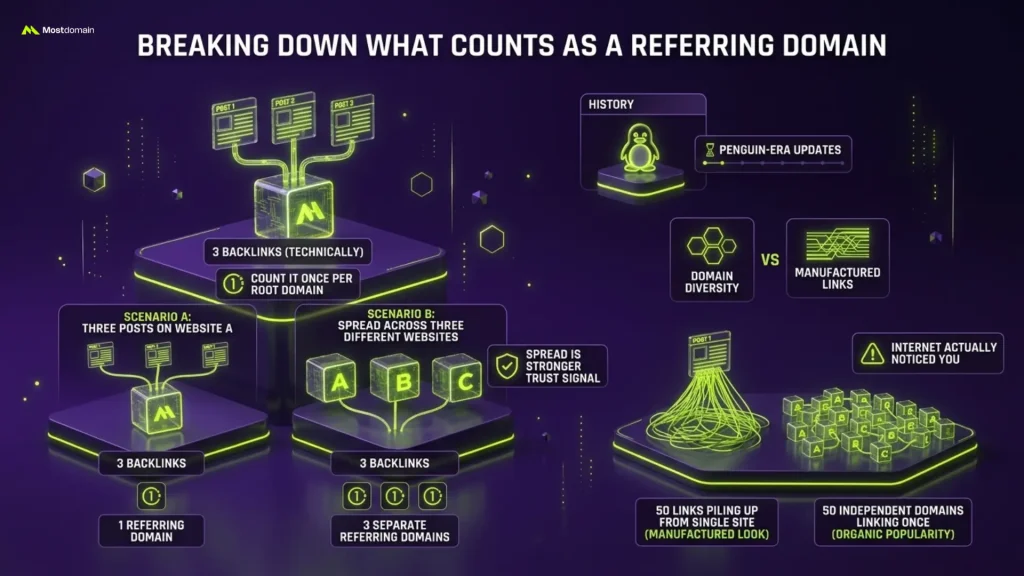
Count it once per root domain, no matter how many separate links or pages send traffic your way. That’s the whole definition of a referring domain: a unique root domain containing at least one hyperlink to your site.
A quick side-by-side makes the difference obvious:
- Three blog posts on Website A each link to your homepage. Three backlinks, technically, but just 1 referring domain, because every link traces back to the same root.
- Now spread those same three links across Websites A, B, and C instead. Still 3 backlinks on paper, but 3 separate referring domains this time, and that spread is what search engines generally read as the stronger trust signal.
This distinction isn’t arbitrary. It traces back to Google’s early Penguin-era updates, when domain diversity started acting as a rough stand-in for genuine organic popularity, and fifty links piling up from a single site started looking manufactured. Fifty independent domains linking once each look like the internet actually noticed you.
Referring Domain or Backlink? The Numbers Rarely Match
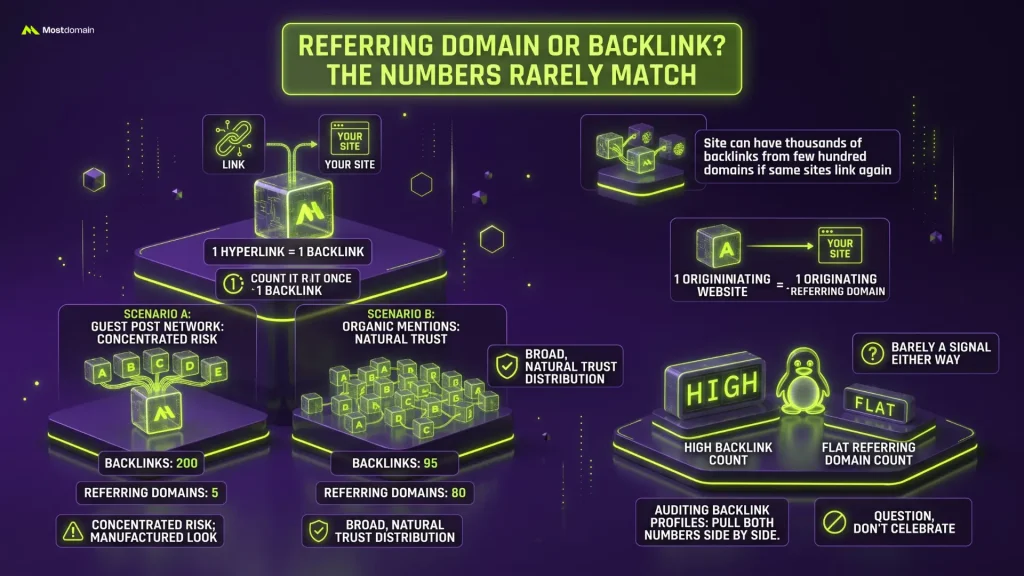
One hyperlink equals one backlink, full stop. A referring domain is the actual website that link originated from, and that’s why a site can rack up thousands of backlinks while sitting at just a few hundred referring domains, if the same handful of sites keep linking again and again.
| Scenario | Backlinks | Referring Domains | What It Signals |
| Guest post network: 5 sites, roughly 40 links each | 200 | 5 | Concentrated risk; looks manufactured even if each link is technically clean |
| Organic mentions scattered across 80 unrelated blogs | 95 | 80 | Broad, natural-looking trust distribution |
| One high-authority directory listing | 1 | 1 | Barely a signal either way, positive or negative |
Anyone auditing a backlink profile should pull both numbers side by side before drawing conclusions. A high backlink count sitting next to a flat referring domain count is the first thing worth questioning, not celebrating.

Why Ahrefs, Moz, and Semrush Never Agree on Referring Domain Counts
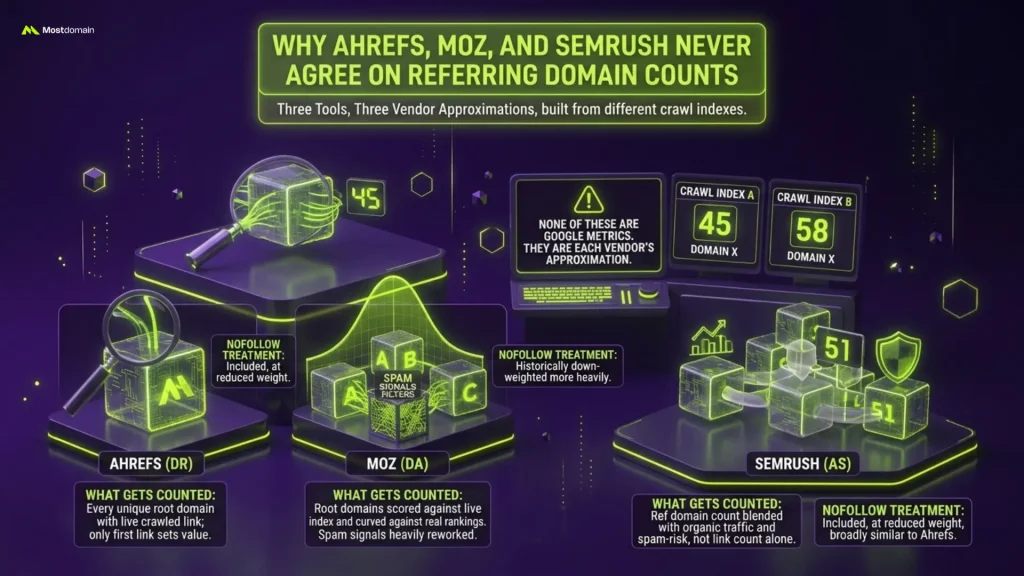
Three tools, three different formulas. Ahrefs, Moz, and Semrush each publish their own “referring domains” figure. And because none of them calculate it the same way, a domain can look impressive on one dashboard and merely average on the next.
| Tool | What Gets Counted | Nofollow Treatment |
| Ahrefs (DR) | Every unique root domain with at least one live, crawled link; only the first link from each domain sets the value | Included, at reduced weight |
| Moz (DA) | Root domains scored against a live index and curved against real ranking outcomes, reworked since 2019 to weigh spam signals more heavily | Historically down-weighted more heavily than Ahrefs |
| Semrush (AS) | Referring domain count blended with organic traffic and spam-risk signals, not link count alone | Included, at reduced weight, broadly similar to Ahrefs |
None of these numbers are Google metrics. They’re each vendor’s own approximation, built from their own crawl index, which is exactly why the same domain can post a 45 on one tool and a 58 on another without anything about the site itself changing.




What a Healthy Referring Domain Profile Actually Looks Like
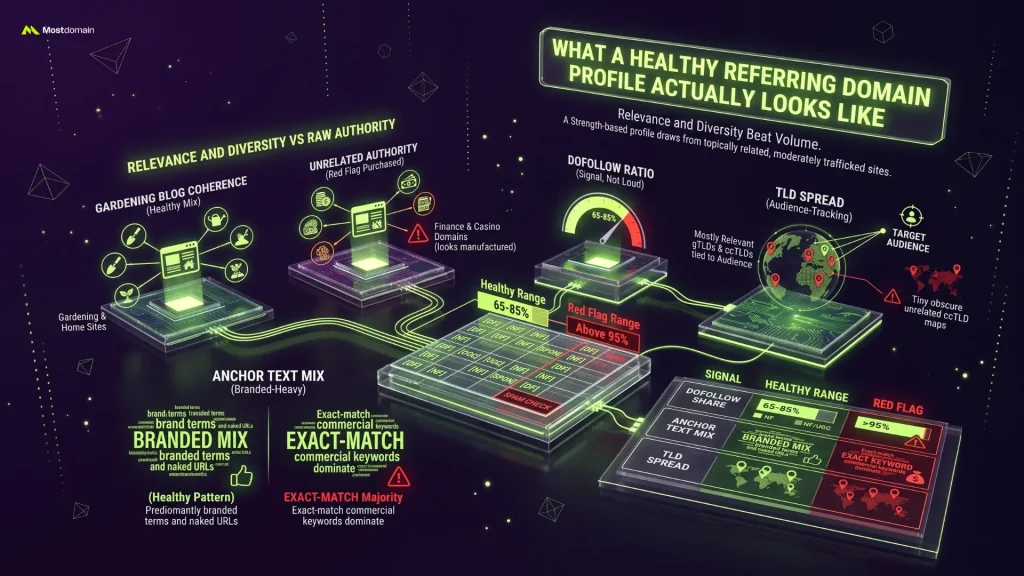
Relevance and diversity beat sheer volume, every time. A healthy referring domain profile draws its strength from topically related, moderately trafficked sites, and those links often carry more weight than a stack of unrelated high-authority domains ever could.
- Relevance beats raw authority. A gardening blog linked by twelve other gardening and home sites reads as coherent. The same blog linked by twelve unrelated finance and casino domains reads as purchased, no matter how “authoritative” those finance domains score individually.
- Dofollow ratio is a quieter signal, not a loud one. Genuinely organic profiles almost always include some nofollow, UGC, or sponsored-tagged links mixed in, simply because real mentions come from forums, social platforms, and press sites, platforms that tag links by default anyway.
- TLD spread should track the audience, not the SEO tactic. This is a separate question from how a domain’s TLD affects SEO rankings in the first place, since a red-flag cluster of unrelated ccTLDs is about link-source pattern, not the domain’s own extension.
- Anchor text mix should stay branded-heavy. If most inbound anchors read like a keyword list built for exact-match domains, that pattern is worth checking against the source before trusting the number at all.
| Signal | Healthy Range | Red Flag |
| Dofollow share | Roughly 65 to 85 percent dofollow, the rest nofollow or UGC-tagged | Above 95 percent dofollow across hundreds of domains, almost none tagged |
| Anchor text mix | Branded terms and naked URLs dominate | Exact-match commercial keywords make up the majority |
| TLD spread | Mostly relevant gTLDs and ccTLDs tied to the actual audience | Dozens of obscure, unrelated ccTLDs clustered together |
Referring Domain Red Flags When You’re Evaluating an Aged or Expired Domain

When you’re buying an aged or expired domain, the referring domain list is usually where a manufactured link history shows itself first, often through timing clusters, shared hosting footprints, or anchor text that reads like a keyword list instead of a genuine mention.
Watch for these patterns before you trust a domain’s authority score:
- A burst of 30 to 50 new referring domains inside a two-week window, then flat for years afterward. Organic growth rarely arrives in one clump.
- Linking domains that share the same registrar and the same handful of hosting IP blocks. Private blog networks tend to reuse infrastructure, and that fingerprint survives even after the domain changes hands.
- WHOIS creation dates on the linking domains clustering suspiciously close together.
- Anchor text across those links repeating the same one or two commercial keywords instead of varying naturally.
Google’s own link spam policies spell out exactly which patterns trigger algorithmic demotion, and a domain carrying that history can lose the ranking benefit those links ever generated, even years after a new owner takes over. Referring domain patterns are only one piece of the broader question of how to know the worth of an aged domain, and getting a full read on that value takes more than a single authority score. None of this replaces running a full aged domain backlink audit before you commit to a purchase.
Referring Domain Velocity and Decay: Reading the Trend, Not Just the Snapshot

A referring domain count is a snapshot. But velocity, how quickly new domains show up or disappear month over month, is what actually tells you whether that number is holding steady, genuinely climbing, or riding a burst that’s already fading.
| Pattern | What It Typically Signals |
| Steady decline over 12+ months | Expired links from sites that shut down, redesigns that dropped old content, or honored removal requests; slow trust erosion even if the current count still looks fine |
| Sharp spike in a single week, spread across unrelated niches | Often a sitewide link injection or a PBN blast rather than fifty separate people independently deciding to link that week |
| Slow, consistent growth over years | The pattern most consistent with organic, earned links |
Take a site that had 400 referring domains a year ago and sits at 220 now. That’s real trust lost, even though 220 still looks perfectly respectable sitting there in isolation.
Checking Your Referring Domains Doesn’t Require Guesswork

Any domain’s referring domain count is one lookup away. Ahrefs Site Explorer, Moz Link Explorer, and Semrush Backlink Analytics will each surface that number for your site or a competitor’s. Though Google Search Console’s Links report tends to run lower, since it only reflects what Google has actually crawled.
| Source | Referring Domain Data | Cost |
| Ahrefs Site Explorer | Full referring domain list with authority scores and first-seen dates | Paid, limited free lookups |
| Moz Link Explorer | Root domain count with Domain Authority per referring site | Freemium |
| Semrush Backlink Analytics | Referring domain count blended with toxicity and traffic signals | Paid, limited free lookups |
| Google Search Console (Links report) | Domains Google has actually crawled and confirmed as linking | Free, requires site ownership |
When there’s a large gap between Search Console’s number and a paid tool’s figure, that usually just means the paid tool is picking up older or lower-quality links, links Google itself never bothered indexing in the first place.
FAQ
Is a referring domain the same thing as a backlink?
No, and the mix-up causes real confusion. A backlink is one hyperlink instance, a referring domain is the unique website that link actually came from. And a single domain can pump out dozens of backlinks while still counting as just one referring domain.
How many referring domains does a site need to rank well?
Honestly, there’s no fixed number here. Competitiveness of the niche decides almost everything: a local service page might rank comfortably with a dozen relevant referring domains. While a competitive national keyword can easily demand hundreds.
Can a referring domain actually hurt my SEO?
It can, yes, particularly if that domain is spammy, unrelated, or part of a manipulative link network. Google’s spam systems are built to discount or ignore those links outright, and a referring domain’s own reputation problems can sometimes bleed into how your site gets evaluated too.
What happens if I lose referring domains over time?
A slow decline usually just reflects expired content, site closures, or redesigns happening elsewhere on the web. Things entirely outside your control, and that erosion can chip away at authority even though nothing changed on your own site. The trend line matters more than any single snapshot.
Is Google Search Console’s referring domain count accurate?
Accurate, yes, but conservative. It only reflects what Google has actually crawled and indexed. Which tends to land smaller than the numbers Ahrefs or Semrush report from their own independent crawls.
Should referring domain count matter when buying an aged domain?
It deserves to be one of the first things you check, though the count by itself won’t tell the whole story. The pattern behind that count, timing, relevance, hosting footprint, matters more than the total.
References
- Semrush, “What Are Referring Domains? + How They Affect SEO”
- Shopify, “What Is a Referring Domain?”
- Google Search Central, “Spam Policies for Google Web Search”
- SEOptimer, “What Are Referring Domains? How to Check Them and Get More”
- Outrank, “Moz DA vs Ahrefs DR: Which One Actually Matters?”