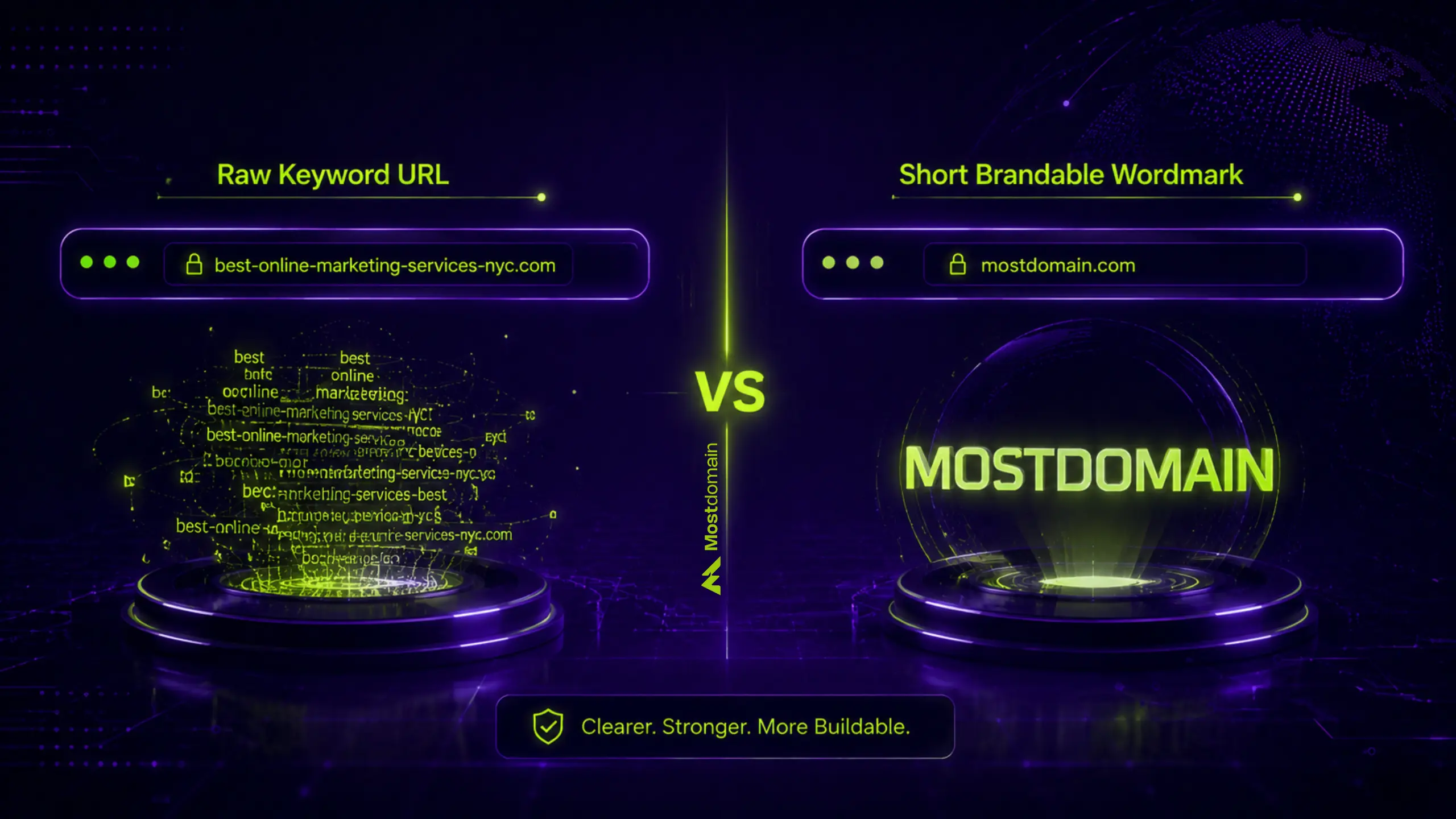
Custom vs engrave domain keyword optimization is what people search for the moment they’ve shortlisted two domain names and can’t pick. “Engrave domain” is a phrase a lot of buyers use for what’s formally called an EMD, an Exact Match Domain that packs the keyword straight into the URL. A custom domain reads like an actual brand instead and carries no built-in keyword signal at all. The short version: an engrave domain (EMD) wins when you need fast relevance on a narrow, low-competition phrase, while a custom domain wins when you’re building something people will search for by name a year from now.
Most guides stop at that definition. This one goes further and gives you a scoring method you can actually run before registering or buying either type, written for someone who needs to decide today, not someone browsing SEO theory.
What Actually Separates a Custom Domain from an Engrave Domain (EMD)
A custom domain is coined or brand-first with no keyword signal, while an engrave domain (EMD) packs your exact target keyword straight into the URL. Everything else in this guide builds on that one distinction.
| Domain Type | What It Means | Example |
| Custom Domain | Brand-first name, often invented or abstract, no keyword requirement | Nike.com, Zillow.com |
| Engrave Domain (EMD) | Contains the exact target keyword phrase, word for word | bestrunningshoes.com |
| Partial Match Domain (PMD) | Includes part of the keyword plus a modifier word | runningshoesblog.com |
| Non-Match Domain (NMD) | Pure brand name, zero keyword fragment | Airbnb.com, Etsy.com |
One data point worth knowing here. After Google’s 2012 algorithm change targeting exact match domains. EMDs lost most of their automatic ranking lift, according to independent testing compiled by Search Engine Journal. That single update is the reason this decision now runs on business fit rather than on an old SEO shortcut.
The Custom vs Engrave Domain Scoring Framework
Score each row from -2 (strongly engrave domain) to +2 (strongly custom), then add up the total: a negative sum points toward an EMD, a positive sum points toward a custom domain.
| Signal You’re Evaluating | Leans Engrave Domain (EMD) | Leans Custom Domain |
| Primary goal for this domain | Ranking one specific keyword phrase fast, often for a niche or lead-gen site | Building a company or product people will search for by name in a year or five |
| Competition on your target keyword | Low to moderate; the domain still nudges click-through when nobody else owns the exact phrase | High; you’ll get outspent on any keyword-based domain anyway, so branding wins the tiebreak |
| Timeline to first revenue | Weeks, not years. Plenty of domain flippers never plan past month six | A long runway, because you’re funding a name people will eventually type unprompted |
| Content plan | One narrow topic, realistically under 30 pages ever | Multiple product lines, or a roadmap that outgrows one keyword fast |
| Budget and how you’ll acquire it | Registering fresh, or picking up a low-cost aged domain with existing search demand | Investing in a coined or brandable name, sometimes through an AI domain finder for creative options |
| Trademark exposure | Lower risk, since generic keyword phrases are harder to trademark | Needs a professional trademark search before anyone gets attached to the name |
This scoring table isn’t a Google ranking factor in disguise. Google has said domain composition carries no direct weight on its own, so treat this as a business-fit tool, not an algorithm hack.

When the Engrave Domain (EMD) Score Wins Out
A negative score usually means one of three business situations, and all three share a common thread: speed matters more than brand equity.
- Domain flippers and portfolio investors: buying to redirect, lease, or resell rarely calls for a lasting brand. A clean-history EMD does the job in one purchase.
- Hyper-local service businesses: a locksmith covering one metro area gets more from cityname-locksmith.com than from an abstract name nobody local remembers on the first try.
- Thin-competition long-tail niches: where fewer than a handful of sites target the exact phrase. An engrave domain still earns a modest click-through edge just by matching what someone typed into search.
When a Custom Domain Score Wins Out
A positive score points to a business that plans to outlive its first keyword, and that shift changes what “good domain” even means.
- Multi-product or multi-vertical businesses: once the roadmap spans more than one product line. A keyword-locked domain becomes a ceiling you’ll hit within a year.
- Funded startups with a long runway: investors evaluate brand defensibility. A generic keyword string reads as a lead-gen site rather than a company with equity to build.
- Trust-heavy categories like finance, health, and legal: these searches carry real E-E-A-T weight, and a branded name signals an actual practice behind the content instead of a keyword grab.
- E-commerce stores building repeat customers: brand identity in e-commerce domain names drives direct traffic and repeat visits in a way a keyword string never will.
What to Do When Your Score Lands in the Middle
A tied or near-tied score means the honest answer is both, sequenced rather than chosen outright.




- Register or acquire the custom brand domain first, since that’s the asset the business grows into.
- Pick up one or two aged EMDs as supporting properties, each one redirect-ready once the brand site has earned enough authority to absorb them cleanly.
- Run a full backlink and penalty check before buying any aged EMD, since a domain that spent a decade on a private blog network brings liabilities along with its keyword match.
- Keep both domains under one ownership record so the eventual redirect and consolidation stay simple.
Sourcing quality matters more here than the domain type itself. Platforms built for vetted aged inventory, MostDomain among them, exist because raw auction listings rarely come pre-screened for spam signals or toxic anchor profiles.
Common Mistakes in Custom vs Engrave Domain Keyword Optimization
Most of these mistakes come from treating the decision as permanent when it usually isn’t, or treating it as more powerful than it is.
| Mistake | Why It Backfires |
| Skipping a trademark check on a “perfect” keyword match | A domain matching your keyword exactly can still collide with an existing mark; see the brand strategy and trademark guidance before falling in love with a name |
| Buying an aged EMD without a backlink audit | Age alone means nothing if the history is spam-filled, so pair it with a proper domain age and history check |
| Treating the scoring framework as a ranking hack | Nothing here moves you up in Google’s results by itself; it only fits the domain to how the business plans to grow |
| Choosing cheap over clean for a “temporary” EMD | A discounted domain with a messy renewal trap or thin history rarely stays temporary once traffic starts flowing to it |
| Ignoring TLD and social-handle availability | A great engrave domain on an odd extension, or one that blocks a matching social handle, creates friction the keyword match can’t offset |
FAQ
Is an engrave domain (EMD) still worth buying in 2026?
For a narrow, low-competition niche site with no branding ambitions, yes. For anything meant to scale into a recognizable name. The keyword lock tends to work against you within a year or two.
Can I switch from an engrave domain to a custom domain later without losing rankings?
Some equity transfers through a proper 301 redirect, but expect a temporary dip. Migrations that skip mapping every URL individually tend to lose more than they should.
Does an exact match domain still get a click-through boost?
A small one, mainly when the phrase in the URL matches what someone just typed into the search bar. It’s a perception effect on the results page, not a ranking algorithm effect.
What is a PMD and does it change this framework?
A Partial Match Domain includes part of your keyword plus a modifier word. Score it the same way, just expect the total to land closer to the middle than a full engrave domain would.
Should agencies register an engrave domain for every client niche?
Only when the client’s actual goal is a fast, disposable lead-gen asset. For any client planning to build an ongoing brand, that habit creates cleanup work later instead of a head start.
References
- Search Engine Journal, “Is Domain Name a Google Ranking Factor?”