
Launching a new project is even more difficult when you are out of money. You need a website, but spending tons of money on a domain for a website without customers is not the best use of your funds. Buying an inexpensive domain allows you to focus on you business.
Your website domain is important. Shorter, simpler domains are easier to remember and type, and customers are more likely to trust and click to visit your site. If you have an unnecessarily long domain because you are trying to get creative with a your words and adding hyphens, you won’t show up on searches and customers will be unlikely to visit your site.
Premium domains are unnecessary. You do not need to drop thousands on a domain for your business to be a success. You may buy an inexpensive domain and continue to develop and expand your business.
Many believe that all inexpensive domains are of poor quality. This is simply not true. We will tell you all of the secrets of domain prices and how to get the best deals without being taken advantage of with surcharges that you may face.
What Is a Low Cost Domain?
When we talk about a cheap domain, we just mean a web address that doesn’t cost an absolute fortune. You aren’t bidding on some premium, highly competitive name. Instead, you’re usually picking these up from normal domain registrars, reseller markets, or expired wholesale lists.
Paying for the name is only the initial hurdle, though. A massive trap for beginners is getting excited about a dirt-cheap checkout price while completely ignoring what happens next. A two-dollar deal can backfire incredibly fast if renewal fees skyrocket later, or if you get hit with random transfer penalties and admin costs.

A few main factors constantly shift these prices around:
- The extension you pick: This dictates a huge chunk of the price. Popular or trending endings are always going to cost way more than obscure options.
- Search volume and demand: If your URL contains popular keywords that lots of companies want, expect the price tag to spike.
- Sneaky renewal fees: It’s incredibly easy to miss these. A cheap first year often turns into a major price hike in year two.
- Arbitrary “premium” labels: Registrars love slapping a premium tag on short, catchy words just to invent an extra fee out of nowhere.
- First-year discounts: These are great for saving quick cash right now. Just make sure you check the normal ongoing price before entering your credit card info.
Keep your eyes open for those sudden upcharges at checkout. Doing that homework upfront keeps you from getting burned by a flashy sticker price later on.
Why Businesses Look for Low Cost Domains
It mostly comes down to saving cash. Picking up a cheap web address means you get to throw your money into things that actually keep you alive—like building the actual product, running ads, and finding customers. When margins are tight, every dollar you save is another dollar you can use to grow.




Cheap domains also let you test weird ideas without a financial hangover. Throw up a quick page, see if anyone cares, and move on. If it bombs, who cares? You’re only out a few bucks. That sort of freedom is awesome for fast side projects. Even if you’re just flipping domains for profit, buying low means you can move inventory faster and protect your margins.
Keeping things cheap gives you some immediate advantages:
- You don’t lock up your cash: Why drop serious money on a name before making your first sale? It makes no sense.
- You can launch tonight: Grab a name, plug it in, and get your offer live by dinner.
- Walking away is easy: If the concept doesn’t pan out, you pivot without feeling guilty about a wasted investment.
- Testing multiple angles is cheap: Grab a few variations or niche angles without draining your actual savings account.
Staying budget-conscious early on gives you a real footprint online. Best of all, it keeps your business safe from unnecessary financial traps right when you’re the most vulnerable.
How to Find Inexpensive and Safe Domain Registrars
Where can you find inexpensive domains while avoiding a scam? There are a few routes you can take, but all have some level of risk associated.
Most consumers will go to a standard domain registrar. These companies tend to offer very cheap first-year pricing. Other registrars will sell domains that have already been purchased. Names that have been purchased, but are for sale, may have some value, as they could have a consistent level of website traffic. You can also search for abandoned domains. Now, being more specific, here is how these options compare:
- Standard Registrars: Your best option for a new domain. Be careful, as these companies may increase their pricing for renewal.
- Reseller Marketplaces: Good for previously owned domains, but these may have a high cost.
- Auctions: Good route for highly sought after domains, but are susceptible to high cost.
- Expired Domains: Good option if you want to rank with search engines, but these are more likely spam domains. Be careful and do a search on past ownership.
Most buyers tend to overlook standard retail registrars, so having an option like Mostdomain can be beneficial. Mostdomain, an aged inventory marketplace based in Singapore, lets customers find registered domains with early signups, making the marketplace a great place to find options at a lower price with a past history of being registered.
How to Evaluate Whether a Low Cost Domain Is Worth Buying
Never judge a low cost domain solely by its sticker price. True worth stems from long-term branding utility and structural growth potential.
Memorability reigns supreme. If a user cannot recite your URL after hearing it once, the domain fails its primary function. Keyword relevance helps, but never sacrifice a strong, unique brand name for a clunky, keyword-stuffed alternative. Finally, evaluate the extension. While .com holds global authority, niche-specific or regional extensions often provide high-value, low-cost alternatives.
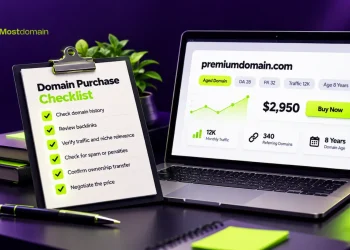
Evaluation Checklist:
- Orthographic simplicity (easy to spell).
- Recall factor (easy to remember).
- Niche alignment.
- Sustainable renewal rates.
- Absence of trademark litigation.
- Clean historical record.
Executing this diligence prevents catastrophic branding errors later.
Common Errors When Purchasing Inexpensive Domains
Low-cost domains appear attractive, but errors result in a loss of value over time.
The worst mistake is valuing cost over quality. Trading a strong brand for a cheap alternative is a horrible mistake. Another mistake falls under the “renewal trap” — a discount during the first year of service, but an outrageous price in the subsequent years. Also, avoid domains that have numbers, excessive non-alphabetical characters, or a creative spelling because they result in poor conversions. Also, low quality domains have a poor history that negatively affects your SEO.
Warning Signs:
- Too many numbers or non-alphabetical characters.
- Poor history of service.
- Black-listed Domains.
- Unrealistic “on sale” prices.
Beware of your domains, the can create value and revenue for years to come.
Low Cost Domain vs Premium Domain
A low cost domain and a premium asset fulfill different business mandates.
Premium names feature ultra-short, high-demand keywords and carry a heavy price tag. They represent a “luxury” branding choice. Conversely, a low cost domain provides a high-access entry point, enabling brand development without the heavy upfront liability.
| Feature | Low Cost Domain | Premium Domain |
| Initial Cost | Minimal | Substantial |
| Branding Strength | Moderate | Superior |
| Market Access | High | Restricted |
| ROI Potential | Steady | Volatile/High |
| SEO Base | Quality-dependent | Quality-dependent |
The sweet spot often resides in the middle. Aged domains, specifically those found via specialized providers like Mostdomain, offer an intermediate path—delivering the established trust of an older asset at a fraction of the cost of a top-tier premium domain.
Practical Methods for Strategic Acquisition
You should think of your domain in your portfolio, not as an expense. Think like an investor if you want to make better acquisitions.
Be selective and make your searches as broad as possible. Try as many TLDs as you can; a valuable domain can be right under your nose with a different extension. Use different registrars to see different prices, and be sure to use forensic tools for domain histories. If you see the domain was used for something malicious, don’t choose it.
Things to Do:
- Secure your mark.
- Shorten your forecasts for renewals.
- Check for trademarks.
- Perform a full backlink and spam audit.
- Think long-term. Always.
You should see better improvements in your investment returns by thinking longer term with your URLs.
FAQs
What is a low cost domain?
An asset in the introductory pricing stage which has low or moderate registration or marketplace costs.
Are these domains safe?
Yes, as long as you check the ownership history, trademarks, and renewal agreements before a domain is transferred.
Does a cheaper domain hurt SEO?
No. Search engines are concerned with the content and the intent of the user and do not decide rankings based on purchase costs of a domain.
New vs. Aged: Which is better?
That depends. New domains are blank slates, and aged domains can be valuable as long as they are also clean.
What accounts for the big difference in value?
That depends on market demand, the domain’s reputation, age, extension, and the domain’s commercial past.
What is the way to check such history?
To check such history, archives, backlinks, and spam will need to be checked through third parties.
Where are the best prices?
Most domain registrars will have the best deals while trusted secondary markets such as Mostdomain will have the best, high quality aged domains.
Defining Value in a Low Cost Domain
A low cost domain address is only a smart move if you select it with precision. You have to look past the initial price tag and consider how catchy the name actually is, whether it fits your market, and what the long-term cost looks like over time.
Honestly, the cheapest option on your list is rarely the one you should buy. It has to actually fit your goals and give you room to grow as traffic builds. Do some homework on its background. Compare a few different sellers. Staying focused on where you want to end up prevents you from buying a total money pit instead of a useful digital asset. If you want a quick shortcut to established options without draining your budget, check out marketplaces like Mostdomain. They offer a solid sweet spot for affordable, aged inventory so you don’t get stuck paying those ridiculous, over-inflated prices people demand for speculative premium domains.
References
- Internet Corporation for Assigned Names and Numbers. (n.d.). Domain names. ICANN. Retrieved June 2, 2026.
- Internet Assigned Numbers Authority. (n.d.). Root zone database. IANA. Retrieved June 2, 2026.
- Google. (n.d.). Site moves with URL changes. Google Search Central. Retrieved June 2, 2026.
- Verisign. (2025). Domain name industry brief. Verisign. Retrieved June 2, 2026.
- Mockapetris, P. (1987). Domain names—Concepts and facilities (RFC 1034). Internet Engineering Task Force.
- Mockapetris, P. (1987). Domain names—Implementation and specification (RFC 1035). Internet Engineering Task Force.
- Google. (n.d.). Search engine optimization (SEO) starter guide. Google Search Central. Retrieved June 2, 2026.
- World Intellectual Property Organization. (n.d.). Guide to domain name disputes and cybersquatting. WIPO. Retrieved June 2, 2026.