Type a keyword into your domain name and Google won’t hand you a ranking boost for it, not directly. But does your domain name affect SEO in other ways? Yes, just not through the mechanism most people assume. What actually shifts is click-through rate, backlink anchor text, and how fast people trust or remember your site. Three things that feed into rankings without being ranking factors themselves.
Most guides on this either overstate the keyword-in-domain effect (still living in 2011) or dismiss domain names entirely (ignoring real, measurable CTR and brand-recall data). Neither extreme holds up. Here’s what actually happened, what Google has confirmed as recently as this year, and where the real effects hide.
What Actually Counts as a Ranking Factor
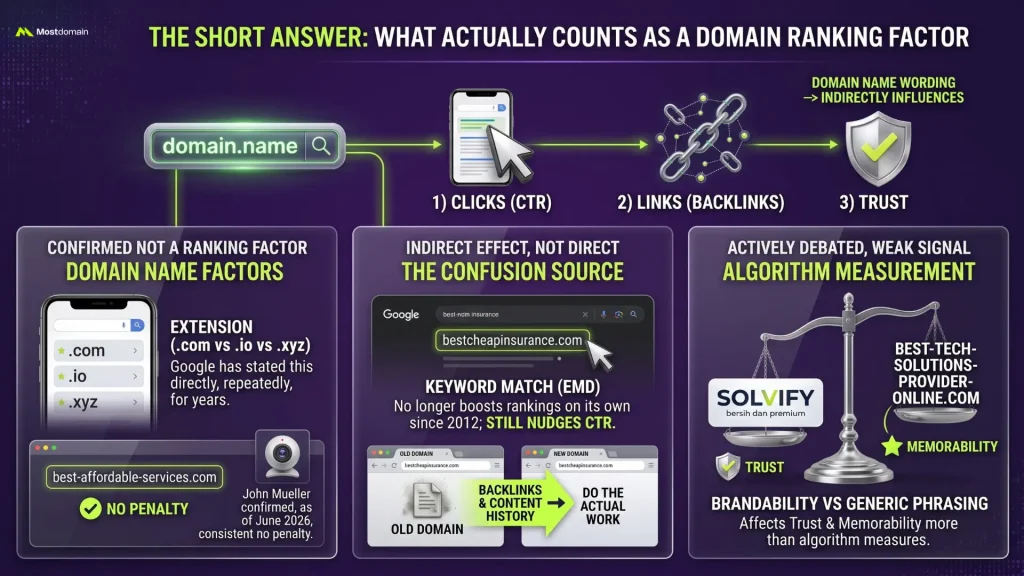
A domain name’s exact wording is not a confirmed Google ranking factor on its own. What does move rankings, indirectly, is everything the domain name influences downstream: clicks, links, and trust.
Three buckets sort out almost every domain-name SEO question people ask:
| Category | Domain-Name Factor | What’s Actually True |
| Confirmed not a ranking factor | Extension (.com vs .io vs .xyz) | Google has stated this directly, repeatedly, for years |
| Confirmed not a ranking factor | Hyphens in the name | Confirmed by John Mueller as recently as June 2026, no penalty |
| Indirect effect, not direct | Keyword match with search query | No longer boosts rankings on its own since 2012; still nudges click-through rate |
| Indirect effect, not direct | Domain age and history | Doesn’t inherently rank higher; existing backlinks and content history do the actual work |
| Actively debated, weak signal at best | Brandability vs generic keyword phrasing | Affects trust and memorability more than anything the algorithm measures directly |
Worth sitting with that middle row for a second, because it’s where most of the confusion started.
The 2012 Update That Actually Changed the Rules
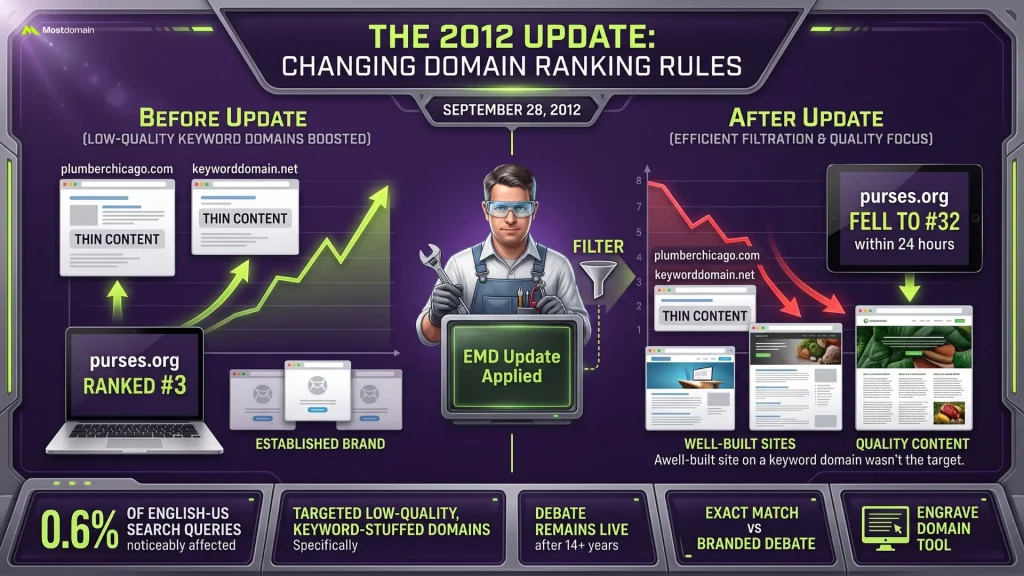
On September 28, 2012, Google’s Matt Cutts announced the Exact Match Domain (EMD) Update. An algorithm change that stopped low-quality keyword-stuffed domains from ranking on domain relevance alone.

Before that date, registering a domain like plumberchicago.com and slapping thin content on it could realistically land page one. Google’s own PageRank weighting leaned on domain relevance heavily enough that keyword domains with barely any real content outranked established sites. purses.org is the case everyone cites: it sat at position #3 for “purses,” ahead of Amazon and Zappos, and fell to #32 within 24 hours of the update rolling out.
- The update affected roughly 0.6% of English-US search queries to a noticeable degree, a small slice, but a brutal one for anyone whose whole strategy was the domain string.
- Cutts was explicit that it targeted low-quality EMDs specifically, not exact-match domains as a category. A well-built site on a keyword domain wasn’t the target.
- Fourteen years later, this is still the reason “should I get an exact-match domain” remains a live debate instead of a settled question.
That debate, and the actual decision-making around exact-match versus branded domains, gets the full treatment in Exact Match Domains, and there’s a scoring-based decision tool for picking between the two in Custom vs Engrave Domain Keyword Optimization.
Hyphens, Length, and the Myths That Refuse to Die
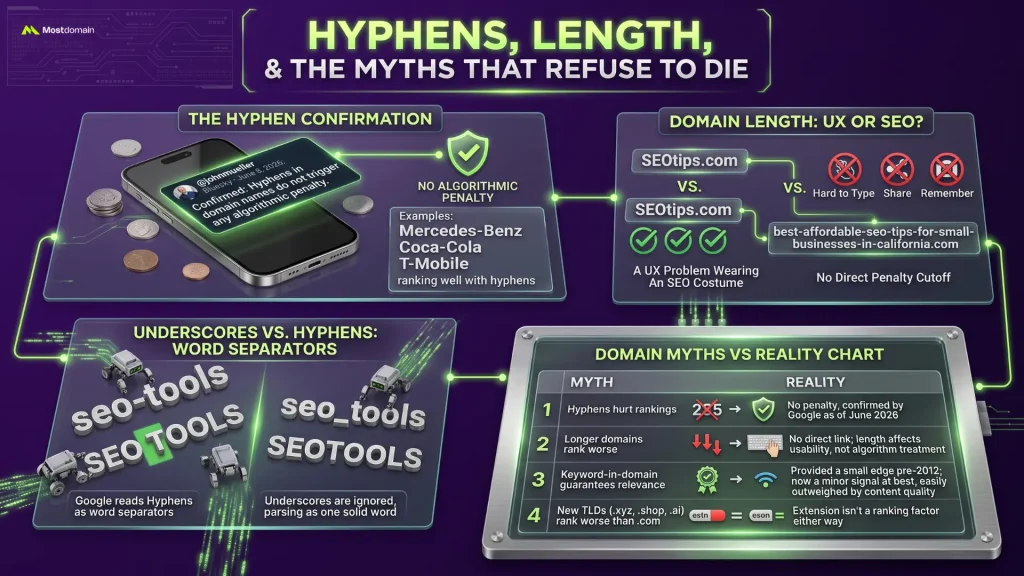
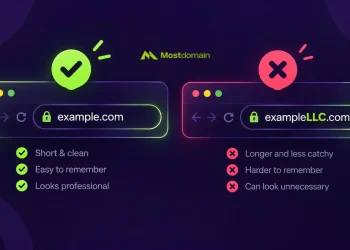
Hyphens in a domain name carry no ranking penalty. It’s confirmed directly by Google’s John Mueller in June 2026, closing out a myth that’s circulated since the early 2000s.




The hyphen fear goes back to when hyphenated keyword domains (best-seo-tips-2004.com, more or less) were everywhere. Mostly registered by affiliates chasing exact-match rankings before the 2012 update existed. That association stuck around far longer than the practice that caused it.
- On June 8, 2026, Mueller addressed it directly on Bluesky, confirming flatly that hyphens don’t trigger any algorithmic penalty. Mercedes-Benz, Coca-Cola, and T-Mobile all rank fine with hyphens in their branding, for what it’s worth.
- Length works the same way. There’s no cutoff where a domain “gets too long” and starts losing rank. It just gets harder to type, share, and remember, which is a UX problem wearing an SEO costume.
- Underscores are the one real exception worth knowing. Google’s crawlers read a hyphen as a word separator. An underscore gets read as nothing at all, so seo_tools parses as one solid word, seotools, not two.
| Myth | Reality |
| Hyphens hurt rankings | No penalty, confirmed by Google as of June 2026 |
| Longer domains rank worse | No direct link; length affects usability, not algorithm treatment |
| Keyword-in-domain guarantees relevance | Provided a small edge pre-2012; now a minor signal at best, easily outweighed by content quality |
| New TLDs (.xyz, .shop, .ai) rank worse than .com | Extension isn’t a ranking factor either way, covered in full in the TLD-specific breakdown |
What Actually Moves the Needle, Just Not Directly
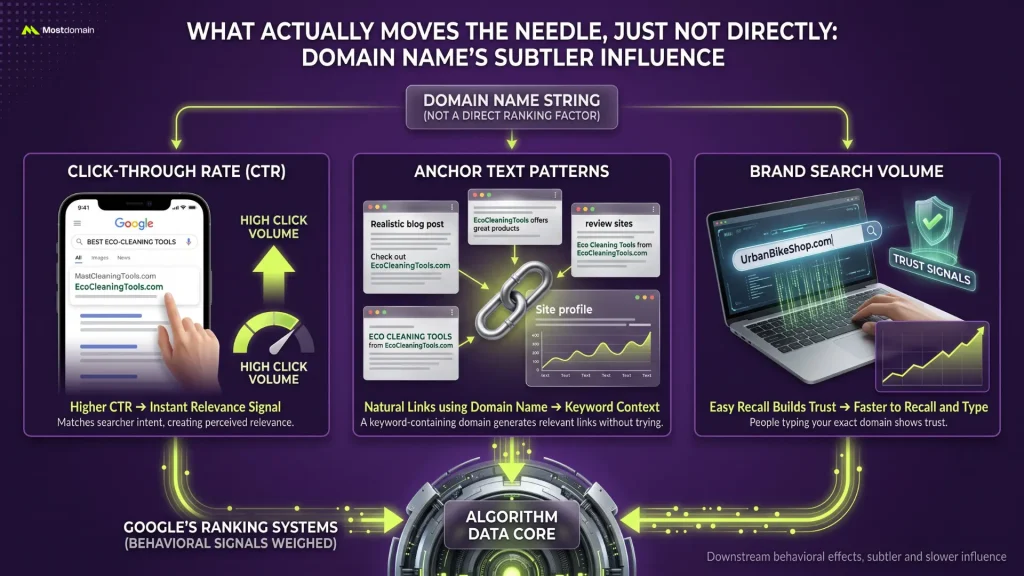
The real SEO effect of a domain name runs through click-through rate, natural backlink anchor text, and brand search volume, three signals Google does weigh, even though the domain string itself isn’t one of them.
- Click-through rate: a domain that matches or closely echoes what someone searched creates instant relevance in the searcher’s head before they even click. Multiple industry CTR studies put this at a real, measurable bump, not huge, but consistent, and CTR does feed back into how a result performs over time.
- Anchor text patterns: when other sites link to you, they tend to use your domain name or something close to it as the link text. A domain that happens to contain your target keyword ends up generating keyword-relevant anchor text without anyone trying. Which was the whole reason EMDs worked as well as they did pre-2012.
- Brand search volume: people typing your exact domain or brand name into Google is itself a trust signal Google’s systems pick up on. A domain that’s easy to recall and re-type builds this faster than one nobody can spell after hearing it once.
None of these are the domain name working as a ranking factor. They’re downstream behavioral effects the domain name shapes, which is a subtler, slower kind of influence than the one most articles imply.
Where the Rest of the Domain-SEO Picture Lives
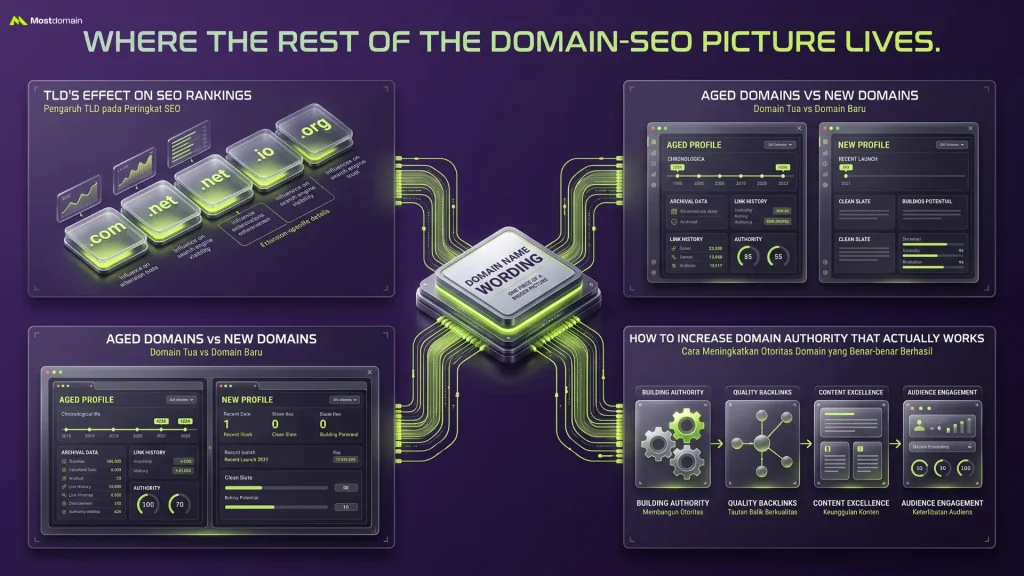
Domain name wording is one piece of a bigger picture, and the other pieces deserve their own depth rather than a shallow mention here. TLD Affect SEO Rankings covers the extension question specifically. Aged Domains vs New Domains handles the age and history angle. And if the actual goal is building authority once the name is locked in, How to Increase Domain Authority That Actually Works picks up from there.
FAQ
Does having my keyword in the domain name help me rank for it?
Barely, and less than it used to. It might contribute a small relevance signal. But remember, content quality, backlinks, and user experience carry far more weight since the 2012 EMD update reshaped the landscape.
Should I avoid hyphens when choosing a domain name?
Not for ranking reasons. Google confirmed in June 2026 there’s no penalty. The real question is whether hyphens make the name harder to say out loud or remember. Which is a branding call, not an SEO one.
Is a brandable domain better than an exact-match domain for SEO?
Depends on the goal. Exact-match domains can nudge click-through rate on matching queries; brandable domains build long-term recall and trust that compounds over years. Neither wins outright. Which is exactly why a scoring framework helps more than a flat rule.
Does changing my domain name hurt my existing SEO?
It can, temporarily, mostly from the migration itself rather than the new name. Proper 301 redirects and a clean transition plan recover most sites within a few months.
Do search engines penalize long domain names?
No direct penalty exists. Length mainly affects how easily people type, remember, and share the address. Which loops back into click-through rate and direct traffic over time.
Does .com still rank better than newer extensions like .xyz or .ai?
No, not algorithmically. Extension choice affects user trust and click-through behavior more than anything Google’s ranking systems measure directly.
References
- Search Engine Journal, Google’s Exact Match Domain Algorithm Update
- Search Engine Land, The EMD Update: Google Issues “Weather Report” of Crackdown on Low Quality Exact Match Domains
- Reva Digital, Google Exact Match Domain (EMD) Update: Brands vs. Affiliate Marketers
- Search Engine Roundtable, Google Says Hyphens In Domain Names Not Considered Low Quality
- SISTRIX, Google Exact-Match Domain (EMD) Update