
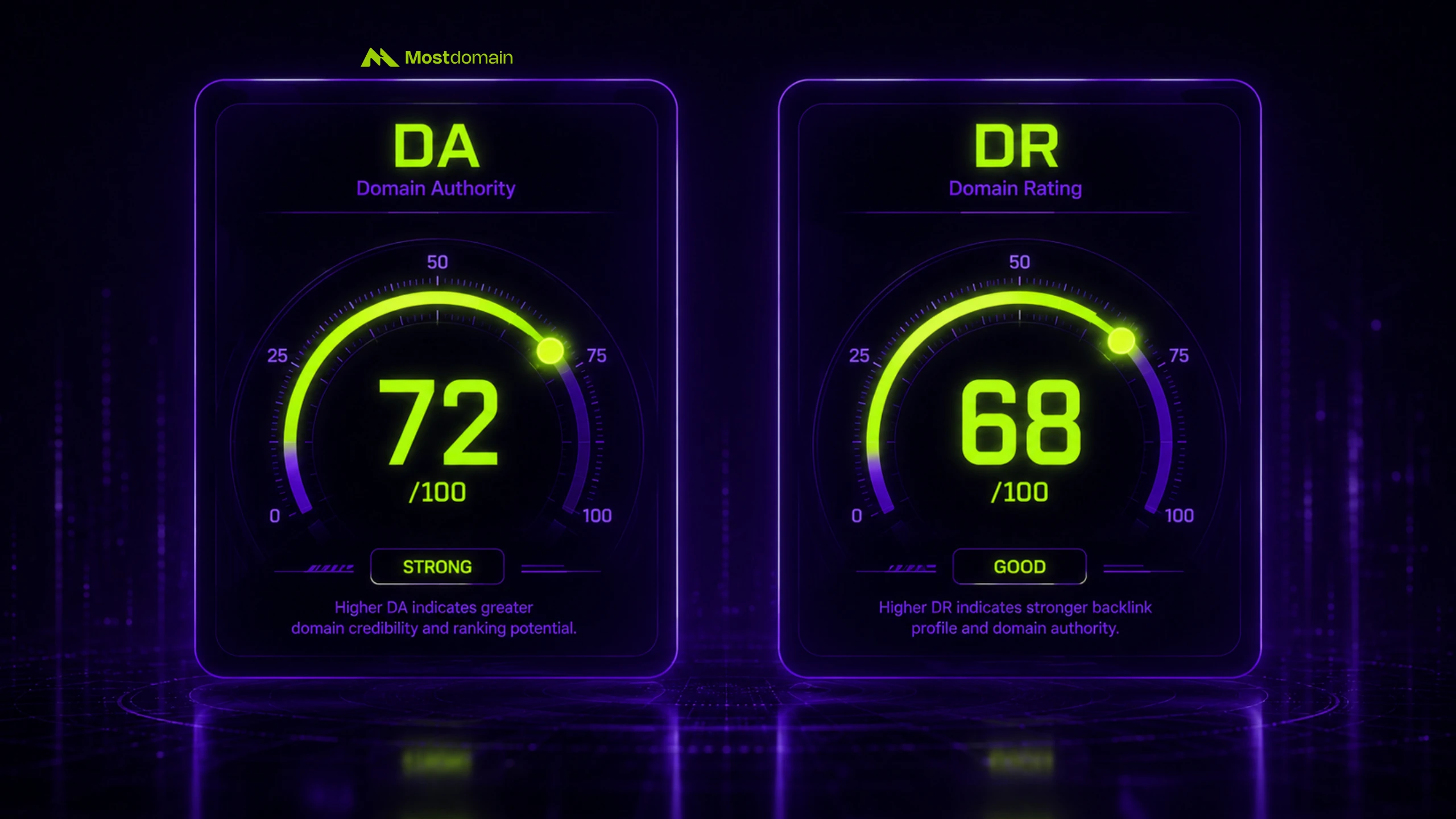
Ask three different SEOs to explain DA versus DR. And you will probably get three overlapping answers. The two get conflated constantly. Moz built Domain Authority to guess at ranking potential, weighing dozens of signals together into one number. Ahrefs took a narrower path with Domain Rating. Strip everything down to backlink strength alone, score it 1 to 100, done. Treat them as interchangeable while actually evaluating a domain. The assumptions baked into that mistake can get costly fast.
So, What Exactly Is Domain Authority (DA)?
Moz’s Domain Authority (DA) score runs 1 to 100. It predicts how likely a site is to rank. Built from dozens of weighted signals rather than backlink count.
Nobody outside Moz has the exact formula, and that is by design. The model trained on real ranking outcomes rather than a fixed checklist anyone could copy. One quirk worth knowing. The scale bends logarithmically. So a jump from 70 to 80 eats up dramatically more link equity. It eat more than the jump from 20 to 30 ever would. Buyers expecting a straight line usually get caught off guard here.
What actually goes into the number:
- Linking root domains, counted separately from raw backlink volume
- Total external links pointing to the site
- MozRank and MozTrust, two older internal metrics that still feed the model
- Spam signals, including link patterns Google itself tends to penalize
A mid-sized site sitting at 50 to 60 is usually considered decent, though that number means little without context, competitive niches push the bar considerably higher.
Ahrefs’ Answer: Domain Rating (DR)
Domain Rating (DR) runs 0 to 100 and measures exactly one thing. How strong a domain’s backlink profile is, based purely on referring links. Pure on referring links rather than traffic or on-page content.

Ahrefs stripped out everything DA bothers to include. No traffic data, no content signals, none of it factors in here. What is left is a single, narrow question answered without the noise DA’s wider input mix tends to add.
DR runs on a logarithmic scale too. A jump from DR 20 to DR 30 happens fairly easily after a handful of decent backlinks land. Getting from 70 to 80 usually requires links from domains already sitting above 80 themselves, since equity flows downhill from stronger pages to weaker ones. DR itself updates continuously, riding along with Ahrefs’ own crawl rather than sitting on a fixed schedule.
Where Domain Authority and Domain Rating Actually Diverge
Scope is really what separates the two.




- Domain Authority folds in traffic patterns
- Root domain diversity
Spam signals alongside backlinks, a wider mix built toward one ranking prediction, while Domain Rating stays narrower on purpose, isolating backlink strength alone.
| Aspect | Domain Authority (DA) | Domain Rating (DR) |
| Developed by | Moz | Ahrefs |
| Scale | 1 to 100, logarithmic | 0 to 100, logarithmic |
| Core inputs | Linking root domains, external links, MozRank, MozTrust, spam score | Referring domains and the quality of link equity flowing through them |
| Factors in traffic or content | Partially | Not at all |
| Update cadence | Every two to four weeks or so | Continuous, tied to Ahrefs’ crawl |
| Most useful for | Gauging overall ranking potential against a niche | Vetting the raw strength of a backlink profile before you rely on it |
A domain can score high on one and mediocre on the other. That is not a flaw in either tool, just two different questions asked of the same website.
Where Authority Score and Trust Flow Fit Into the Picture
Domain Authority and Domain Rating are not the only players. Semrush’s Authority Score and Majestic’s Trust Flow and Citation Flow round out the four metrics SEOs check most often, and each one weighs backlinks differently enough that a domain can look strong on one and unremarkable on another.
Semrush Authority Score
Semrush combines backlink data with organic traffic patterns and anti-spam signals into a single 0 to 100 score. Sites leaning on purchased links or manipulated traffic tend to score lower here than they would on DR alone, since Semrush’s model is built to catch exactly that kind of pattern.
Majestic’s Two Scores: Trust Flow and Citation Flow
Trust Flow works by distance, essentially how close a link sits to a curated set of trusted seed sites. Citation Flow ignores quality entirely and just counts volume. When Citation Flow towers over Trust Flow on the same domain, that gap alone is usually worth a second look, often it means plenty of links exist but hardly any of them come from anywhere Google actually respects.
Google Doesn’t Actually Use DA or DR
Yes, not directly. Domain Authority and Domain Rating are both third-party estimates. One from Moz, one from Ahrefs, and Google’s own ranking algorithm was never built to read either number.
The correlation people notice between a high score and strong rankings comes from somewhere else entirely: the same backlinks feeding those scores also carry weight inside Google’s actual ranking systems. Google has said as much publicly. More than once. So next time someone pitches a link purely on its DA number, that pitch is leaning on a proxy, not the real signal. More on that distinction lives in the companion piece on domain authority and Google’s ranking signals.
Buying an Aged Domain? Check DR Before DA
Before buying an aged domain, lean on Domain Rating first, since it isolates backlink strength cleanly. Save Domain Authority for afterward, once there’s actual content and traffic to judge the domain against.
- Running DR first weeds out domains carrying weak or outright spammy link histories, before any money changes hands
- Checking DA second lets you compare ranking potential against actual niche competitors, not just raw link count
- Neither score confirms whether the backlinks are still live. A domain can carry a decent DR built on links that quietly stopped resolving months ago, so manual verification still matters
Generic SEO guides tend to skip this part entirely, mostly because they were never written with domain buyers in mind in the first place. Treat DR as the pre-purchase filter and DA as the post-purchase benchmark, and the two stop getting used interchangeably for something neither one actually measures alone.
DA and DR Don’t Stay Fixed Once a Domain Sells
Both scores can drop after a domain changes ownership. Since Moz and Ahrefs periodically re-crawl and re-score every domain. And backlinks pointing to content that no longer exists. Or to a niche the site has since abandoned, get discounted or dropped entirely in later crawls.
- Ownership change alone rarely moves the score immediately, the drop usually follows a few crawl cycles later
- Redirect chains set up carelessly during a migration can strip link equity that would otherwise carry over
- Deleted or altered content on the pages that originally earned the backlinks weakens their relevance signal
- A niche shift, say a site pivoting from finance to travel, can make its existing backlink profile look mismatched, even though the raw link count has not changed
For anyone buying aged domains, the DR listed at the point of sale is a snapshot, not a guarantee. It reflects the domain’s history under its previous owner, and that history starts eroding the moment the content or purpose changes.
How to Check Your DA and DR
You can check both scores for free. Moz’s Link Explorer covers Domain Authority, and Ahrefs offers a free Domain Rating checker, while several third-party tools let you compare multiple domains side by side at once.
Both official tools cap free lookups per day, so if you are screening a batch of domains, a bulk checker saves considerable time over checking one at a time. For a full rundown of which free tools are worth trusting, see the dedicated backlink checker tools guide.
FAQ
Is Domain Authority or Domain Rating more important?
Neither outranks the other universally. It depends on what you are deciding. DR is sharper for pure backlink vetting. DA is more useful when you want a rough sense of ranking potential relative to competitors.
Is it possible to have a high DR but low DA?
Happens all the time. A pile of low-quality backlinks can push DR up while DA barely budges. It happen since DA’s spam filters and traffic weighting catch exactly what DR’s raw link count never checks for.
Does a high DA guarantee better Google rankings?
No. DA predicts likelihood, not outcome. Content quality, search intent match, and dozens of factors Google actually uses in its algorithm still decide the final ranking.
How often do DA and DR scores update?
DR updates continuously alongside Ahrefs’ crawl. DA typically refreshes every two to four weeks, though Moz has adjusted this cadence before and may again.
Is Semrush’s Authority Score more accurate than DA or DR?
Not more accurate, just built around a different formula. Authority Score weighs organic traffic more heavily than DR does, which makes it a useful third opinion rather than a replacement for either metric.
Making Sense of Both Scores in Practice
Neither score was ever meant to be the final word on a domain’s value. They are shortcuts built by two companies running their own crawl data and their own priorities. Checking both, alongside a manual look at where the backlinks actually point, beats trusting a single number pulled from a checker tool. That habit alone saves more than one bad aged domain purchase down the line.
References
- SearchAtlas, “Domain Rating vs. Domain Authority: What’s the Difference?”
- Loganix, “Domain Rating vs Domain Authority: What To Know in 2026”
- 10X Digital Marketing Agency, “Quick Guide: Domain Rating vs. Domain Authority”
- PressWhizz, “Domain Rating vs. Domain Authority (Most SEOs Get This Wrong)”
- LinkBuildingHQ, “Domain Rating (DR) & Domain Authority (DA)”
- Semrush, “Website Authority Checker: Check Any Domain for Free”