Why do we need the domain name system (DNS) comes down to one blunt fact: without it, the internet as most people use it simply doesn’t function. Nothing about “slower” or “clunkier” covers it accurately. Unusable is the actual word, at least for anyone unwilling to memorize strings of digits just to check email.
The short answer stops there. Longer answers touch memory, uptime, email, security, and a decentralization decision most people never even think to question, each one standing on its own as a reason DNS became core infrastructure rather than some optional convenience layer bolted on top.
Nothing here strays into anything else domain-related outside this specific question. Just the reasons DNS exists and why none of them have gone away.
What Problem Does the Domain Name System Actually Solve
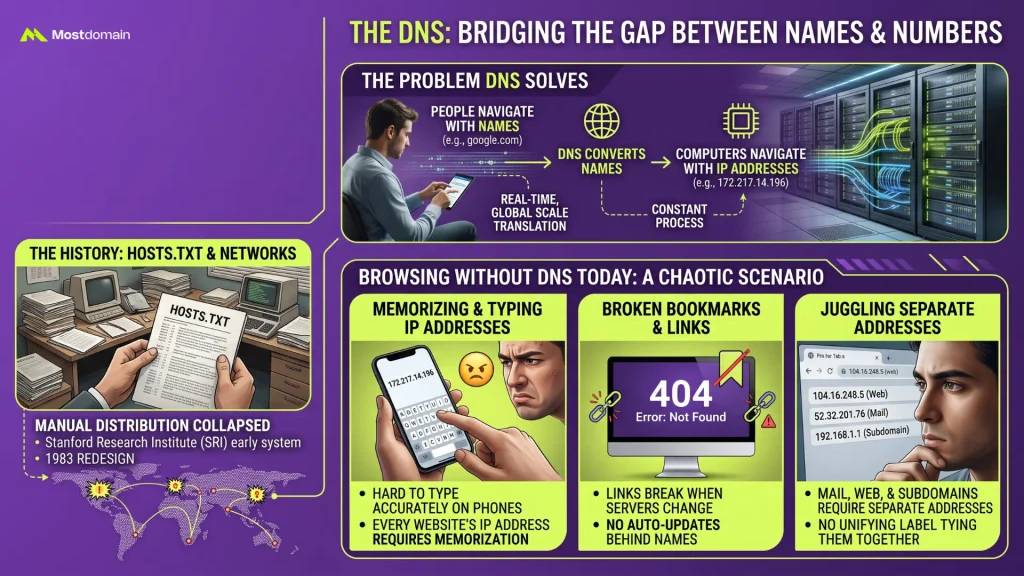
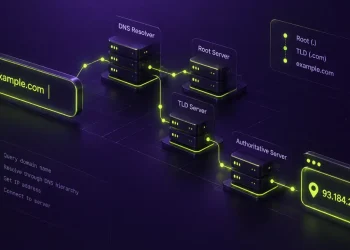
DNS exists to solve a matching problem: computers navigate the internet using numeric IP addresses, while people navigate it using names, and something has to translate between the two constantly, in real time, at massive scale.
The Internet Before DNS Existed
A single shared file handled this translation before DNS came along, and it worked fine right up until it didn’t. Domain Name System Overview covers that full origin story, HOSTS.TXT, Stanford Research Institute, the 1983 redesign, in detail. The short version: manual file distribution collapsed the moment the network grew past a few hundred connected machines.
What Browsing Would Look Like Without DNS Today
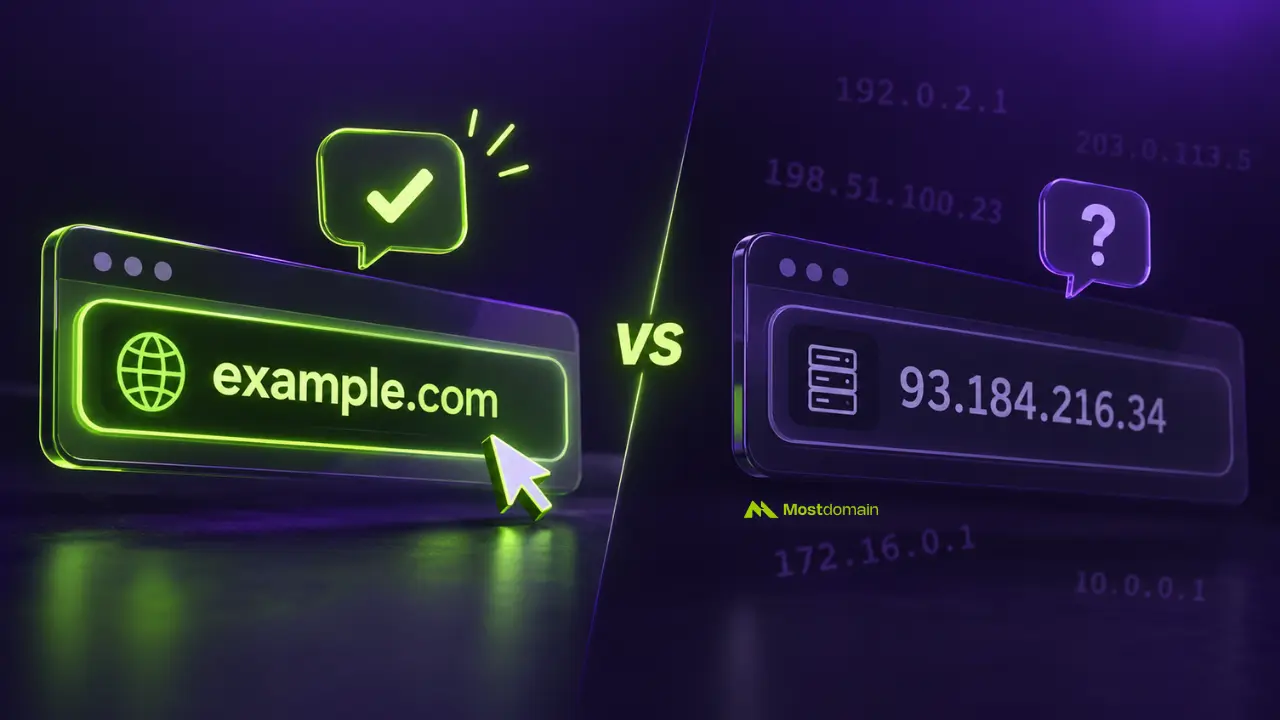
Type 172.217.14.196 into a browser instead of google.com, then imagine doing that same thing for every site, app, and service that depends on the internet. Today’s internet would genuinely demand exactly that, with DNS pulled out from underneath it.

- No exceptions here: every website’s IP address would need to be memorized or written down somewhere
- Bookmarks and shared links would break the instant a server changed, since nothing would auto-update behind them
- Mail, web, and a subdomain all running under one domain would mean juggling separate addresses with no unifying label tying them together
- Typing numeric strings accurately on a phone keyboard is hard enough that mobile browsing alone would take a serious hit
Exaggeration doesn’t factor into any of this. That’s more or less exactly what browsing looked like in the earliest days of networked computing, back before naming systems existed at all.
The Real Reason Humans Need DNS at All
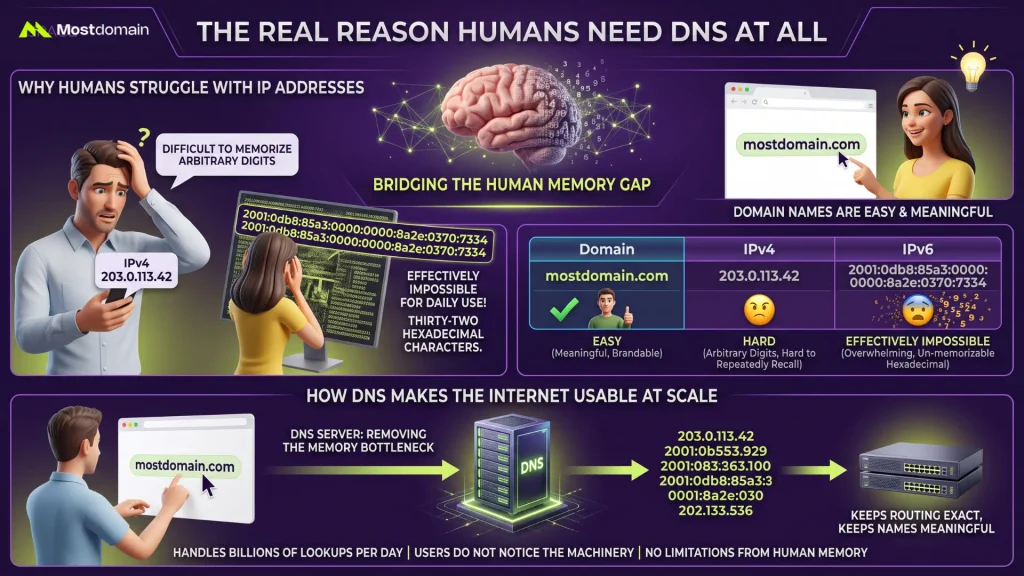
Human memory is bad at holding onto arbitrary numbers, and DNS exists partly because that limitation isn’t going away no matter how tech-savvy someone becomes.
Why Nobody Remembers IP Addresses
Trivial describes remembering mostdomain.com. Doing the same for 203.0.113.42, over and over for every site visited that day, is a much heavier ask on most brains, and IPv6 only widens that gap further.




| Address Type | Example | How Memorable It Is |
| Domain name | mostdomain.com | Easy, tied to meaning or brand |
| IPv4 address | 203.0.113.42 | Hard, arbitrary digits |
| IPv6 address | 2001:0db8:85a3:0000:0000:8a2e:0370:7334 | Effectively impossible for daily use |
IPv6 addresses close the argument on their own. Thirty-two hexadecimal characters isn’t something anyone memorizes casually just to check their inbox.
How DNS Makes the Internet Usable at Scale
Removing memory as a bottleneck entirely is what lets DNS handle billions of daily lookups without anyone noticing the machinery underneath. Names get to carry meaning. Routing gets to stay exact. Neither side has to give anything up for the other to work.
Why DNS Matters for Uptime and Reliability
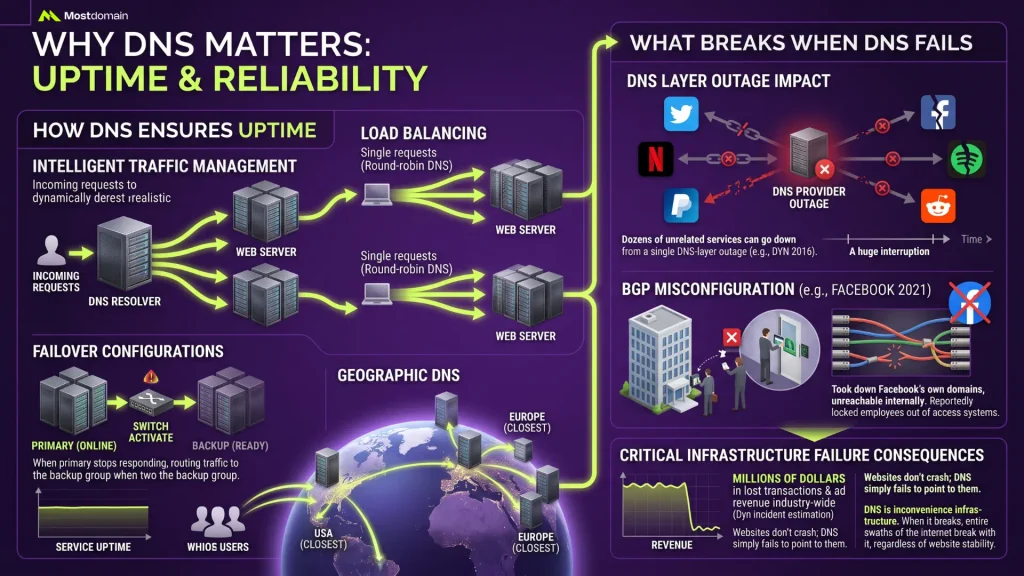
DNS does more than translate names, it actively keeps services online by directing traffic intelligently rather than sending every request to a single fixed address.
How DNS Enables Load Balancing and Failover
A domain isn’t limited to one IP address behind the scenes. Multiple servers can sit behind the same name, and DNS decides, request by request, which one actually answers.
- Automatic traffic spreading across several servers is what round-robin DNS does, easing the load any single machine has to carry
- Failover configurations route traffic to a backup server the instant a primary one stops responding
- Geographic DNS routing sends visitors to whichever server sits physically closest, cutting latency without the user doing anything
- None of this would be possible if a domain had to point at exactly one hardcoded address forever
What Actually Breaks When DNS Fails
Dozens of unrelated services can go down at once from a single DNS-layer outage, not just one website, and that’s precisely what the 2016 attack on Dyn, a major DNS provider, demonstrated on a massive scale.
- For hours, Twitter, Netflix, PayPal, Spotify, and Reddit sat dark, not from any failure on their own servers but because the DNS provider they all shared got knocked offline
- A DNS-related BGP misconfiguration is what took down Facebook’s own domains in 2021, unreachable even internally, reportedly locking employees out of building access systems tied to that same network
- Neither incident involved a website actually crashing; both involved DNS simply failing to point anywhere at all
- A five-hour outage at this scale translates into millions of dollars in lost transactions and ad revenue industry-wide, based on public estimates following the Dyn incident
That’s the uncomfortable part most explainers skip. DNS isn’t just convenience infrastructure. When it breaks, entire swaths of the internet break with it, regardless of how solid the actual websites behind it are.
How DNS Keeps Email and Multiple Services Running
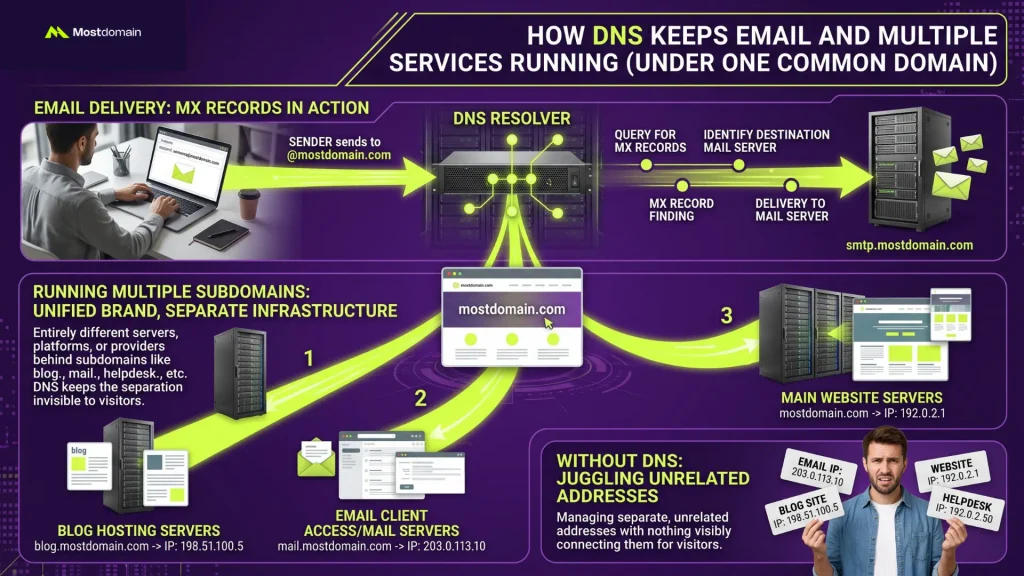
A single domain routinely runs several services at once, and DNS is the only reason a browser, an email client, and a subdomain-hosted app all know where to send their respective traffic.
How Email Delivery Relies on DNS Behind the Scenes
Knowing which mail server actually accepts messages for [email protected] is a question MX records inside DNS answer instantly, every time, with the sender never once having to think about it.
Why One Domain Can Run Many Services at Once
Entirely different servers, hosting platforms, or providers can sit behind blog.mostdomain.com, mail.mostdomain.com, and mostdomain.com itself, all while DNS keeps that separation invisible under one recognizable brand. Strip DNS out of the picture, and running a website plus email plus a helpdesk under one identity turns into juggling separate, unrelated addresses with nothing visibly connecting them for visitors.
Why Security and Trust Depend on DNS
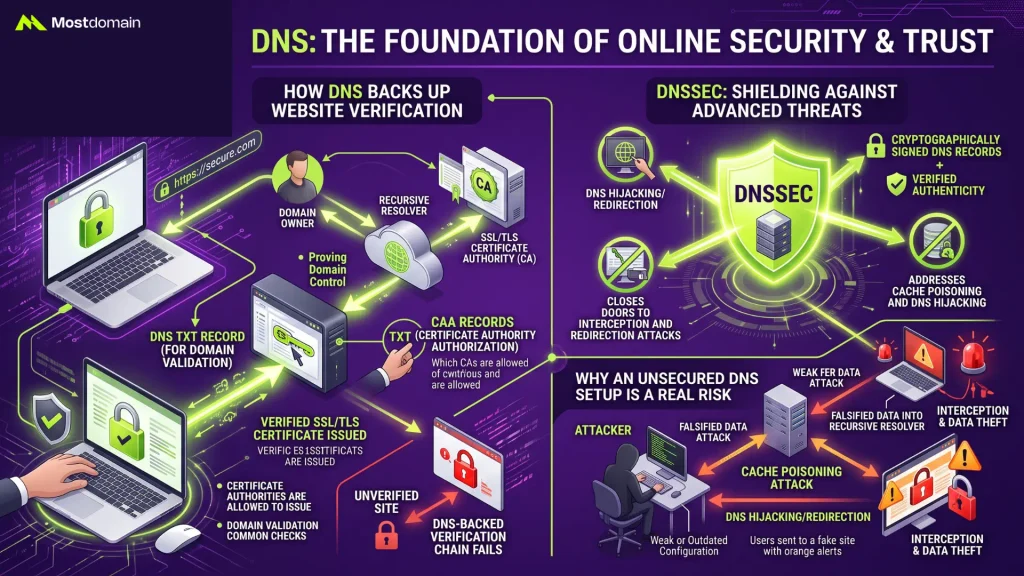
Security online leans on DNS more than most users realize, since verifying that a server is actually who it claims to be usually starts at the DNS layer before anything else happens.
How DNS Backs Up Website Verification
Proving control over a domain’s DNS records is typically step one in issuing an SSL/TLS certificate, and that exact requirement is what stops a random third party from getting a valid certificate for a domain they don’t own.
- Which certificate authorities are even allowed to issue certificates for a domain gets specified through CAA (Certification Authority Authorization) records
- Domain validation for SSL certificates commonly checks for a specific DNS TXT record placed by the domain owner
- Without this DNS-level check, certificate issuance would rely entirely on trust, with far less proof behind it
- Browsers flag sites without valid certificates specifically because that DNS-backed verification chain didn’t check out
Why an Unsecured DNS Setup Is a Real Risk
Weak or outdated DNS configuration opens the door to interception and redirection attacks that DNSSEC and other safeguards exist specifically to close. Domain Name System Overview goes deep on cache poisoning, DNS hijacking, and how DNSSEC addresses both, for anyone wanting the full technical breakdown.
Why DNS Was Never Meant to Be Centralized
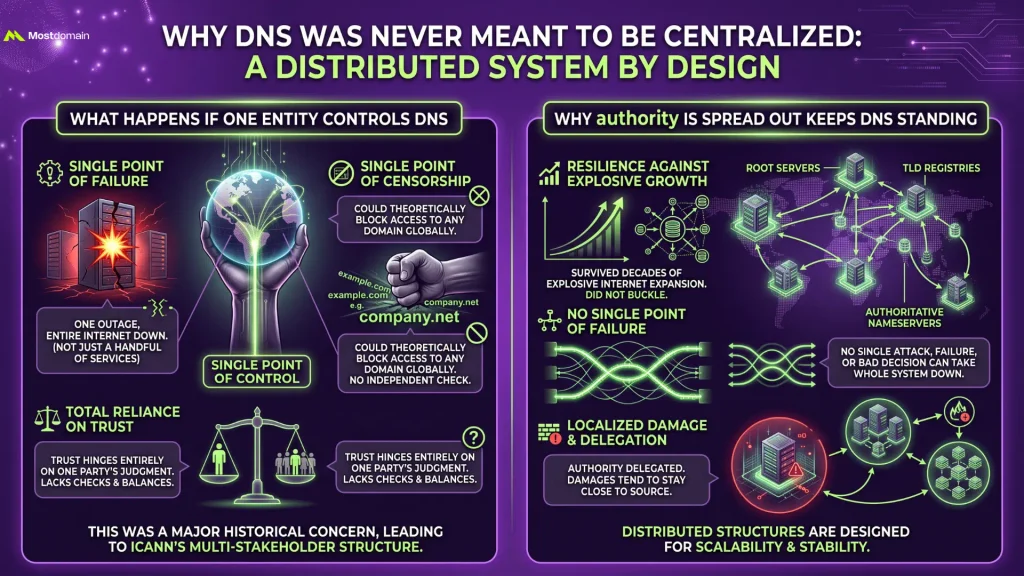
On purpose, DNS was built as a distributed system, and that one design decision explains a lot of why the internet hasn’t buckled under its own weight through decades of explosive growth.
What Would Happen If One Entity Controlled DNS
A single point of control over DNS would mean a single point of failure for the entire internet, and a single point of censorship power too, depending on who held that control.
- One company or government controlling the root zone could theoretically block access to any domain globally, with no independent check on that decision
- A single outage at that one point of control would take down the entire internet, not just a handful of services
- Trust in the system would hinge entirely on one party’s judgment, rather than being distributed across independent registries and operators
- ICANN’s structure as a multi-stakeholder nonprofit, rather than a government agency or private company, exists largely because of this exact historical concern
Why Spreading Out Authority Keeps DNS Standing
No single failure, attack, or bad decision can take the whole system down at once, precisely because authority gets delegated across root servers, TLD registries, and individual authoritative nameservers. Whatever damage does occur tends to stay close to wherever it started.
Why Businesses Can’t Afford to Ignore DNS
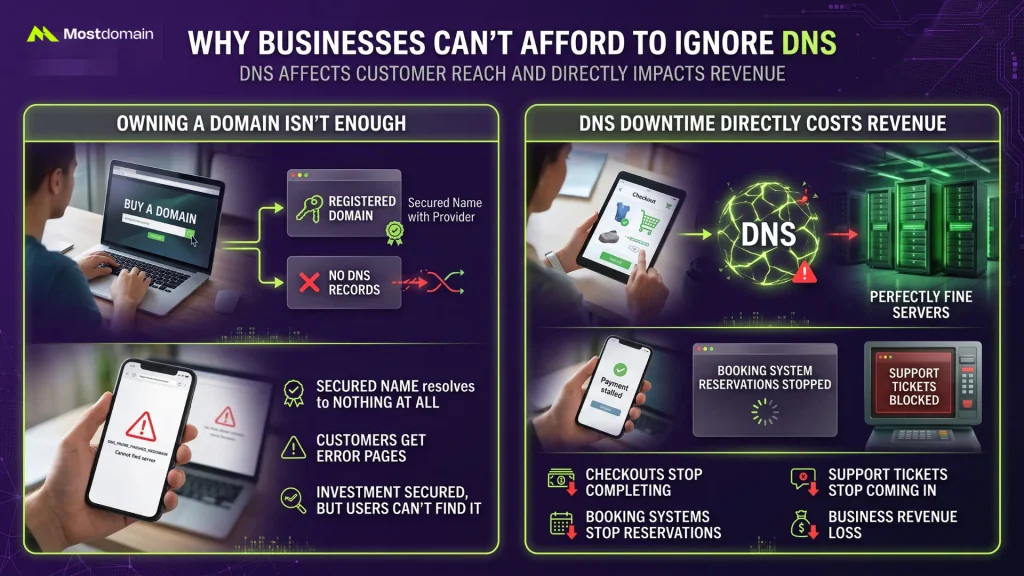
DNS configuration directly affects whether customers can actually reach a business online, which makes it a lot closer to a revenue concern than an IT footnote most companies treat it as.
Why Owning a Domain Isn’t Enough Without DNS
A registered domain sitting with no DNS records configured resolves to nothing at all, meaning customers get an error page instead of a working website, regardless of how much was spent securing the name itself.
Why DNS Downtime Directly Costs Revenue
Checkouts stop completing, booking systems stop taking reservations, and support tickets stop coming in the second DNS resolution breaks for a business domain, and all this while the actual servers behind it stay perfectly fine the whole time.
FAQ
Is DNS the same thing as web hosting?
A website’s files live at hosting; DNS is the separate piece telling browsers where that hosting actually sits. Registering a domain at one company, hosting it at another, and managing its DNS through a third party entirely is a completely normal setup.
Can the internet function without DNS at all?
Technically, raw IP addresses would still work. Practically, not at any scale people use the internet today. Even memorizing addresses for a handful of daily sites stops being realistic fast, let alone thousands.
Why do big companies use multiple DNS providers?
Redundancy drives that decision more than anything else. A secondary DNS provider keeps resolving requests if the first one suffers an outage, which is exactly the setup that would have softened the blow during something like the 2016 Dyn attack.
Does DNS affect website speed?
To a meaningful degree, yes. Page load time includes DNS lookup time as part of the total, and features like geographic routing and caching exist specifically to keep that lookup as fast as it can possibly be.
Who decided the internet needed DNS in the first place?
Paul Mockapetris gets that credit, designing DNS in 1983 to replace a single shared text file that had stopped scaling with ARPANET’s growth. Optional isn’t the right word for how that need arrived; the old system was already buckling under its own weight by that point.
References
- Cloudflare, What Is DNS? | How DNS Works
- LARUS, Why Do We Need the Domain Name System
- ClouDNS, Why do we need Managed DNS?
- Segue Technologies, Domain Name System: What Is It and Why Do We Need It?