
Calculating baseline market rates allows you to establish a firm financial ceiling before securing your online presence. You should anticipate a standard, newly minted .com to carry a domain name cost per year between $10 and $20.
This recurring fee covers the registrar’s administrative overhead plus the mandatory $0.18 annual levy required by the Internet Corporation for Assigned Names and Numbers (ICANN), the regulatory body overseeing global internet infrastructure. Prices fluctuate wildly based on your chosen extension and the specific history of the asset. Standard endings maintain predictable pricing, while niche TLDs or pre-owned digital real estate operate under entirely different economic models.
Average Domain Name Cost Per Year
| Domain Category | Typical Annual Cost Range | Primary Use Case |
| Standard .com | $10 – $20 | Global commercial brands and mainstream entities |
| Legacy .net / .org | $12 – $22 | Networks, technical platforms, and non-profits |
| Country Codes (ccTLDs) | $15 – $60+ | Geo-targeted ventures (e.g., .sg, .de) |
| New gTLDs | $30 – $120+ | Industry-specific branding (e.g., .app, .guru) |
| Premium & Aged Domains | Variable + Renewal | Immediate authority and SEO advantages |
Distinguishing between raw registrations and established assets is mandatory. Premium aged domains command higher upfront acquisition prices because they possess pre-existing authority and historical data. When exploring this niche, specialist platforms like the Singapore-based marketplace Mostdomain focus on these assets. Here, the premium value manifests as a one-time acquisition price, sparing you from inflated annual renewal cycles.
Why Renewal Expenses Usually Outpace Registration
Stop assuming your initial payment covers your long-term commitment. Providers bait you with cheap entries. They harvest profits later. Expect your budget to fracture once the introductory window slams shut. That two-dollar hook quickly transforms into a twenty-dollar burden because the standard domain name cost per year is hidden behind deceptive marketing.
Investigate these specific variables before clicking purchase:
Year-1 vs. Renewal Price
Verify the actual post-promotion rate. Never rely on the bold, front-page digits that expire after twelve months.

Auto-Renewal Terms
Identify if the system mandates a recurring charge at the inflated price point. Prevent surprise debits by auditing these settings immediately.
WHOIS Privacy Fees
Distinguish between permanent identity protection and short-term trial offers. Many firms charge extra for basic data concealment once the grace period ends.
Transfer-Out Fees
Demand clarity regarding your portability. Rogue registrars impose steep exit taxes to trap your digital property under their control.




Multi-Year Discounts
Secure your investment by paying for a multi-year block. This strategy locks in existing rates and shields your wallet from sudden corporate price hikes.
How Domain Extensions Dictate Annual Expenses
The Top-Level Domain (TLD), the suffix following the dot, functions as the engine driving your ongoing digital overhead. Registry operators set their own wholesale rates, meaning the underlying technology and market demand dictate the retail price. Extensions linked to artificial intelligence, such as .ai, have seen massive hikes in yearly costs due to intense global interest, often exceeding $100 annually.
- Legacy Generic: (.com, .net, .org) Priced at $10–$22. Best for general credibility.
- Country Code: (.sg, .io, .co) Priced at $30–$90. Ideal for localized branding.
- Industry Specific: (.ai, .tech, .finance) Priced at $60–$150+. Necessary for niche positioning.
- New Generics: (.club, .online, .site) Priced at $25–$70. Useful when .com inventory is depleted.
- Aged .com: Standard renewal. Best for bypassing search engine sandboxes immediately.
Selecting a trendy extension to save pennies usually backfires. Users often ignore obscure suffixes, and your brand suffers as a result. Investing in a premium, aged .com through a platform like Mostdomain represents a superior long-term strategy. You inherit decades of digital trust while avoiding the high-maintenance, recurring costs associated with weaker, trendy extensions.
Neglected Budget Burdens
Acquiring a digital address serves merely as the initial step. Operational websites demand secondary utility subscriptions that regularly inflate your total expenditure. Anticipate these hidden charges to safeguard your capital from unwelcome fiscal shockwaves while factoring in your expected domain name cost per year.
WHOIS Privacy Protection
This mechanism shields your private contact details from global databases. Avoid vendors who demand payment for this service; premium providers bundle it at zero extra charge.
Domain Security Features
Specialized safeguards like Registry Lock thwart malicious attempts to hijack your assets or reroute traffic. Relying on basic security is a gamble.
Professional Email Hosting
Branding your communications via a personalized address requires consistent monthly investments. Free alternatives rarely project the authority your enterprise demands.
SSL Certificates
Data encryption is non-negotiable. While superior hosting packages include these credentials, predatory registrars occasionally inflate bottom lines with unnecessary annual premiums for security tokens.
Domain Parking Fees
Keeping dormant assets in your portfolio invites maintenance levies. Certain platforms impose monetization penalties once your holdings remain stagnant.
Transfer Fees
Relocating an established digital property triggers mandatory renewal cycles. Expect to pay for an additional twelve-month registration period during every migration.
Raw Registration vs. Aged Assets: The Long-Term Reality
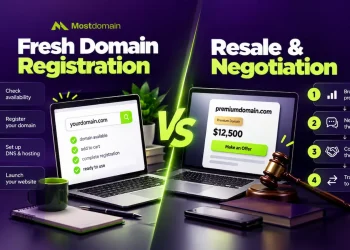
Total cost of ownership outweighs the initial checkout total. A fresh registration seems cheap, but you start from zero. You will hemorrhage capital on SEO, backlink building, and content marketing just to earn a shred of visibility.
Conversely, a premium aged domain costs more upfront but provides instant financial leverage. Because these assets hold historical authority, they bypass the search engine “sandbox” entirely. For growing enterprises, Mostdomain stands out as a premier Asian resource for identifying these high-value assets. The traffic and reduced marketing spend from an aged domain often pay for the acquisition in the first year alone.
Tactics for Reducing Your Yearly Outlay
Slash your expenses by treating your digital assets like a high-stakes investment portfolio. Negligence bleeds capital.
1. Register Long-Term
Commit to five or ten-year cycles immediately. This maneuver insulates your budget from aggressive wholesale price hikes while stabilizing your domain name cost per year.
2. Compare Renewals
Ignore cheap introductory bait. Scrutinize the provider’s back-end fee structure instead. Most registrars trap users with exorbitant long-term rates after the honeymoon phase ends.
3. Prioritize Free Privacy
Demand total anonymity as a standard feature. Only select vendors that include WHOIS masking at zero additional charge.
4. Delete Upsells
Ruthlessly uncheck every pre-selected box. Ignore website builders, bloated hosting packages, and redundant email tools during the checkout sequence. These extras provide zero value for professional portfolios.
5. Maintain Auto-Renewal
Enable automated billing immediately. Losing a domain to expiration triggers predatory redemption fees that can reach triple digits. Never risk your ownership status for a manual oversight.
6. Calculate Marketing ROI
Recognize that acquiring an aged, established asset often yields a superior return. You save thousands in labor by skipping the years of foundational SEO work required to rank a fresh, unknown address.
FAQs
What is the average domain name cost per year?
Budget for a typical .com address between $10 and $20 annually. Prices fluctuate depending on your chosen registrar and the specific infrastructure support you require.
Why does the renewal price climb?
Registrars employ aggressive “loss leader” strategies to hook new clients. Once your initial term concludes, they pivot back to standard, significantly steeper rates.
Are free domains legitimate?
Sure. Hosting providers frequently bundle them. However, relying on these often sacrifices long-term security and that sense of professional credibility found with an independently owned, paid asset.
Why do premium domains cost more?
These digital real estate pieces possess brevity and high recall value. They function as historical powerhouses, delivering immediate brand equity and organic search traffic.
Does my TLD influence yearly costs?
Undeniably. Every registry sets unique wholesale pricing structures. Modern tech-focused extensions like .ai command a massive premium compared to legacy options.
How can I lower my long-term expenses?
Lock in multi-year registration agreements. Select registrars that publish transparent renewal matrices upfront and refuse those bloated, unnecessary premium service bundles.
Where can I find premium or aged domains?
Browse Mostdomain to secure vetted, high-authority web properties designed for aggressive commercial scaling.
Final Verdict
Mastering your digital overhead requires ignoring marketing gimmicks to focus on the total cost of ownership. Your choice of extension, registrar, and long-term renewal strategy dictates your structural investment.
Audit every cart for hidden upsells and verify post-promotional rates before paying. For those serious about growth, high-authority assets from marketplaces like Mostdomain provide the most efficient route to market dominance. Invest in a stable foundation to ensure your digital address drives actual, long-term performance.
References
- Berger, J. (2025, October 4). How much does a domain name cost? HubSpot Blog.
- Hardwick, J. (2024, May 15). How much does a domain name cost? (And how to get one free). Ahrefs Blog.
- Harkins, M. (2025, February 20). The definitive guide to domain security and hidden registration fees. Moz Blog.
- Semrush Team. (2025, November 12). The complete guide to website costs: What to budget for. Semrush Blog.
- Sufyan, M. (2026, January 8). Evaluating the ROI of aged domains vs. new domains for SEO. Backlinko.
- Verisign. (2026, April). The domain name industry brief (Q1 2026). Verisign Registry Insights.