
A company domain name is an internet address registered to a business, acme.com for example, that the business then hangs its website, staff email and online identity on. Jane at Acme writes from [email protected]. Customers reach the site by typing it. Google, Meta and a growing list of other platforms also check it before treating the business as legitimate.
Odd places use the phrase too. An app’s sign-in page might ask for it, so might an IT setup wizard, and so might the small print when a business gets sold. Each of those meanings gets covered below, along with ownership, which most definitions never get round to even though it’s exactly where companies lose their domains.
What Is a Company Domain Name?
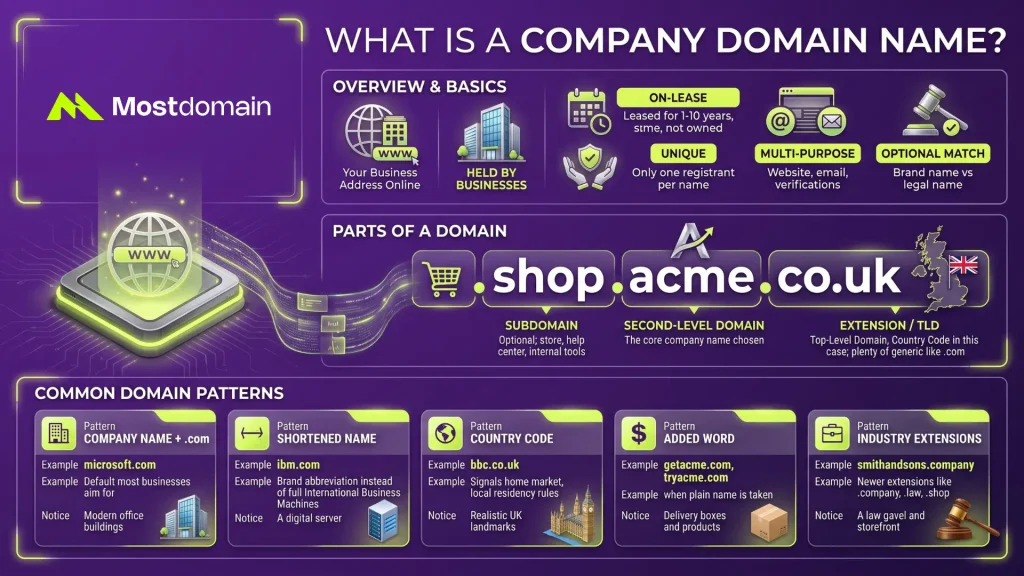
Held by a business instead of a person, a company domain name serves as that company’s address online. Under the hood it’s identical to any other domain. What sets it apart is who holds it and how many jobs it ends up doing.
- Nobody buys one outright. Registrars lease it for anywhere between one and ten years, and the business keeps renewing for as long as it wants the name.
- Two bakeries called Acme can’t both hold acme.com. One registrant per name, at any given moment.
- Matching the company name is common but optional; lots of famous brands go shorter.
- In most small companies the same domain handles the website, every staff inbox and a handful of platform verifications, all at once.
Parts of a Company Domain Name
Two parts at minimum, the name and the extension, with an optional subdomain sometimes sitting in front. Taking shop.acme.co.uk apart:
| Part | In shop.acme.co.uk | What it does |
| Subdomain | shop | Optional. The company creates these itself for sections like a store, help center, or internal tools, with no extra registration needed |
| Second-level domain (the name) | acme | The part the company picked and registered |
| Extension, or top-level domain (TLD) | .co.uk | A UK country code (ccTLD) in this case. Plenty of companies use generic .com instead |
So acme.co.uk is the company domain name here, and whatever the company puts to its left (shop, help, mail) comes free with it.
Company Domain Name Examples
Most company domains follow one of a handful of patterns, and the table shows how differently businesses handle the same basic decision.

| Pattern | Example | Worth noticing |
| Company name + .com | microsoft.com | The default most businesses aim for first |
| Shortened or brand name | ibm.com | The legal name is International Business Machines Corporation, and nobody types that |
| Country code | bbc.co.uk | Signals a home market. Some ccTLDs have local residency rules |
| Added word | getacme.com, tryacme.com | Common when the plain name was already taken |
| Industry extension | smithandsons.company | Newer extensions like .company, .law, or .shop |
Company Domain Name vs Similar Terms
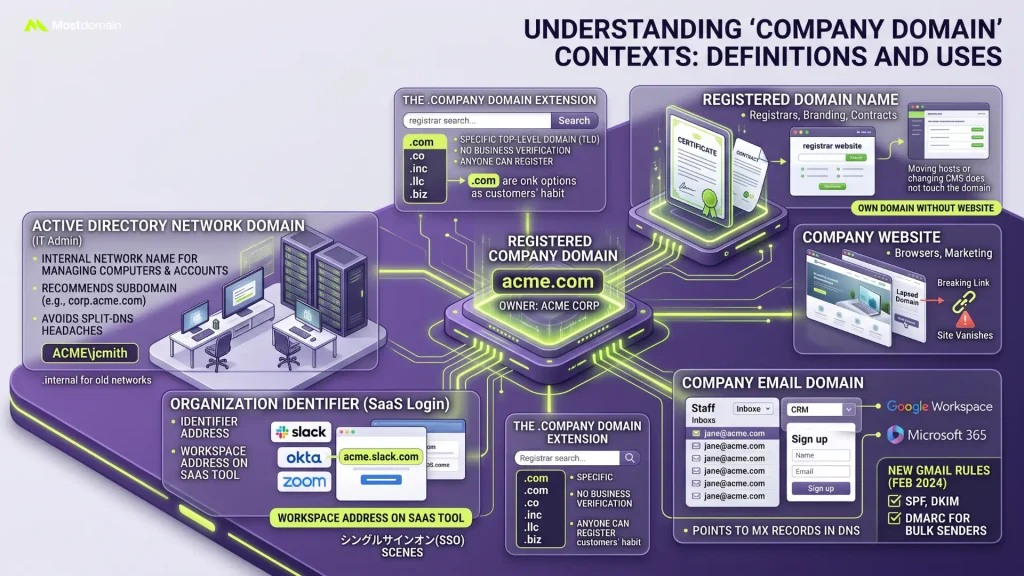
“Company domain” means slightly different things depending on who’s asking. A marketer, a sysadmin, and a lawyer could each use the phrase in the same week and mean three separate things.
| Term | What it means | Where you’ll see it |
| Company domain name | The registered domain the business owns | Registrars, branding, contracts |
| Company website | The site that loads at that domain | Browsers, marketing |
| Company email domain | Everything after the @ in staff email addresses | Email, CRM fields, sign-up forms |
| Active Directory domain | An internal network name for managing company computers and accounts | Windows logins, IT administration |
| Login “company domain” | Your organization’s identifier or workspace address on a SaaS tool | Slack, Okta, Zoom, other single sign-on screens |
| .company | A specific domain extension | Registrar search results |
Company Domain vs Company Website
A website lives at the domain; the domain itself is only the address. You can own one without the other.
- A company domain name can exist with no website at all, used only for email.
- Moving from WordPress to Shopify, or to a new host, doesn’t touch the domain at all.
- Let the domain lapse, though, and the site vanishes from that address. Its files are still sitting on a server somewhere; visitors just can’t get to them.
What Is a Company Email Domain?
Everything after the @ in a work address. In [email protected] that’s acme.com, and in nearly every business it’s the same as the company domain name.




- Where mail actually lands depends on MX records in the domain’s DNS, usually pointed at Google Workspace or Microsoft 365.
- A gmail.com address says nothing about where someone works, which is why “company email” fields on sign-up forms often block it.
- Gmail tightened its rules in February 2024. Every sender now needs SPF or DKIM on the sending domain, and bulk senders (over 5,000 messages a day to Gmail) need DMARC as well. A company email domain without those records struggles to reach inboxes.
Company Domain in Windows and Active Directory
In IT, the company domain is often the name of the internal Active Directory network that staff computers log into. Ideally, it borrows from the public company domain name without copying it outright.
- A subdomain such as corp.acme.com is what Microsoft recommends, rather than reusing acme.com itself.
- Lots of networks set up years ago ended in .local, a choice Microsoft now advises against. If a subdomain isn’t practical, it suggests .internal instead.
- Reusing the exact public domain internally creates split-DNS headaches, where staff inside the office can’t reach the company’s own website.
- If a login screen shows something like ACME\jsmith, “ACME” is the short (NetBIOS) version of that internal domain name.
When a Login Screen Asks for Your Company Domain
The app is trying to figure out which organization’s account to sign you into. Usually, one of these answers works:
- Your company email domain, like acme.com. That alone is often enough for single sign-on tools to send you to the right login page.
- A workspace address your company set up, acme.slack.com or acme.okta.com for instance (Zoom uses acme.zoom.us). Many of these only want the first bit, acme.
- Not sure? Look at the address bar the last time you logged in successfully, or ask your IT team. Guessing tends to land you on another company’s login page.
The .company Domain Extension
.company is a generic top-level domain launched during ICANN’s expansion of extensions beyond .com, .net, and .org. It’s one option for a company domain name, and it’s no more official than .com.
- Anyone can register one. There’s no business verification.
- It’s handy when the .com of your brand is taken, though customers still type .com by habit.
- Similar business-flavored extensions include .co, .inc, .llc, and .biz.
What a Company Domain Name Is Used For
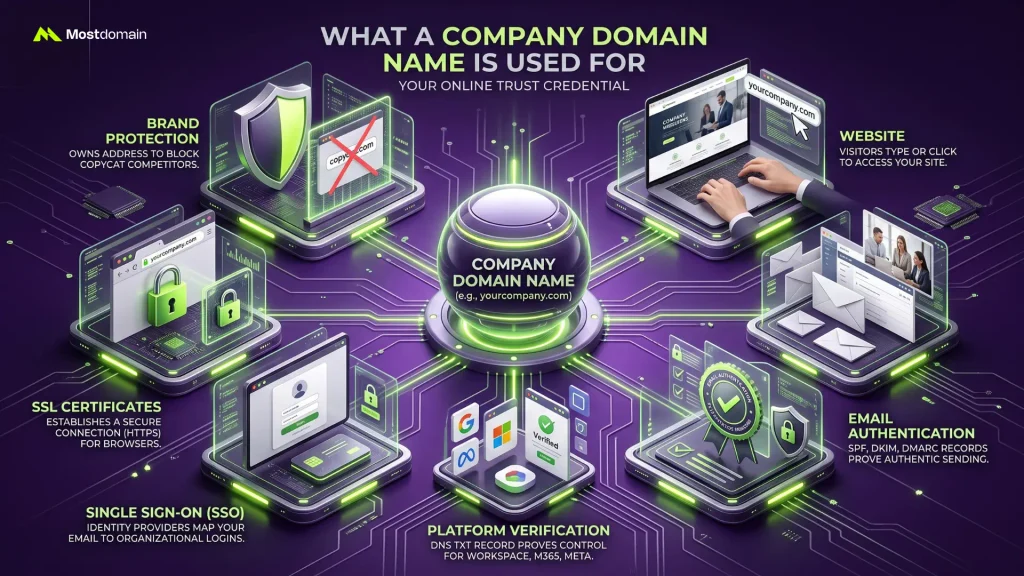
Past the website and email, a company domain name has quietly become a trust credential. A lot of platforms now use it to check that a business is real. Why a business needs one in the first place is covered in why you need a domain name for your business. The table below lists what it actually does day to day.
| Use | How the domain is involved |
| Website | Visitors type it or click through to it |
| Staff addresses and mail routing via MX records | |
| Email authentication | SPF, DKIM, and DMARC records published on the domain prove mail really came from you |
| Platform verification | A TXT record added to DNS is the usual proof of control for Google Workspace, Microsoft 365 or Meta Business |
| Single sign-on | Identity providers map your email domain to your organization’s login |
| SSL certificates | Issued specifically for the domain so browsers show a secure connection |
| Brand protection | Owning the domain blocks copycats from using that exact address |
Who Should Own a Company Domain Name?
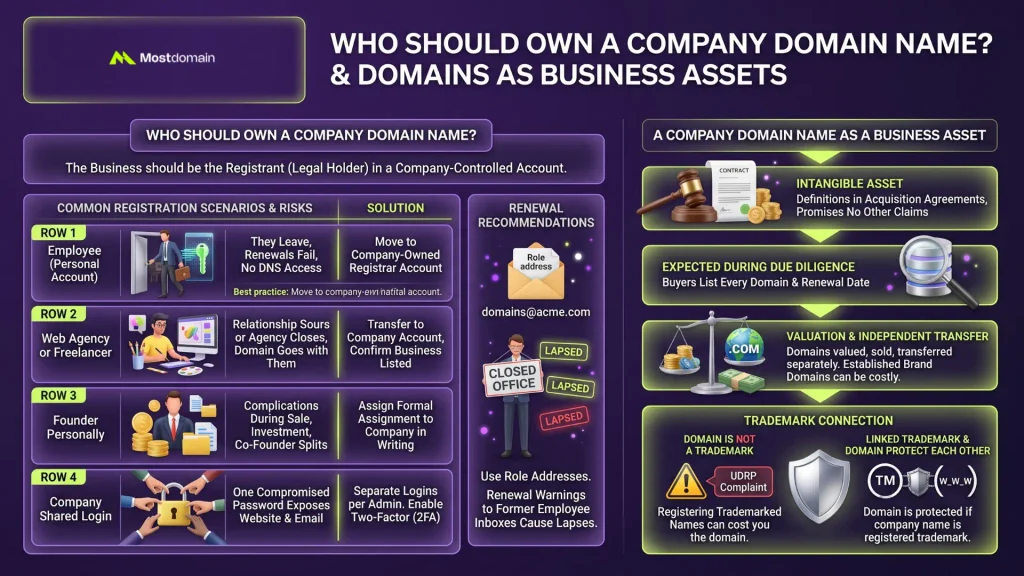
The business itself should be the registrant, meaning the legal holder listed in the registration record. It should sit in an account the company controls. In practice, a surprising number of company domains end up registered to whoever happened to buy them.
| Who registered it | What can go wrong | How to fix it |
| An employee, on their personal account | They leave, and nobody can log in to renew it or change DNS | Move it to a company-owned registrar account while they’re still around |
| The web agency or freelancer | The relationship sours, or they close shop, and the domain goes with them | Ask for the domain to be transferred to your own account, and confirm your business is listed as registrant |
| A founder, personally | Complications during a sale, investment round, or co-founder split | Assign it to the company formally, ideally in writing |
| The company, on a shared login | One compromised password exposes the website and email together | Separate logins per admin. Two-factor on all of them |
For registrar notices, a role address such as [email protected] beats any one person’s inbox. Renewal warnings sent to a former employee’s inbox are how working company domains end up lapsing.
A Company Domain Name as a Business Asset
A company domain name is an intangible asset, and it’s treated as one once money changes hands. Acquisition agreements routinely define “Company Domain Names” and ask sellers to promise nobody else claims them.
- In a sale or investment, buyers expect a list of every domain the business owns, along with renewal dates.
- Domains can be valued, sold, and transferred separately from the company, which is why an established brand’s .com sometimes costs more than a small business.
- A domain doesn’t give you trademark rights on its own. Registering a trademarked name can actually cost you the domain through a UDRP complaint.
- If the company name is also a registered trademark, the domain and the trademark protect each other in practice.
How to Find a Company’s Domain Name
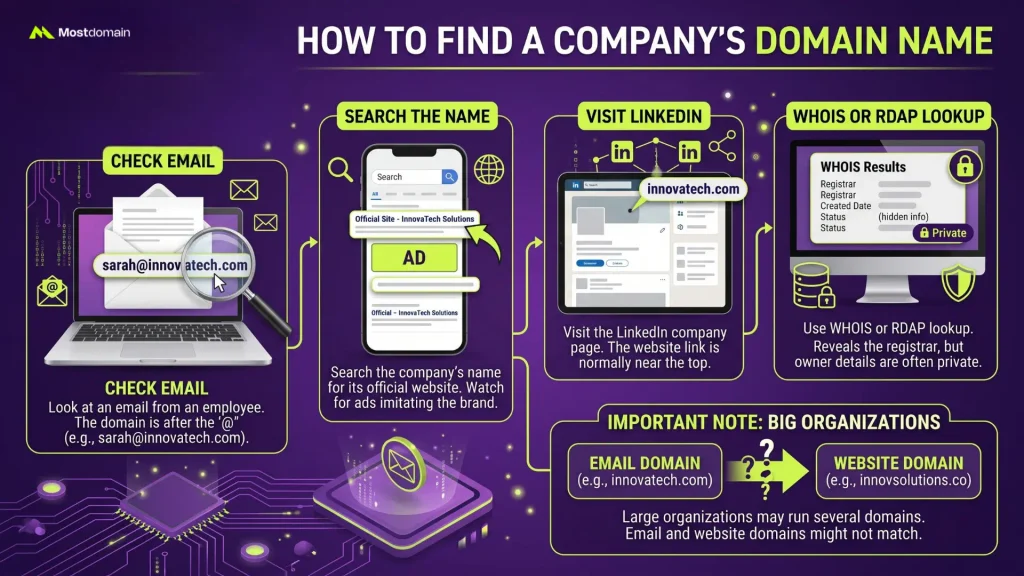
Most of the time the fastest route is the company’s own email or website. When that fails, a few other sources usually turn it up within a minute or two.
- Check an email from anyone who works there. The part after the @ is almost always the company domain name.
- Search the company’s name and look for its official site. Watch for ads imitating the brand.
- On LinkedIn, the company page normally has the website link near the top.
- A WHOIS or RDAP lookup reveals the registrar. Owner details are often hidden, though, since many registrants use private registration.
- Big organizations sometimes run several domains. Their email domain and website domain might not match.
How to Protect a Company Domain Name
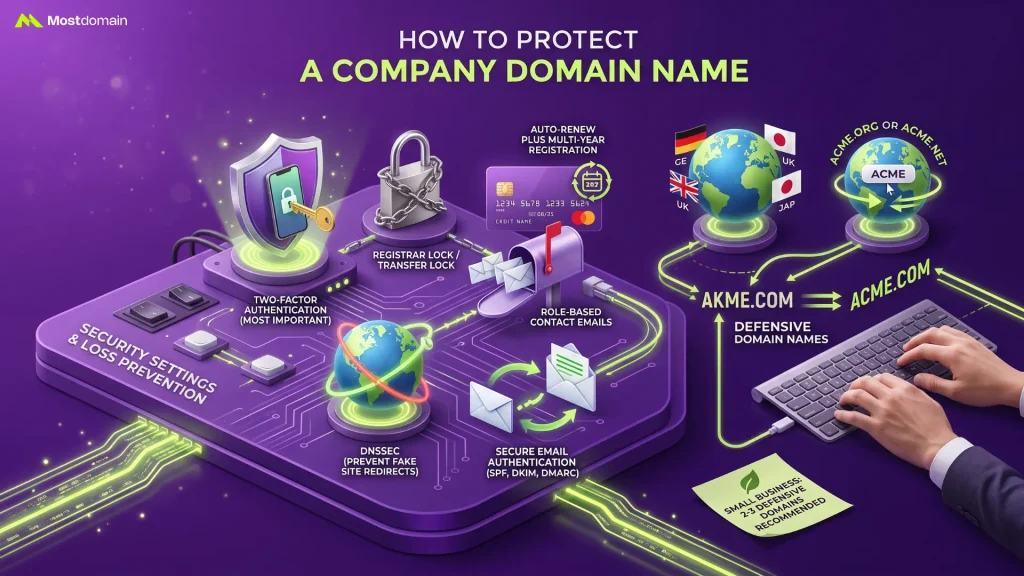
Most company domain losses come from missed renewals and hijacked accounts, and neither has anything to do with sophisticated attacks. A handful of settings closes most of the gaps.
- Auto-renew plus a multi-year registration. Two layers of safety, because an outdated payment card on file quietly kills more renewals than anything else.
- Registrar lock, which some registrars call transfer lock. With it on, nobody can move the domain elsewhere without your approval.
- If you only change one setting, make it two-factor authentication on the registrar account.
- Role-based contact emails, as covered above.
- DNSSEC is worth switching on where your registrar and DNS host support it; attackers then find it much harder to redirect visitors to a fake copy of your site.
- Publishing SPF, DKIM and DMARC records makes spoofed email from your domain a lot harder to pull off.
Defensive Company Domain Names
Many businesses register a few extra domains purely to keep them away from others. It’s cheap insurance, and it’s a judgment call how far to take it.
- Common misspellings of the company domain name, redirected to the real site.
- The .com if your main domain uses another extension, or vice versa.
- Country codes for markets you actually sell into.
- A small business rarely needs more than two or three. Our small business domain guide goes deeper on what’s worth buying.
How to Get a Company Domain Name
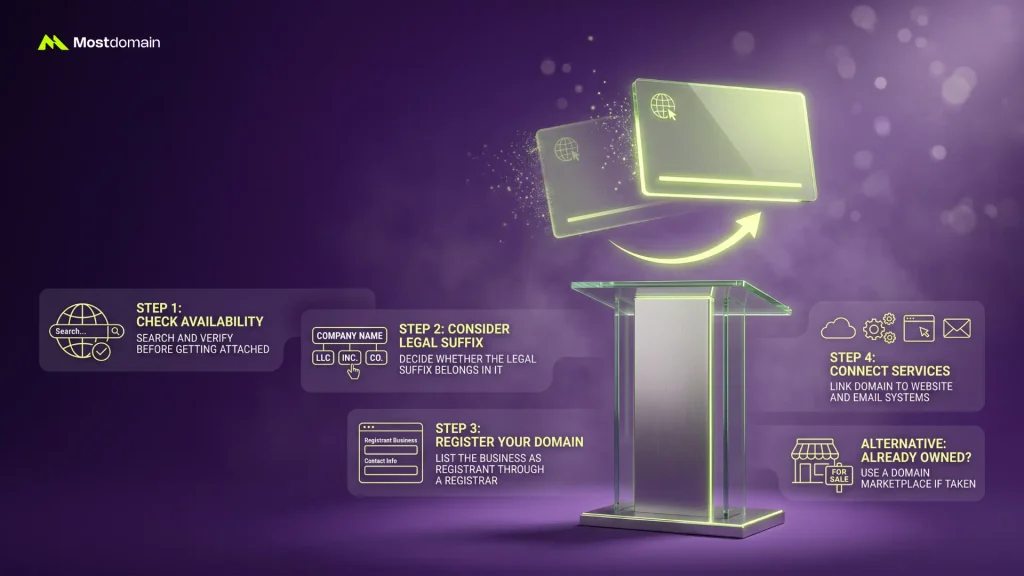
You search for an available name, register it in the company’s name through a registrar, and connect it to your website and email. Each step has its own guide:
- Check whether a domain name is available before you get attached to one.
- Decide whether the legal suffix belongs in it. See should you put LLC in your domain name.
- Follow the steps to register a domain name, listing the business as registrant.
- If the name you want is already owned, a domain name marketplace is where it’s most likely listed for sale.
FAQ
Is a company domain name the same as a company name?
Not always. The company name is legal and registered with the government, while the domain is registered with a registrar. Lots of businesses use a shorter or different domain because their exact name was taken or too long.
Can two companies have the same domain name?
Not with the same extension. acme.com has exactly one registrant at a time. Change the extension and it’s a different domain, so one Acme can own acme.com while another holds acme.io, which is a big part of why businesses tend to grab both.
Does a company domain name have to end in .com?
No. Any extension works, including country codes like .de or newer ones like .company. The catch is habit. People type .com without thinking, and some of that traffic ends up with whoever owns the .com version.
How much does a company domain name cost?
Registering a fresh .com usually costs somewhere around $10 to $20 a year. Names that someone else already owns can cost far more. There’s a full breakdown in what a domain name costs.
Can a company have more than one domain name?
Most established businesses have several. Usually there’s one primary domain doing the real work, with misspellings, extra extensions or country versions redirecting to it.
How long does a company domain name last?
As long as it’s renewed. Registrations run one to ten years at a time, and no domain is ever owned permanently. Stop renewing, and it eventually becomes available to anyone.
Can a business use Gmail instead of a company email domain?
It can, and plenty of very small businesses start that way. The trade-off shows up fast. Many B2B forms reject free email addresses, customers trust them less, and you can’t set up email authentication on a domain you don’t control.
References
- Google Gmail Help, Email Sender Guidelines
- Microsoft Learn, Active Directory Domain Name in Windows EBS
- Varonis, Best Practices for Naming an Active Directory Domain
- ActiveCampaign, Company Domain: Definition and Benefits
- Law Insider, Company Domain Name Definition
- Network Solutions, Should You Buy a .company Domain Name? Pros and Cons Explained
- Fit Small Business, What Is a Business Domain Name? A Quick Overview
- DomainWheel, Company Domain Name Generator