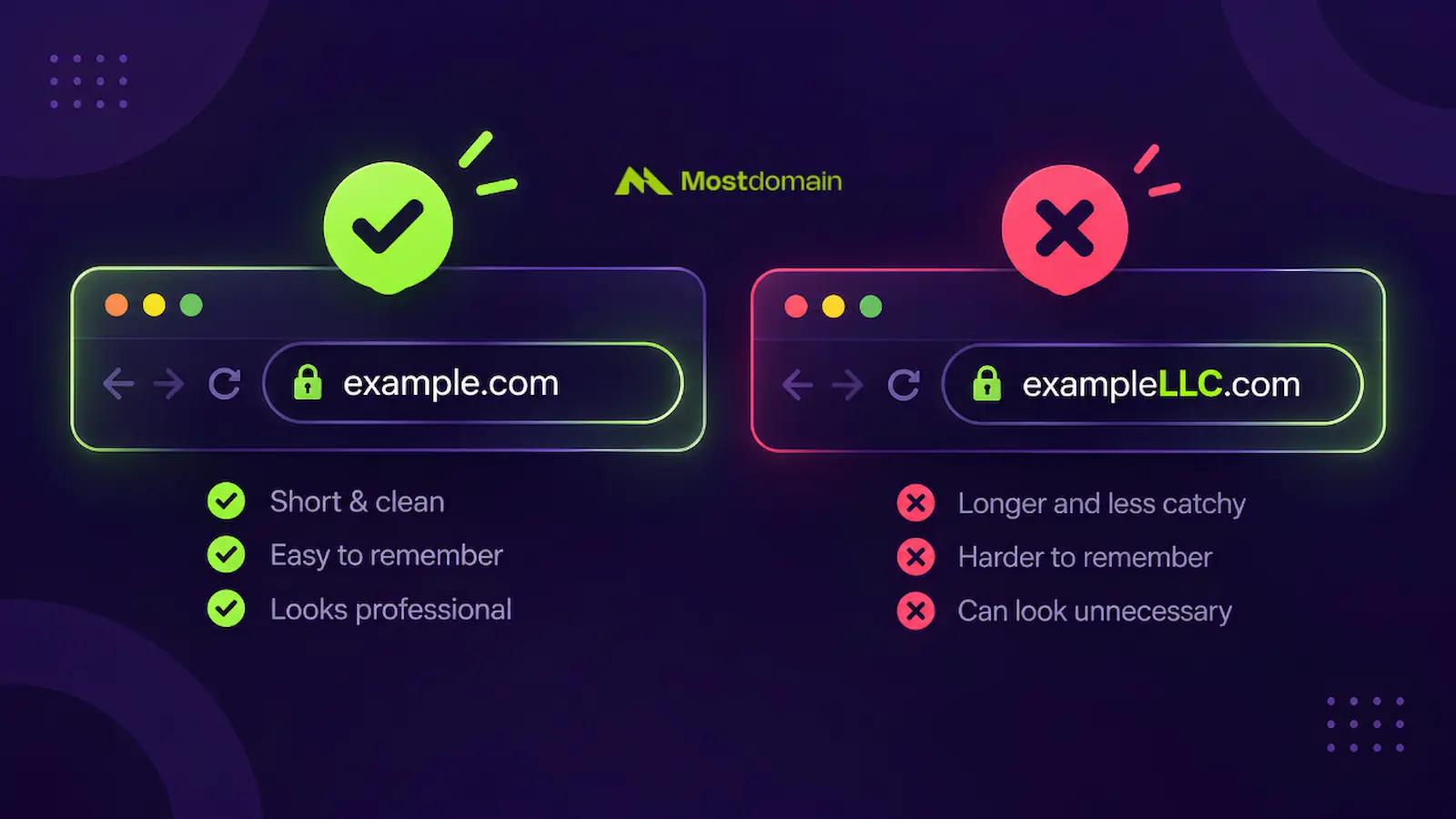
Most businesses should leave it out, and that’s the short answer to should you put LLC in your domain name. Nothing in the law requires it, it adds length without adding meaning, and customers searching for a business almost never type “LLC” as part of that search. A handful of specific situations flip that rule entirely, and those exceptions carry just as much weight as the general recommendation.
Most articles here stop short of the real confusion: a domain name, a legal business name, a trademark, and a DBA are four separate things. None of them are required to match. This one covers the full decision, the real exceptions, and who should actually own the domain once a name gets picked.
Nothing here wanders into anything else domain-related outside this specific naming decision. Just whether “LLC” belongs in the domain, when it doesn’t, and what to do instead.
Do You Legally Have to Put LLC in Your Domain Name
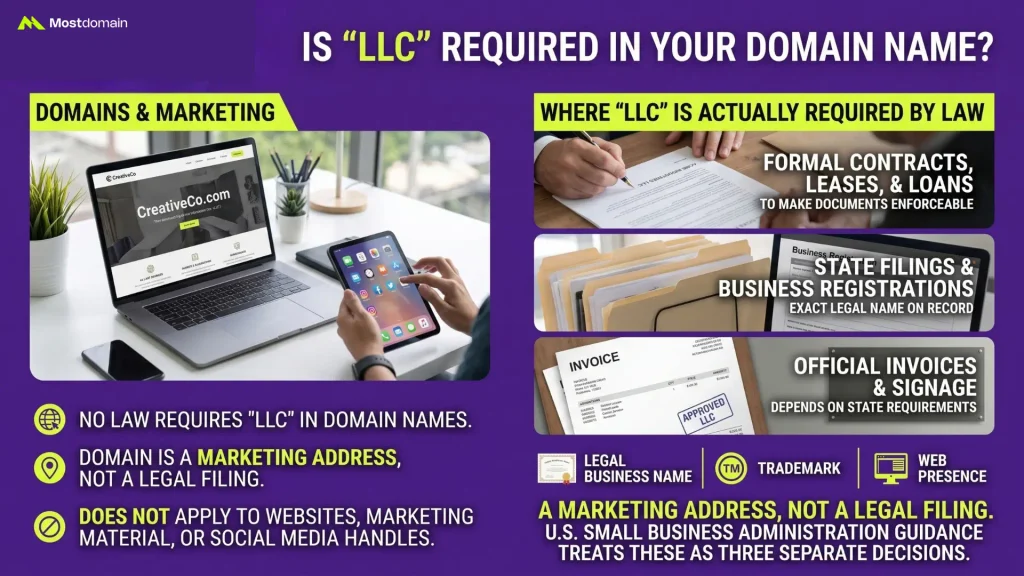
No law anywhere requires “LLC” to appear in a domain name, since a domain is a marketing address rather than a legal filing, and the two operate under completely different rules.
Where “LLC” Is Actually Required by Law
- Formal contracts, leases, and loan agreements typically need the full legal name, “LLC” included, to make the document enforceable
- State filings and business registration paperwork require the exact legal name on record
- Signage and official invoices often need the legal designation too, depending on state-level requirements
- None of these requirements extend to a website address, marketing material, or social media handle
A Marketing Address, Not a Legal Filing
Reaching a website is the entire job of a domain name, nothing more formal than that, and the U.S. Small Business Administration’s own guidance treats a legal business name, a trademark, and a web presence as three separate decisions rather than one bundled requirement.
Why Most Businesses Leave LLC Out
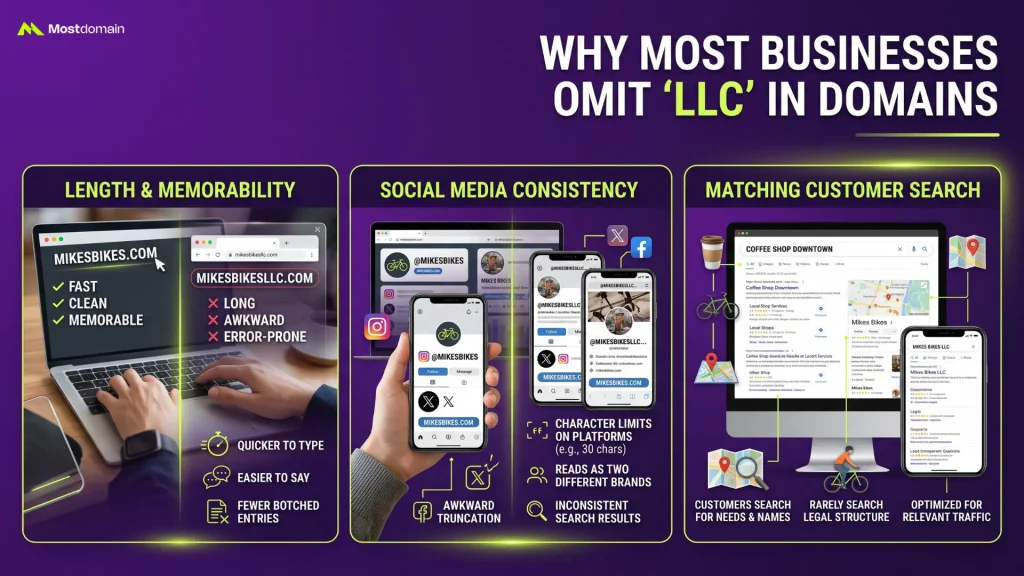
Length, memorability, and consistency across platforms, “LLC” tacked onto an otherwise clean domain costs all three at once. Most established companies skip it for exactly that reason.

How It Affects Length and Memorability
MikesBikes.com wins on every practical measure over MikesBikesLLC.com. Quicker to type. Easier to say out loud. Far less likely to get botched when someone shares it verbally or scribbles it down in a hurry.
The Social Media Handle Problem It Creates
- Character limits on platforms like Instagram and X often can’t accommodate a full business name plus “LLC” without truncating it awkwardly
- A domain carrying “LLC” next to a social handle without it ends up reading as two slightly different brands, not one
- Customers searching for a business by name run into inconsistent results depending on which platform they check first
- Keeping “LLC” out of both the domain and the handles from the start avoids this mismatch altogether
Why It Rarely Matches What Customers Actually Search For
Nobody searches for a legal structure. “Coffee shop downtown” or “mikes bikes” pulls in far more real volume than any query containing the word “LLC” ever could, because people search by recognizable name instead.
The Exceptions Worth Knowing
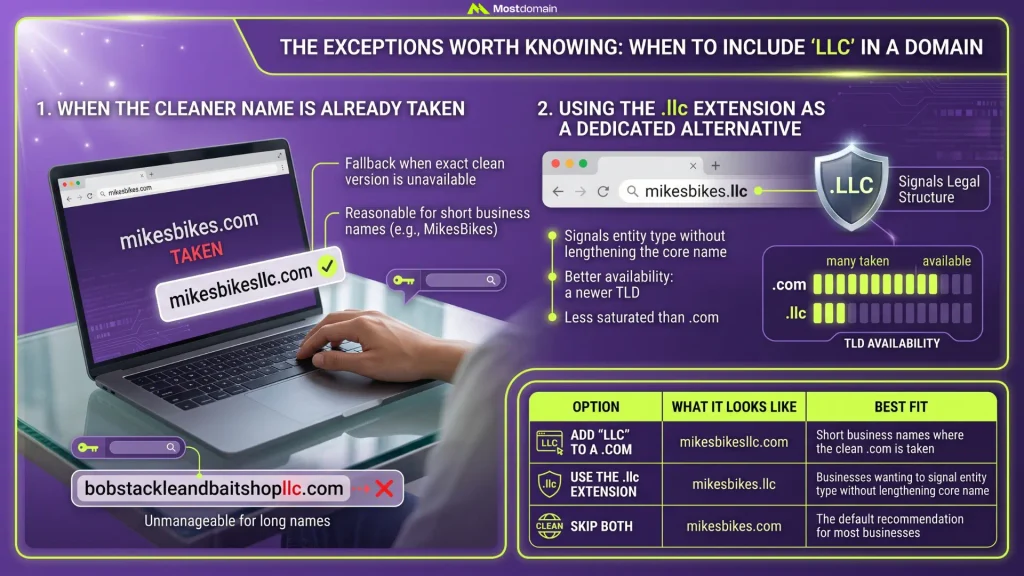
A handful of specific situations actually justify including “LLC” in a domain name, and both of them come down to availability rather than branding preference.




When the Cleaner Name Is Already Taken
Registering the “LLC” version becomes a reasonable fallback specifically when the exact, clean version of a business name is already registered by someone else, and no acceptable close variation is available either. A short name like MikesBikesLLC.com stays manageable; a long one like BobsTackleAndBaitShopLLC.com does not, so this workaround holds up better for already-short names than long ones.
Using the .llc Extension as a Dedicated Alternative
| Option | What It Looks Like | Best Fit |
| Add “LLC” to a .com | mikesbikesllc.com | Short business names where the clean .com is taken |
| Use the .llc extension | mikesbikes.llc | Businesses wanting to signal entity type without lengthening the core name |
| Skip both | mikesbikes.com | The default recommendation for most businesses |
The .llc extension exists specifically for this situation, letting a business signal its legal structure through the extension itself rather than stuffing it into the name. Availability tends to be better here too, since it’s a newer, less saturated TLD than .com.
Does Your Domain Name Have to Match Your Legal Business Name
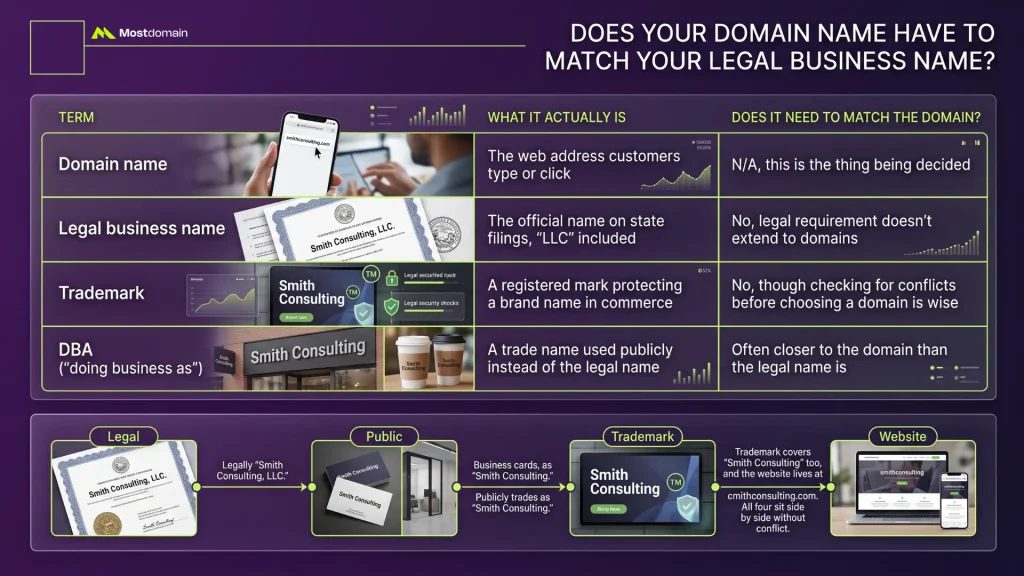
Treating a domain name and a legal business name as interchangeable is exactly where most of the confusion around this topic starts, since a domain name, a legal name, a trademark, and a DBA each serve a genuinely different purpose.
Four Terms People Constantly Mix Up
| Term | What It Actually Is | Does It Need to Match the Domain? |
| Domain name | The web address customers type or click | N/A, this is the thing being decided |
| Legal business name | The official name on state filings, “LLC” included | No, legal requirement doesn’t extend to domains |
| Trademark | A registered mark protecting a brand name in commerce | No, though checking for conflicts before choosing a domain is wise |
| DBA (“doing business as”) | A trade name used publicly instead of the legal name | Often closer to the domain than the legal name is |
Legally, it’s “Smith Consulting, LLC.” Publicly, it trades as “Smith Consulting.” The trademark covers “Smith Consulting” too, and the website lives at smithconsulting.com. All four sit side by side without a hint of conflict.
Who Should Actually Own the Domain: You or Your LLC
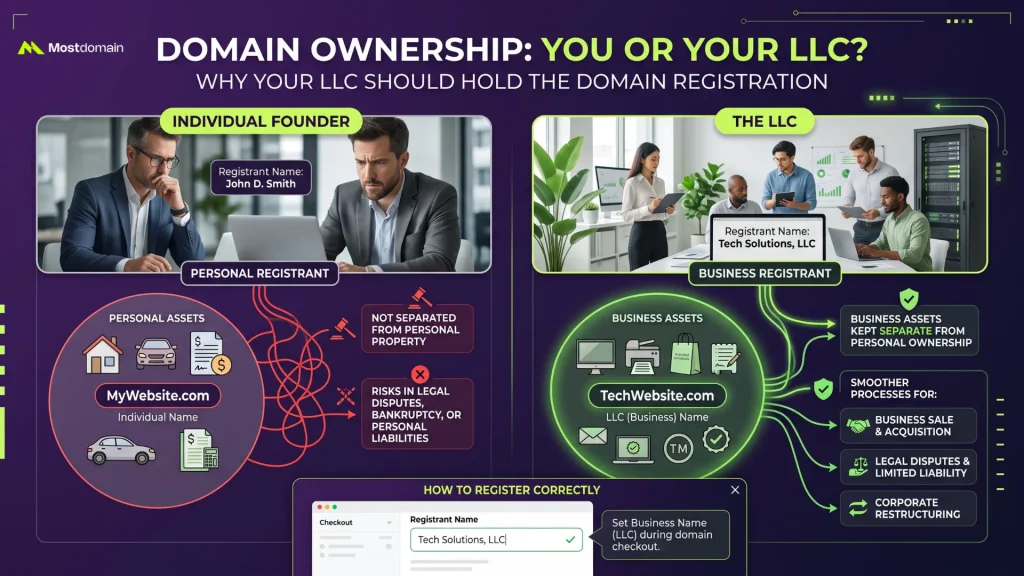
The LLC itself, not an individual founder personally, should hold the domain registration in nearly every case, since that keeps the business asset properly separated from personal ownership.
Keep the Registration Under the Business, Not a Person
A sale, a restructuring, a legal dispute down the road, any of these go smoother when the domain sits under the LLC from day one rather than an individual’s name, since that keeps a business asset properly separated from personal property. How to Register a Domain Name walks through setting the registrant field correctly during checkout, along with the broader implications of business versus individual registration.
Real Examples of How Companies Handle This
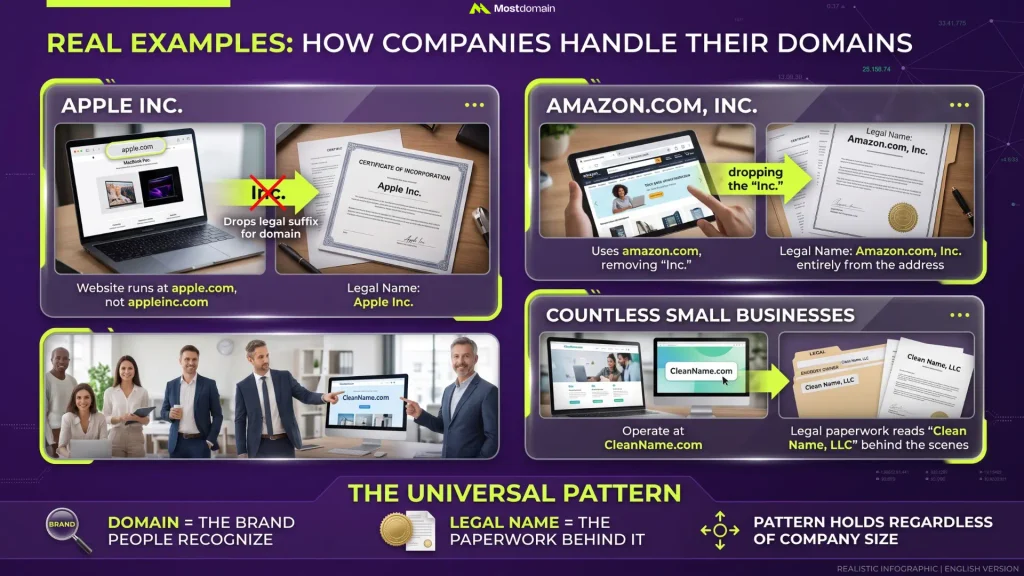
Checking how established companies actually structure their domains makes the pattern obvious almost immediately.
- apple.com, not appleinc.com, is where Apple Inc. runs its website
- Amazon.com, Inc. uses amazon.com, dropping the “Inc.” entirely from the address
- Countless small businesses operate at CleanName.com while their legal paperwork reads “Clean Name, LLC” behind the scenes
- The pattern holds regardless of company size: the domain reflects the brand people recognize, not the legal paperwork behind it
FAQ
Will including LLC in my domain name hurt my SEO?
Not directly, no, since “LLC” isn’t a ranking factor either way. Discoverability can take an indirect hit, though: almost nobody types “LLC” into an actual search query, so that portion of the domain does zero work toward attracting search traffic.
Can I change my domain name later if I registered it with LLC in it?
Nothing stops that. A fresh domain without “LLC” plus a redirect from the old one works fine, it just means two domains to manage going forward and proper redirects set up to hold onto existing traffic and backlinks.
Does my LLC need to own the domain for liability protection to apply?
Liability protection itself comes from the LLC’s formal legal structure, not from domain ownership specifically. Registering the domain under the LLC is still good practice for keeping business and personal assets cleanly separated.
Is a .llc domain as trustworthy as a .com to customers?
.com still wins on recognition, overwhelmingly, purely from decades of being the default choice. Trustworthiness isn’t inherently lower with a .llc domain, though it might take a beat of extra explanation the first time a customer runs into one.
What if my business name is generic and “LLC” is the only way to get an available domain?
Reconsidering the name itself usually beats defaulting to a long, cluttered domain just to route around availability. A short pivot toward something more distinctive tends to fix this more cleanly than bolting “LLC” onto the end ever does.
References
- LLC University, Should I Put “LLC” in my Domain Name?
- Register.domains, .llc vs .com: Should You Include It in Your Domain Name?
- Bluehost, Should I Buy a .LLC Domain Name? A Complete Guide
- Northwest Registered Agent, Domain Privacy Using an LLC