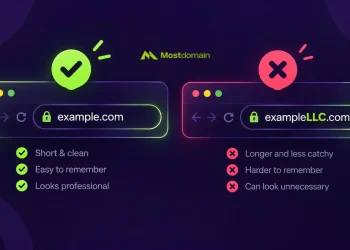

An SEO domain is a domain name evaluated for its accumulated ranking power, its age, link profile, and topical focus, rather than for the words in the name itself. In finance, legal, and health, that distinction rarely gets revisited once it’s made. A well-positioned domain compresses years of ranking work into a much shorter window. A poorly chosen one racks up cost quietly, usually until it’s too expensive to unwind.
Why Domain Choices Shape Competitive SEO Results
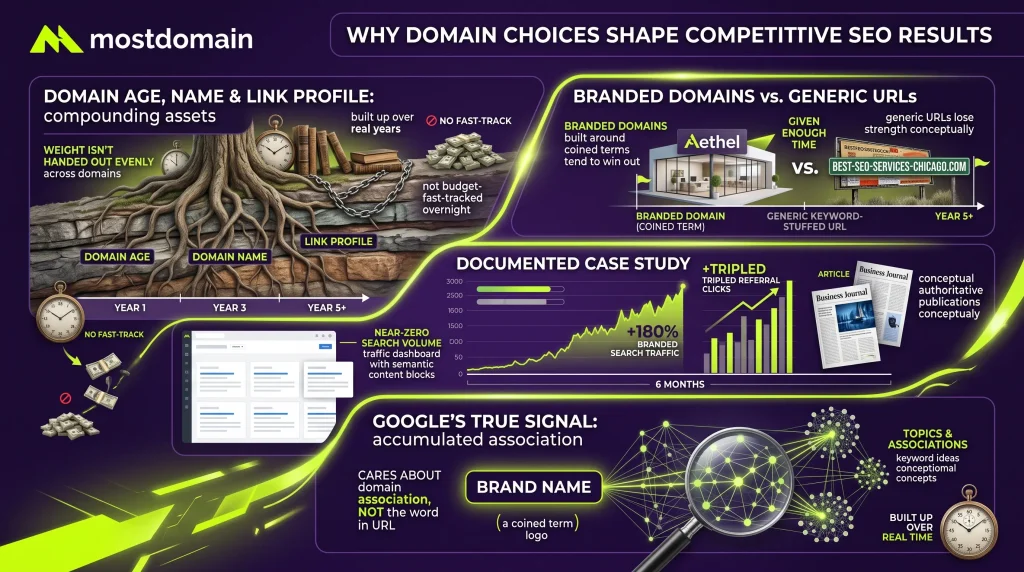
Weight isn’t handed out evenly across domains. Anyone who’s operated in a cutthroat niche for a while already knows this: a domain’s name, age, and link profile behave like compounding assets, and no amount of budget fast-tracks that into existence overnight.
- Branded domains built around coined terms tend to win out over generic keyword-stuffed URLs, given enough time
- One documented case: semantic content built around a branded term that started at near-zero search volume. Within six months, branded search traffic climbed 180% and referral clicks from authoritative publications tripled
- The signal Google actually cares about was never the word sitting in the URL. It’s the accumulated association between a name and a topic, built up over real time
Exact-Match Domains Are Not Dead, But Context Matters
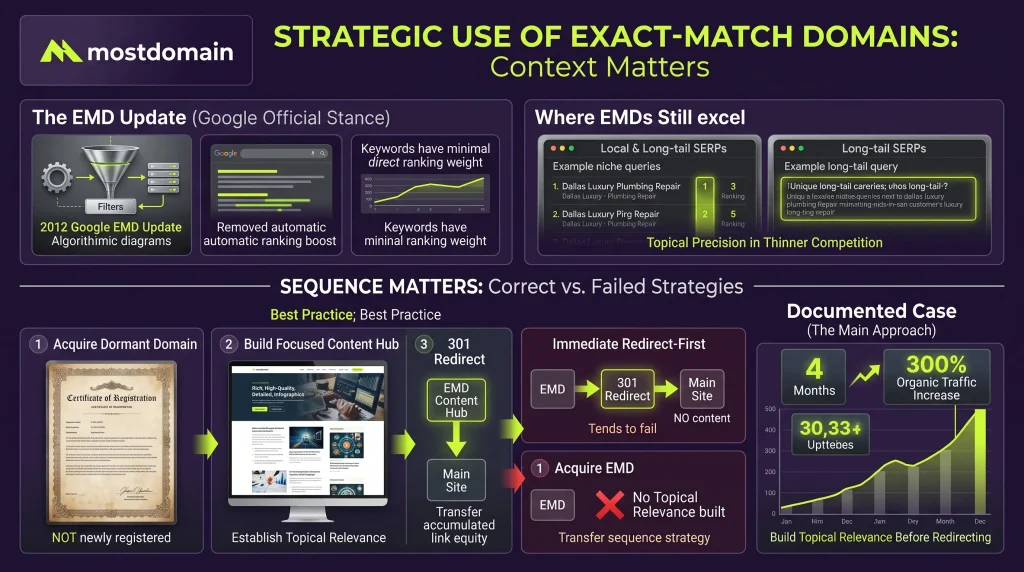
Google says keywords in a domain name carry minimal direct ranking weight, officially. Exact-match domains keep surfacing anyway in local and long-tail SERPs, right at the points where topical precision runs into thinner competition.
- Google’s 2012 EMD update removed the direct ranking boost exact-match domains once carried automatically
- A documented case: four months, a 300% organic traffic increase, using a dormant domain rather than a newly registered one
- A focused content hub was built on that domain first. Only after it established its own topical relevance did a 301 redirect transfer the accumulated link equity to the main site
- Sequence mattered here. Redirect-first is the version of this strategy that tends to fail
Domain Authority as a Currency in Competitive Niches
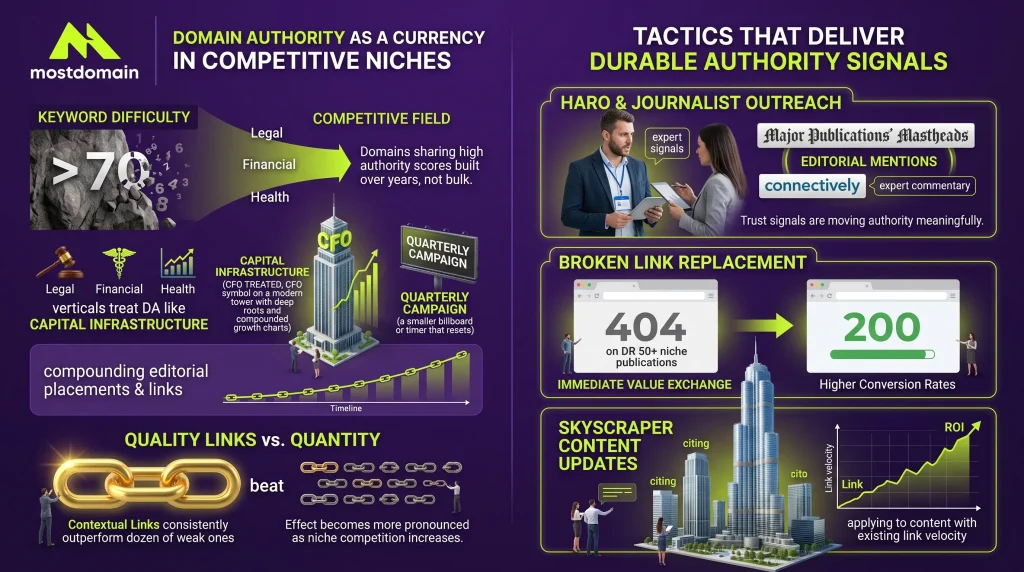
Keyword difficulty above 70 narrows the competitive field to domains sharing one consistent trait: high authority scores built over years, not assembled in bulk.
In legal, financial, and health verticals, that observation translates directly into budget decisions. Domain authority building gets treated the way a CFO treats capital infrastructure, not a quarterly campaign, mainly because editorial placements and passively earned links keep compounding long after the work that produced them is finished.
A few strong contextual links consistently outperform dozens of weak ones in these environments, and that ratio only becomes more pronounced as niche competition increases.

Tactics That Deliver Durable Authority Signals
- HARO and journalist outreach. Contributing expert commentary to reporters through platforms like Connectively earns editorial mentions from publications that would never accept a cold guest post pitch, and those links carry trust signals that move authority meaningfully.
- Broken link replacement. Finding dead links on DR 50+ niche publications and offering a live replacement targets sites already inclined to link within your topic area. Conversion rates run higher than cold pitches because the value exchange is immediate.
- Skyscraper content updates. Publishing a version demonstrably more complete than whatever currently ranks first. Sites already citing that piece tend to update their references without prompting. Not a new tactic, still one of the highest-ROI approaches when applied to content with meaningful existing link velocity.
Topical Authority vs Domain Authority: Which One Actually Wins in 2026?
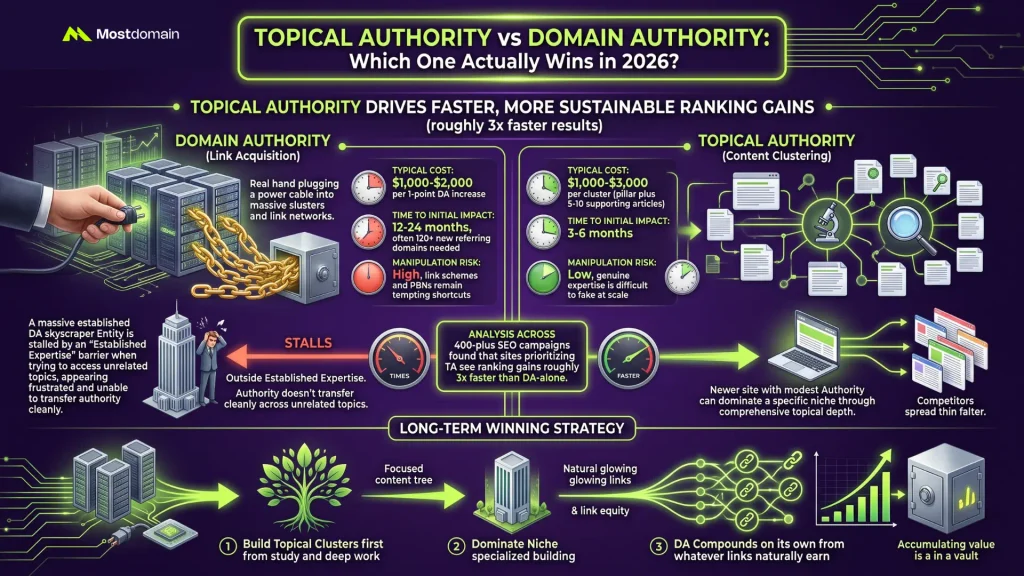
Topical authority drives faster, more sustainable ranking gains than domain authority alone, full stop. The cost-to-result gap between the two is wide enough that it should genuinely change how a budget gets allocated.
| Approach | Typical Cost | Time to Initial Impact | Manipulation Risk |
| Domain authority (link acquisition) | $1,000-$2,000 per 1-point DA increase | 12-24 months, often 120+ new referring domains needed | High, link schemes and PBNs remain tempting shortcuts |
| Topical authority (content clustering) | $1,000-$3,000 per cluster (pillar plus 5-10 supporting articles) | 3-6 months | Low, genuine expertise is difficult to fake at scale |
Analysis across 400-plus SEO campaigns found that sites prioritizing topical authority first saw ranking gains roughly 3x faster than those chasing domain authority alone. That doesn’t make domain authority irrelevant. It makes it the slower, more expensive lever of the two, best treated as a long-term compounding asset rather than the first move.
- A site with exceptional domain authority can still stall outside its established expertise. Authority doesn’t transfer cleanly across unrelated topics. A newer site with modest authority can still dominate a specific niche through comprehensive topical depth. This works especially well where competitors have spread themselves thin across too many subjects at once.
None of this makes the two approaches mutually exclusive, though. Niches that win long-term tend to build topical clusters first, then let domain authority compound on its own from whatever links that strong content naturally earns.




How Much Domain Authority Do You Actually Need to Compete?
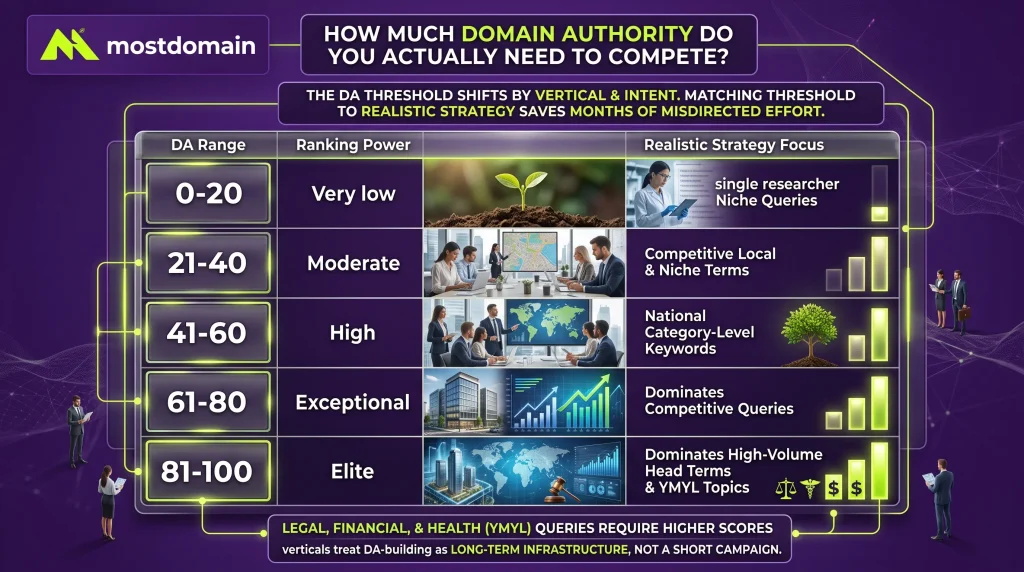
The domain authority threshold to rank competitively shifts by vertical and intent, and matching that threshold to realistic strategy saves months of misdirected effort.
| DA Range | Ranking Power | Realistic Strategy Focus |
| 0-20 | Very low | Long-tail, low-volume keywords only |
| 21-40 | Moderate | Competitive for local and niche-specific terms |
| 41-60 | High | Can compete for national category-level keywords |
| 61-80 | Exceptional | Dominates competitive commercial and informational queries |
| 81-100 | Elite | Dominates high-volume head terms and YMYL topics |
Legal, financial, and health queries in particular tend to require scores toward the higher end of that range before competing seriously on head terms, which is exactly why those verticals treat authority-building as long-term infrastructure rather than a short campaign.
How Hedging Across Multiple Domains Works
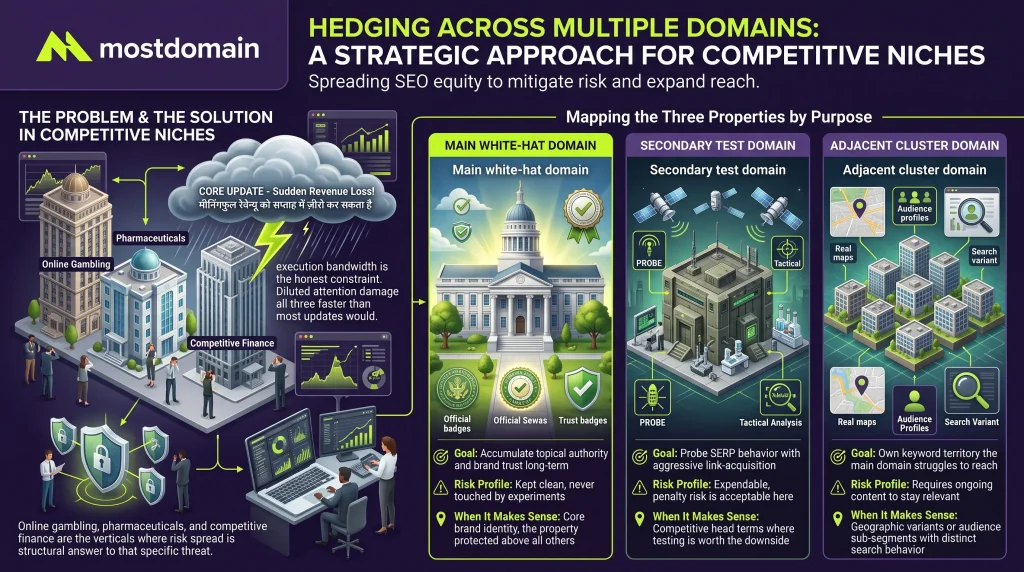
Some operators in ultra-competitive niches deliberately spread SEO equity across multiple domains instead of betting everything on one property.
That structure usually breaks into three roles. One domain plays the long game on white-hat authority building. A second runs more aggressive link acquisition on a property that’s essentially expendable. A third goes after adjacent keyword clusters the main site can’t quite reach on its own.
Execution bandwidth is the honest constraint here. Diluted attention across three domains at once damages all three faster than most algorithm updates would. Online gambling, pharmaceuticals, and competitive finance are the verticals where a single core update can zero out meaningful revenue within a week, which is exactly why spreading risk across domains is the structural answer to that specific threat. One property alone can’t absorb it the same way.
Mapping the Three Properties by Purpose
| Domain Role | Primary Goal | Risk Profile | When It Makes Sense |
| Main white-hat domain | Accumulate topical authority and brand trust long-term | Kept clean, never touched by experiments | Core brand identity, the property protected above all others |
| Secondary test domain | Probe SERP behavior with aggressive link-acquisition tactics | Expendable, penalty risk is acceptable here | Competitive head terms where testing is worth the downside |
| Adjacent cluster domain | Own keyword territory the main domain struggles to reach | Requires ongoing content to stay relevant | Geographic variants or audience sub-segments with distinct search behavior |
Topical Authority at the Domain Level
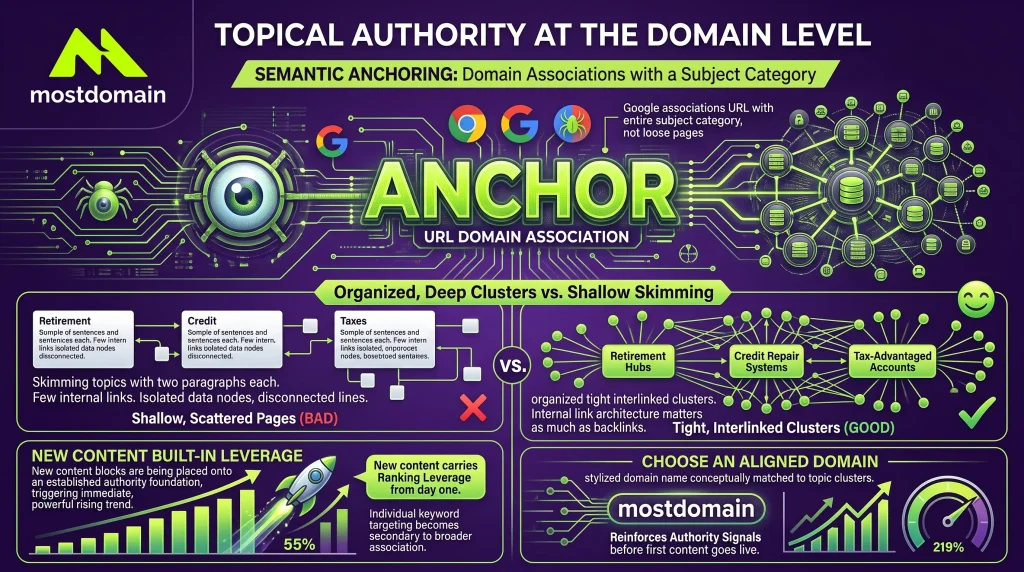
Semantic anchoring describes a domain so topically concentrated that Google stops treating it as a loose collection of pages and starts associating the URL itself with an entire subject category.
New content published on a domain like that carries built-in ranking leverage from day one. Individual keyword targeting becomes secondary to that broader association.
Internal link architecture carries as much weight here as the backlink profile does. A personal finance site organized into tight, interlinked clusters around retirement accounts, credit repair, and tax-advantaged accounts reads differently to Google than one skimming those same topics at two paragraphs each. Choosing a domain aligned to a specific topical cluster from the outset reinforces those authority signals before the first piece of content ever goes live.
What Competitive Niches Know About E-E-A-T and Domain Signals
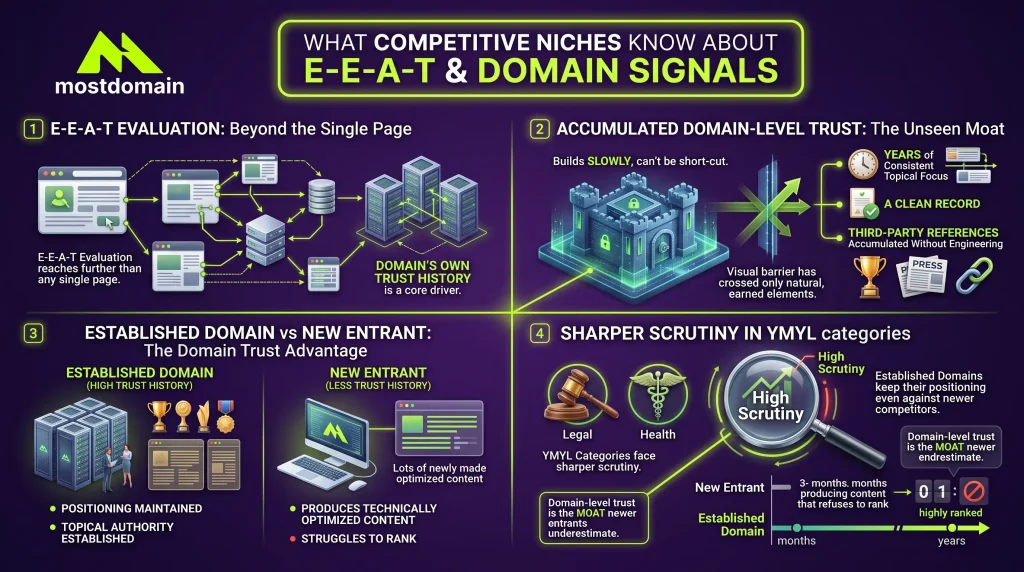
E-E-A-T evaluation reaches further than any single page, and a domain’s own trust history feeds directly into it: years of consistent topical focus, a clean record, and third-party references that accumulated without being engineered.
None of that shows up overnight. Accumulated trust builds slowly and can’t be shortcut by a newer competitor, even one producing technically stronger content on any individual page.
YMYL categories face sharper scrutiny on these signals than nearly any other vertical, which is exactly why established domains in these spaces keep their positioning even against newer competitors with more technically optimized content. Domain-level trust is, in many cases, the moat that newer entrants underestimate until they’ve spent 18 months producing content that refuses to rank.
FAQ
What are SEO domains and why do they matter in competitive niches?
The naming exercise is usually the smallest part of it. What matters longer-term is the asset the domain becomes: age, topical concentration, and accumulated authority collectively determine how much leverage each new piece of content starts with. A strong SEO domain in a competitive niche means every new page begins from a higher floor, and when ranking positions separate by fractions, that floor matters more than most people account for.
Does an exact-match domain still help with rankings?
Not automatically, and that distinction matters. EMDs no longer carry the direct ranking boost they had before Google’s 2012 EMD update. Their current value comes from what surrounds them: focused content, quality backlinks, and enough age for trust signals to accumulate. Pair a well-built EMD with a coherent content strategy and it will outperform a branded domain on specific long-tail and local queries. Past 18 months, that advantage becomes more about which property earned more authority in the interim.
Should a business prioritize topical authority or domain authority first?
Topical authority wins in most cases. It builds faster, 3-6 months against 12-24, costs less per unit of ranking improvement, and carries less risk since it rests on genuine content depth rather than link tactics that can draw a penalty. Domain authority still matters over the long run, but it tends to compound on its own once topical clusters start earning organic citations, rather than needing a separate parallel push from day one.
Should a small business use a separate domain for niche targeting?
It depends on the keyword gap and how much execution bandwidth is realistic. A separate exact-match or keyword-anchored domain can capture highly specific traffic a main domain struggles to reach, particularly in localized markets. The practical risk is spreading content effort across two properties instead of building one strong, coherent domain. Two thin properties almost always lose to one deep one, so most small businesses are better served building one domain deep rather than splitting effort across two shallow ones.
How does domain age affect SEO in competitive markets?
It was never a lack of effort holding newer domains back. It’s time, plain and simple. Backlink age, crawl history, established topical associations, all of that takes years to build, and there’s no real shortcut around it. Put an older domain with a clean history head-to-head against a new one on identical keywords, and the older one usually wins for the first 12 to 24 months, sometimes longer. Consistent authority building does eventually close that gap. Just not fast, which is worth factoring in before registering something brand-new in a niche where competitors already have a multi-year head start.
References
- Moz, “Domain Authority”
- Ahrefs, “Domain Rating and Backlink Analysis”
- Google Search Central, “How Google Evaluates Links and Domain Signals”
- Search Atlas, “Domain Authority vs Topical Authority: 2026 SEO Guide”
- Linkscope, “Average DA Needed to Rank in 2026 (by Industry)”
- GoDaddy Blog, “Domain Name SEO Strategies That Increased Web Traffic”
- Venture Harbour, “Ultra-Competitive SEO Strategies”