Most guides hand you the same list.
- Keep it short
- Keep it spellable
- Buy it fast
None of that is wrong. It is just incomplete in a way that costs money later, because it quietly assumes your options are limited to whatever is still sitting unregistered at a registrar. That assumption was reasonable in 2011. But In 2026 it means you are picking from leftovers.
This guide takes the naming decision seriously as a business decision. You will get the fundamentals. Then the parts nobody publishes.
- How to test a name against the search results it will have to live inside
- What a wrong name actually costs over five years
- Scoring rubric you can run on a shortlist before you spend anything.
If you want the wider context first, our guide to what is an aged domain explains why some names arrive with a history attached.
What Actually Makes a Domain Name Work in 2026
A domain name works when it does four jobs at once.
- People can recall it
- People can trust it
- Search engines can read it as a clear entity
- It does not box in your business three years from now.
Length and spelling matter. But only because they serve those four jobs.

Ask most people how to choose a domain name. And the conversation collapses into aesthetics within a minute. Does it sound good, does it look clean on a business card. Useful, but shallow. The name is infrastructure. It sits underneath your email, your ads, your invoices, and every citation anyone ever gives you.
| The job the name does | What actually drives it | Where people get this wrong |
| Recall | Sound pattern, syllable count, whether it maps to a word people already store in memory | Choosing clever spellings that survive a slide deck but not a phone call |
| Trust | Extension, absence of hyphens and stray numbers, alignment with what the business claims to do | Assuming a cheap extension is neutral. It reads as a signal whether you intended one or not |
| Machine clarity | Whether search engines and AI assistants can resolve your name to one entity and only one | Almost nobody checks this. It is the newest failure mode and the least discussed |
| Room to grow | How narrow the name is. citypizzabekasi.com cannot sell catering in Jakarta later | Naming for the first product instead of the eventual company |
Length still earns its reputation. HubSpot’s naming research puts the average length of successful domains at roughly 6.5 characters, and Instant Domain Search recommends a working band of 5 to 16 characters with 20 as a ceiling. Short. Consider that a constraint, not a rule.
The Naming Checklist Everyone Teaches, and Where It Quietly Fails You
The standard checklist is accurate but narrow. It filters your shortlist by what is still available to register, which means the strongest names were removed from your options before you started thinking.



Read three guides on how to choose a domain name and the advice converges: keep it under fifteen characters, avoid hyphens and numbers, run the radio test, check the trademark register, grab the matching social handles, register before someone else does. Keep all of it. It works.
What none of them tell you is what the filter costs.
Availability is not the same as quality.
By 2026 the .com zone has been picked over for two decades. A name that is available today is available for a reason, and that reason is usually that it was passed over by everyone before you.
The good names are not gone, they are owned.
Registered does not mean unavailable. It means priced. Expired and aged names come back into circulation every day, which is precisely why an entire secondary market exists.
The “register it now” advice creates the rush it warns about.
Panic buying a mediocre name because the perfect one was taken is the most common naming mistake there is, and every registrar blog nudges you toward it.
Nobody prices the alternative.
A guide will tell you a domain costs twelve dollars a year. It will not tell you what it costs to rebrand in year three when the name stops fitting.
There is a reason for that gap, and it is not conspiracy. Registrars monetise new registrations. Telling you to consider acquiring a name someone already owns is not their business model. It might, in specific cases, still be the better move for yours.
Choosing Your TLD Without Falling for the .com-Only Myth
.com remains the strongest default for global commercial brands. But it is no longer the only defensible choice. The right extension depends on your audience, your category, and how much ambiguity you can afford.
Extension advice ages badly. According to Identity Digital’s Q2 2026 domain trend report, .info and .pro still lead the non-traditional extensions, while .ai, .live, .io and .digital continue to grow quarter over quarter. Users have adapted. The stigma around alternatives has mostly worn off, at least among audiences who buy software.
| If this is your business | The extension that makes sense | The risk you are accepting |
| A global brand selling to consumers | .com, and it is not close | Higher acquisition cost, since the good ones are owned |
| A software or AI product selling to technical buyers | .io, .ai, .dev | These carry a category signal. If you pivot out of tech, the name pivots with you awkwardly |
| A business serving one country | The local ccTLD, for example .id | Weaker recognition abroad, and some ccTLDs carry residency or documentation requirements at registration |
| A publisher, tool, or community project | .org, .net, .co | .net in particular still reads as the second choice to a general audience, fairly or not |
One caveat that applies across the table. If you take a non-.com extension while a different company owns the .com of the same string, you have not saved money. You have inherited a permanent competitor in your own brand search results, and you will be paying for that in ad spend and customer confusion for as long as the business exists.
Does a Keyword in Your Domain Still Help SEO
A keyword in your domain is a weak ranking signal on its own. And has been since Google’s exact-match domain update in 2012. It still helps indirectly through click-through rate, natural anchor text, and category clarity. But it will not carry a thin site.
Exact-match domains had a good run. Then they stopped working as a shortcut, and a decade of SEOs kept quoting the shortcut anyway. Anyone researching how to choose a domain name for SEO reasons should start from the boring version of the truth, which is also the more useful one.
Where a keyword in the name genuinely pays:
- Click-through in a crowded SERP. A user scanning ten results will click a name that matches their query slightly more often. Slightly. Not enough to beat better content, but enough to matter at the margin.
- Anchor text that writes itself. When other sites link to you and use your brand name as the anchor, a keyword sitting inside that name means every brand mention carries a small topical hint. This compounds quietly over years.
- Category clarity for both humans and machines. A visitor who has never heard of you can guess what you sell. So can a language model summarising you.
Where it actively hurts:
- Growth lock-in. A keyword name is a promise about scope. Breaking that promise later means rebranding, which is expensive.
- Brandability ceiling. Generic keyword names are hard to trademark, hard to defend, and easy to confuse with the six competitors who chose a variant of the same phrase.
- Spam adjacency. Keyword-stuffed names with hyphens sit in the same visual neighbourhood as low-quality affiliate sites. Users have learned that pattern.
A hybrid usually beats both extremes. One recognisable word plus one category word, where the category word is broad enough to survive a pivot.
The Brand SERP Collision Test Before You Commit
Before you register anything, search your candidate name and see who already owns those results. A name that collides with an existing brand, a common phrase, or a high-volume generic query means you will spend years failing to rank for your own name.
This is the test I have never seen in a naming guide, and it takes fifteen minutes.
Why it matters more now than it used to: AI assistants have to resolve your name to a single entity before they can say anything accurate about you. Wellows, analysing 11.1 million AI citations between December 2025 and March 2026, found that entity recognition, whether the model correctly identifies who you are without confusing you for a similarly named company, is one of the core drivers of whether a brand appears in AI answers at all. An ambiguous name is not just a marketing problem now. It is a retrieval problem.
Run these five checks on every finalist:
Search the bare name in Google.
If page one is owned by an established company, a film, a song, or a dictionary definition, you are starting your brand SEO from a hole. Ranking for your own name should be trivial. If it looks hard, the name is wrong.
Search the name plus your category.
For example, “northgate accounting”. If a competitor already occupies that combination, your paid search costs will reflect it forever.
Ask an AI assistant who the name refers to.
Ask ChatGPT or Gemini what the name is. If you get a confident answer about a different company, the model has already assigned that entity slot. Getting it reassigned is slow and mostly outside your control.
Check the homonym and misspelling map.
Say the name out loud to five people and ask them to type it. This is the old radio test, but score it against the domains those typos actually resolve to. If a typo lands on a competitor, that is leakage you pay for daily.
Check the social and trademark surface together.
Handles across the platforms your buyers actually use, plus the relevant trademark register. Consistency across sources is one of the things AI systems weigh when deciding whether they can describe you confidently.
Failing check one or check three is disqualifying. The other three are negotiable if the name is strong enough elsewhere, though I would not fail more than one of them and proceed.
The Real Cost of the Wrong Name
A domain registration costs around twelve dollars a year. A wrong name costs the rebrand, the lost link equity, the reprinted assets, and the compounding confusion in between. That gap is the number nobody puts in the naming guides.
Cheap upfront, expensive later. That is the shape of most naming regret, and it is the reason how to choose a domain name deserves more than an afternoon.
| Path you take | Year 1 outlay | Years 2 to 5 | The cost that gets forgotten |
| Register the leftover name that was available | Roughly $12 to $20 | Renewals, plus defensive registrations of the typo variants and the .net and .co you now feel obliged to own | If the name underperforms, the rebrand. Redirects preserve some link equity, but brand recall resets to zero and every citation, directory listing, invoice template, and printed asset has to be redone |
| Acquire the name you actually wanted | Anywhere from a few hundred to five figures, paid once | Standard renewals | Vetting time, and the discipline to check the history before you pay. Some names carry problems that are cheaper to walk away from than to fix |
| Compromise on a longer or hyphenated variant | Roughly $12 | Renewals | The slow tax. Every phone call includes a spelling correction. Every ad has slightly worse click-through. None of it shows up as a line item, which is exactly why it survives so long |
Rebranding a business that has been trading for three years is rarely a cheap exercise once you count design, print, legal, and the SEO recovery period after the migration. Set against that, a four-figure acquisition for a name that will not need replacing starts to look less like a splurge and more like insurance. Not always. But the comparison deserves to be made explicitly, and most founders never make it.
When the Name You Want Is Already Taken
If your preferred name is registered, you have three real options. Compromise on a variant, wait for it to drop, or buy it from the current owner. Compromise is the default, and it is often the worst of the three.
Taken does not mean unavailable. It means the price is not twelve dollars.
Compromise on a variant.
Add a prefix, change the extension, lengthen the string. Cheapest, fastest, and the one that quietly imposes the spelling tax described above.
Wait for the drop.
Registered names expire constantly and re-enter circulation. This works if you have time and no launch date. It also means competing with automated systems that monitor these lists continuously, so the odds are not in your favour on anything desirable.
Acquire it.
Either directly from the owner or through a marketplace that lists names already screened for history and quality. Names bought this way often arrive with existing age and backlinks, which is a separate advantage worth understanding before you dismiss the price.
That third option is where this decision meets the aged domain market, and it is why MostDomain exists as a curated inventory rather than a raw drop list: the screening work is the expensive part, not the transaction. Where to look, how each channel differs, and how the pricing works is covered in our guide on how to find aged domains.
If Your Name Already Has a Past, Check It Before You Commit
Any name that was registered before you got to it may carry a history. And that history transfers with the name. Before you commit, you need to know what the domain was used for. Who linked to it, and whether Google has any reason to distrust it.
This is the step people skip. And the one that turns a bargain into a liability. One 2024 analysis cited by PlatoForms found that 28% of purchased domains carried hidden SEO penalties. Or even spam-linked histories.
What has to be checked before money changes hands:
- What the site used to be, and whether that content had anything to do with what you plan to build
- Who links to it now, and whether those links look earned or purchased
- Whether the name is still indexed, and whether it has ever been penalised
- What the name is associated with in the minds of people who might already recognise it
Each of those checks has a method, and doing them properly is its own discipline. Our aged domain evaluation guide covers the process step by step. Do not shortcut it. A clean name at a fair price beats a cheap name with a past you did not investigate, every time.
Score Your Shortlist Before You Buy
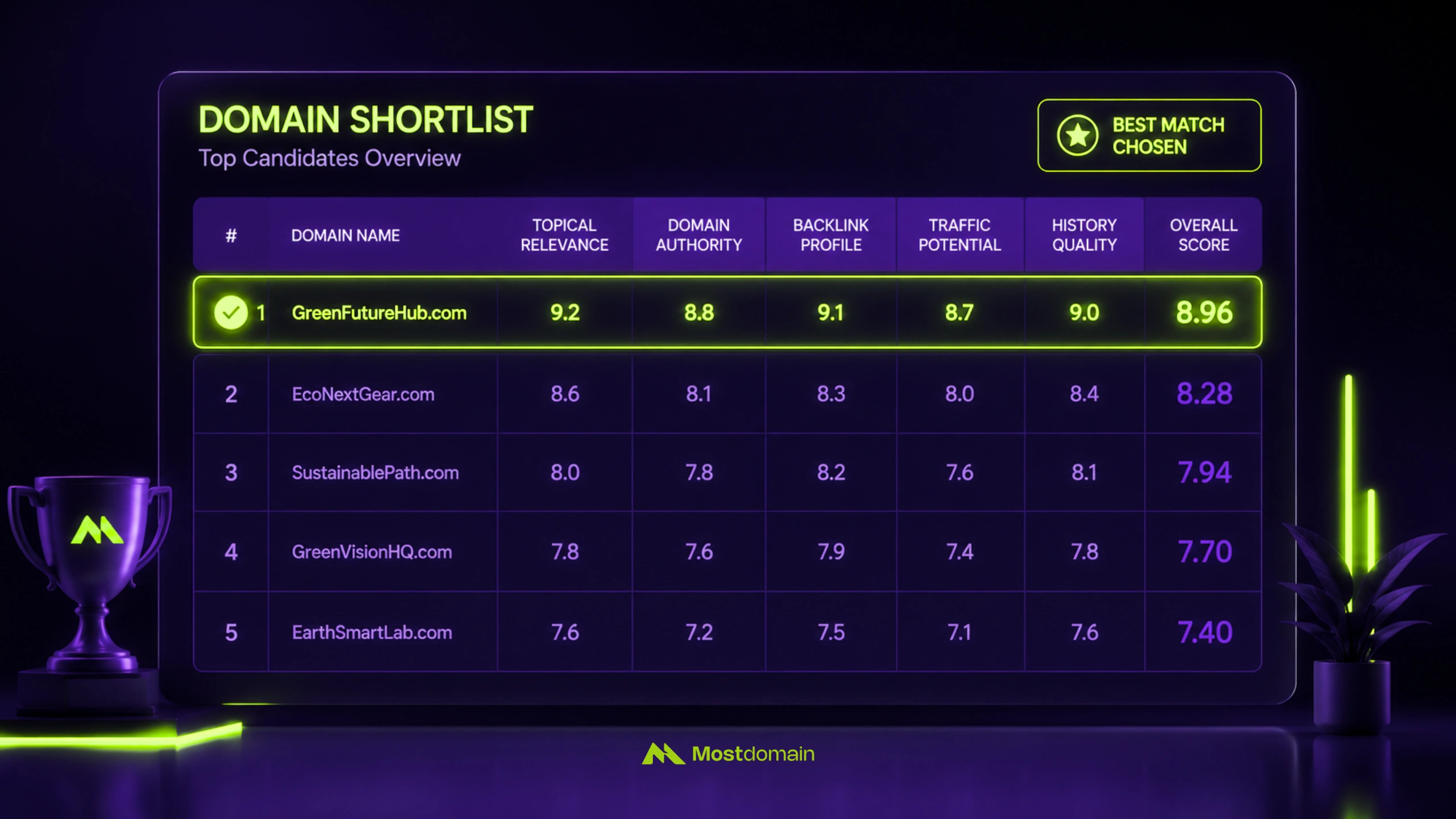
Run every finalist through the same six dimensions and score it out of 100. A name that scores below 65 will cause problems eventually, and a name that scores above 80 is worth paying real money for.
Gut feel is a bad selection mechanism for something this durable, which is why the last step in how to choose a domain name should be arithmetic rather than instinct. Founders fall in love with names for reasons that have nothing to do with how those names will perform. A rubric will not remove taste from the decision, but it will stop taste from being the only input.
| Dimension | Weight | What a perfect score looks like | The fastest way to test it |
| Recall | 20 | Someone hears it once, repeats it correctly two days later | Say it to five people. Call them in 48 hours and ask |
| Spell safety | 15 | No plausible misspelling exists | Dictation test. Count the typo variants that resolve to a live site |
| Entity clarity | 20 | The name resolves to you and only you, for both search engines and AI assistants | The five-step collision test above |
| SEO headroom | 15 | Ranking for the bare name is trivial, and the name does not restrict your future categories | Search the bare name. Then imagine your third product line and see if the name still fits |
| Legal risk | 15 | No trademark conflict in any market you plan to sell in | Search the relevant registers. If you are unsure, this is worth an hour of a lawyer’s time |
| Exit liquidity | 15 | The name would be worth something to someone else even without your business attached to it | Look at what comparable names have sold for. A name with resale value is a name that was scarce to begin with |
Scoring is deliberately blunt. Ten points per dimension, multiplied by the weight, divided by ten. What matters is not the arithmetic, it is that you are forced to write a number next to entity clarity and legal risk rather than skipping them because they are boring.
Where This Leaves Your Shortlist
Knowing how to choose a domain name is mostly about knowing when to stop looking. Naming fatigue produces worse decisions than constraint ever does: after the fortieth candidate, people start compromising on the dimensions that are hardest to measure, which are precisely the ones that cost the most later. Give the process a deadline. Two weeks, three finalists, one scoring pass, then decide.
And keep a documented second choice. Not because you expect to need it, but because founders who have no fallback tend to overpay in a panic when their first choice slips away, and the fallback you wrote down while thinking clearly is almost always better than the one you invent under pressure.
FAQ
How long should a domain name be?
Short enough to say once and have it typed correctly. Five to sixteen characters is the practical working range, with roughly twenty as a hard ceiling. Character count matters less than syllable count and spelling ambiguity, so a nine-letter name built from two common words usually outperforms a seven-letter invented string.
Do hyphens and numbers hurt a domain name?
Yes, in nearly every case. Hyphens fail the spoken test, since nobody says “dash” naturally when reading out a web address, and numbers create an immediate ambiguity between the digit and the spelled-out word. The exception is a brand where the number is genuinely part of the identity and always written the same way.
Can I change my domain name later?
Technically yes, and a properly executed 301 migration preserves a meaningful share of your link equity. What it does not preserve is brand recall, existing citations, printed material, or the trust of customers who bookmarked the old address. Treat a rename as a project with real cost, not a settings change.
Is .com still necessary in 2026?
Not necessary, but still the strongest default for a global commercial brand. Alternative extensions have lost most of their stigma among technical and younger audiences. The real question is whether someone else owns the .com of your exact string, because that turns them into a permanent competitor in your own brand results.
Does my domain name affect my Google rankings?
Directly, barely. A keyword in the domain has been a weak signal since the 2012 exact-match domain update. Indirectly it does more work than people assume, through click-through rate, the anchor text other sites use when they link to you, and how clearly search engines and AI systems can identify what you are.
Is buying an existing domain better than registering a new one?
It depends on what you are optimising for. A registered name is cheap and clean but starts with zero authority and comes from a picked-over pool. An existing or aged name can arrive with age, backlinks and topical history, which shortens the ramp considerably, but only if you vet it properly first. Skipping the vetting is how people buy penalties.
References
- Google Search Central: EMD update and domain name guidance
- Instant Domain Search: How to Choose a Domain Name
- Name.com: How to Choose a Domain Name, Beginner’s Guide
- Wellows: Brand Visibility in LLMs, audit findings from 11.1M AI citations
- Identity Digital: Q2 2026 Domain Trend Report
- ICANN: Domain name registration and transfer policies