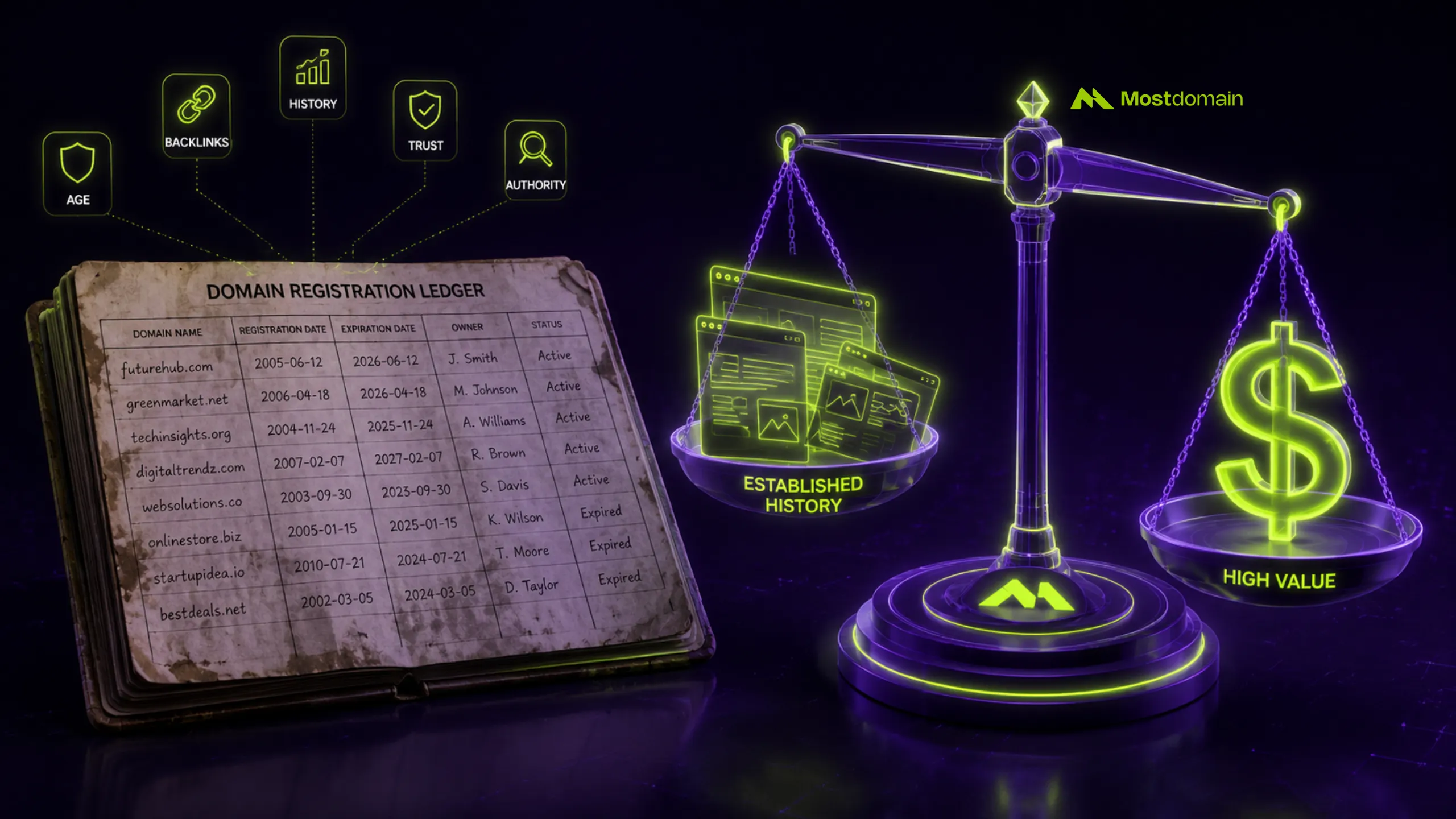
The worth of an aged domain rarely comes down to one number. It sits at the intersection of five overlapping signals:
- Backlink quality
- Continuous history
- Niche relevance
- Historic traffic
- How clean the domain’s past actually is
Ignore any one of them and you risk overpaying for a name that looks impressive on paper but adds nothing once you point a real site at it.
Most buyers start with age alone. Since it is the easiest thing to check. That habit is exactly why so many people overpay. A domain can sit registered for fifteen years. And still be worth less than one that has only been live for four, if the older one never earned a single quality link.
What Actually Determines an Aged Domain’s Worth
Five factors decide most of an aged domain’s worth. There is backlink profile quality. Then how long it has stayed continuously registered and active. Next is how closely its past content matches your intended niche. Then whether it ever carried real traffic. And how clean its history is.
Backlink quality tends to carry the heaviest weight of the five, and multiple domain investors point to it as the single biggest driver of price. Age matters mostly because it gives those links time to accumulate naturally rather than in a suspicious burst.
| Factor | What It Signals | Why Buyers Pay More For It |
| Backlink Profile Quality | Real referring domains from relevant, non-spammy sites | Link equity is expensive to build manually; a clean profile skips years of outreach |
| Domain Age & Continuity | Registration and use without long dead gaps | Google treats unbroken history as a trust signal, not just a birthdate |
| Niche Relevance | Past content topics overlapping your planned use | Topical continuity avoids a rebuild penalty and speeds up re-ranking |
| Historic Traffic | Direct or residual visits still hitting the domain today | Existing demand means day-one visitors instead of a cold start |
| Clean Record | No manual actions, spam links, or trademark conflicts | One penalty in the history can zero out every other metric above |
A 2022 review of 313 vetted aged domains across three marketplaces (Odys, SerpDomains, and SerpNames) found per-year pricing landing anywhere between roughly $155 and $260 depending on the platform. Which is a useful sanity check before you accept a seller’s asking price at face value.

The Aged Domain Worth Score
Running the five factors above through a weighted score out of 100. It turns a gut feeling into something you can actually defend. Backlink quality contributes 35 points. Age and continuity 20. Niche relevance 20. Traffic history 15. And clean record 10.
This weighting exists because not every factor deserves equal say. A spotless clean record on a domain with zero backlinks still isn’t worth much, but the reverse (strong links, minor spam elsewhere) often is.
| Score Range | What It Means | Suggested Move |
| 80 to 100 | Premium acquisition, the metrics justify a real premium | Buy even at a stretch price |
| 60 to 79 | Solid pick, worth it at fair market value | Buy if the asking price roughly matches the metrics |
| 40 to 59 | Speculative territory | Only touch it at genuine bargain pricing |
| Below 40 | The age label isn’t earning its keep | Walk away, or treat it as a redirect-only asset at most |
Scoring isn’t a permanent verdict, either. A domain sitting at 45 today can climb past 70 within a year of clean redirects and fresh, on-topic content. Treat the number as a snapshot of right now. Not a life sentence.




Quick Filter Before You Run the Full Numbers
A two-minute manual check kills most bad candidates before you ever open a paid tool. Pull up the Wayback Machine. Then run a WHOIS lookup. And scan the homepage snapshots for red-flag niches.
- Wayback Machine shows at least three to four years of genuine content. Not just a parked placeholder page
- WHOIS history shows no long ownership gaps or repeated expiry-and-recapture cycles
- A quick “site:domain.com” search still returns indexed pages
- Homepage snapshots carry no history in gambling, pharma, or adult content if you’re rebuilding for a different, cleaner niche
Domains that fail two or more of these checks rarely score above 40 anyway, so this filter saves the time you’d otherwise spend running a full backlink export on something you were always going to reject.
Where the Real Numbers Live
Each factor in the worth score deserves its own deep dive, because checking age uses different tools and thresholds than auditing backlinks or comparing sale prices across the market.
This article is meant to give you the full framework in one place. For the hands-on process behind each piece, these are worth reading next:
- How to check domain age, for the tools that separate a genuinely continuous history from a re-registered gap
- Aged domain backlink audit, for pulling apart live link equity from links that technically still exist but stopped counting years ago
- How much do aged domains cost, for current price benchmarks broken down by niche and TLD
- Aged domain checker tools, for a side-by-side comparison of the platforms that automate most of this scoring
Common Mistakes That Quietly Wreck a Valuation
The three mistakes that most often inflate or crater a valuation: First is treating age as value on its own. Then counting backlinks instead of judging them. And skipping a manual penalty check because the automated score already looked fine.
- Chasing age alone. A fifteen-year-old domain with no real backlinks is just an old registration. And not an asset worth a premium.
- Counting links instead of grading them. Five hundred spun-article backlinks can inflate a checker tool’s total link count while adding almost nothing to real authority.
- Skipping the manual check. Automated tools rarely catch a Google manual action, and buyers have paid full price for domains that were structurally unable to rank.
- Ignoring TLD mismatch. History on a .net rarely transfers full trust if you’re rebuilding the same name on .com, though how much this matters depends on what you’re actually trying to achieve with the domain.
Turning the Score Into a Buy or Pass Decision
Running a candidate through the weighted score above takes maybe ten minutes once you have the backlink and traffic data pulled up, and it gives you a number you can put in front of a client or a business partner instead of a hunch. Marketplaces that surface backlink and traffic data upfront, the way Mostdomain lists its aged domain inventory, cut a meaningful chunk of that time out, since you’re not chasing WHOIS exports and Ahrefs reports before you can even begin scoring a candidate.
One thing worth remembering: the score reflects the domain today, not what it could become under active management. A mediocre score paired with a genuinely low price is sometimes the better buy over a domain sitting at 75 with a price tag that already assumes the work is done for you.
FAQ
Is an older domain always worth more than a newer one?
Not automatically. Age helps mostly because it gives backlinks. And also traffic time to build up naturally. A new domain with relevant link profile can easily outscore a fifteen-year-old one that sat dormant with no real activity.
How much should I pay for a highly rated aged domain?
There’s no fixed number. Market data across vetted marketplaces has landed in the rough range of $155 to $260 per year of registered age, adjusted up sharply for exceptional backlink quality or down for thin or generic domains. Use that as a starting benchmark, not a ceiling.
Can an aged domain lose its worth after I buy it?
Yes. A domain can drop in value if it picks up a manual penalty post-purchase. If its backlinks age out and stop counting. Or if a careless migration (changing hosting, DNS, and ownership all at once) resets the trust signals that made it valuable in the first place.
Does a high worth score guarantee strong rankings?
No, and this is where a lot of buyers get burned. The score measures acquired potential, not future performance. Content quality, on-page SEO, and how the site is built out afterward still decide whether that potential ever converts into rankings.
What’s the fastest way to sanity check an automated tool’s score?
Cross-reference it against the manual quick filter earlier in this article. If a tool rates a domain highly but the Wayback Machine shows almost no real content history, trust the manual check over the automated number.
References
- The Website Flip, “How Much is An Aged Domain Worth? Valuation Metrics”
- SearchLogistics, “What Are Aged Domains And How Can I Use Them?”
- DomCop, “How to Find & Buy Aged Domains: Steps, Tools, and Best Practices”
- Dynadot, “What Makes a Domain Valuable? Top Factors Explained”
- Web Acquisition, “Beginner’s Guide To Aged Domains: Risks & Benefits”