
Your web presence hinges entirely on your choice of registrar. Stop treating this decision like a casual errand.
Aggressive branding demands absolute accuracy. You must scrutinize every option when evaluating the best places to buy domain name assets.
Avoid the digital gutter. Most registrars clutter the web with pricing and predatory renewal traps. They masquerade as helpful gateways while hiding exorbitant fees behind deceptive convenience. One slip leads to disaster. Choose a subpar provider and you compromise your security. You face immediate risks: astronomical price spikes, malicious hijacking, or the complete erasure of your online presence.
Deciphering the Two Primary Procurement Channels
Web address procurement requires a firm grasp on the gap between retail registrars and secondary exchanges. Registrars act as authorized retail storefronts, leasing vacant extensions directly from central registries. Alternatively, domain marketplaces function as aftermarket clearinghouses. Here, private entities trade pre-owned, high-value web properties that already possess traffic, search authority, or established brand recognition.
Review the following table for a breakdown of these procurement venues:
| Category | Definition | Optimal Use Case | Representative Examples |
| Domain Registrar | ICANN-accredited retail provider leasing unowned names. | Securing brand-new, unclaimed identities at retail pricing. | Namecheap, Cloudflare, GoDaddy |
| Domain Marketplace | Secondary exchange facilitating private transfers between parties. | Purchasing premium, short, or SEO-optimized established assets. | Sedo, Afternic, Flippa, MostDomain |
| Hybrid Platform | Integrated hub combining new registrations with public auctions. | General users require basic tools plus occasional auction access. | GoDaddy Auctions, Name.com |
Matching your budget to your specific asset requirements is mandatory. Boutique exchanges such as MostDomain prioritize premium aged domains, catering to professional buyers who demand immediate search engine equity and clean operational histories rather than unproven new registrations.

Elite Registrars for Fresh Registrations
Secure an ICANN-accredited partner immediately after finalizing a unique corporate identity that avoids secondary market clutter. These entities execute legally binding contracts, tethering your business enterprise to the primary domain registry. Watch your step. Low-cost initial pricing often masks predatory, long-term renewal obligations.
Scrutinizing potential places to buy domain name requires cold, hard skepticism. High-volume firms bait unsuspecting founders with razor-thin introductory offers, only to gouge your bank account with inflated renewal costs once your enterprise relies on their systems. Analyze these fiscal models to dodge predatory overpricing.
| Registrar | Starting Price (.COM) | WHOIS Privacy | Known For |
| MostDomain | Market Variable | Registry Dependent | High-authority aged domains. |
| Namecheap | $5.98 – $10.98 | Lifetime Included | Fluid UI, rapid support. |
| Cloudflare | $9.15 (At-Cost) | Lifetime Included | Wholesale, zero-markup fees. |
| GoDaddy | $2.99 (Promo) | Basic Included | Massive reach, aggressive ads. |
| Hostinger | $4.99 – $9.99 | Lifetime Included | Integrated hosting bundles. |
| Name.com | $8.99 – $12.99 | Via Promo Codes | Developer-centric tools. |
Cloudflare dominates long-term planning. They eliminate retail premiums by passing wholesale registry costs directly to the user. This policy anchors your budget against arbitrary price hikes.




Note on Secondary Asset Acquisitions
Standard registrars like Namecheap focus on blank-slate registration. Conversely, MostDomain operates as a niche exchange for premium, aged assets. You bypass the agonizing sandbox phase by purchasing established domains complete with existing backlink profiles. Buy authority. Skip the wait.
Top Marketplaces for Premium and Aged Domains
Marketplace participants operate on a sophisticated level. They prioritize established search engine trust and historic backlink profiles over entry-level fees. Processing these high-value intellectual property transfers requires robust, secure transaction infrastructure.
Evaluating platform specialization is non-negotiable. Compare the following global and regional exchanges:
| Marketplace | Specialty | Auction/Escrow | Focus |
| Mostdomain | Curated Aged Domains | By Request / Yes | SE Asia / Global |
| Sedo | Massive Global Inventory | Yes / Yes | Global / Europe |
| Flippa | Established Businesses | Yes / Yes | Global |
Global platforms often suffer from unvetted, low-quality listings. MostDomain operates as a curated, Singapore-based alternative specifically for buyers seeking vetted premium aged domains. This localized focus streamlines acquisition, delivering high-authority assets ready for immediate regional deployment.
Evaluation Criteria for Choosing Your Vendor
Your decision rests entirely on your specific goals and the nature of the digital asset you intend to secure. A massive corporation building a global brand demands vastly different technical capabilities than a solo developer spinning up a temporary testing environment. Investigate these seven metrics before spending a single cent on your chosen provider, as these are the top places to buy domain name assets reliably.
1. Inventory Alignment
Confirm the registrar actually carries your preferred top-level domains. Don’t waste time on platforms that lack the specific digital real estate you need to claim.
2. Renewal Structures
Analyze the recurring billing cycles immediately. Many services lure buyers with cheap introductory rates only to ambush them with exorbitant long-term price hikes.
3. Privacy
Verify that WHOIS protection remains free and permanent. Ethical firms never charge extra to keep your personal contact details shielded from public databases.
4. Escrow
Determine if the site forces an independent middleman to hold funds during high-value acquisitions. Secure transactions demand this layer of protection.
5. Transfer Velocity
Measure how quickly the system issues EPP keys or authorization codes. Sluggish administrative response times effectively lock your assets inside their ecosystem.
6. Support Accessibility
Test their response speed before you encounter a crisis. Can you actually speak to a knowledgeable technician when your DNS records break?
7. Reputation
Scrutinize the vendor’s past performance regarding data breaches and service stability. A flawless history remains your only insurance against catastrophic loss.
Registrar vs. Marketplace: Choosing Your Strategy
Align your digital strategy with your deployment timeline. Purchasing via a registrar keeps initial costs low, yet forces your team to overcome search engine invisibility. New domains lack authority, requiring massive SEO investment to rank.
Aftermarket acquisitions bypass this “sandbox” period. For buyers targeting aged domains with clean, verifiable records, MostDomain provides a low-noise environment. This framework allows businesses to skip the typical spam-filled auction clutter, securing names with immediate organic reach.
Safety Protocols for Domain Acquisitions
Online asset transfers involve zero margin for error. Predators frequently hawk digital real estate tainted by intellectual property litigation or decaying, radioactive backlink portfolios. Perform aggressive vetting. You must uncover reliable places to buy domain name assets to bypass these risks.
Mandatory Escrow
Secure your capital. Demand escrow services for every transaction surpassing the $200 threshold. Never bypass this neutral third party.
Audit History
Scour the Wayback Machine. Analyze historical snapshots to verify if the site previously hosted malicious or prohibited material.
Trademark Verification
Cross-reference your target with international legal registries. Avoid expensive litigation by confirming your acquisition won’t trigger an infringement claim.
Penalty Screening
Examine the site’s backlink health. Search for red flags indicating search engine blacklists or spam-heavy link structures.
Instant Transfer
Demand authorization codes the second your payment clears. Do not wait.
Redundancy
Activate auto-renewal features. Link multiple payment sources to guarantee your ownership window never lapses due to an expired credit card.
Policy Review
Study the specific mediation guidelines before placing a single bid. Ignorance provides no legal defense when disputes arise.
FAQs
Which venue suits a small business?
For original names, Namecheap and Cloudflare offer the best value. To gain instant market trust, use secondary exchanges like MostDomain.
Is marketplace purchasing secure?
It is, provided you use platforms that integrate verified escrow. This holds your funds until you confirm full administrative control.
What distinguishes a registrar from a marketplace?
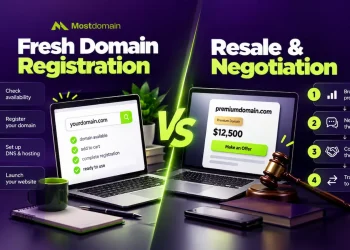
Registrars are retail agents for new names. Marketplaces function as exchanges for pre-owned, valuable assets.
Can I purchase an owned domain?
Yes. You can submit private offers on exchanges or retain a professional broker.
How is an aged domain valued?
Focus on link quality, history cleanliness, and brand memorability. Verify that previous traffic was legitimate.
What is the pre-purchase checklist?
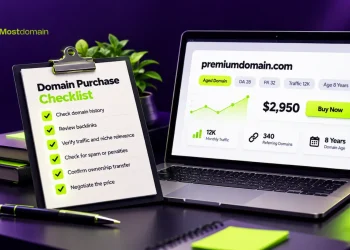
Check trademarks, search engine index status, ownership history, and transferability.
Where can I buy premium Asian domains?
MostDomain offers a curated selection of verified aged domains specifically for Asian and global market expansion.
Summary
Deciding between a standard registrar and a specialized secondary market comes down to a simple reality: are you merely parking a URL, or are you acquiring a revenue-generating digital asset? Serious investors must safeguard their capital by scrutinizing renewal fees, enforcing escrow protocols, and conducting exhaustive investigations into a domain’s past.
When you seek high-value, aged web real estate for immediate market dominance, MostDomain offers the robust infrastructure necessary for long-term expansion. If you are currently searching for reliable places to buy domain name assets, align your financial limits with your growth objectives. Choose your platform wisely. Command your digital presence.
References
- Aguerre, C. (2023, December 15). The legacies of long tail and concentration in the top-level domain sector.
- Caruana, C. (2014, June 22). Understanding the legal nature and ownership of digital domain names.
- Coull, S. E. (2012, October 08). Analyzing and preventing domain registration abuses in modern infrastructure.
- Froomkin, A. M. (2011, May 14). Almost free: An analysis of ICANN’s governance and commitments.
- Lauinger, T. (2018, October 25). From deletion to re-registration in zero seconds: What happens during a domain drop.
- Lehr, W. (2020, November 11). Changing tech and economic markets for internet domain names.
- Lepp, J. T. (2012, April 03). Examining ICANN’s regulatory oversight and antitrust liabilities.
- Lindenthal, T. (2016, September 19). Analyzing monocentric cyberspace and the primary market for domain names.
- Lu, C. (2021, February 21). From WHOIS to WHOWAS: How GDPR changed domain registration privacy.
- Rooksby, J. H. (2015, March 28). Higher education’s branding battles for digital cyberspace ownership.