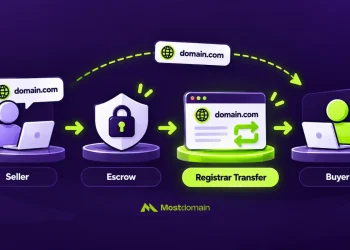
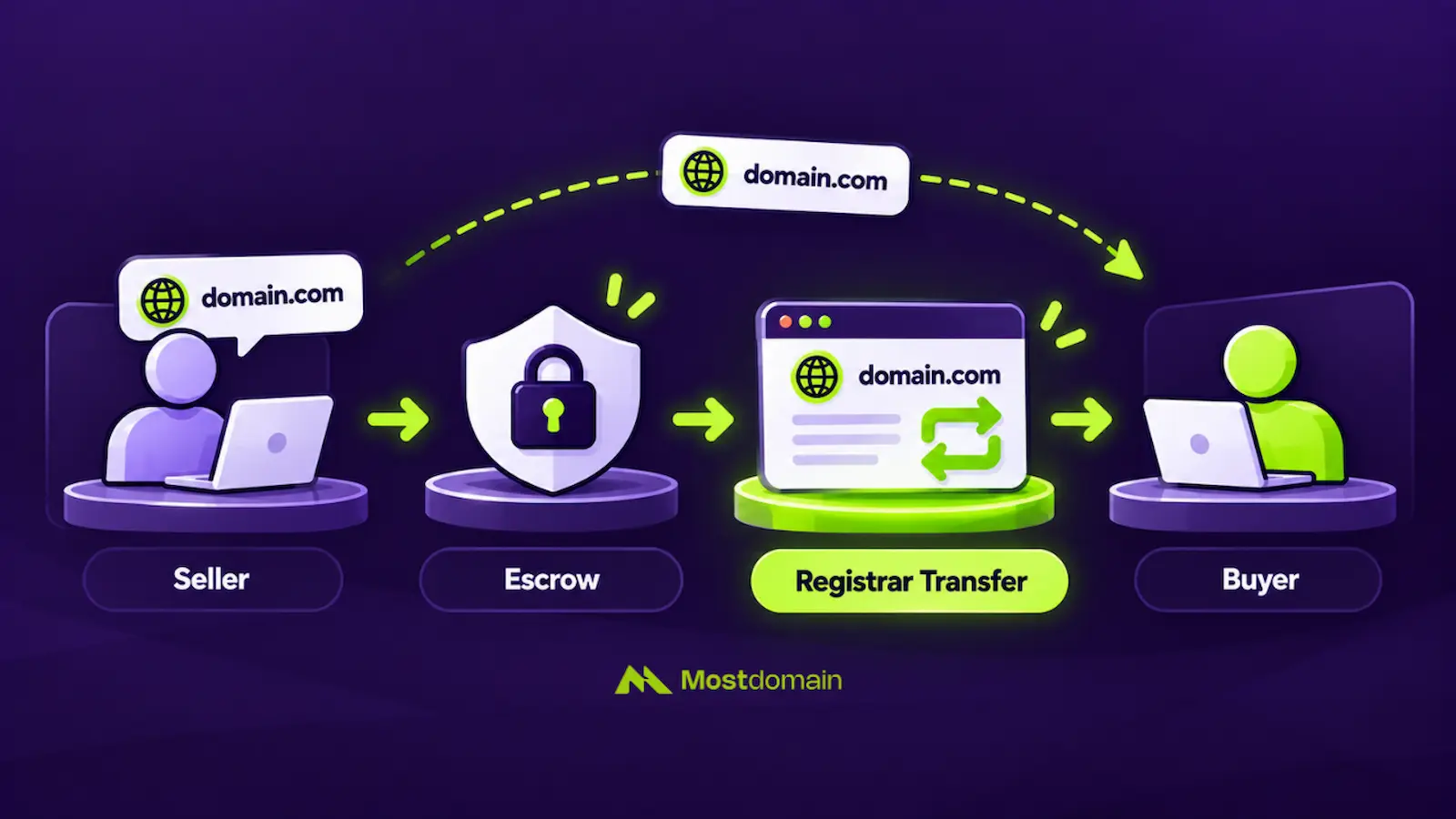
A domain aftermarket is the resale market for domain names that someone already owns. Buyers and sellers meet on marketplaces, auctions, or through brokers. They agree on a price. An escrow service holds the money. The registrar then moves the name to the buyer. Money is released after the transfer succeeds.
This guide covers each domain aftermarket step, who pays what, and the risks. It also shows how to read the market data without being misled.
Key Takeaways
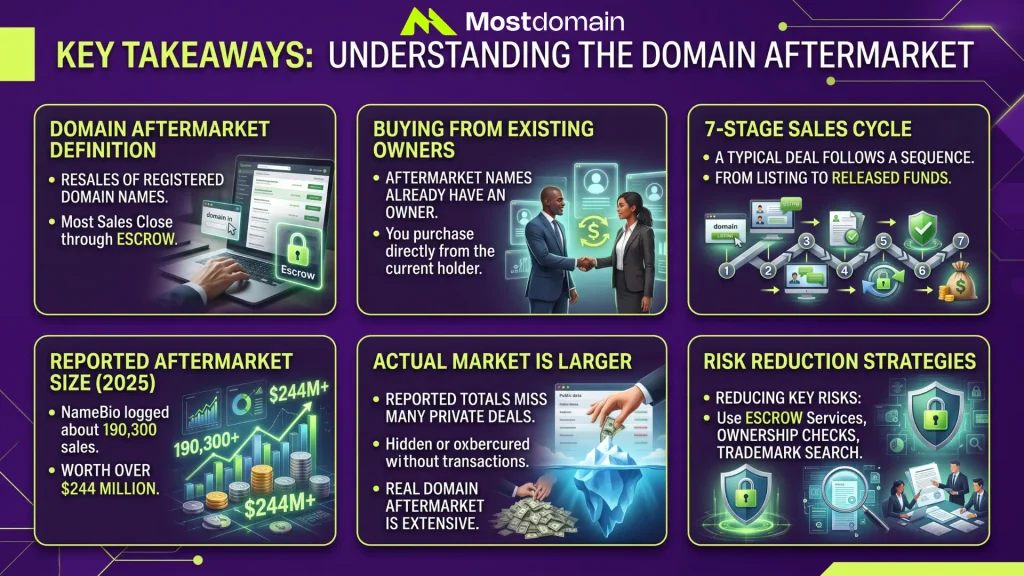
The domain aftermarket resells registered names, and most sales close through escrow.
- Aftermarket names already have an owner, so you buy from that owner.
- A typical deal runs through seven stages, from listing to released funds.
- NameBio logged about 190,300 domain aftermarket sales worth over $244 million in 2025.
- Reported totals miss many private deals, so the real domain aftermarket is larger.
- Escrow, ownership checks, and a trademark search reduce the main risks.
What Is the Domain Aftermarket?
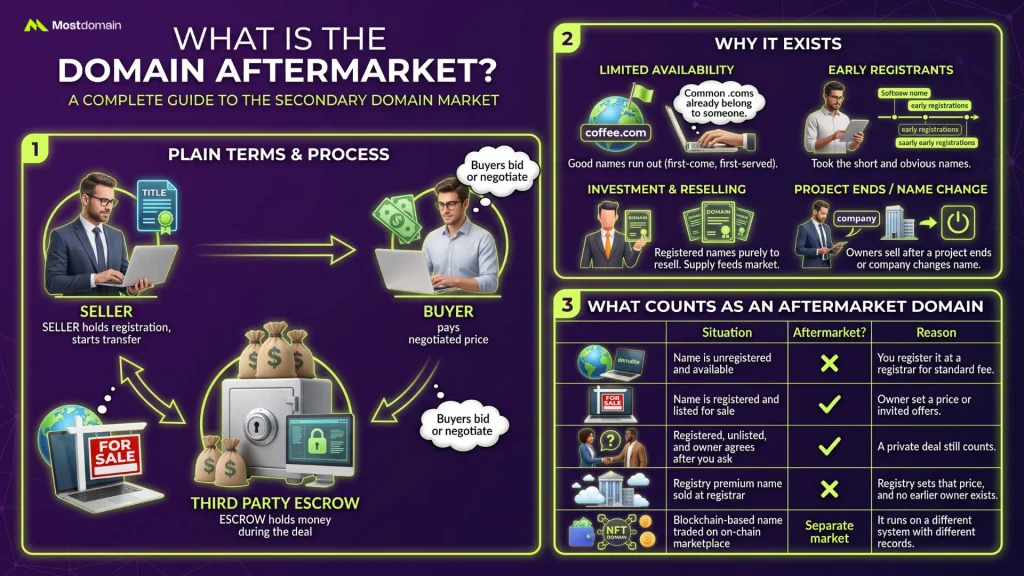
The domain aftermarket is where already-registered domain names change hands between owners.
Domain Aftermarket Definition in Plain Terms
Plainly put, it resells names that already have an owner.
- In any domain aftermarket deal, the seller holds the registration and starts the transfer.
- The buyer pays a negotiated price instead of a standard registration fee.
- A third party, usually an escrow provider, holds the money during the deal.
- Wikipedia frames it as a secondary market where buyers bid or negotiate.
Why the Domain Aftermarket Exists
Only one person can hold a given name, so good ones run out.

- Registration is first come, first served. Early registrants took the short and obvious names.
- Try registering a common one-word .com today. It already belongs to someone.
- Some owners registered names purely to resell them. That supply feeds the domain aftermarket.
- Others sell after a project ends or a company changes its name.
What Counts as an Aftermarket Domain
A name is an aftermarket domain when its current owner is willing to sell.
| Situation | Aftermarket? | Reason |
| Name is unregistered and available | ✗ No | You register it at a registrar for the standard fee. |
| Name is registered and listed for sale | ✓ Yes | The owner set a price or invited offers. |
| Name is registered, unlisted, and the owner agrees after you ask | ✓ Yes | A private deal still counts. |
| Registry premium name sold at a registrar | ✗ Usually no | The registry sets that price, and no earlier owner exists. |
| Blockchain-based name traded on an on-chain marketplace | Separate market | It runs on a different system with different records. |
Domain Aftermarket vs Primary Market
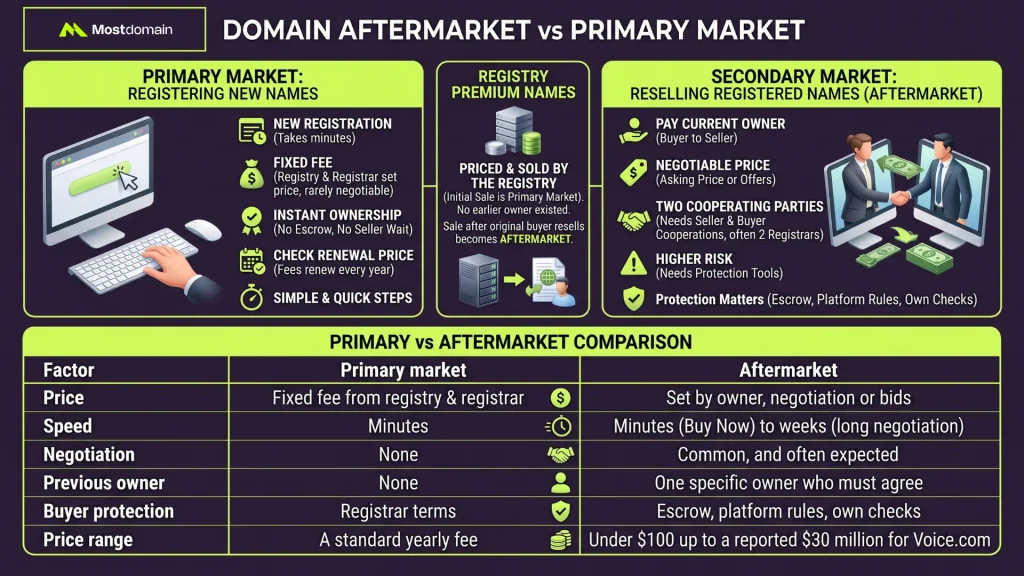
The primary market sells unregistered names; the domain aftermarket resells names someone already registered.
How Primary Market Registration Works
Registering a new name takes minutes and costs a fixed fee.


- The registry and registrar set the price, so buyers rarely negotiate.
- Ownership starts at once, with no escrow and no waiting for a seller.
- Fees renew every year, so check the renewal price too.
- The standard steps for registering a domain name are simple and quick.
How Secondary Market Sales Work
Aftermarket buyers pay the current owner, so price and timing are negotiable.
- The owner sets an asking price or invites offers.
- The transfer needs two cooperating parties, and often two registrars.
- The domain aftermarket carries more risk than a fresh registration, so protection tools matter.
Registry Premium Names
Registry premium names are priced by the registry itself.
- Many newer extensions hold back short or meaningful names as premium.
- Registrars sell them at prices well above the standard fee.
- No earlier owner existed, so these sales belong to the primary market.
- The line blurs when a buyer later resells one. That resale becomes a domain aftermarket sale.
- Our guide to premium domain names covers the category in more detail.
Primary vs Aftermarket Comparison
Price, speed, and risk are the biggest differences between the two markets.
| Factor | Primary market | Aftermarket |
| Price | Fixed fee from the registry and registrar | Set by the owner, a negotiation, or bids |
| Speed | Minutes | Minutes for a Buy Now, weeks for a long negotiation |
| Negotiation | None | Common, and often expected |
| Previous owner | None | One specific owner who must agree |
| Buyer protection | Registrar terms | Escrow, platform rules, and your own checks |
| Price range | A standard yearly fee | Under $100 up to a reported $30 million for Voice.com |
How Does the Domain Aftermarket Work?
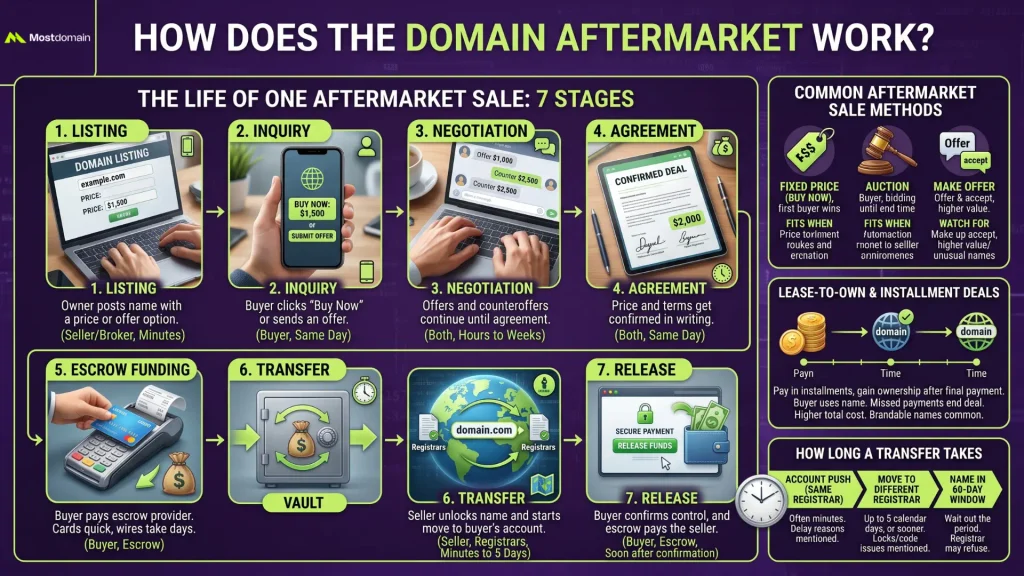
Most domain aftermarket sales follow seven stages, from listing to the final transfer.
The Life of One Aftermarket Sale
One sale moves from listing to released funds in seven stages.
| Stage | What happens | Who acts | Usual timing |
| 1. Listing | The owner or a broker posts the name with a price or offer option | Seller, broker | Minutes |
| 2. Inquiry | A buyer clicks Buy Now or sends an offer | Buyer | Often the same day |
| 3. Negotiation | Offers and counteroffers continue until both sides agree | Both | Hours to weeks |
| 4. Agreement | Price and terms get confirmed in writing | Both | Same day |
| 5. Escrow funding | The buyer pays an escrow provider, which holds the money | Buyer, escrow | Cards are quick. Bank wires can take days. |
| 6. Transfer | The seller unlocks the name and starts the move to the buyer’s account | Seller, registrars | Minutes to five days |
| 7. Release | The buyer confirms control, and escrow pays the seller | Buyer, escrow | Soon after confirmation |
Click-by-click steps for buying a domain name and selling a domain name live elsewhere.
Fixed-Price, Auction, and Make-Offer Sales
Names sell at a fixed price, at auction, or after a negotiated offer.
| Method | How it works | Fits when | Watch for |
| Fixed price (Buy Now) | The owner posts a price, and the first buyer to pay wins | You know your budget and want speed | A price set above what the name would fetch elsewhere |
| Auction | Buyers bid until a set end time | Several bidders are likely to want the name | A winning bid that ends up above your plan |
| Make offer | The buyer proposes a number, and the seller accepts, counters, or declines | The name is high in value or unusual | Slow replies. Some offers never get an answer. |
Lease-to-Own and Installment Deals
Lease-to-own lets a buyer pay in installments and gain ownership after the final payment.
- The buyer usually gets to use the name while payments continue.
- Registration often stays with the seller until the last installment clears.
- Missed payments can end the deal, so read the default terms first.
- Total cost can run higher than a one-time purchase. Sellers price in the risk.
- Brandable names are common candidates for lease-to-own deals in the domain aftermarket.
How Long an Aftermarket Transfer Takes
Expect anywhere from a few minutes to about five days for the transfer itself.
| Transfer type | Usual timing | What can slow it |
| Push between accounts at the same registrar | Often minutes | Seller delays or account checks |
| Move to a different registrar | Up to five calendar days, or sooner with early approval | Locks, a missing transfer code, an unanswered email |
| Name inside 60 days of registration or a prior transfer | The registrar may refuse | Waiting out the window |
Rules changed recently, so confirm the current process with both registrars. Our guide shows how to transfer a domain name step by step.
Who Takes Part in the Domain Aftermarket?
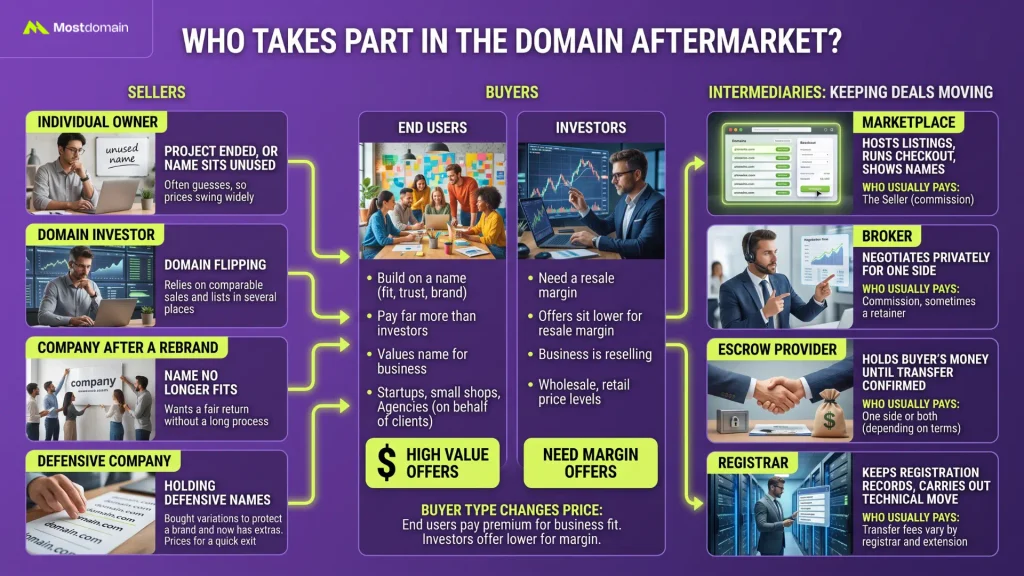
Sellers, buyers, and intermediaries make up every domain aftermarket deal.
Sellers in the Domain Aftermarket
The Sellers range from individuals with one spare name to investors with large portfolios.
| Seller type | Why they sell | How they price |
| Individual owner | The project ended, or the name sits unused | Often guesses, so prices swing widely |
| Domain investor | Selling names is the business, a practice often called domain flipping | Relies on comparable sales and lists in several places |
| Company after a rebrand | The name no longer fits | Wants a fair return without a long process |
| Company holding defensive names | It bought variations to protect a brand and now has extras | Prices for a quick exit |
Buyers in the Domain Aftermarket
Buyers are end users who build on a name, or investors who resell.
- End users care about fit, trust, and brand, so they pay more.
- Investors need a resale margin, so their offers sit lower.
- Startups and small shops are common end users. Our startup domain strategy guide shows how they choose.
- Agencies sometimes buy in the domain aftermarket on behalf of clients.
Intermediaries That Keep Deals Moving
Marketplaces, brokers, escrow providers, and registrars each handle one part of a deal.
| Role | What it does | Who usually pays |
| Marketplace | Hosts listings, runs checkout, and shows names to buyers | The seller, through commission |
| Broker | Negotiates privately for one side | Commission, sometimes a retainer |
| Escrow provider | Holds the buyer’s money until the transfer is confirmed | One side or both, depending on the terms |
| Registrar | Keeps the registration records and carries out the technical move | Transfer fees vary by registrar and extension. See our list of domain registrars. |
Why Buyer Type Changes the Price
End users often pay far more than investors for the same name.
- Investors need a margin to resell, so their offers stay low.
- An end user values what the name does for a business.
- That gap creates the wholesale, retail, and end-user price levels covered below.
- Sellers who know who is asking can price with more confidence.
Domain Aftermarket Platforms and Sales Channels
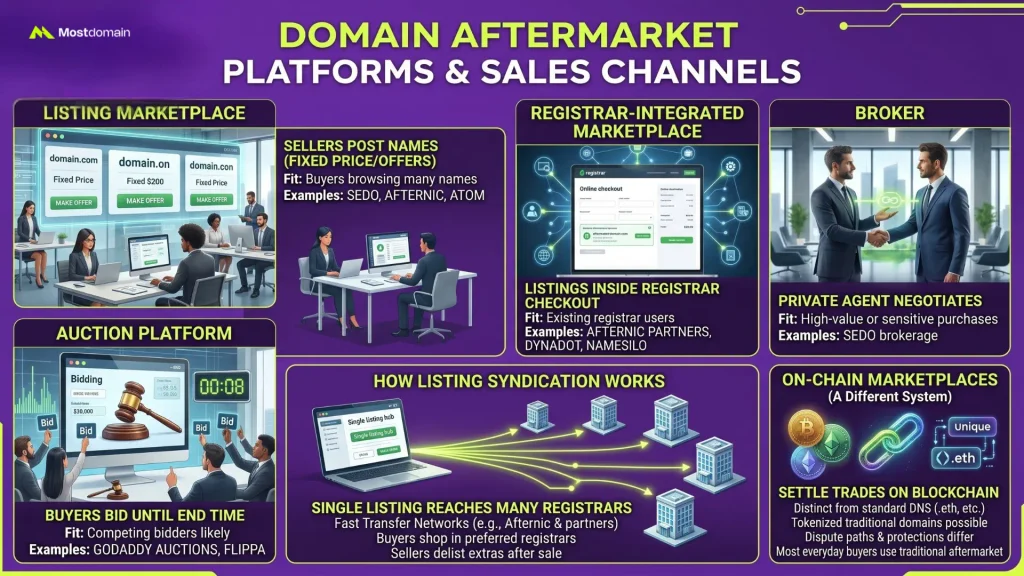
Six channel types carry most domain aftermarket sales, and one name can use several.
| Channel | How it works | Names mentioned in industry guides | Where it fits |
| Listing marketplace | Sellers post names at fixed prices or accept offers | Sedo, Afternic, Atom | Buyers who want to browse many names |
| Auction platform | Buyers bid until a set end time | GoDaddy Auctions, Flippa | Names likely to draw competing bidders |
| Registrar-integrated marketplace | Listings appear inside the registrar’s own checkout | Afternic partners, Dynadot, NameSilo | Buyers who already use that registrar |
| Broker | An agent negotiates in private | Sedo’s brokerage service | High-value or sensitive purchases |
| Direct from owner | The buyer contacts the owner or uses a for-sale page | The owner’s own landing page | Names that are not listed anywhere |
To compare specific marketplaces, read our full marketplace guide. One auction-style platform gets a closer look in our Flippa review.
How Listing Syndication Works
Syndication puts one listing in front of buyers on many registrar sites at once.
- Afternic’s Fast Transfer network shows listings across GoDaddy and partner registrar sites.
- Buyers can check out inside the registrar they already use.
- Commissions differ by channel, and partner-registrar sales often carry higher rates.
- Many sellers list one name in several places. They delist the extras after a sale.
On-Chain Domain Marketplaces
Some marketplaces settle trades on a blockchain instead of through a registrar.
- Blockchain names, such as .eth, use a different system than the standard DNS.
- A few services tokenize regular domains so ownership can move on-chain.
- Most everyday buyers still use the traditional, registrar-based domain aftermarket.
- Dispute paths and legal protections differ, so read each platform’s terms.
- This guide covers the traditional market.
How Domain Aftermarket Prices Work
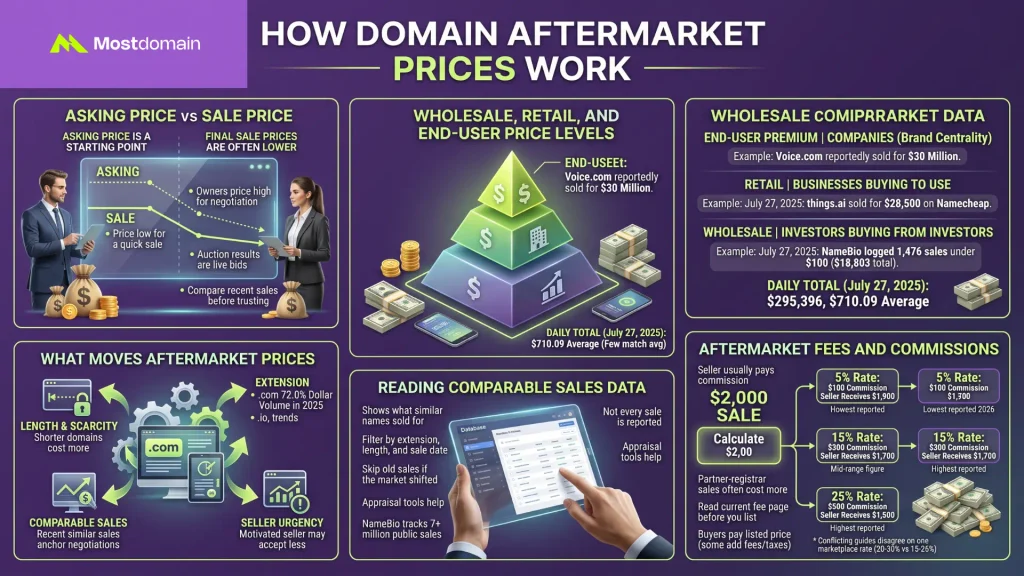
Domain aftermarket prices come from a negotiation between seller and buyer.
Asking Price vs Sale Price
The asking price is a starting point, and final sale prices are often lower.
- Some owners price high on purpose, to leave room to negotiate.
- Others price low for a quick sale.
- Auction results come from live bids, not from the opening price.
- Compare recent domain aftermarket sales before trusting any single asking price.
Wholesale, Retail, and End-User Price Levels
Prices sit on three levels, depending on who buys and how the deal closes.
| Level | Who buys | What reported sales show |
| Wholesale | Investors buying from other investors | On July 27, 2025, NameBio logged 1,476 sales under $100, totaling $18,803. |
| Retail | Businesses buying a name to use | That same day, things.ai sold on Namecheap for $28,500. |
| End-user premium | Companies where the name is central to the brand | Voice.com reportedly sold for $30 million. |
The daily total on July 27, 2025 reached $295,396, averaging $710.09 per sale. Few individual sales look like that average.
What Moves Aftermarket Prices
Length, extension, wording, and demand move prices the most.
- Shorter names are scarcer, which is why short domains cost more.
- Extension matters. The .com extension made up 72.0% of reported dollar volume in 2025.
- Newer or country extensions, such as .io domains, swing with trends.
- Exact phrases and clear brand names attract more bidders. See exact-match domains and branded and keyword-based names.
- Recent similar sales anchor most negotiations. Our guide explains how domain value is estimated.
- Seller urgency plays a role too. A motivated seller may accept less.
Reading Comparable Sales Data
Comparable sales show what similar names sold for, not what owners hoped for.
- NameBio tracks more than 7 million publicly reported domain aftermarket sales.
- Filter by extension, length, and sale date for closer matches.
- Skip sales from years back if the market has shifted since.
- Not every sale is reported, so one price can be typical or an outlier.
- Appraisal tools help too, as in our Sedo domain appraisal review.
Who Pays What on a $2,000 Sale
On a $2,000 sale, commission can leave the seller between $1,500 and $1,900.
| Commission rate | Commission | Seller receives | Where the rate comes from |
| 5% | $100 | $1,900 | The lowest rate reported for a seller platform in one 2026 comparison |
| 15% | $300 | $1,700, before escrow costs | A mid-range figure within several marketplace ranges |
| 25% | $500 | $1,500 | The highest rate reported for one marketplace |
These figures are illustrative. Each platform sets its own rates. Escrow fees depend on the amount and payment method.
Aftermarket Fees and Commissions
Sellers usually pay the commission, and domain aftermarket rates vary by platform and channel.
- Two guides disagree on one marketplace’s rate: 20 to 30% versus 15 to 25%.
- Partner-registrar sales often cost more than sales made directly.
- Some platforms charge a low flat rate. Others charge far more and add marketing.
- Buyers usually pay the listed price, though some platforms add fees or taxes.
- Read the current fee page before you list a name.
Domain Aftermarket Size and Statistics
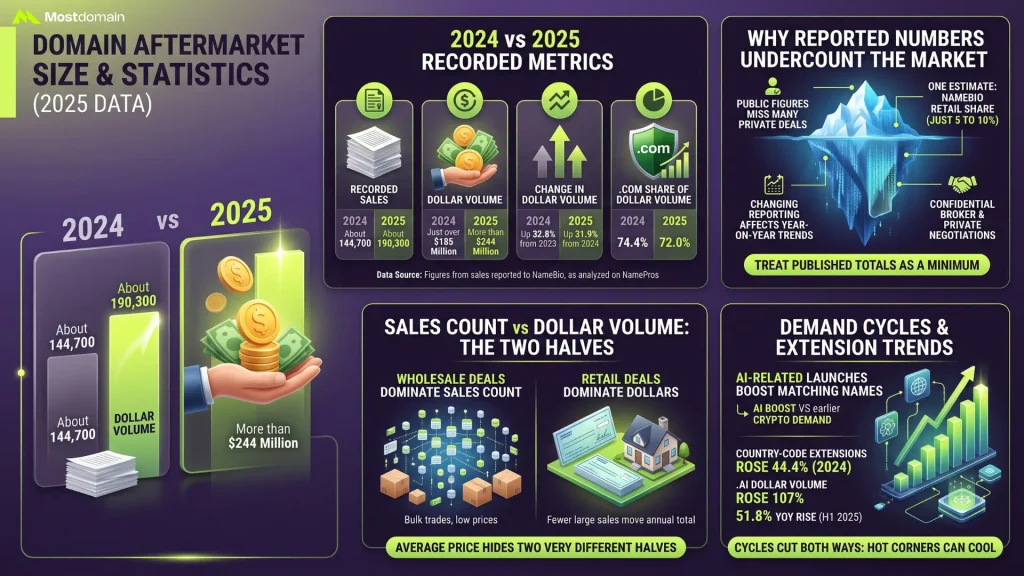
NameBio recorded about 190,300 domain aftermarket sales worth over $244 million in 2025.
2025 Sales Count, Dollar Volume, and .com Share
The domain aftermarket saw dollar volume rise 31.9% in 2025, with .com at 72.0%.
| Metric | 2024 | 2025 |
| Recorded sales | About 144,700 | About 190,300 |
| Dollar volume | Just over $185 million | More than $244 million |
| Change in dollar volume | Up 32.8% from 2023 | Up 31.9% from 2024 |
| .com share of dollar volume | 74.4% | 72.0% |
Figures come from sales reported to NameBio, as analyzed on NamePros.
Why Reported Numbers Undercount the Market
Public figures miss many private deals, so the real domain aftermarket is larger.
- One estimate puts NameBio’s share of retail sales at just 5 to 10%.
- Which sales get reported changes over time, so year-on-year trends need caution.
- Broker deals and private negotiations often stay confidential.
- Treat any published total as a minimum.
Why Sales Count and Dollar Volume Differ
Wholesale deals dominate the sales count, while retail deals dominate the dollars.
- Bulk investor trades create thousands of low-priced sales.
- A few large retail sales can move the annual dollar total.
- The 2025 rise came from more recorded sales, not from pricier ones.
- An average price hides two very different halves of the domain aftermarket.
Demand Cycles and Extension Trends
AI-related launches boosted demand for matching names in 2025, by one investor’s account.
- A long-running domain investing blog compares the AI boost to earlier crypto-driven demand.
- Country-code extensions rose 44.4% in 2024, and .ai dollar volume rose 107%.
- In the first half of 2025, country-code extensions rose 51.8% year over year.
- Cycles cut both ways, so a hot corner of the domain aftermarket can cool.
- Our domain trends article tracks these shifts.
Is the Domain Aftermarket Safe?
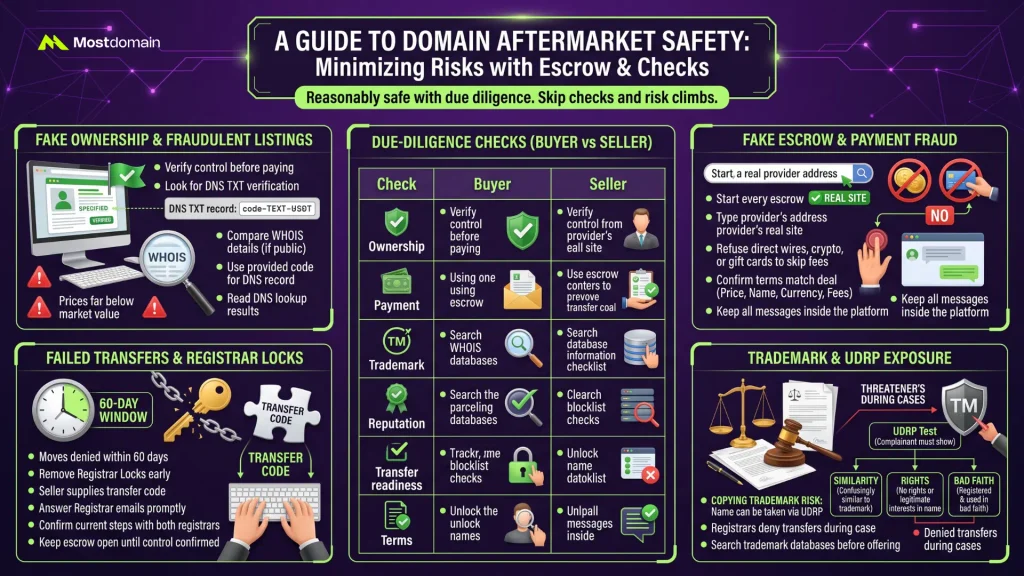
The domain aftermarket is reasonably safe with escrow and ownership checks. Skip them and risk climbs.
Fake Ownership and Fraudulent Listings
Someone can list a name they do not own, so verify control before paying.
- Some marketplaces verify ownership with a DNS TXT record. Look for that flag on listings.
- Compare the seller’s details with a WHOIS lookup when the record is public.
- Ask the seller to add a DNS record containing a code you provide.
- If you need help reading the result, see how to read DNS lookup results.
- Be wary of prices far below similar sales.
Fake Escrow and Payment Fraud
Fake escrow sites exist, so start every escrow from the provider’s real site.
- Type the escrow provider’s address yourself, never from a seller’s message.
- Refuse direct wires, crypto, or gift cards offered to skip the fee.
- Confirm that the escrow terms match your deal on price, name, currency, and fees.
- Keep all messages inside the platform when you can.
Trademark and UDRP Exposure
A name that copies someone’s trademark can be taken away through a UDRP complaint.
| UDRP test | What the complainant must show |
| Similarity | The name is identical or confusingly similar to a trademark the complainant holds. |
| Rights | The owner has no rights or legitimate interests in the name. |
| Bad faith | The name was registered and is being used in bad faith. |
- Registrars must deny transfers while a UDRP case is pending.
- Search trademark databases before offering on any brand-like name.
Failed Transfers and Registrar Locks
Many failed transfers trace back to locks, missing codes, or a 60-day window.
- Registrars may deny moves within 60 days of initial registration or a previous transfer.
- A registrar lock must come off before the transfer can start.
- The seller must supply the transfer code and answer the registrar’s email.
- The transfer rules changed recently, so confirm current steps with both registrars.
- Keep escrow open until you actually control the name.
Due-Diligence Checks for Buyers and Sellers
Buyers and sellers each need a short set of checks before money moves.
| Check | Buyer | Seller |
| Ownership | Confirm the seller controls the name | Prove control with a DNS record or an account screenshot |
| Payment | Use escrow, opened from the provider’s real site | Release the name only after escrow confirms funds |
| Trademark | Search brand databases before you offer | Avoid listing names that copy known brands |
| Reputation | Check spam and security blocklists | Fix or disclose any blocklist flags |
| Transfer readiness | Ask about locks and codes early | Unlock the name and prepare the transfer code |
| Terms | Get price, fees, and deadlines in writing | Same, and keep the record |
Should You Use the Domain Aftermarket or Register a New Name?
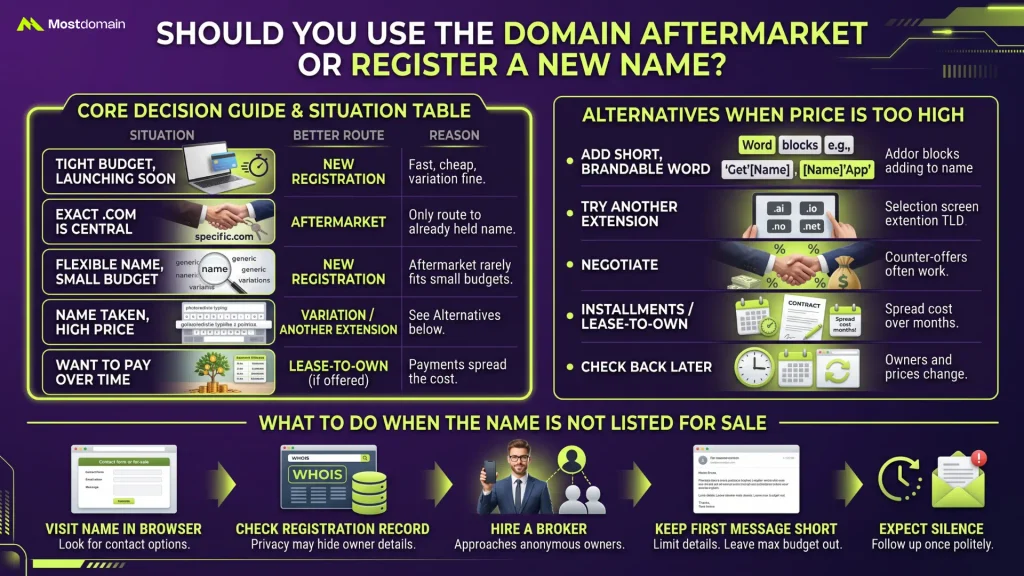
Use the domain aftermarket when the exact name matters more than the price.
Decision Table by Situation
Your budget, timeline, and attachment to one exact name decide the right market.
| Situation | Better route | Reason |
| Launching soon on a tight budget | New registration | It is fast and cheap, and a variation may work fine |
| The exact .com is central to your brand | Aftermarket | It is the only route to a name someone already holds |
| The name is flexible and the budget is small | New registration | Aftermarket prices rarely fit small budgets |
| The name is taken and the price is too high | Variation or another extension | See the alternatives below |
| You want to pay over time | Lease-to-own, if offered | Payments spread the cost |
Alternatives When the Price Is Too High
Variations, other extensions, and payment plans can close the gap without overpaying.
- Add a short, brandable word before or after the name.
- Try an extension that fits your industry.
- Negotiate. Sellers often counter somewhere in the middle, though not always.
- Ask about installments or a lease-to-own deal.
- Check back later. Owners, prices, and needs change.
What to Do When the Name Is Not Listed for Sale
You can still contact the owner, either directly or through a broker.
- Visit the name in a browser. Many owners post a contact form or a for-sale page.
- Check the registration record. Privacy services often hide the owner, though.
- Hire a broker if the owner stays anonymous. The broker approaches them for you.
- Keep the first message short, and leave your maximum budget out.
- Expect silence in many cases. Follow up once, politely.
FAQ
Is the domain aftermarket legit?
Yes, the domain aftermarket is legit when you use established platforms and escrow.
- Fraud exists. Deals made outside escrow carry the most risk.
- Ownership checks and trademark searches add protection, as covered above.
- Read each platform’s dispute and refund terms before you commit.
What is the difference between the primary market and the aftermarket?
One sells names nobody owns, the other sells names someone does.
- Primary prices are fixed. Aftermarket prices are negotiated or bid.
- Registry premium names still count as primary, despite their high prices.
- Aftermarket deals need a willing seller and usually escrow.
Why are aftermarket domains more expensive than new registrations?
Sellers price scarcity and demand, while a registration fee only covers the basics.
- A standard registration fee reflects a name nobody owns.
- An aftermarket price reflects what the name is worth to a buyer.
- Reported sales run from under $100 to a reported $30 million for Voice.com.
- Compare against similar sales before you accept any price.
Can I buy any registered domain through the aftermarket?
Only if the owner agrees to sell.
- Unlisted names can still sell after outreach.
- Some owners never sell, at any price.
- Brokers can reach owners who hide behind privacy services.
How long does an aftermarket purchase take?
A quick Buy Now can close in a day. Negotiated deals take longer.
- Negotiation adds hours to weeks.
- Transfers between registrars can take up to five days.
- Slow payment methods, like bank wires, stretch escrow funding.
Who pays the fees in an aftermarket sale?
Sellers usually pay the platform commission, while escrow fees depend on the deal.
- Commissions come out of the seller’s proceeds.
- Escrow fees can fall on either side, or be split.
- Buyers should check for platform fees, taxes, and registrar transfer charges.
Do I need a broker to buy or sell a domain?
Not for most standard deals, though brokers help with high-value or anonymous sales.
- Marketplaces and escrow cover routine deals.
- Brokers charge commission, sometimes plus a retainer.
- A broker can approach owners who will not answer buyers.
Set Your Walk-Away Number First
Decide your maximum price before you send the first message.
- Write the number down. Deals drift upward once a name starts to feel like yours.
- Bring a backup name. It keeps your leverage honest.
- Watch comparable sales for a few weeks, if the seller is not rushing you.
- Every domain aftermarket deal has a price where you should stop.
References
- Wikipedia, Domain aftermarket
- NamePros, 2025 Domain Name Market Dollar Volume Trends based on NameBio Data
- NamePros, 2024 Domain Name Market Dollar Volume Trends
- NamePros, Domain Name Sales Reported At NameBio During First Six Months Of 2025
- NameBio, Domain Name Sales History