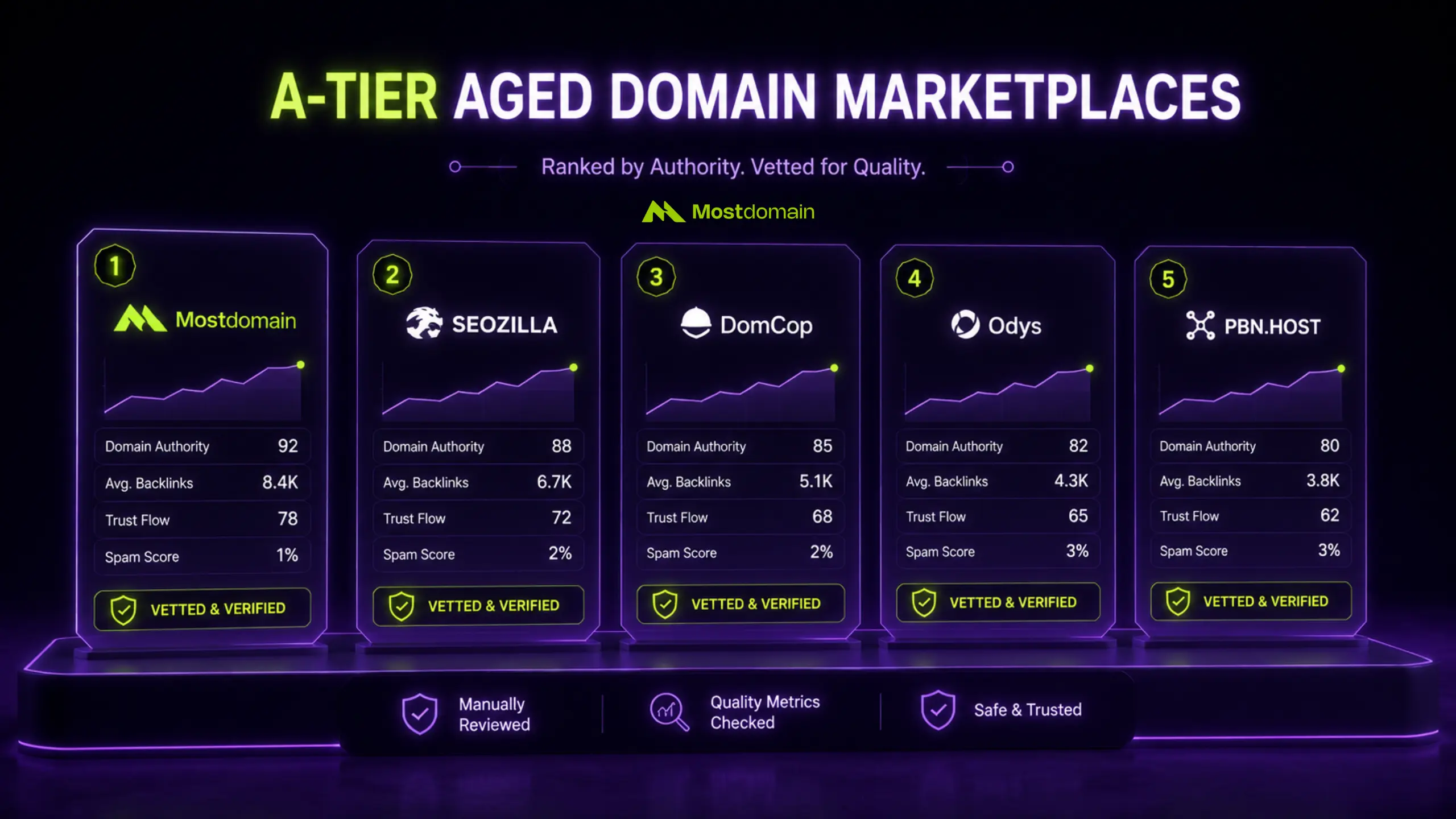
The best aged domain marketplaces let you check a domain’s authority before you pay for it, instead of leaving you to guess from a wall of names. Some screen every listing for penalties, backlinks, and history. Others hand you raw inventory and expect you to do the digging. Knowing which type you are dealing with saves money, and it saves the months you would otherwise lose to a domain that never ranks.
This guide sits inside a larger topic on finding and sourcing aged domains, and it focuses on one question only: where to buy. Not how to price a domain, not how to run a backlink audit. Just the platforms, and how they actually differ once you look past the marketing.
What Sets an Aged Domain Marketplace Apart From an Ordinary One
An aged domain marketplace is organized around a domain’s history, its age, backlinks, and past traffic, while a general domain marketplace is organized around the name and its branding appeal. On the surface they look similar. What you are paying for is not.
Plenty of “best marketplace” roundups mix the two together, which is where buyers get burned. A short table makes the split obvious.
| The angle | General domain marketplace | Aged domain marketplace |
| What you actually pay for | The name and how brandable it feels | Authority the domain already carries |
| Typical inventory | Fresh registrations, premium and brandable names | Expired or aged domains with a backlink trail |
| Core buyer | A founder naming a company | An SEO team buying ranking momentum |
| The metric that decides value | Length, memorability, the TLD | Referring domains, DR, topical history, penalty status |
If you are buying to rank, that last row is the whole game. A clever name does nothing for your position on Google. A clean five year old backlink profile can move you weeks ahead of a fresh registration.
The Three Tiers You Will Run Into
Aged domain marketplaces fall into three practical tiers.

- Curated platforms that pre-screen every listing.
- Raw auction and inventory platforms where you vet each domain yourself.
- Aggregator tools that surface dropping domains from across the web.
Here is the trade-off at a glance before the detail.
| Tier | What it really is | The catch |
| Curated and screened | Every listing checked for penalties, backlinks, and history before it goes live | Smaller inventory, higher prices |
| Raw auctions and open inventory | Enormous live supply you bid on or buy as-is | The entire due-diligence load lands on you |
| Aggregators and discovery tools | Crawlers that surface dropping domains with filterable metrics | No transactions happen here, it is research only |
Curated and Pre-Screened Platforms
Curated platforms do the vetting first, then list. Odys Global, SerpNames, and Mostdomain all sit here. The pitch is simple: fewer domains, but the ones you see have already been checked for spam signals, penalty history, and backlink quality. You pay for that filtering. For buyers without the time or tooling to audit dozens of candidates, it is often the cheaper choice once wasted hours are counted.
Raw Auctions and Open Inventory
This is where most of the world’s expired inventory actually flows. GoDaddy Auctions and Sedo are the giants. The upside is scale and price discovery. The downside is that nobody has vetted anything for you. So a listing with great surface metrics can still hide a manual penalty or a porn-and-casino past.




Aggregators and Discovery Tools
ExpiredDomains.net and DomCop do not sell you the domain. They crawl drops daily and let you filter by the metrics that matter, then send you off to buy elsewhere. Think of them as the radar, not the runway.
How We Scored Each Platform
Every aged domain marketplace here was judged on five buyer-side signals: whether it shows real SEO metrics natively, how deeply it screens for penalties, how honest its history disclosure is, how it handles escrow and transfer, and how its pricing works.
Most competing guides stop at pros, cons, and commission rates. Those are seller concerns. Buyers of aged domains care about something narrower, and it is worth naming the rubric out loud.
| Signal we scored | Why a buyer should care |
| Native metric disclosure | Whether DR, referring domains, and spam score sit on the listing, or you go fetch them yourself somewhere else |
| Penalty and spam screening | The depth of the platform’s own filtering, which is the single biggest predictor of whether a domain is safe |
| History transparency | Access to the domain’s prior use through archived snapshots, so you are not buying a former gambling site by accident |
| Escrow and transfer handling | Whether your money is held safely and the transfer is clean, especially across borders |
| Pricing model | Fixed price, auction, or make-offer, because each one rewards a very different buying style |
Full disclosure on method: this is a synthesis of publicly reported platform data and hands-on buyer experience across the three tiers, not a lab test. Treat the rankings as a starting map, not gospel.
The Best Aged Domain Marketplaces Compared
For most SEO buyers in 2026, the strongest best aged domain marketplaces are the curated trio of Odys Global, SerpNames, and Mostdomain for screened authority. GoDaddy Auctions and Sedo for raw volume. And ExpiredDomains.net or DomCop for discovery.
The table does the heavy lifting. Read the “how much vetting you still do” column carefully, because that is the hidden cost nobody quotes you upfront.
| Platform | SEO data on the listing | Where it fits best |
| Odys Global | Backlink profile and DR shown, history pre-vetted | Buyers who want done-for-you authority and can spend more |
| SerpNames | Granular filters for DR and referring domains, spam-free claim | SEO pros who need domains matching exact metric specs |
| Mostdomain | DA, DR, spam score, and traffic history disclosed per listing | Buyers who want a curated shortlist without auction chaos |
| GoDaddy Auctions | Basic age and traffic filters, little else | High-volume hunters who enjoy the diligence work |
| Sedo | Listing details, thin on SEO-specific metrics | Buyers chasing the widest international selection |
| Flippa | Traffic and revenue data on attached-site listings | Anyone after a domain that already has a live site on it |
| ExpiredDomains.net | Aggregated, filterable metrics refreshed daily | DIY hunters building watchlists from scratch |
| DomCop | Cross-platform metrics in one dashboard | Researchers comparing many drops quickly |
A few numbers give the landscape its shape. One 2026 analysis of 97,742 aftermarket sales found GoDaddy alone accounting for 64.59% of transactions, which tells you where raw expired inventory concentrates.
Sedo, meanwhile, carries over 18 million listings and posts one of the highest average sale prices in the market, near 13,900 dollars, a sign of its premium and international lean. Volume lives in the raw tier. Safety, mostly, lives in the curated one.
Why Brandable and Premium Marketplaces Did Not Make the Cut
Platforms like Atom.com and other brandable storefronts sell naming and design value, not SEO history, which puts them outside what an aged domain marketplace is supposed to deliver.
This is the line the general guides refuse to draw, so it is worth being blunt about it.
- Atom.com, formerly BrandBucket, curates memorable names with logos attached. Beautiful for a launch. Useless if your goal is inherited backlinks.
- Namecheap Marketplace and Afternic move enormous volume, but their strength is distribution and low fees, not aged-authority screening.
- NamePros is a community forum for peer deals, which means no built-in vetting and no escrow unless you add it yourself.
None of these are bad platforms. They just answer a different question. Buying a brandable name and buying a domain’s ranking history are two separate transactions, and treating them as one is how people end up disappointed.
Matching a Marketplace to How You Actually Buy
The right domain marketplace depends on your risk tolerance and time. Curated platforms suit buyers who want screened safety. Auctions suit hands-on hunters chasing value. And aggregators suit anyone building a sourcing pipeline at scale.
Pick by your working style, not by a leaderboard.
| If you are | Start with | Because |
| Short on time, wary of risk | A curated platform | The screening is done, you just choose |
| Comfortable auditing domains and hunting deals | GoDaddy Auctions or Sedo | Raw supply plus price discovery reward the effort |
| Buying at scale or feeding a team pipeline | An aggregator to source, then a marketplace to close | Watchlists and filters do the sifting for you |
| After a domain with a working site already on it | Flippa | Attached-site listings show real traffic and revenue |
Whichever tier you land on, the same vetting checklist applies before you pay. That part deserves its own walkthrough, which lives in the checklist for vetting an aged domain marketplace.
Red Flags Worth Checking Before You Pay
Watch this before you commit to any aged domain marketplace. Watch for:
- Missing history disclosure
- No escrow
- Vague or unverifiable metrics
- Listings that quietly bury the domain’s prior use.
Keep it quick. These are the tells that separate a clean buy from an expensive mistake.
- No way to see archived snapshots of the domain’s past life
- Metrics quoted with no source, or numbers that will not reconcile with a third-party tool
- Escrow treated as optional rather than standard
- A backlink profile that leans on gambling, adult, or obvious link-farm sources
- Pressure to close fast, before you have had time to run your own checks
For the full safety walkthrough, including how to spot a laundered penalty history, see the guide on buying aged domains safely.
FAQ
Are aged domain marketplaces safe to buy from?
Safety tracks the tier more than the brand. Curated platforms screen listings first, so the risk is lower by design. On raw auction sites the responsibility shifts to you. Which is fine if you know how to audit a backlink profile and check archived history before bidding.
How much do aged domains cost on these marketplaces?
Expect a wide range. A modest aged domain from an auction can clear under a couple hundred dollars. While curated, high-authority names with clean profiles routinely run into four figures. Sedo’s average sale, skewed by premium listings, sits near 13,900 dollars, though most aged-domain buys land far below that.
Can I check a domain’s backlinks before buying?
Yes, and you always should. Curated platforms surface DR, referring domains, and spam score on the listing itself. On raw marketplaces you will need to pull the profile through a separate tool before you trust any number a seller quotes.
What is the difference between an aged domain and an expired domain?
Both have history, but the framing differs. An expired domain simply dropped from its previous owner and re-entered the pool. An aged domain is valued specifically for the authority its age and backlinks carry, whether or not it ever expired.
Do curated marketplaces really screen out penalized domains?
For the most part, yes, and that screening is what you are paying the premium for. Platforms like SerpNames advertise a spam-free standard and filter by strict metric thresholds. Still, no filter is perfect, so a quick independent check before purchase remains worth the ten minutes.
Which aged domain marketplace is best for beginners?
A curated platform is the gentler entry point. It removes the two hardest parts of the process, finding clean inventory and judging whether a domain is safe, and lets a first-time buyer focus on matching a domain to their niche instead.
References
- DomCop, “Best Domain Marketplaces of 2026”.
- Bishopi.io, “Best Domain Marketplaces to Sell Domain Names in 2026, Ranked by Real Sales”.
- NameExperts, “Best Marketplaces to Buy and Sell Domains”.
- Atlantic.Net, “The Top Domain Marketplaces to Buy a Premium Domain Name”.
- Domain Drake, “The Top 12 Trusted Sources for Aged Domains for Sale in 2026”.
- Google Search Central, guidance on spam policies and manual actions.