
Short answer: yes, Flippa is legit. Running since 2009, north of $1 billion in completed digital business sales, 4.2/5 on Trustpilot from over 3,000 reviews. None of that means every single listing on the site can be trusted, though. A $500 starter blog and a $2M SaaS exit sit on the exact same page, and anything under $50,000 barely gets checked by Flippa at all. Figuring out which is which is basically on you.
What Is Flippa, Exactly?
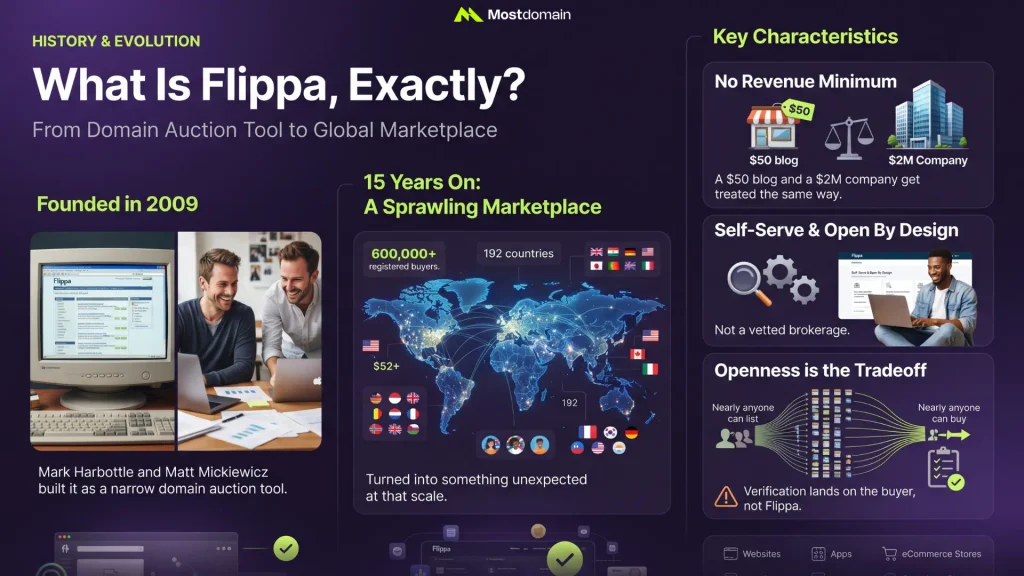
Not always this sprawling. Back in 2009, Mark Harbottle and Matt Mickiewicz built Flippa as a fairly narrow domain auction tool, aimed at solving one specific problem for one specific crowd. Fifteen years on, it’s turned into something neither of them probably saw coming at that scale.
- Founded 2009, Mark Harbottle and Matt Mickiewicz
- 600,000+ registered buyers, spread across 192 countries
- No revenue minimum to list. A $50 blog and a $2M company get treated the same way
- Self-serve and open by design, not a vetted brokerage
Openness is the whole tradeoff here. Nearly anyone can list, nearly anyone can buy, and what that really means is verification lands on the buyer, not on Flippa itself.
Is Flippa Legit? What the Trust Data Actually Shows
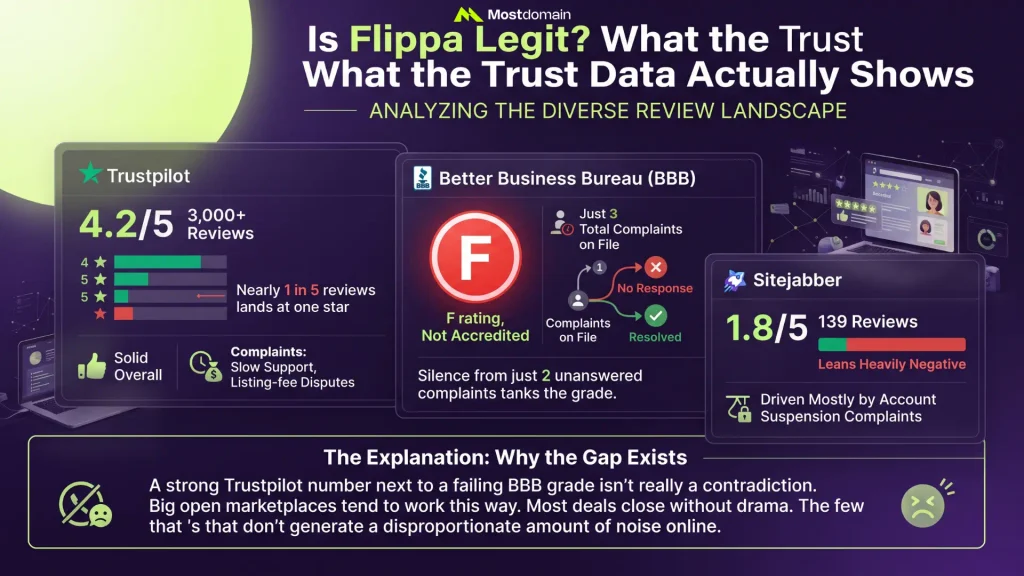
Depends which review site you check, honestly, and the gap between them tells you something worth knowing before trusting either number alone.
| Source | Rating | What It Reflects |
| Trustpilot | 4.2/5 (3,000+ reviews) | Solid overall. Still, nearly 1 in 5 reviews lands at one star, mostly complaints about slow support or listing-fee refund disputes |
| Better Business Bureau | F rating, not accredited | Just 3 complaints on file total, but 2 never got a response, and that silence is what tanks the grade |
| Sitejabber | 1.8/5 (139 reviews) | Leans heavily negative, driven mostly by account suspension complaints |
A strong Trustpilot number next to a failing BBB grade isn’t really a contradiction once you think about it. Big open marketplaces tend to work this way. Most deals close without drama. The few that don’t generate a disproportionate amount of noise online.
What Can You Actually Buy on Flippa?
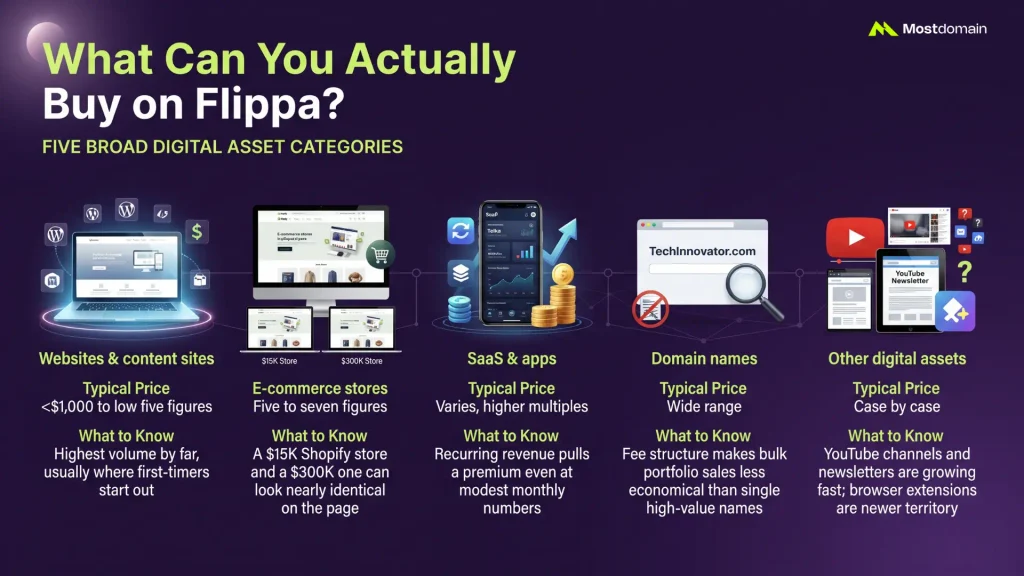
Five broad categories, each with wildly different pricing behavior once you actually look under the hood.

| Asset Type | Typical Price Range | What to Know |
| Websites & content sites | Under $1,000 to low five figures | Highest volume by far, usually where first-timers start out |
| E-commerce stores | Five to seven figures | A $15K Shopify store and a $300K one can look nearly identical on the page |
| SaaS & apps | Varies, higher multiples | Recurring revenue pulls a premium even at modest monthly numbers |
| Domain names | Wide range | Fee structure makes bulk portfolio sales less economical than single high-value names |
| Other digital assets | Case by case | YouTube channels and newsletters are growing fast; browser extensions are newer territory with looser pricing norms |
How Much Does Flippa Actually Cost?
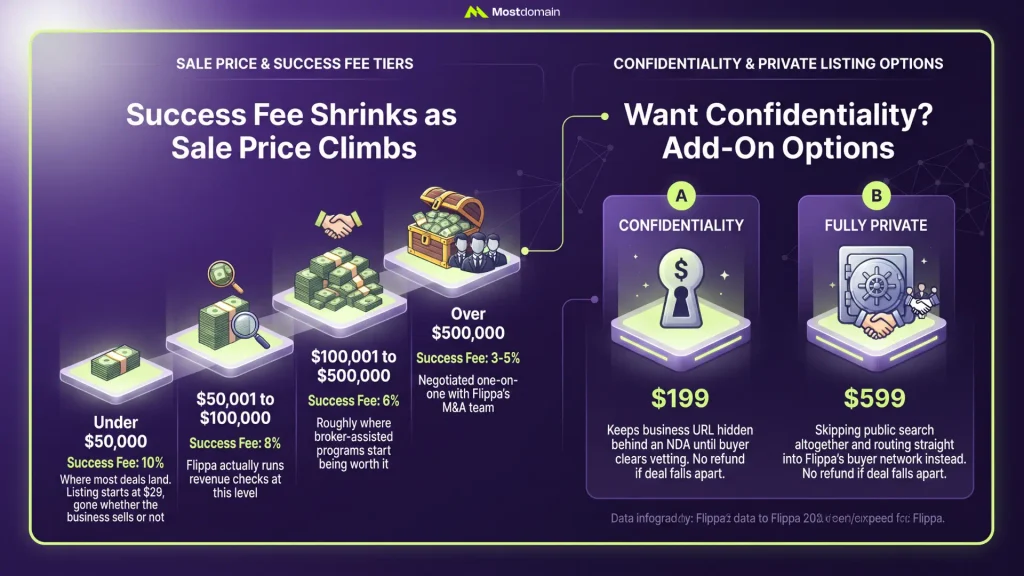
Non-refundable listing fee up front, then a success fee that shrinks as the sale price climbs.
| Sale Price | Success Fee | Notes |
| Under $50,000 | 10% | Where most deals land. Listing starts at $29, gone whether the business sells or not |
| $50,001 to $100,000 | 8% | Flippa actually runs revenue checks at this level |
| $100,001 to $500,000 | 6% | This is roughly where broker-assisted programs start being worth it |
| Over $500,000 | 3-5% | Negotiated one-on-one with Flippa’s M&A team |
Want confidentiality? That’s $199, and it keeps the business URL hidden behind an NDA until a buyer clears vetting. Going fully private runs $599, skipping public search altogether and routing straight into Flippa’s buyer network instead. Either way, no refund if the deal falls apart.
How Does the Escrow Process Actually Work?
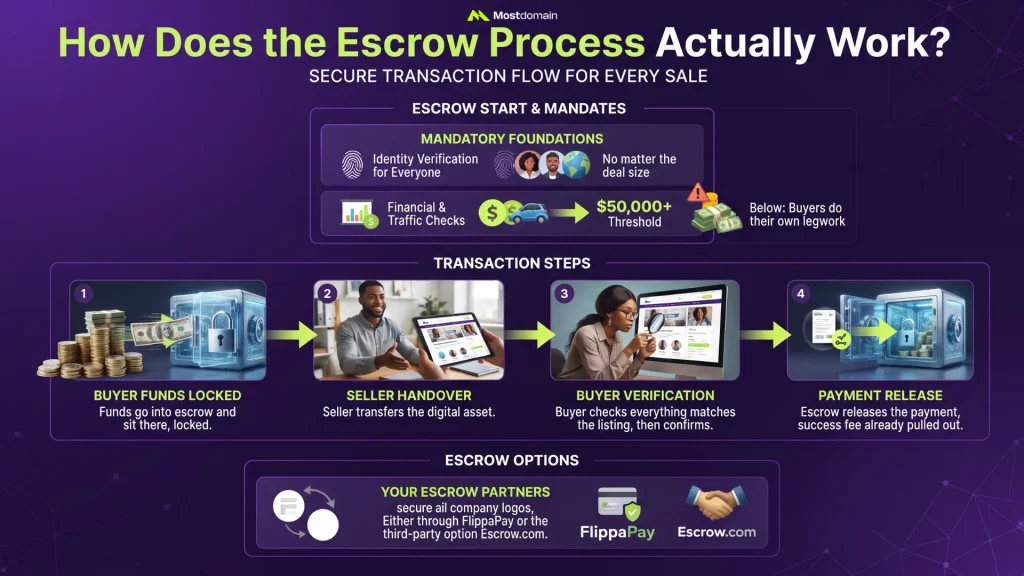
Every closed sale runs through escrow first, no exceptions, either through FlippaPay or the third-party option Escrow.com.



- Buyer’s funds go into escrow and sit there, locked.
- Seller hands over the asset.
- Buyer checks everything matches what was listed, then confirms.
- Escrow releases the payment, success fee already pulled out.
Identity verification is mandatory for everyone on the platform, no matter the deal size. Financial and traffic checks only start above $50,000 though, which leaves most first-time buyers doing their own legwork below that threshold.
Weighing the Pros and Cons
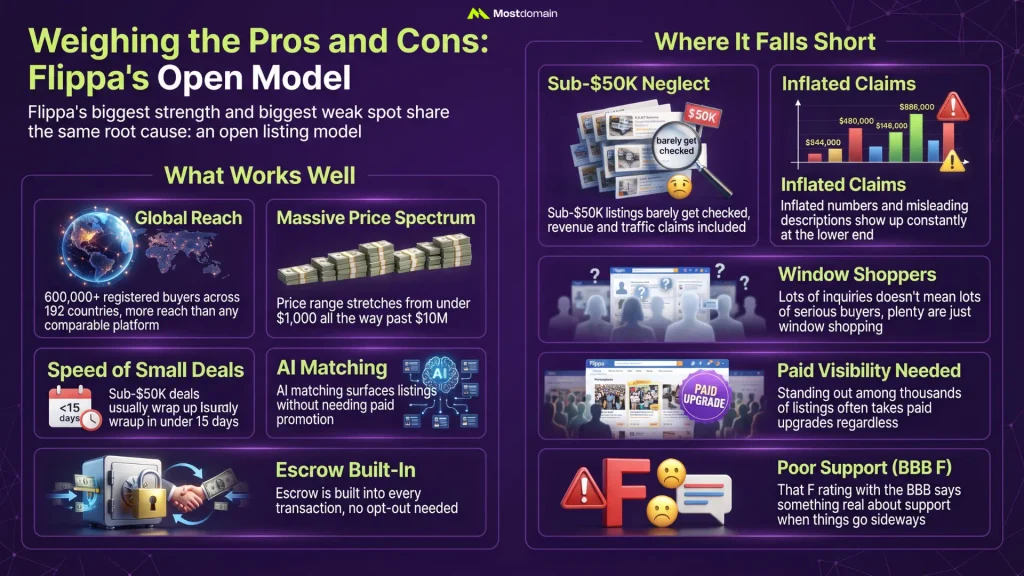
Same root cause behind Flippa’s biggest strength and its biggest weak spot: an open listing model with almost nothing standing at the door.
| What Works Well | Where It Falls Short |
| 600,000+ registered buyers across 192 countries, more reach than any comparable platform | Sub-$50K listings barely get checked, revenue and traffic claims included |
| Price range stretches from under $1,000 all the way past $10M | Inflated numbers and misleading descriptions show up constantly at the lower end |
| Sub-$50K deals usually wrap up in under 15 days | Lots of inquiries doesn’t mean lots of serious buyers, plenty are just window shopping |
| AI matching surfaces listings without needing paid promotion | Standing out among thousands of listings often takes paid upgrades regardless |
| Escrow is built into every transaction, no opt-out needed | That F rating with the BBB says something real about support when things go sideways |
Flippa vs. Empire Flippers: Which One Fits?
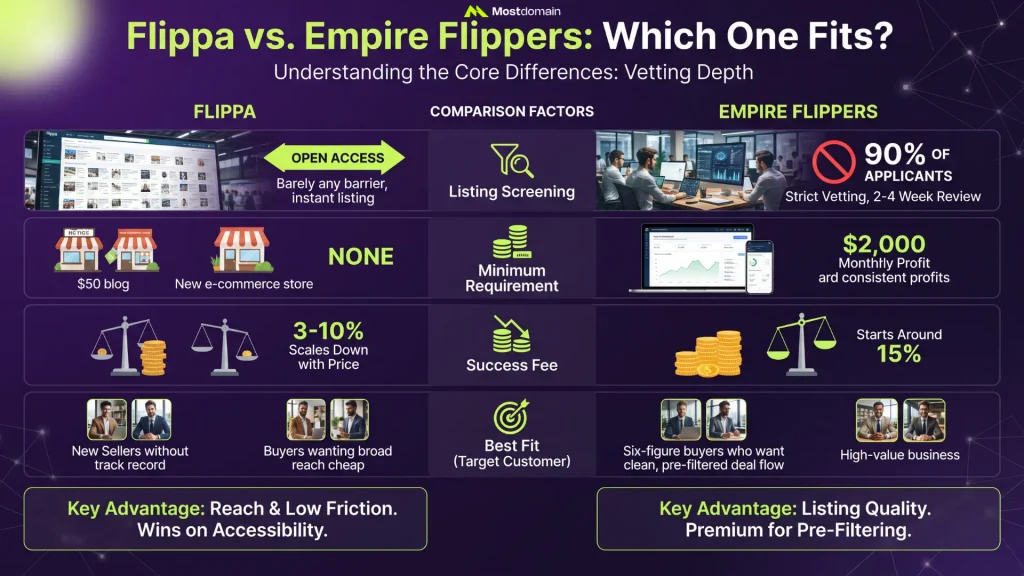
Vetting depth is really the whole story here, everything else follows from that one difference.
| Factor | Flippa | Empire Flippers |
| Listing screening | Open, barely any barrier | Turns away roughly 90% of applicants, 2-4 weeks of review first |
| Minimum requirement | None | $2,000 monthly profit |
| Success fee | 3-10%, scales down with price | Starts around 15% |
| Best fit | New sellers without a track record, or buyers wanting broad reach cheap | Six-figure buyers who want cleaner, pre-filtered deal flow |
They’re barely even competing for the same customer, if you think about it. Flippa wins on reach and low friction. Empire Flippers wins on listing quality, but you pay for that with a steeper fee and a longer wait to get in.
How to Actually Succeed as a Buyer on Flippa
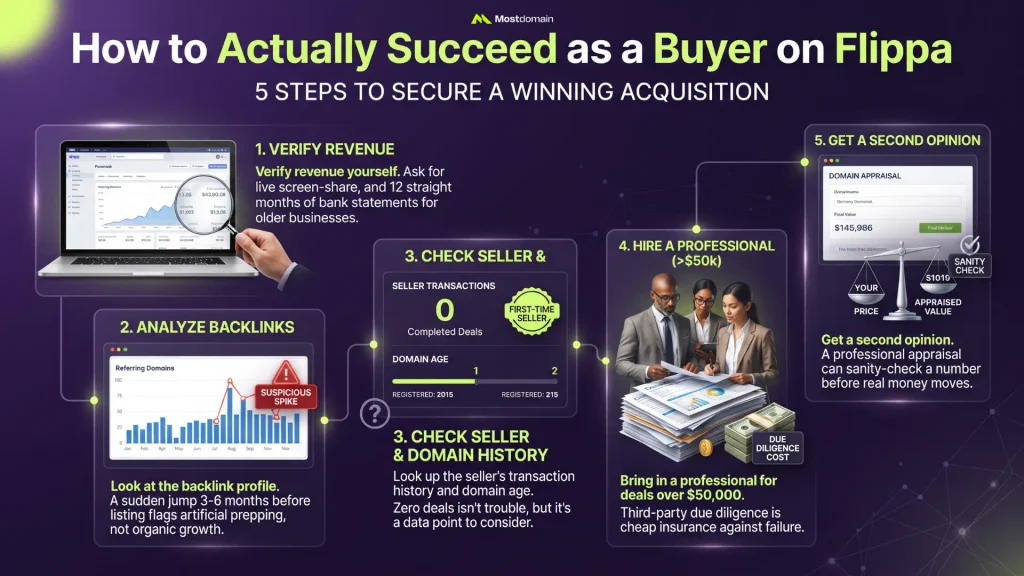
Comes down to prep work, not luck. The buyers who come out ahead are almost always the ones who verified things themselves instead of assuming someone else already did.
- Verify revenue yourself. A screenshot proves nothing on its own. Ask for live screen-share into Stripe or PayPal, and if the business is over three years old, push for 12 straight months of bank statements.
- Look at the backlink profile before you bid. A sudden jump in referring domains three to six months before listing usually means someone prepped the numbers for sale, not organic growth. A domain authority checker flags that kind of spike fast, and a domain value guide is worth reading if the asset’s price hinges heavily on its SEO footprint.
- Look up the seller’s transaction history, and the domain’s too. Zero completed deals doesn’t automatically mean trouble, plenty of first-time sellers are legit. It’s just one more data point, and ignoring it isn’t smart either. If the asset is domain-based, a quick domain age checker confirms how long it’s actually been registered, separate from whatever the seller claims about the business itself.
- Bring in a professional once you’re past $50,000. Third-party due diligence runs a few hundred to a few thousand dollars. Cheap insurance against a failed acquisition, honestly.
- Get a second opinion if the price feels off. Something like a Sedo domain appraisal can sanity-check a number before real money moves.
FAQ
Does Flippa actually deliver on its promises?
Real money, real volume. Over a billion dollars in digital business sales have gone through Flippa since 2009, and identity verification is required before anyone gets marketplace access. 4.2/5 on Trustpilot from 3,000+ reviews, but also an F with the Better Business Bureau over unanswered complaints. Not a scam, but definitely an open marketplace where the verification work below $50,000 falls on you.
What can be listed on Flippa?
Pretty much anything with documented revenue behind it. Websites, Shopify and Amazon FBA stores, SaaS products, mobile apps, domains, YouTube channels, email newsletters, all fair game.
How long does it take to sell on Flippa?
Depends a lot on price point, honestly. Above $250,000, qualified buyers thin out, so figure around two and a half months. Land between $50,000 and $250,000, and six weeks is closer to normal. Anything under $50,000 usually wraps up in about fifteen days.
What’s the real cost of selling on Flippa?
Anywhere from $29 to $699 goes out before the listing even goes live, gone regardless of outcome. Then a success fee of 3% to 10% on top at close, with the full 10% only hitting deals under $50,000.
Is Flippa safe for buyers?
Reasonably, yes, assuming you do your own verification work. Escrow keeps funds protected through the whole transfer. Most of the actual risk sits in listings where nobody’s checked the financial claims, which describes the bulk of what’s active under $50K.
Why does Flippa have an F rating with the BBB?
It’s about unresponsiveness, not volume. Only 3 complaints total, but 2 went unanswered, and BBB scoring punishes silence hard regardless of how small the complaint count actually is.
What are the best alternatives to Flippa?
Depends what you’re buying. Empire Flippers makes sense if you want a pre-vetted catalog and don’t mind paying more for it. If the acquisition is domain-focused rather than a full business, it’s worth comparing other domain marketplaces side by side first. For sanity-checking domain pricing specifically, either a Sedo appraisal or reading up on how domain flipping actually works helps regardless of which marketplace you end up using.
References
- Better Business Bureau, “Flippa Business Profile”
- Trustpilot, “Flippa Reviews”
- Investors Club, “Flippa Review for Buyers and Sellers: Is It Legit?”
- Sophisticated Investor, “Flippa Review 2026: Fees, Scams & Is It Safe to Buy or Sell?”
- CPI Inflation Calculator, “Flippa Review 2026: Real Fees From 10% to 5%, the $50,000 Vetting Cliff and an F at the BBB”