$10 to $20 for year one, then anywhere from $15 to $40 once renewal hits. That’s the standard range most domains fall into. Extension, registrar, and whether the name itself carries premium weight all push that number around.
Fine for covering the basics. It doesn’t explain why prices jump around so much between registrars, why renewal frequently costs double what you paid to sign up, or what people actually want can go for once it hits the open market. None of it gets explained upfront, and that’s the real issue: a pricing structure buyers rarely see until they’re already locked in.
Domain Name Cost, Tier by Tier
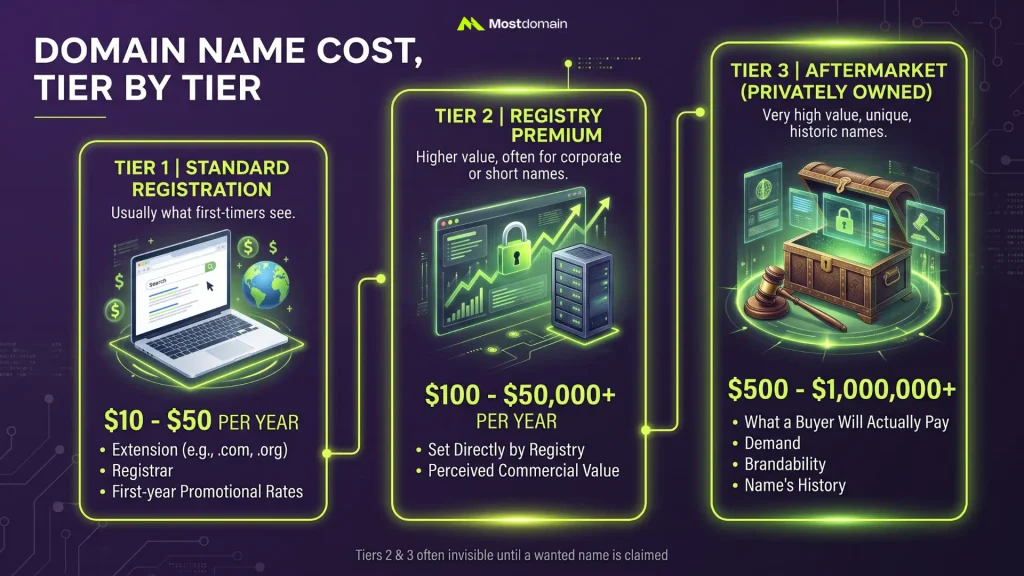
Roughly three tiers exist here. Standard registrations sit at $10 to $50 a year, registry-set premium names climb into the thousands, and privately owned aftermarket names can run six or seven figures.
| Domain Tier | Typical Price | What Determines It |
| Standard registration | $10-$50/year | Extension, registrar, and whether it’s a first-year promotional rate |
| Registry premium | $100-$50,000+ | Set directly by the registry based on the name’s perceived commercial value |
| Aftermarket (privately owned) | $500-$1,000,000+ | Whatever a buyer will actually pay; comes down to demand, brandability, and the name’s history |
Tier one is usually all a first-timer ever sees. The other two stay invisible until later. That gap in awareness tends to surface fast, usually the moment a name someone actually wants turns out already claimed.
Why Do Domain Names Cost What They Cost?
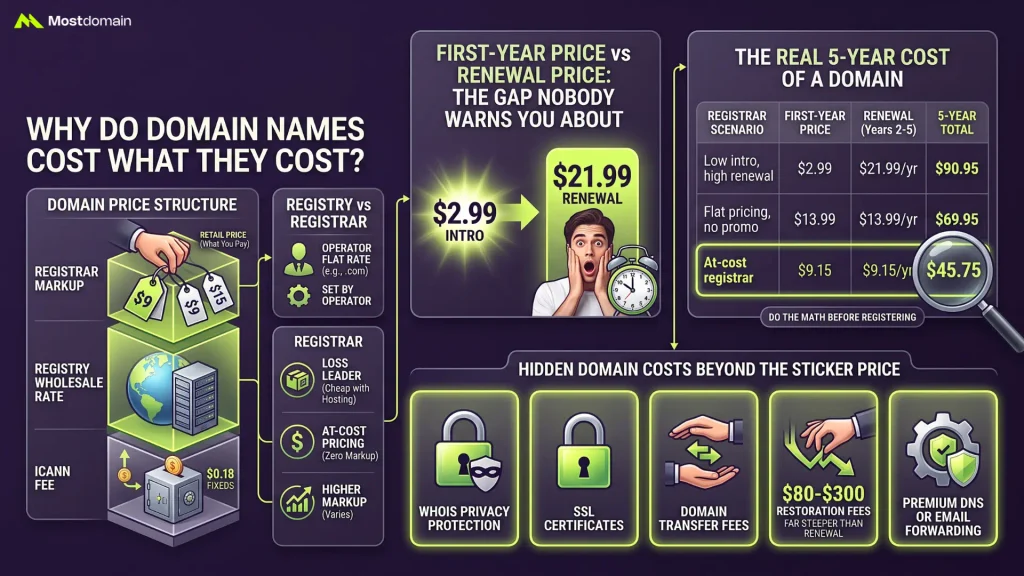
Three layers, one stacked on the next: a flat ICANN fee, a wholesale rate the registry decides, then whatever the registrar tacks on for itself before you ever see a price.
The ICANN Fee Everyone Pays But Nobody Explains
Every generic top-level domain, .com and .net and .org among them, carries a small built-in transaction fee, roughly $0.18 historically, that goes straight to ICANN for running the domain system’s oversight. Fixed, invisible at checkout, and the one part of the price tag that stays exactly the same no matter who you buy from.

Registry Wholesale Pricing vs Registrar Markup
Whoever operates a given extension, Verisign for .com, sets one wholesale price and charges every registrar the same rate.
Registrars pile their own markup on top from there, which explains why identical .com names run $9 in one place and $15 somewhere else.
Some registrars deliberately price near wholesale, treating the domain as a loss leader to pull people toward hosting or email instead, where the actual profits sit.




A few advertise flat “at-cost” pricing, meaning close to zero markup gets added above what the registry itself charges.
First-Year Price vs Renewal Price: The Gap Nobody Warns You About
That attractive first-year number rarely survives into year two intact, and this specific gap is behind more billing surprises than anything else in domain ownership.
Look at the renewal number before you ever hit register, not just whatever’s flashing on the checkout button. Just one habit erases the most common budgeting mistake first-time buyers make.
The Real 5-Year Cost of a Domain
Compare two registrars on year-one price alone, and the wrong one can win. A lower signup fee sometimes hides a pricier total once the five-year math actually runs.
| Registrar Scenario | First-Year Price | Renewal (Years 2-5) | 5-Year Total |
| Low intro, high renewal | $2.99 | $21.99/year | $90.95 |
| Flat pricing, no promo | $13.99 | $13.99/year | $69.95 |
| At-cost registrar | $9.15 | $9.15/year | $45.75 |
Look closely at that table and the registrar asking more upfront actually wins out over five years, by a real margin too.
Doing this math before registering, rather than after that first renewal notice lands, separates a fair deal from a mildly irritating one.
Hidden Domain Costs Beyond the Sticker Price
That advertised registration number almost never captures the full cost of owning a domain for the long haul. A few extra costs always lurk just past that headline number, and they show up down the road, not at checkout.
- WHOIS privacy protection: it keeps your personal contact info out of the public WHOIS lookup. Some registrars throw this in free; others bill $10 to $15 a year for it.
- SSL certificates: usually free if you’re already paying for hosting, but some registrars charge $20 to $100+ a year when it’s not bundled in.
- Domain transfer fees: typically equal to one year of registration, charged when moving a domain between registrars
- Restoration fees: let a domain lapse into its redemption period, and pulling it back before deletion can run $80 to $300, far steeper than any normal renewal.
- Premium DNS or email forwarding: optional, easy to skip, but registrars tack on $10 to $50 a year for it if you opt in.
Not every one of these applies universally, sure, but at least one or two show up in most real purchases anyway. That’s exactly why the actual yearly cost tends to land higher than whatever number greeted you at signup.
How Much Do Premium and Aftermarket Domain Names Cost?
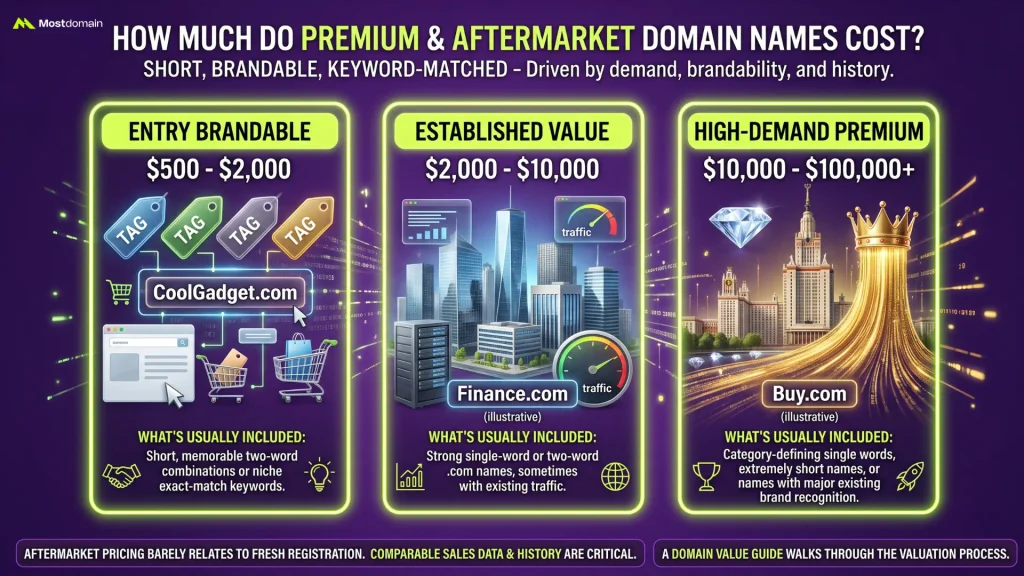
Short, brandable, keyword-matched, take your pick, and the price can stretch from a few hundred dollars all the way into six or seven figures, driven entirely by demand, brandability, and history.
| Aftermarket Tier | Typical Price | What’s Usually Included |
| Entry brandable | $500-$2,000 | Short, memorable two-word combinations or niche exact-match keywords |
| Established value | $2,000-$10,000 | Strong single-word or two-word .com names, sometimes with existing traffic |
| High-demand premium | $10,000-$100,000+ | Category-defining single words, extremely short names, or names with major existing brand recognition |
A full side-by-side comparison against similarly spelled names does matter, comparable sales data, aftermarket pricing barely relates to what a fresh registration would cost at all. A domain value guide walks through exactly how that valuation process plays out in practice.
Domain Name Cost by Registrar, and Who Charges What
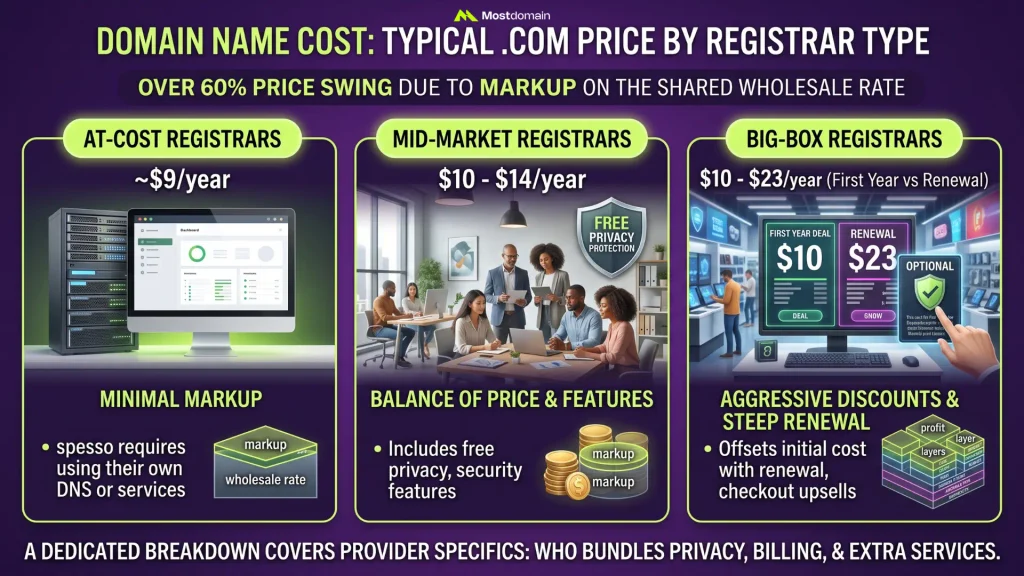
More than 60%. That’s how much the exact same .com can swing in price between registrars, and almost all of that gap traces back to markup stacked over one shared wholesale rate.
| Registrar | Typical .com Price | Notable Pricing Trait |
| At-cost registrars | ~$9/year | Minimal markup, often requires using their own DNS or services |
| Mid-market registrars | $10-$14/year | Balance between price and included features like free privacy protection |
| Big-box registrars | $10-$23/year (first year vs renewal) | Aggressive first-year discounts offset by steep renewal pricing and checkout upsells |
A dedicated breakdown of the best domain registrars covers this provider-by-provider, down to who bundles privacy protection free and who bills extra for it.
Avoiding an Overpriced Domain Name
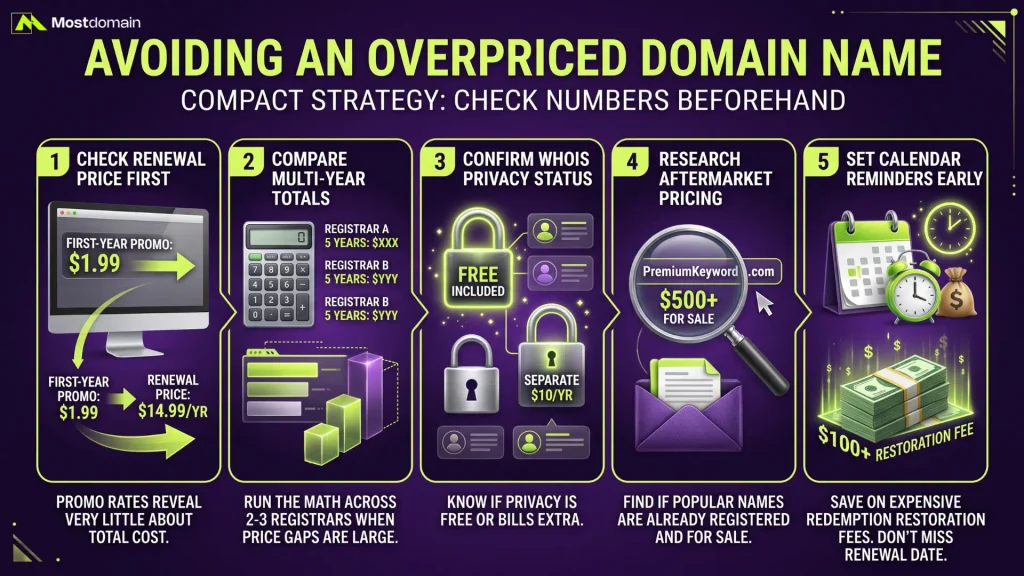
Check the numbers before you ever register, not after the renewal notice lands. That’s the whole strategy, really, compressed into one line.
- Check the renewal price first. The first-year promo rate tells you almost nothing about what you’ll actually pay.
- Worth running a multi-year total across two or three registrars whenever the price gap looks big enough to matter
- WHOIS privacy protection: some registrars throw it in free, others bill it separately. Confirm which before you commit.
- Going after a brandable or keyword-heavy name? Check the aftermarket first. It might already be registered and for sale there.
- A calendar reminder ahead of renewal saves more than people expect; miss it, and redemption-period restoration fees run far past a normal renewal
FAQ
Why do some domains cost $2 while others cost $50 for the same extension?
That $2 price is almost always a first-year promo, built purely to win the signup. It says nothing about the domain’s real ongoing cost. Renewal pricing is what actually matters, since that’s the number reflecting what the registrar and registry genuinely charge once the discount runs out.
Is it normal for a domain’s renewal price to be higher than its registration price?
Very common, especially with registrars pushing aggressive first-year promos or newer extensions like .shop and .app. Look at the renewal rate before you sign up, not just what’s on the checkout page, and there’s no surprise left to find.
Do more expensive domain extensions mean better quality or more trust?
Not really. Extension pricing follows registry-set wholesale cost and demand, and neither has anything to do with quality or trust. A $9 .com works exactly as well as a $70 .io. The gap between them just reflects how each registry prices its own inventory, nothing about which one you can rely on more.
What’s the cheapest way to get a domain name?
Long-term, an at-cost registrar barely marking up wholesale usually wins, particularly if you’re holding the domain for years rather than dropping it after one. Compare multi-year totals instead of the first-year sticker price, and whatever’s genuinely cheapest tends to surface, not just whatever’s shouting loudest in the ad.
Can a domain’s price change after I’ve already registered it?
Yes, registries can shift wholesale pricing over time, and registrars pass that straight through at renewal. Some registries, newer gTLDs especially, have raised prices considerably since launch. Worth the extra few minutes: check a registrar’s renewal pricing history before committing to any long-term domain strategy.
What Makes Premium Domain Names So Much Pricier Than a Standard One?
Pure market demand, nothing close to a standard registration fee. Short, memorable, or exact-match names get priced the way any scarce asset does: whatever a buyer will actually pay the current owner, not some fixed number off a registry’s pricing chart.
References
- ICANN, “Registrar Transaction Fees”
- Verisign, “Registry Agreement and Wholesale Pricing”
- Shopify, “How Much Does a Domain Name Cost? Pricing Guide”
- NameExperts, “Domain Name Pricing: What You’ll Actually Pay”
- Nametastic, “How Much Does a Domain Name Cost? Pricing Guide”