Right after the last dot in mostdomain.com sits a TLD: .com. Three letters, technically the highest rung in the internet’s entire Domain Name System hierarchy. Most people register one without ever asking what stands behind it, and fair enough, until you’re the one choosing.
Mechanics only, here. What a TLD actually is, who runs it, the official categories, and a 2026 shift most existing guides haven’t caught up with.
Where a TLD Sits in a Domain Name
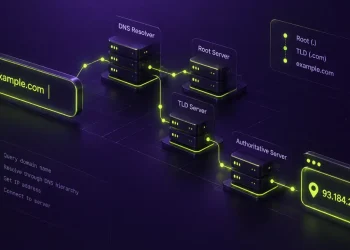
Directly below the invisible DNS root, that’s where a TLD sits, with everything else in a domain name stacking downward from that point.
Take docs.github.io. Read it backward, past a trailing dot nobody actually types, and the hierarchy unfolds on its own:
| Reading Order | Label | Example Here | What It Actually Does |
| 1st (invisible) | Root | (a silent trailing dot) | Sits above the entire DNS tree; every lookup starts here |
| 2nd | TLD | .io | Determines which registry governs everything registered beneath it |
| 3rd | Second-level domain | github | The name itself, chosen and registered |
| 4th | Subdomain | docs | Optional. Free to create once you own the domain above it |
The fuller anatomy of a domain name, plus a running count of how many exist worldwide, lives in What Is a Domain Name? A Domain Name Complete Explanation instead of here. A resolver finding the right TLD is only step one, too; the rest of that walk gets covered in How to Actually Read DNS Lookup Results.
Who Actually Controls TLDs
Rule-setting for TLDs runs through ICANN. Keeping the actual record of who operates each one, that’s IANA’s job, its technical arm.

Four separate layers are usually involved, and mixing them up is a common source of confusion:
- ICANN (Internet Corporation for Assigned Names and Numbers): sets policy, approves new TLD applications, and writes the contractual ground rules
- Underneath ICANN sits IANA (Internet Assigned Numbers Authority). The department actually maintaining the Root Zone Database. The authoritative list of every delegated TLD and which nameservers answer for it
- Running a specific TLD day to day falls to a registry operator, Verisign for .com, Public Interest Registry for .org, and so on
- Then there’s the registrar, the retail seller (Namecheap, GoDaddy) that sells registrations to the public but holds zero authority over the TLD itself
Worth sitting with, that: a string like .shop or .nyc functions purely because one nonprofit’s database says so. A handful of registry operators, and only them, get to touch it directly.
The Official Types of TLDs
Six. That’s how many TLD categories IANA formally recognizes, even though most domain buyers only ever bump into two of them: gTLD and ccTLD.



| Category | Example | Notes |
| Generic (gTLD) | .com, .net, .xyz | Open to anyone, no eligibility check |
| Country-code (ccTLD) | .id, .uk, .de | Tied to a specific country or territory |
| Sponsored (sTLD) | .edu, .gov, .mil | Restricted; you need to prove you qualify |
| Generic-restricted | .biz, .name | Generic in theory, but usage rules still apply |
| Infrastructure | .arpa | Reserved for internet plumbing, never sold publicly |
| Test | .test, .example | Reserved for docs and testing, never delegated live |
That’s the full system, six categories and nothing more. Picking an extension for an actual brand is a separate question though, and the practical side of it, including which categories tend to perform best by business type, lives over in How to Choose Domain Extensions for Business.
How Many TLDs Exist, and Why That Number Is About to Move
1,593. That’s how many delegated TLDs sat in IANA’s root zone database as of February 2026, a number about to move again for a reason most TLD guides written a year ago simply couldn’t have known.
- 2012: the internet’s last major expansion. Over 1,200 new gTLDs in one wave, .app to .guru among them
- Early 2026: 1,593 delegated TLDs on record. Up from around 1,502 back in 2021
- Right now: a fresh application round is underway. With the next batch of approvals expected later this year
That third point gets its own section next. It’s the one thing separating a genuinely current TLD explainer from one written twelve months ago.
Where New TLDs Actually Come From: the 2026 Application Round
30 April 2026: that’s when ICANN reopened new-TLD applications for the first time since 2012. The window closed again on 12 August.
- Cost: a USD 227,000 evaluation fee per application, non-refundable no matter the outcome
- Requirement: every applicant needs a pre-approved Registry Service Provider handling the technical side
- Timeline: about fifteen weeks to submit, with ICANN expecting to publish approved strings around mid-October 2026
- Scale, last time around: 2012 gave us brand extensions like .bmw and .google, city extensions like .nyc and .berlin, plain generic terms like .bank and .eco
Practically, nobody invents a TLD overnight. Clearing ICANN’s application, evaluation, and, if two parties want the same string, an auction, can stretch well past a year start to finish.
The Second-Level Twist Most Guides Skip
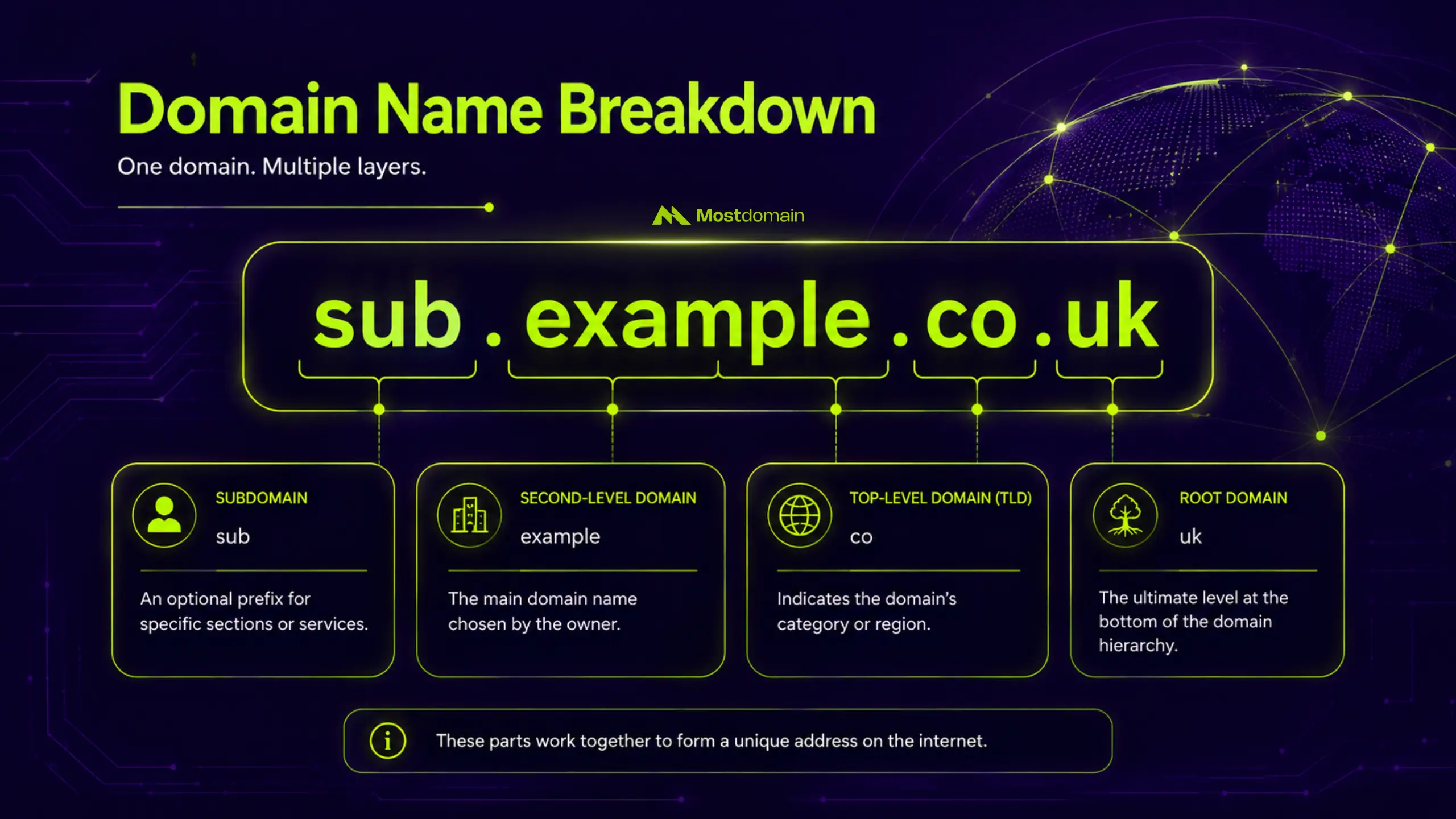
.co.uk looks like a TLD. It isn’t one, technically, a second-level domain sitting underneath the real ccTLD, .uk.
| Structure | Actual TLD | What Sits Beneath It |
| example.co.uk | .uk | .co.uk (commercial), .gov.uk (government), .ac.uk (academic) |
| example.com.au | .au | .com.au (commercial), .gov.au (government), .edu.au (education) |
| example.com | .com | Nothing, .com is the TLD itself with no extra layer |
The practical effect: registering a .co.uk domain puts you two levels down from the actual DNS root, not one. Worth knowing before assuming every extension with a dot in the middle behaves identically.
TLD vs Domain Extension vs Domain Name
Same thing, TLD and domain extension, just two different labels for it. Domain name is the broader term, covering the whole registered address.
| Term | What It Refers To |
| TLD | The formal DNS term for the string after the last dot |
| Domain extension | The same string, described in everyday, non-technical language |
| Domain name | The full registered address: second-level domain plus TLD together |
People use these three interchangeably in casual conversation. The distinction only matters when reading technical documentation. Or an ICANN policy document that leans on the formal terms.
Does Your TLD Choice Affect SEO?
Not as a direct Google ranking factor, according to Google’s own public statements. Though it can shape click-through rate and user trust indirectly.
- Country-code TLDs can nudge which region search engines associate a site with
- Familiar extensions like .com tend to earn a slightly higher click-through rate, mostly through recognition
- None of that changes how the algorithm itself actually scores content
That question deserves a full answer on its own, which is exactly what already exists at Do TLDs Affect SEO Rankings? Complete Guide, including the data behind the click-through and trust argument.
What This Means Before You Register Anything
A TLD carries more institutional weight than its size implies. A governance chain running through ICANN and IANA. A six-category classification system. And, as of 2026, a fresh application cycle that will add new options to the list before the year is out.
One thing worth noticing along the way: extensions built for one purpose often drift toward a completely different one once actual usage takes over, a small Pacific territory’s country code becoming shorthand for “we build software” being the clearest case of it.
Quick recap for anyone just scanning:
- A TLD is the segment after the last dot, governed by ICANN and recorded by IANA
- There are six official categories, though gTLDs and ccTLDs cover almost everything you’ll encounter
- 1,593 TLDs existed as of February 2026, with more on the way from the 2026 application round
- Some extensions with a dot in the middle, like .co.uk, are second-level domains, not TLDs themselves
If you’re evaluating a domain, whether brand new or already aged, the TLD is one signal worth checking alongside registration history and prior use. That kind of due diligence is part of what MostDomain’s marketplace listings are built to make easier to verify before committing to a purchase.
FAQ
What is the difference between a TLD and a domain extension?
None. TLD is the formal DNS term. Domain extension is the same string described in everyday language.
How many TLDs exist in 2026?
1,593 TLDs were delegated as of February 2026. According to IANA’s root zone database, that number is expected to grow once the 2026 application round finishes processing.
Can I create my own TLD?
Only through ICANN’s formal application process. Which reopened for the first time since 2012 in the 2026 round, at a cost of USD 227,000 per application. A private TLD can exist on a closed internal network, but it won’t be valid on the public internet.
Is .co.uk a TLD?
Not technically. .uk is the actual ccTLD, and .co.uk sits underneath it as a second-level domain. The same setup .com.au uses under .au.
What was the first TLD ever created?
January 1985: that’s when .com, .org, .net, .edu, .gov, and .mil first went live as TLDs. Alongside the country-code system that followed shortly after.
Does the TLD I choose affect my website’s SEO?
Not directly, per Google’s own statements. Though it can influence click-through rate and perceived trust. The full breakdown lives in the dedicated guide linked above.
References
- Wikipedia, “Top-level domain”
- Wikipedia, “List of Internet top-level domains”
- IANA, “Root Zone Database”
- ICANN, “New gTLD Program: 2026 Round”
- MDN Web Docs, “TLD – Glossary”