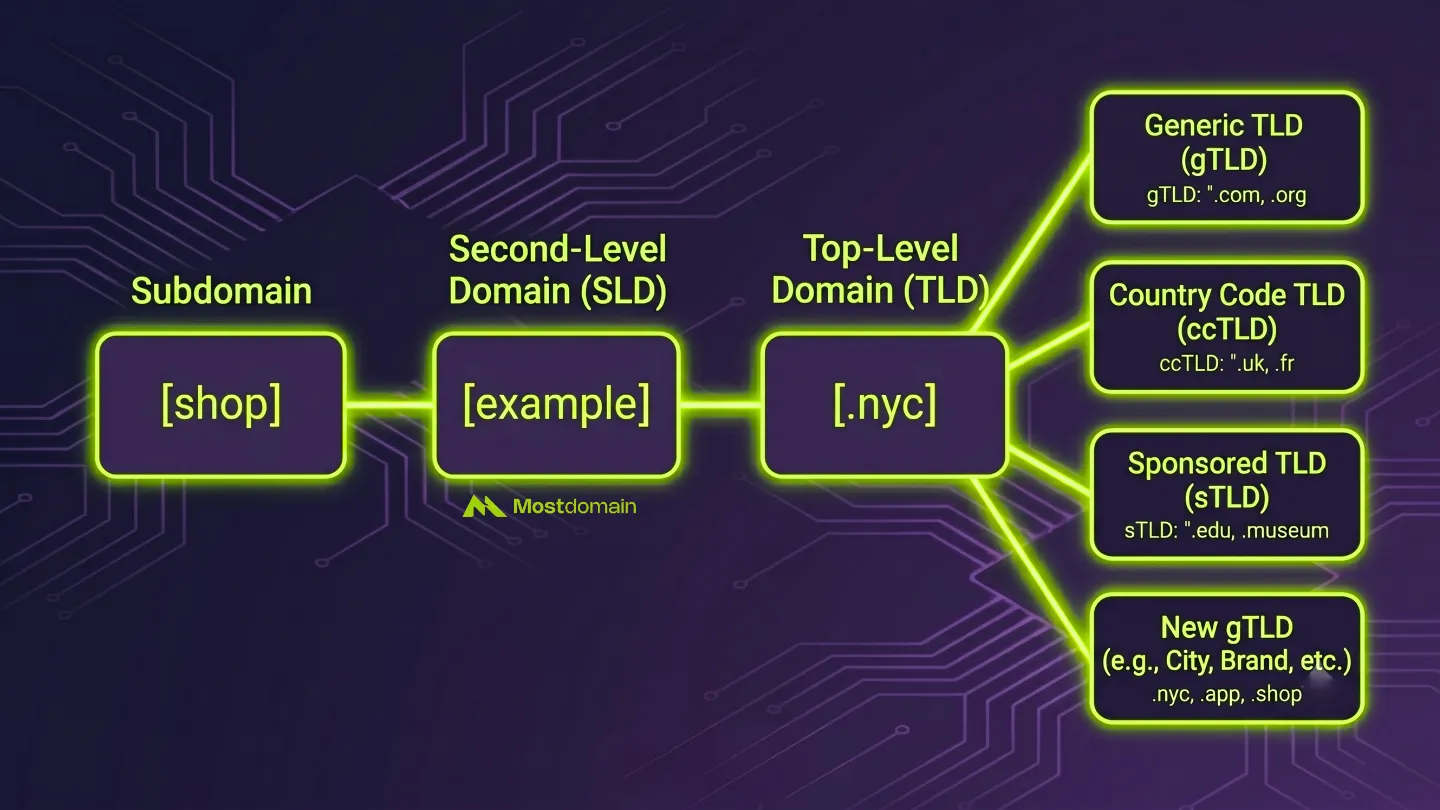
Break a domain name apart and you get three layers: subdomain, second-level domain, and the top-level domain, or TLD. Five families cover every TLD out there, generic (gTLD), country-code (ccTLD), sponsored (sTLD), the newer batch ICANN released after 2013, and a small leftover set of infrastructure and internationalized extensions almost nobody registers directly. Ask any question about domains, .com versus .io, what something costs, whether it touches your SEO, and the answer traces back to which family it belongs to.
What Are the Parts of a Domain Name?
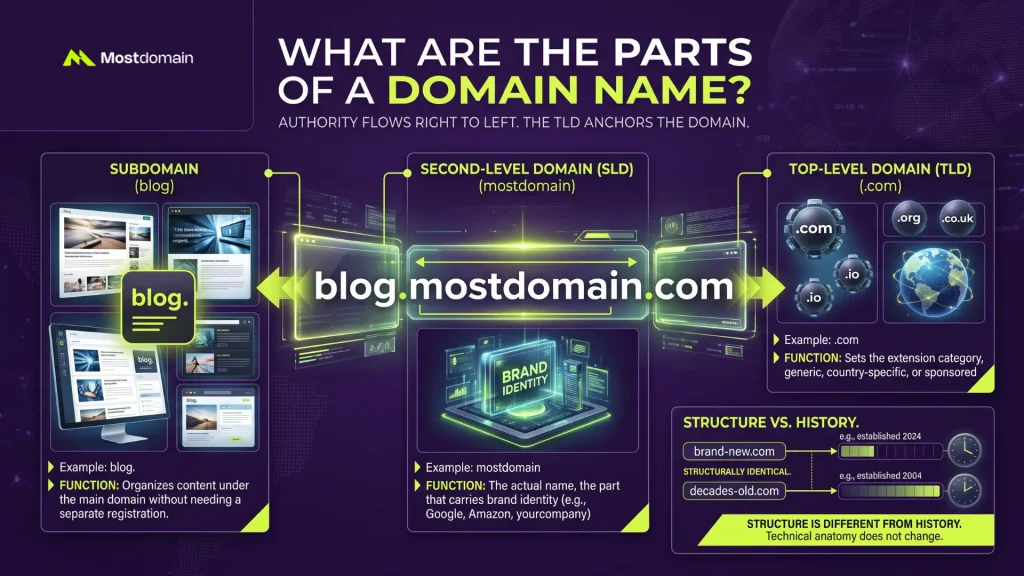
Authority in a domain reads right to left. The TLD at the end anchors everything sitting in front of it. Pull blog.mostdomain.com apart and three distinct pieces show up, each doing its own job.
| Part | Example (blog.mostdomain.com) | What It Does |
| Top-level domain (TLD) | .com | Sets the extension category, generic, country-specific, or sponsored |
| Second-level domain (SLD) | mostdomain | The actual name, the part that carries brand identity |
| Subdomain | blog | Organizes content under the main domain without needing a separate registration |
One distinction trips people up more than it should: structure and history are two different things entirely. A brand-new .com and a decades-old .com look structurally identical. One’s just been around longer, nothing about the technical anatomy changes.
What Is a Generic Top-Level Domain (gTLD)?
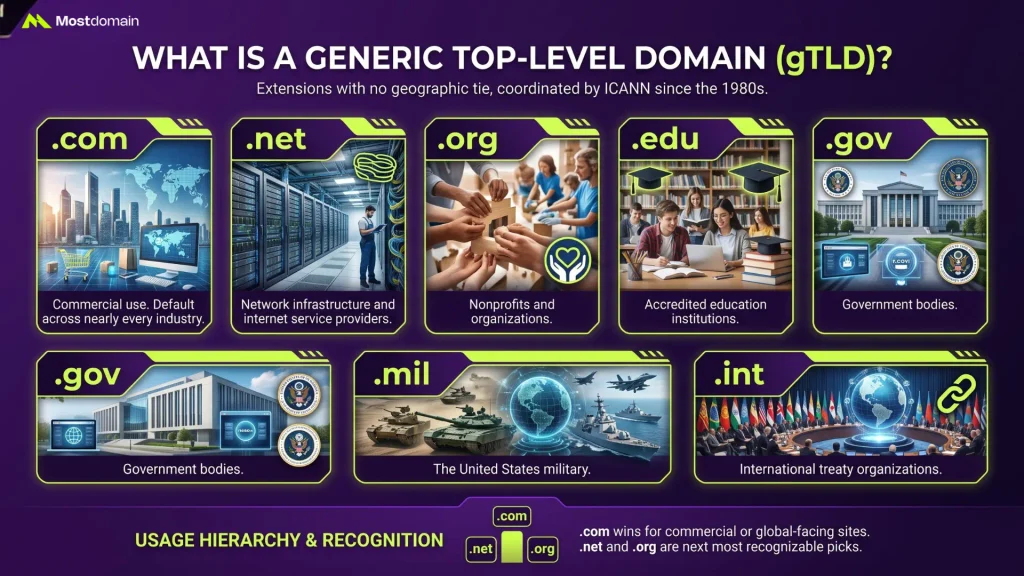
.com, .net, and .org set the pattern here, extensions with no geographic tie, open to whatever use fits. These go back to the 1980s and ICANN still coordinates them today.
| gTLD | Originally Intended For |
| .com | Commercial use, now the default across nearly every industry |
| .net | Network infrastructure and internet service providers |
| .org | Nonprofits and organizations |
| .edu | Accredited education institutions |
| .gov | Government bodies |
| .mil | The United States military |
| .int | International treaty organizations |
.com still wins by default for commercial or global-facing sites. .net and .org trail behind as the next most recognizable picks, in that order.
How Open Is a gTLD, Really?
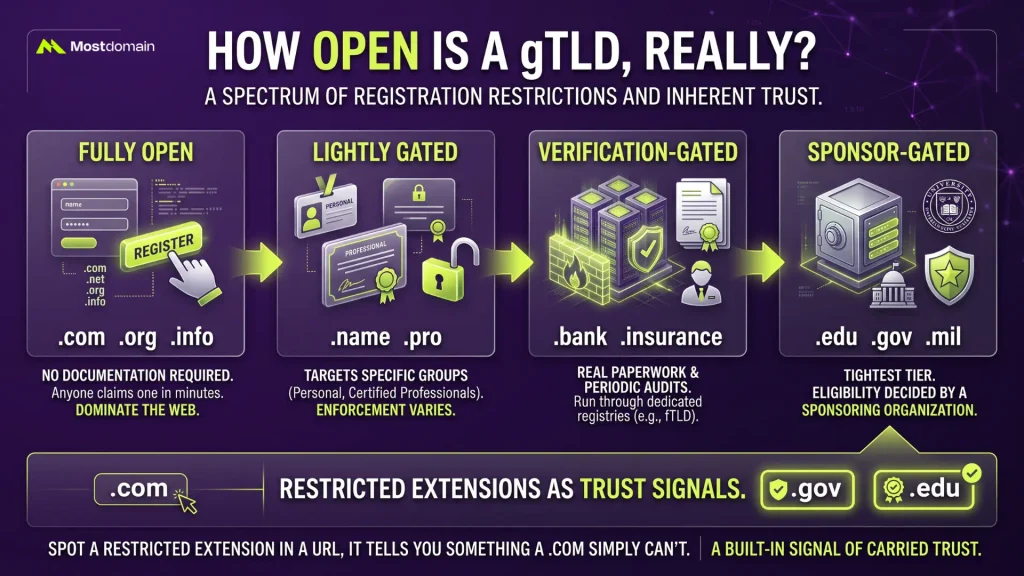
Getting one ranges from instant and unrestricted to requiring actual documentation, and where a given extension sits on that spectrum tells you something about how much trust it carries out of the gate.

- Fully open — .com, .net, .org, and .info ask for nothing at registration. Anyone anywhere claims one in minutes, which is exactly why these dominate the web the way they do.
- Lightly gated — .name targets people wanting a personal identifier. .pro was built for certified professionals, doctors and lawyers mainly, though enforcement has drifted looser over the years.
- Verification-gated — .bank and .insurance demand real paperwork and periodic audits, run through dedicated registries like fTLD Registry Services.
- Sponsor-gated — .edu, .gov, .mil sit at the tightest tier. A sponsoring organization decides who’s eligible, full stop.
A restricted extension doubles as a built-in trust signal. Spotting .gov or .edu in a URL tells a visitor something a .com simply can’t.
What Is a Country Code Top-Level Domain (ccTLD)?
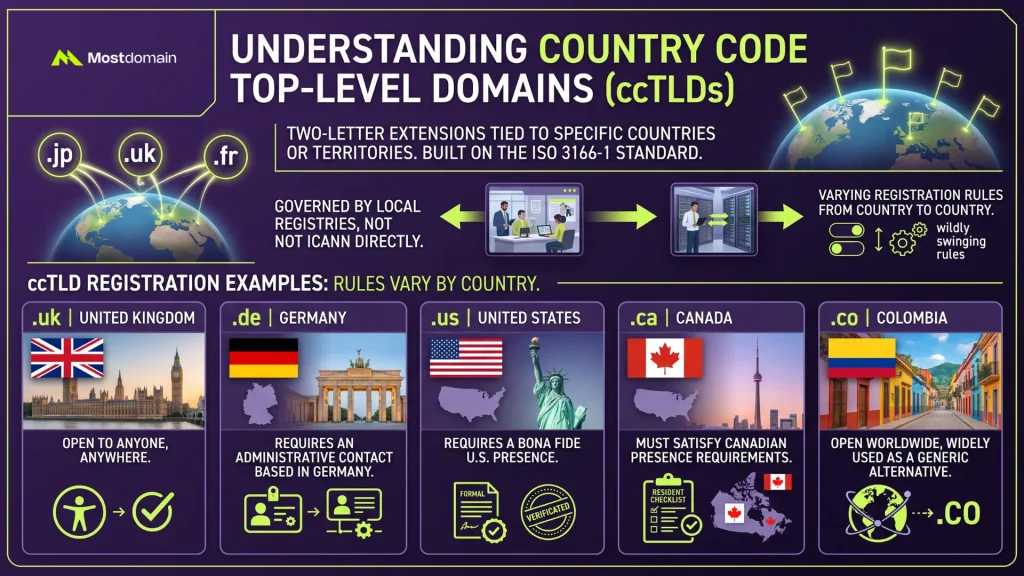
Two letters, tied to a specific country or territory, built on the ISO 3166-1 standard, that’s a ccTLD in a sentence. Local registries run these instead of ICANN directly, which is exactly why registration rules swing so wildly from one country to the next.
| ccTLD | Country / Territory | Who Can Register |
| .uk | United Kingdom | Open to anyone, anywhere |
| .de | Germany | Requires an administrative contact based in Germany |
| .us | United States | Requires a bona fide U.S. presence |
| .ca | Canada | Must satisfy Canadian Presence Requirements |
| .co | Colombia | Open worldwide, widely used as a generic alternative |
Does a ccTLD Help or Hurt Your SEO?
Google reads a ccTLD as a strong geotargeting signal, full stop, and whether that works for or against you comes down entirely to who you’re trying to reach.



- Where it helps: serving one market? Google generally treats the country-code extension as proof the site belongs to that audience. Real advantage, no downside, if you’re staying local.
- Where it hurts: that same signal turns into a ceiling the second you want to grow past one country. Search engines read the site as locally focused and won’t budge much from that read.
- The exception: a handful of ccTLDs dodge the regional lock-in entirely. Google treats .ai, .io, and .co as generic despite their origin. How .io domains function gets into exactly why tech companies lean on this exception so hard.
The .io Domain’s Uncertain Future
Not just a branding quirk anymore. This one’s actually tangled up in real geopolitics. Back in May 2025, the UK and Mauritius signed a treaty handing sovereignty of the Chagos Archipelago, officially the British Indian Ocean Territory, over to Mauritius. “IO” exists as a country code purely because that territory exists on paper. Change the territory’s status, and the extension’s future gets shaky along with it.
- Territory codes disappearing from ISO 3166-1 usually trigger IANA’s retirement process, a phase-out clock that typically runs five years, sometimes stretched to ten
- Over 270,000 .io sites are registered right now, and that alone gives Mauritius a solid financial reason to keep collecting on the extension rather than shutting it down
- Nothing official yet, worth repeating. ICANN maintains that “IO” still holds under the current ISO standard, meaning zero registrar-level changes so far
- File this under watch, not panic, if .io is central to your brand. Just go in knowing the uncertainty exists before committing a decade of budget to it
What Is a Sponsored Top-Level Domain (sTLD)?
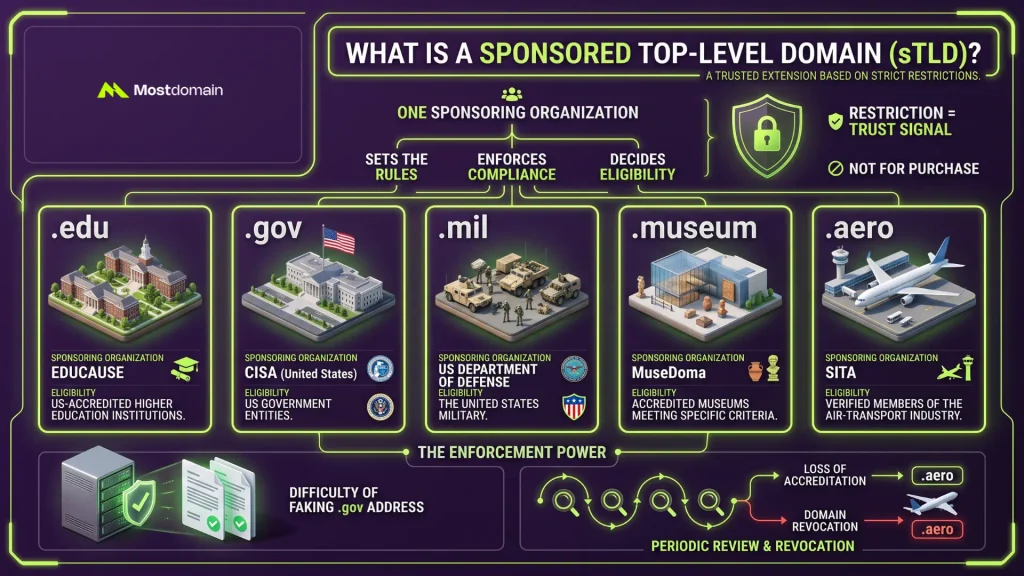
One organization sets the rules, enforces them, and decides who’s in. That’s the whole deal with a sponsored TLD. Nobody buys their way into one, and that exact restriction is what makes the category function as a trust signal in the first place.
| sTLD | Sponsor / Governing Body | Who May Register |
| .edu | EDUCAUSE | US-accredited higher education institutions |
| .gov | CISA (United States) | US government entities |
| .mil | US Department of Defense | The United States military |
| .museum | MuseDoma | Accredited museums meeting specific criteria |
| .aero | SITA | Verified members of the air-transport industry |
Faking a .gov address is genuinely hard, and that difficulty is the entire point. Registrants who fall out of compliance, say a business that loses its aviation accreditation, can lose the right to keep a .aero domain once the sponsor’s periodic review catches it.
What Changed When ICANN Expanded New gTLDs in 2013?
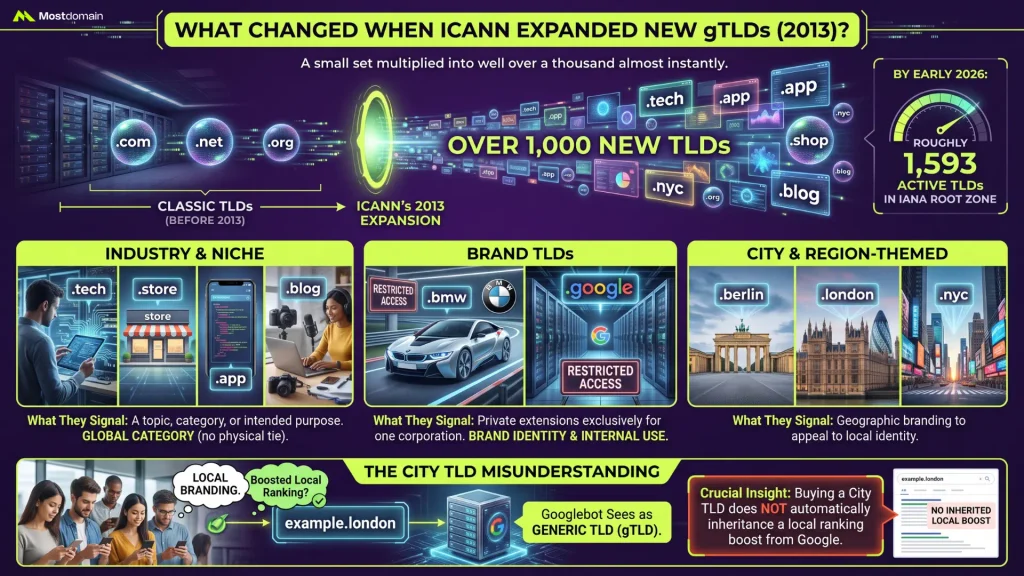
A handful of extensions turned into well over a thousand almost overnight, at least by internet-history standards. ICANN’s 2013 expansion split the new arrivals into three rough buckets. By early 2026, IANA’s root zone database had roughly 1,593 active TLDs on the books.
| Category | Examples | What They Signal |
| Industry & niche | .tech, .store, .app, .blog | A topic or purpose, rather than any physical location |
| Brand TLDs | .bmw, .google | Private extensions reserved entirely for one company’s internal use |
| City & region themed | .berlin, .london, .nyc | Geographic branding, but without geotargeting power behind it |
That last bucket confuses people constantly. A city-themed extension reads as local branding to a human, but Google just sees it as generic. Sharing a name with a city buys you zero inherited local ranking boost.
Other Domain Categories You’ll Occasionally Run Into
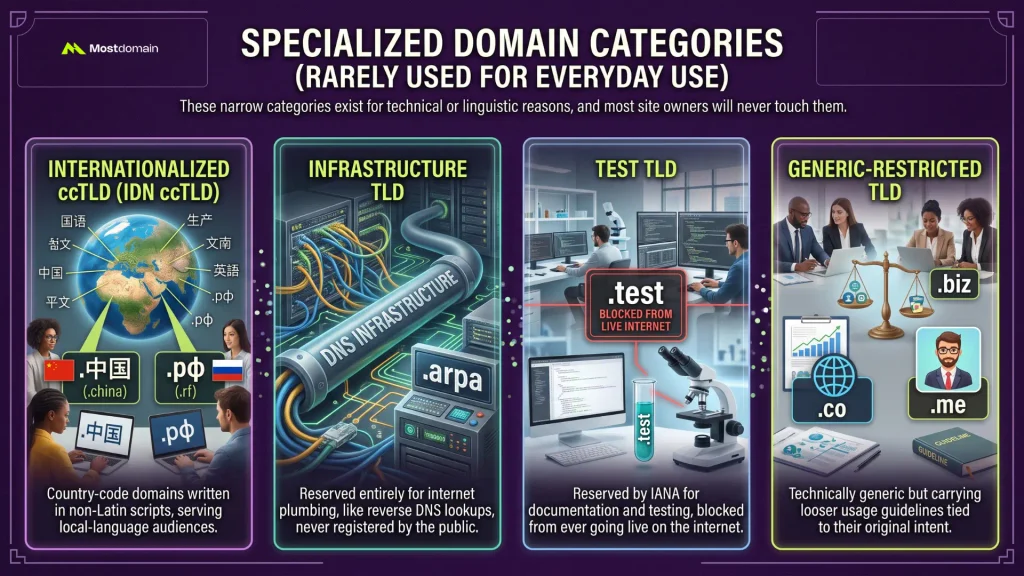
A few narrower categories float around out there, mostly for technical or linguistic reasons rather than everyday registration. Most site owners will never touch these directly. Still, knowing they exist saves confusion on the rare occasion one actually crosses your path.
| Category | Example | What It’s For |
| Internationalized ccTLD (IDN ccTLD) | .中国 (China), .рф (Russia) | Country-code domains written in non-Latin scripts, serving local-language audiences |
| Infrastructure TLD | .arpa | Reserved entirely for internet plumbing, like reverse DNS lookups, never registered by the public |
| Test TLD | .test | Reserved by IANA for documentation and testing, blocked from ever going live on the internet |
| Generic-restricted TLD | .biz, .co, .me | Technically generic but carrying looser usage guidelines tied to their original intent |
None of these land in a typical registrar’s shopping cart the way .com or .io does. But they explain why some domain documentation references extensions you’ll genuinely never get offered.
What Does Each TLD Category Actually Cost?
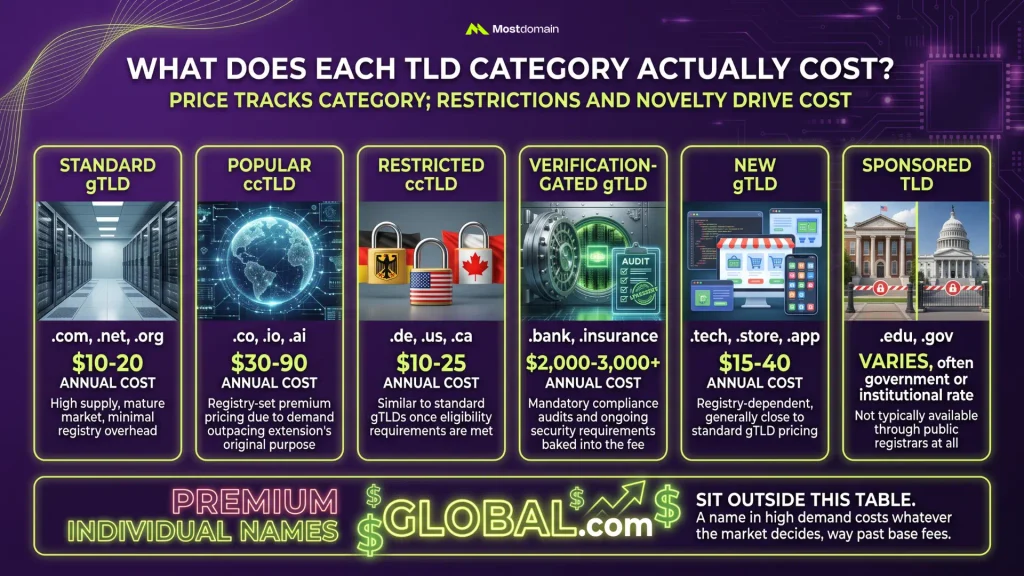
Price tracks category way more than it tracks brand recognition, and the gap between cheapest and priciest option can stretch into the thousands per year. Restriction level and how new an extension is drive most of that cost.
| TLD Type | Typical Annual Cost | Why |
| Standard gTLD (.com, .net, .org) | $10-20 | High supply, mature market, minimal registry overhead |
| Popular ccTLD (.co, .io, .ai) | $30-90 | Registry-set premium pricing due to demand outpacing the extension’s original purpose |
| Restricted ccTLD (.de, .us, .ca) | $10-25 | Similar to standard gTLDs once eligibility requirements are met |
| Verification-gated gTLD (.bank, .insurance) | $2,000-3,000+ | Mandatory compliance audits and ongoing security requirements baked into the fee |
| New gTLD (.tech, .store, .app) | $15-40 | Registry-dependent, generally close to standard gTLD pricing |
| Sponsored TLD (.edu, .gov) | Varies, often government or institutional rate | Not typically available through public registrars at all |
Premium individual names sit outside this whole table, regardless of TLD type. A name in high demand costs whatever the market decides, way past the base registration fee, and that’s a separate pricing mechanism entirely.
How to Choose the Right TLD Category
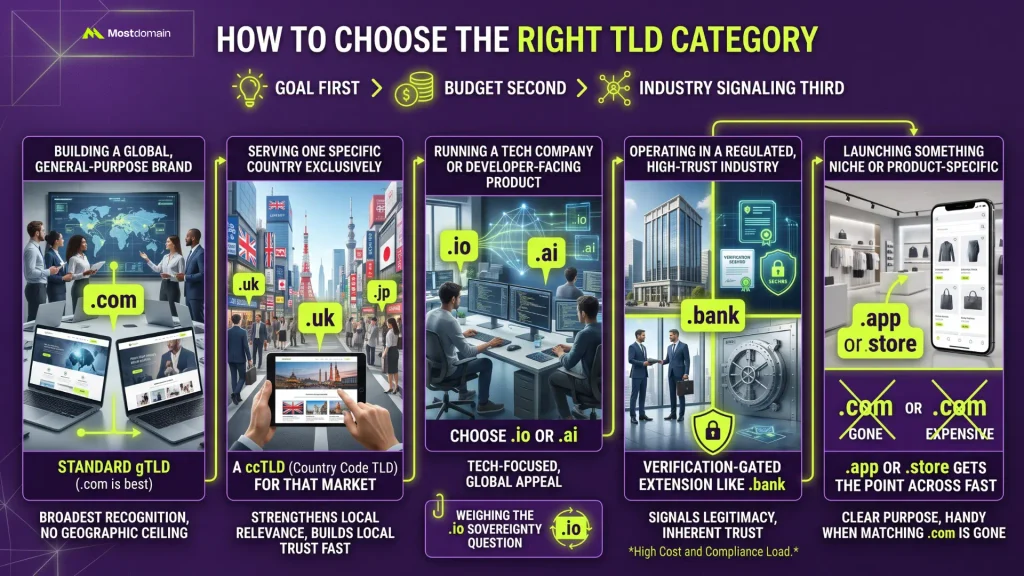
Goal first, budget second, industry signaling third, roughly in that order. Most situations fall into one of a handful of common scenarios, and matching the right one saves a lot of second-guessing later.
- Building a global, general-purpose brand: go with a standard gTLD, .com if you can snag it. Broadest recognition around, and no geographic ceiling holding you back.
- Serving one specific country exclusively: a ccTLD for that market strengthens local relevance, and it tends to build trust with local customers faster than a foreign-registered .com ever would.
- Running a tech company or developer-facing product: .io or .ai both work here, generic-treated ccTLDs either way. Worth weighing the .io sovereignty question first if a decade-long brand is the plan.
- Operating in a regulated, high-trust industry: a verification-gated extension like .bank signals legitimacy right away, though the cost and compliance load are real and don’t go away.
- Launching something niche or product-specific: .app or .store gets the point across fast, especially handy when the matching .com is gone or priced way out of reach.
Does Your Domain Extension Actually Affect SEO?
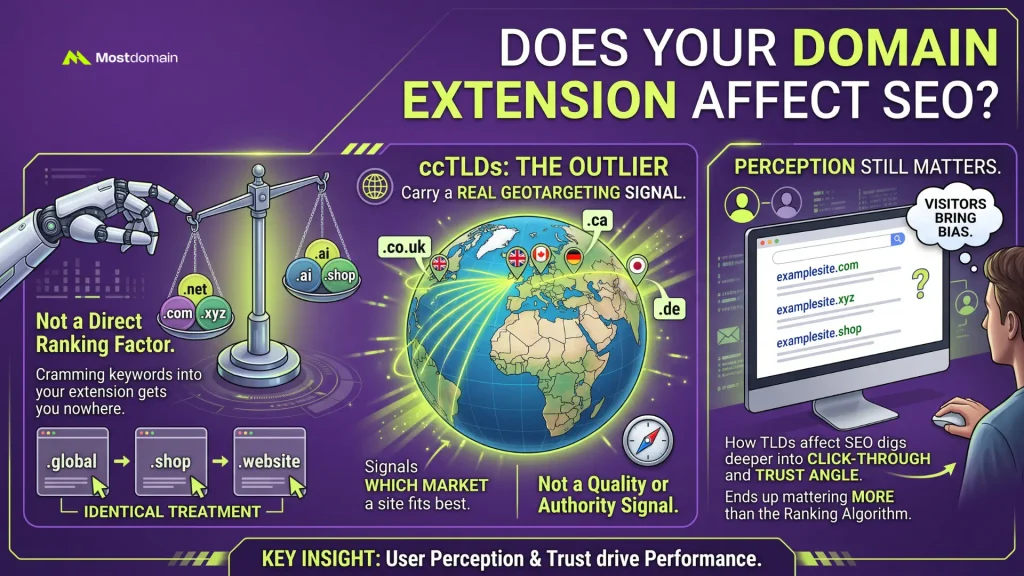
Not directly, no, with exactly one exception worth knowing. Google has said outright the TLD isn’t a ranking factor, and cramming a keyword into your extension gets you nowhere in search results.
- Most extensions get identical treatment. New gTLDs, brand extensions, city-themed suffixes like .london, Google’s algorithms process all of it the same as .com or .org.
- ccTLDs are the outlier. Country-code extensions carry a real geotargeting signal, pointing search engines toward which market a site fits best. That’s different from a quality or authority signal entirely.
- Perception still matters even where algorithms don’t care. Visitors bring their own biases regardless of what happens behind the scenes at Google. How TLDs actually affect SEO digs deeper into the click-through and trust angle, which in practice ends up mattering more than the ranking algorithm ever does.
A Quick Glossary of Domain Terms
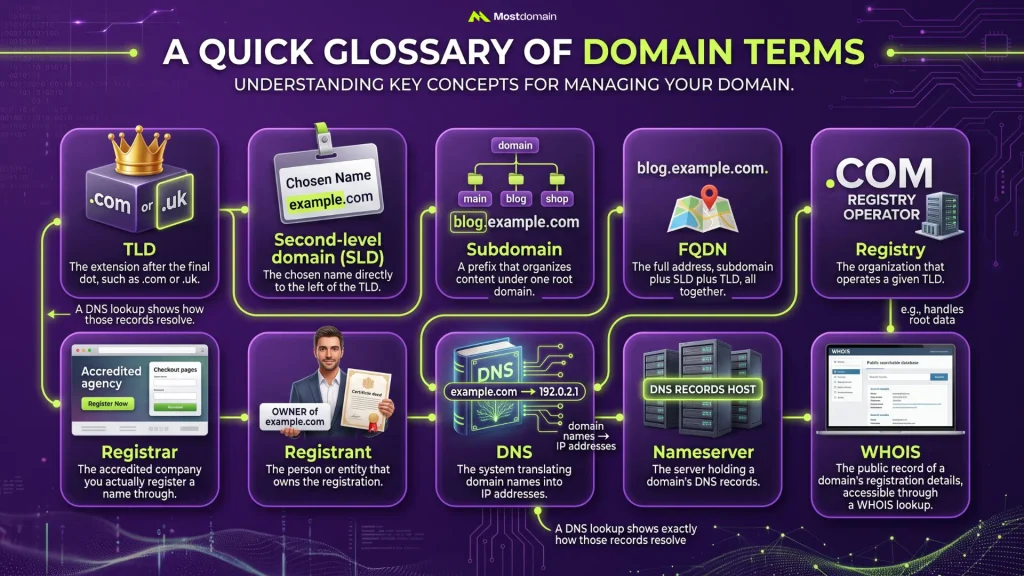
Ten terms cover almost everything you’ll bump into managing a domain. Knowing them turns a registrar’s checkout page from jargon into something you can actually parse.
| Term | Plain Definition |
| TLD | The extension after the final dot, such as .com or .uk |
| Second-level domain (SLD) | The chosen name directly to the left of the TLD |
| Subdomain | A prefix that organizes content under one root domain |
| FQDN | The full address, subdomain plus SLD plus TLD, all together |
| Registry | The organization that operates a given TLD |
| Registrar | The accredited company you actually register a name through |
| Registrant | The person or entity that owns the registration |
| DNS | The system translating domain names into IP addresses. A DNS lookup shows exactly how those records resolve |
| Nameserver | The server holding a domain’s DNS records |
| WHOIS | The public record of a domain’s registration details, accessible through a WHOIS lookup |
FAQ
What’s the difference between a gTLD and a ccTLD?
Geography, basically. A gTLD ignores it entirely and appeals globally through recognized extensions like .com or .tech. A ccTLD ties directly to one country or territory, usually with local registration requirements attached.
How many TLDs exist today?
Roughly 1,593, per IANA’s root zone database as of early 2026, and that count shifts constantly as registries launch new strings or retire old ones. The number itself isn’t the useful part. Understanding the functional categories, gTLD, ccTLD, sTLD, new gTLD, plus the smaller infrastructure and internationalized set, is what actually helps.
Does the domain extension affect SEO rankings?
Not directly. Google’s confirmed the TLD isn’t a ranking factor on its own, and stuffing a keyword into an extension buys nothing. The real exception is ccTLDs, which signal geographic relevance rather than authority or content quality.
Is a subdomain a separate domain?
No. It’s a branch of the root domain you already own, not its own registration, and it shares that domain’s renewal cycle. Search engines sometimes index subdomains as distinct content areas, but ownership and billing stay tied to the parent the whole time.
Which TLD works best for a business targeting a global audience?
.com, generally, since it carries the broadest and most neutral recognition across markets everywhere. A ccTLD makes sense only if you’re deliberately targeting one country, and it turns into a limitation fast the moment expansion plans kick in.
Are new gTLDs generally more expensive than .com?
Not usually, no. Most new gTLDs like .tech or .store price close to standard gTLDs, somewhere around $15-40 a year. The real cost outliers are verification-gated extensions like .bank, running into the thousands from mandatory compliance audits, plus premium individual names, which get priced completely separately from the base registration fee.
Is .io still safe to build a business on?
For now, yes. Long-term, there’s real uncertainty attached. The extension works fine today with no retirement date set anywhere. That said, the UK-Mauritius sovereignty treaty means the underlying country code could eventually phase out over a five-to-ten-year window once formal retirement procedures actually begin. Worth weighing if you’re planning a multi-decade brand specifically on a .io address.
Can someone lose a sponsored TLD like .edu or .aero after registering it?
Yes, and this catches people off guard. Sponsored TLDs stay tied to ongoing eligibility, not just whatever got approved at registration. Lose accreditation or industry certification, and a sponsor’s periodic review can pull the domain during that check.
References
- ICANN, “Top-Level Domains”
- Internet Assigned Numbers Authority (IANA), “Root Zone Database”
- Google Search Central, “Handling of New Top-Level Domains”
- Search Engine Journal, “John Mueller on gTLDs Versus ccTLDs”
- Verisign, “Domain Name Industry Brief”
- The Register, “The .io Domain Isn’t Going Anywhere in the Next Few Years”
- ICANN, “IANA Country-Code TLD Retirement Procedures”