
Domain renewal isn’t just clicking “renew” before a deadline. ICANN actually requires your registrar to notify you twice before expiration and once after, and most owners have no idea that obligation exists, let alone whether their registrar is meeting it. This covers what renewal actually involves, why the standard 30-60 day advice undersells the real risk window, and how to stop treating a single domain’s renewal like a portfolio of fifty domains doesn’t need a different system entirely.
What Is Domain Renewal Actually Requires From Your Registrar
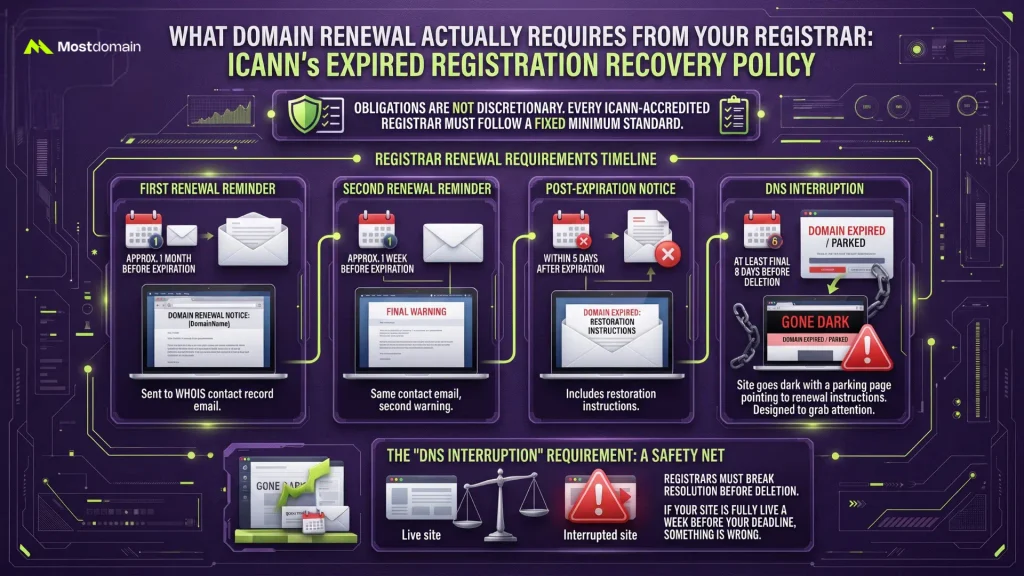
Domain renewal obligations aren’t left to each registrar’s discretion. ICANN’s Expired Registration Recovery Policy, in force since 2013, sets a fixed minimum standard every accredited registrar has to follow.
| Requirement | Timing | What it means for you |
| First renewal reminder | Roughly one month before expiration | Sent to whatever email sits in your WHOIS contact record |
| Second renewal reminder | Roughly one week before expiration | Same contact email, second and final warning |
| Post-expiration notice | Within 5 days after expiration | Includes restoration instructions |
| DNS interruption | At least the final 8 days before deletion | Site goes dark with a parking page pointing to renewal instructions |
That DNS interruption requirement matters more than it looks. Registrars are required to break resolution before deleting a domain, specifically so an owner notices something’s wrong even if every email got missed. Still fully live a week before what you think is the deadline? Something’s off, either the date is wrong or the registrar isn’t holding up its end of the contract.
Domain Renewal Timing: Why 30-60 Days Isn’t Just a Guess
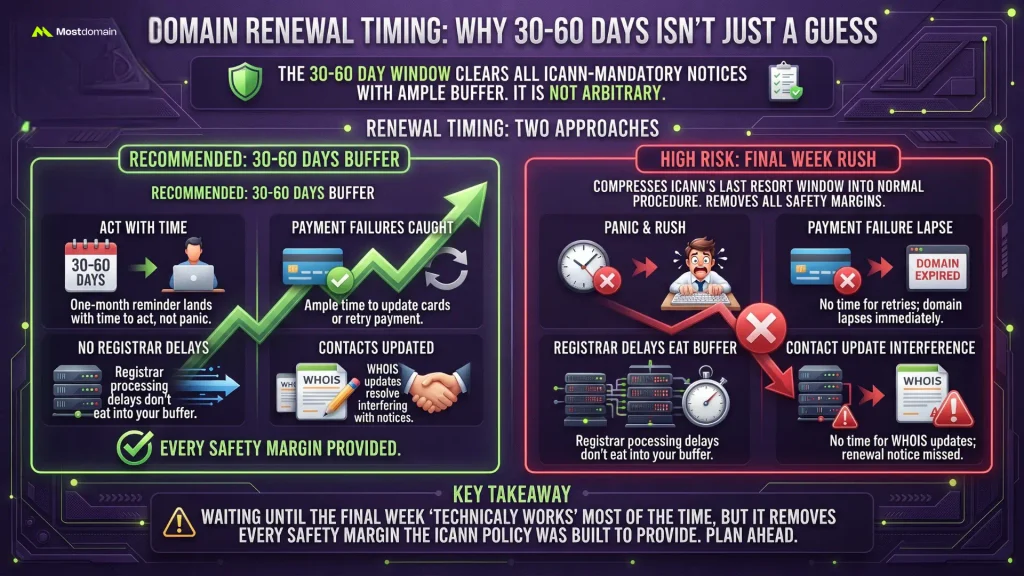
Thirty to sixty days ahead of expiration isn’t an arbitrary number someone picked. That window is what it takes to clear every mandatory notice ICANN requires, with room left over.
- The one-month reminder lands with time to actually act on it, rather than triggering a rushed payment update
- Payment failures get caught early enough for a retry, a new card, or a manual invoice before anything lapses
- Registrar-side processing delays, which do happen during bulk renewal periods, don’t eat into your actual buffer
- Any pending WHOIS or contact updates get resolved before they interfere with a renewal notice reaching the right inbox
Waiting until the final week compresses all of that into the same short window ICANN designed as a last resort, not a normal operating procedure. It technically still works most of the time. It just removes every safety margin the policy was built to provide.
Domain Renewal: Where Auto-Renewal Actually Breaks Down
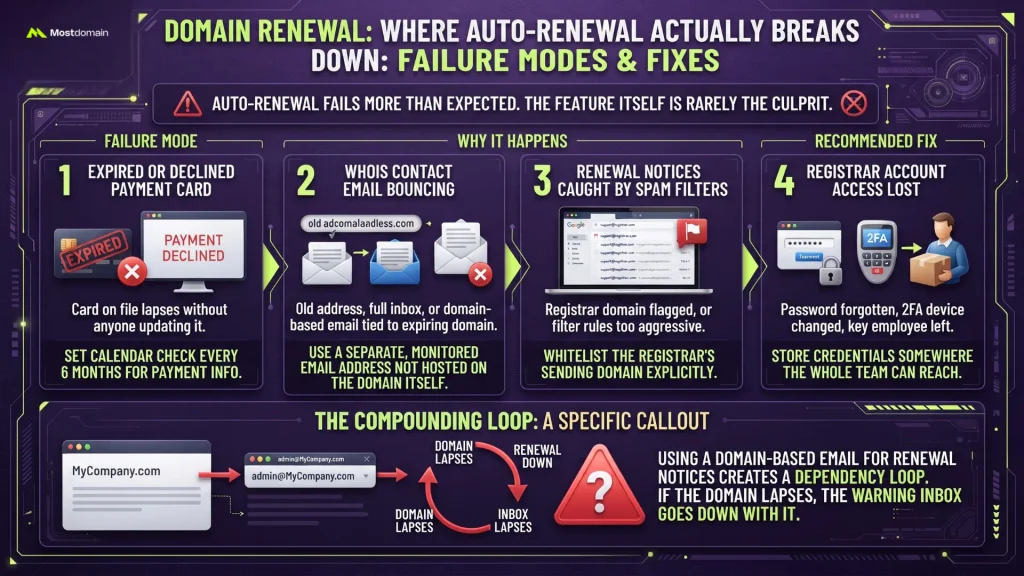
Auto-renewal fails more than most owners expect. The feature itself is rarely the culprit.

| Failure mode | Why it happens | Fix |
| Expired or declined payment card | Card on file lapses without anyone updating it | Set a calendar check every 6 months for payment info, not just domains |
| WHOIS contact email bouncing | Old email address, full inbox, or domain-based email tied to the same expiring domain | Use a separate, monitored email address never hosted on the domain itself, and confirm it via a WHOIS lookup periodically |
| Renewal notices caught by spam filters | Registrar sending domain flagged, or filter rules too aggressive | Whitelist the registrar’s sending domain explicitly |
| Registrar account access lost | Password forgotten, 2FA device changed, employee who set it up left the company | Store credentials somewhere the whole team, not one person, can reach |
The WHOIS email issue deserves its own callout, since it’s the one failure mode that compounds itself. A domain using an email address on that same domain for its own renewal notices creates a dependency loop: if the domain lapses, the inbox meant to warn about the lapse goes down with it.
Multi-Year Domain Renewal Economics
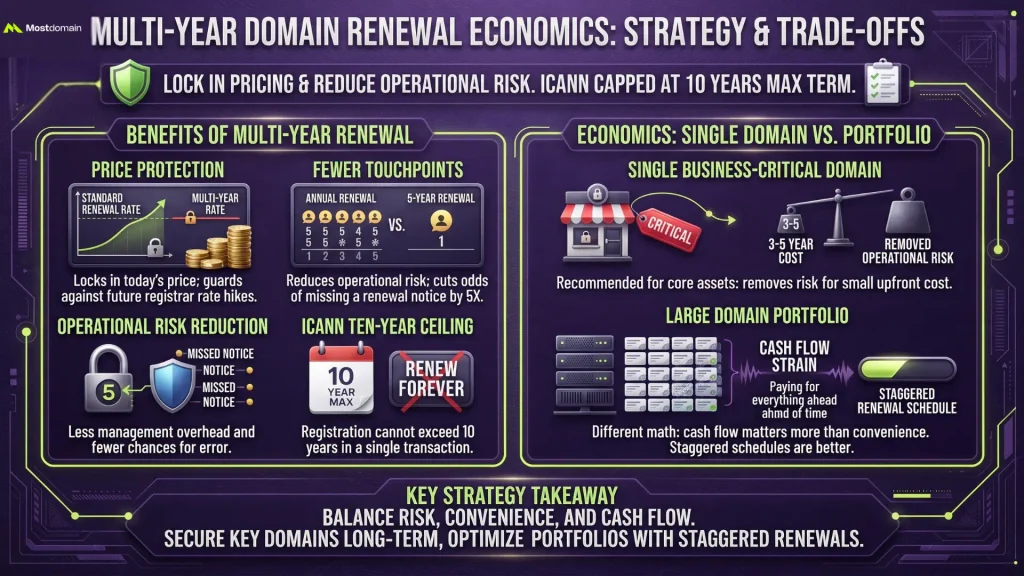
Multi-year renewal locks in pricing and reduces the number of chances something goes wrong, and ICANN caps how far that strategy can go at a 10-year maximum registration term per renewal.
- Price protection: registrars can raise renewal rates year over year, and a multi-year term locks in today’s price for the full term
- Fewer touchpoints: a domain renewed for 5 years needs attention once, not five separate times, cutting the odds of a missed notice by roughly the same factor
- Upfront cost: the trade-off is tying up capital in a renewal years ahead of when it’s actually due, which matters more for a large portfolio than a single domain
- Ten-year ceiling: ICANN’s base registry agreement doesn’t allow any single renewal transaction to push a registration past 10 years out, so “renew forever in one transaction” isn’t actually an option
For a single business-critical domain, locking in 3 to 5 years removes most of the operational risk covered above for a relatively small upfront cost. A portfolio of dozens of domains is a different math problem entirely. Cash flow starts to matter more than convenience, and a staggered schedule usually beats paying for everything years ahead all at once.




Domain Renewal Checklist for a Portfolio, Not Just One Domain
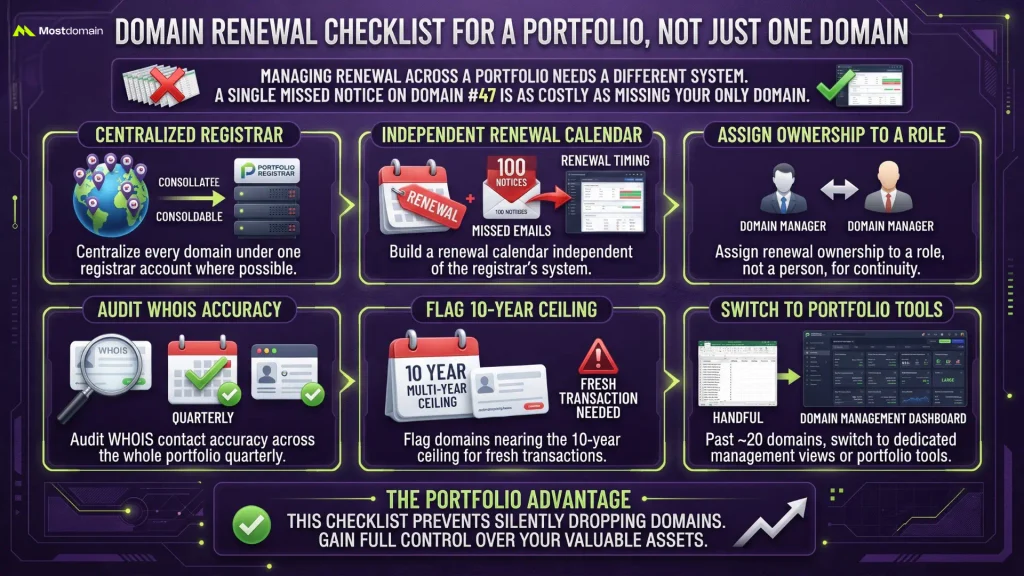
Managing renewal across a domain portfolio needs a different system than managing one domain, since a single missed notice on domain forty-seven of fifty is just as costly as missing the only domain you own.
- Centralize every domain under one registrar account where possible, rather than scattering them across whichever registrar happened to have the best price at registration time
- Build a renewal calendar independent of the registrar’s own reminder system, since relying solely on ICANN’s mandated two notices per domain means fifty domains generate a hundred easy-to-miss emails
- Assign renewal ownership to a role, not a person, so the responsibility survives staff turnover
- Audit WHOIS contact accuracy across the whole portfolio quarterly, not per-domain whenever it happens to come up
- Flag domains nearing their 10-year multi-year renewal ceiling separately, since those need a fresh renewal transaction rather than an extension of the existing one
A spreadsheet with expiration dates works fine for a handful of domains. Past roughly twenty, the manual approach starts silently dropping domains, and most teams end up switching to a dedicated domain management view inside their registrar’s portal, or a third-party portfolio tool, just to keep the list under control.
Domain Renewal After a Miss: What Actually Happens
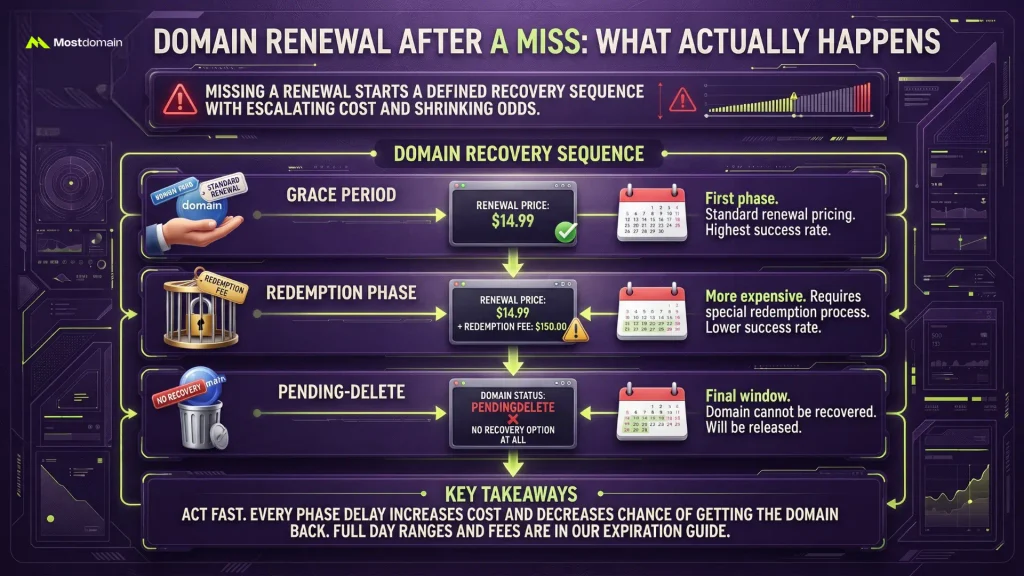
Missing a renewal doesn’t mean immediate loss. It starts a defined recovery sequence with escalating cost and shrinking odds of getting the domain back the longer it takes to act.
The short version: a grace period with standard renewal pricing comes first, followed by a more expensive redemption phase, followed by a short pending-delete window with no recovery option at all. The exact day ranges and fee tiers for each phase, along with recovery success rates at each stage, are covered in full in the domain expiration checker guide rather than repeated here.
FAQ
How many days before expiration should I renew my domain?
30 to 60 days ahead covers every ICANN-mandated notice window with margin left over for payment issues or registrar delays. The final week still works, technically, most of the time. It just eats into every bit of buffer those notice requirements were built to give you.
Does ICANN require registrars to send renewal reminders?
Yes. The Expired Registration Recovery Policy sets a floor of two reminders before expiration, one roughly a month out and one roughly a week out, plus a third notice within 5 days after expiration if renewal hasn’t happened.
Is auto-renewal enough to protect a domain on its own?
Not by itself. Auto-renewal depends on a valid payment method and a monitored contact email, and both of those fail often enough that relying on auto-renewal alone, with no manual check, still leads to accidental lapses.
What’s the maximum length I can renew a domain for at once?
10 years. ICANN’s base registry agreement caps any single registration or renewal transaction at 10 years out from the current date, regardless of how far in advance an owner wants to lock in pricing.
Should every domain in a portfolio use the same renewal strategy?
No. A single business-critical domain does better locked in for several years at once. A large portfolio usually doesn’t, spreading cost and attention across a staggered schedule tends to beat concentrating everything into one massive renewal push.
References
- ICANN, Expired Registration Recovery Policy
- ICANN, Base Registry Agreement