
Four things, done in order, that’s really the whole game: valuing the asset accurately, picking the right platform for its price tier, prepping it technically before a buyer shows up, and closing through escrow instead of trusting a stranger on a handshake. Skip any one of these and you end up with one of two outcomes, a domain that sits unsold for years, or one that sells for a fraction of what it was actually worth. Demand in the secondary market keeps climbing too, startups chasing instant brand credibility, companies fighting tooth and nail over specific keyword territory. None of that demand pays off, though, unless a seller treats this like an actual sale process rather than slapping up a garage-sale listing.
How Do You Determine What Your Domain Is Actually Worth?
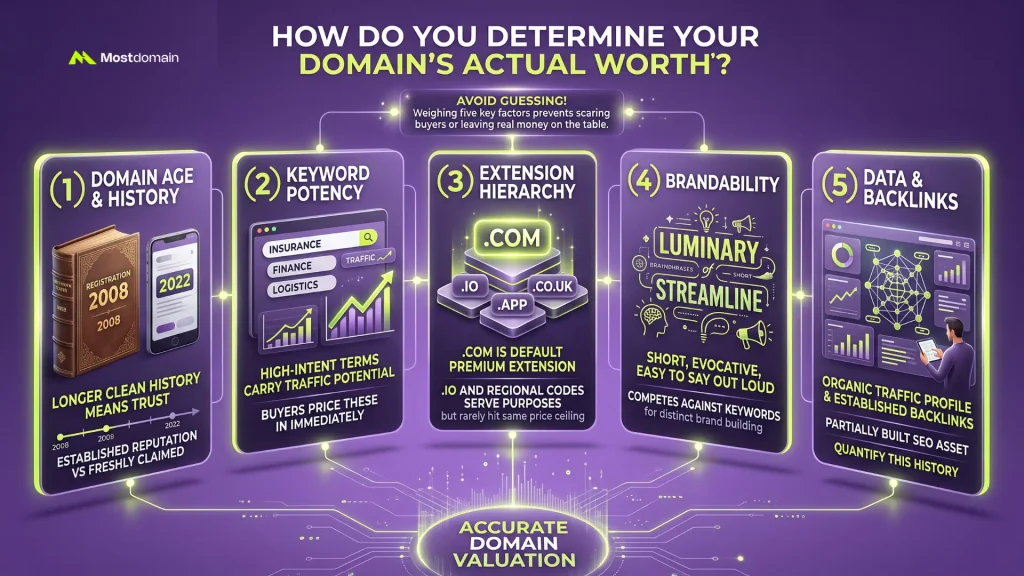
Five factors, working together, and guessing instead of weighing them is the fastest way to either scare off a serious buyer or leave real money sitting on the table.
- Domain age and history: a 2008 registration usually outweighs a 2022 one on trust alone. Longer clean history reads as established, not freshly claimed
- Keyword potency: high-intent terms, insurance, finance, logistics, that kind of thing, carry more traffic potential, and buyers price that in immediately
- Extension hierarchy: .com stays the default premium extension. .io and regional codes serve real purposes but rarely hit the same price ceiling
- Brandability: short, evocative, easy to say out loud, a name like that competes fine against a keyword-heavy domain even with zero obvious match, especially once a buyer’s building a distinct brand
- Data and backlinks: organic traffic or an established backlink profile turns a domain into more than just a name. Call it a partially built SEO asset, and that history deserves quantifying rather than assuming
A domain value guide walks through weighing these factors against each other when they pull in different directions, which happens more than sellers expect going in.
Where Should You List Your Domain for Sale?
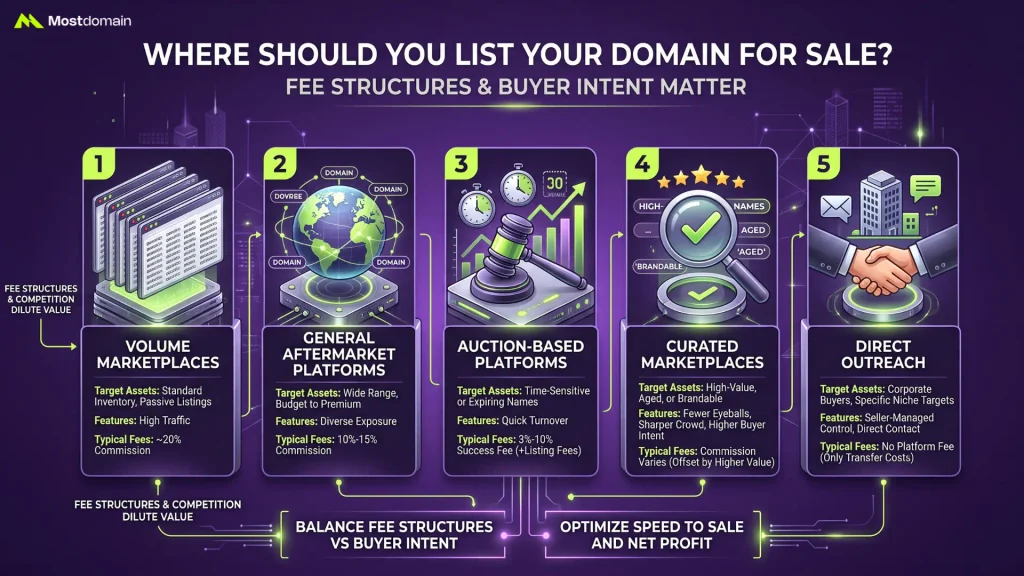
Speed to sale and how much of the final price stays in your pocket, both hinge on where you list. Fee structures and buyer intent swing pretty wildly across platform types, so this choice matters more than most sellers assume going in.
| Platform Category | Example Platforms | Target Asset | Typical Fee |
| Volume marketplaces | Afternic, GoDaddy | Standard inventory, passive listings | ~20% commission |
| General aftermarket platforms | Sedo | Wide range, from budget to premium | 10%-15% commission |
| Auction-based platforms | Flippa, NameJet | Time-sensitive or expiring names | 3%-10% success fee, scaling down as price increases, plus possible listing fees |
| Curated marketplaces | Platforms specializing in vetted or aged inventory | High-value, aged, or brandable assets | Commission varies, often offset by reaching higher buyer intent |
| Direct outreach | None, seller-managed | Corporate buyers, specific niche targets | No platform fee, only transfer costs |
A full breakdown of how a domain name marketplace actually works covers pricing models and platform mechanics in more depth, useful if you’re deciding between a marketplace listing and direct outreach for the first time.
Real aftermarket value gets swallowed fast on general high-volume marketplaces, thousands of competing listings will do that to anything. A curated platform usually means fewer eyeballs but a sharper crowd, and that trade sometimes wins even with a smaller pool.

Fixed Price, Make an Offer, or Auction: Which Pricing Strategy Fits?
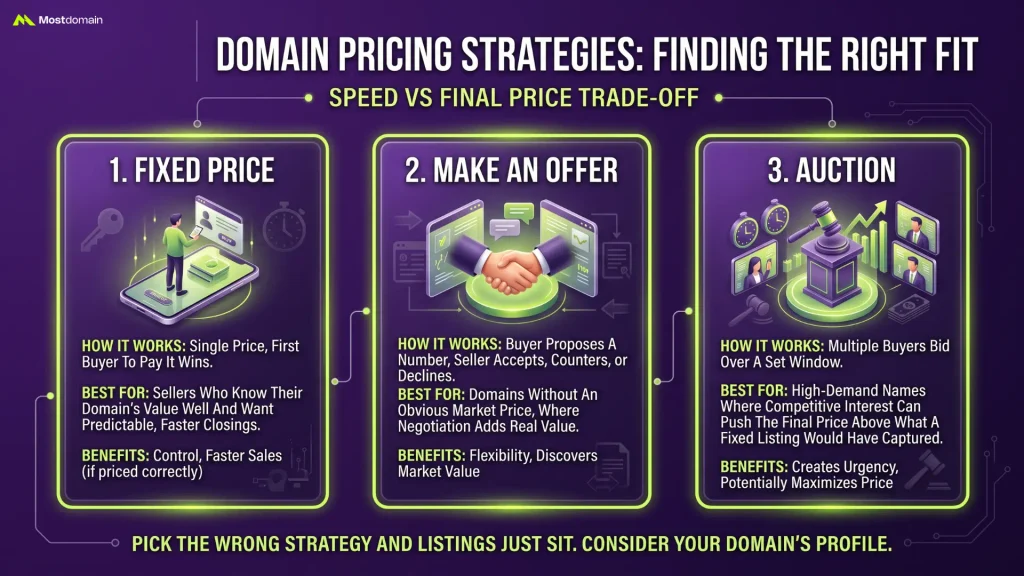
Speed against final price, that’s the trade-off across all three pricing structures, and picking the wrong one for your domain’s profile is a common reason listings just sit there.
| Strategy | How It Works | Best For |
| Fixed price | One price, first buyer to pay it wins | Sellers who know their domain’s value well and want predictable, faster closings |
| Make an offer | Buyer proposes a number, seller accepts, counters, or declines | Domains without an obvious market price, where negotiation adds real value |
| Auction | Multiple buyers bid over a set window | High-demand names where competitive interest can push the final price above what a fixed listing would have captured |
Fixed price hands you control if you can afford to wait for the right buyer. Auctions create urgency and can push the price higher, but only once genuine competing interest actually materializes.
How to Set a Price That Doesn’t Leave Money on the Table
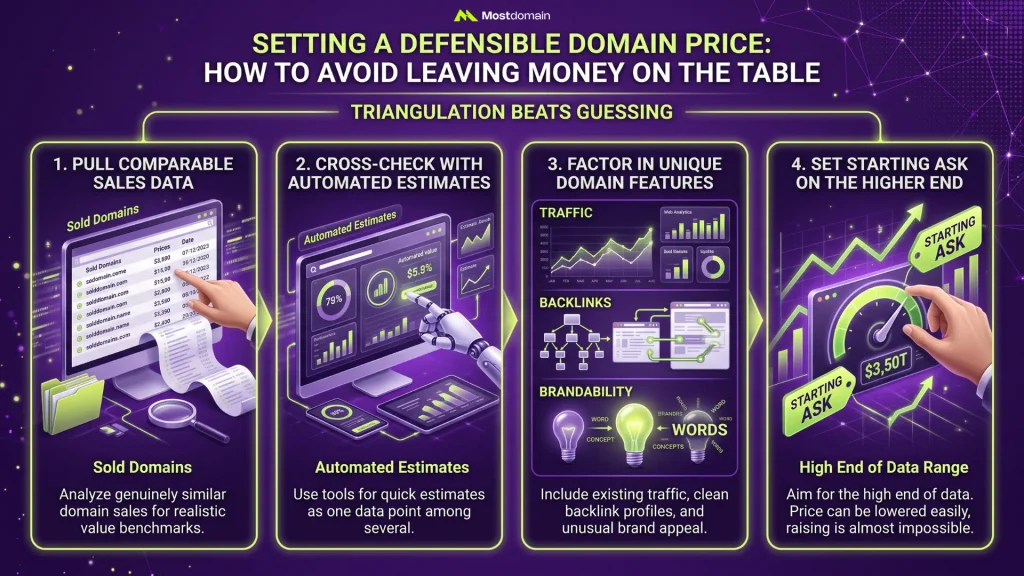
Triangulation beats guessing, every time. A defensible asking price comes from cross-referencing data across multiple sources rather than picking a number that just feels right.



- Pull comparable sales data from a service like NameBio to see what genuinely similar domains actually closed for
- Cross-check that against an automated estimate from a tool like Estibot, one data point among several, not a final answer on its own
- Factor in anything unique to your domain, existing traffic, a clean backlink profile, unusual brandability, none of which a generic comparable sale fully captures
- Set your starting ask on the higher end of what the data supports. Lowering a price later is easy. Raising it after buyers have already seen a number, nearly impossible
How to Prepare Your Domain Before Listing It
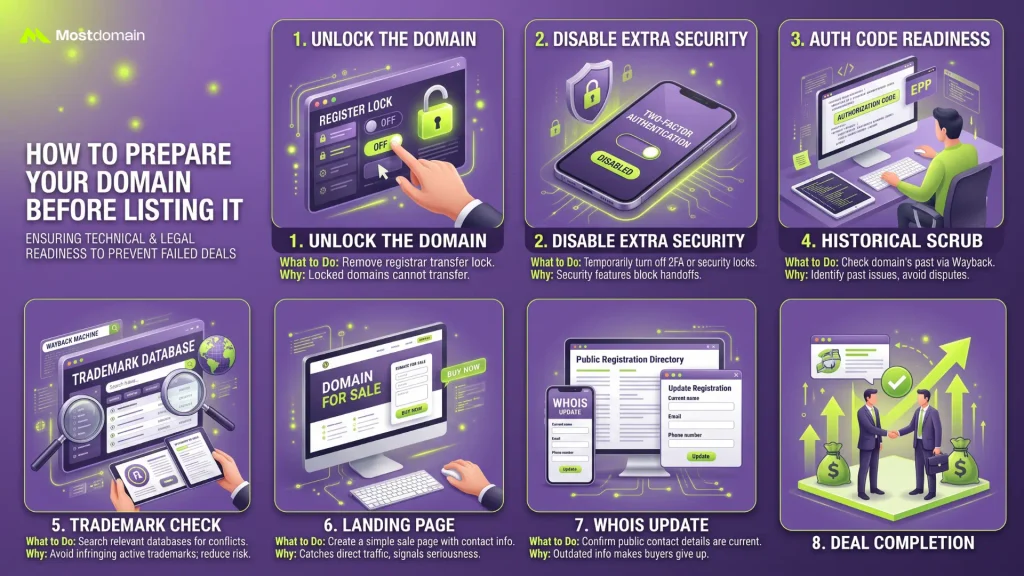
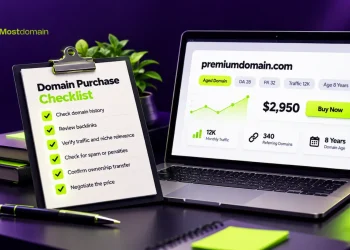
A domain that isn’t technically and legally ready to transfer kills deals right at the finish line, usually after a buyer’s already committed mentally to buying it.
| Step | What to Do | Why It Matters |
| Unlock the domain | Remove the registrar transfer lock in your account settings | A locked domain can’t transfer, full stop, and this trips up more sales than you’d expect |
| Disable extra security | Temporarily turn off two-factor authentication or registrar-level locks tied to transfers | Valuable day to day, sure, but they block a clean handoff if left switched on |
| Auth code readiness | Locate your EPP transfer authorization code in advance | The buyer’s registrar needs this immediately once the transfer starts |
| Historical scrub | Check the domain’s past through the Wayback Machine | Previously hosted questionable content? Disclosing it upfront heads off disputes down the line |
| Trademark check | Search relevant trademark databases for conflicts | Selling a name that infringes on an active trademark exposes both sides to real legal risk |
| Landing page | Build a simple page stating the domain is for sale, with contact details | Catches direct type-in traffic and signals you’re serious to anyone researching the domain |
| WHOIS update | Confirm your public registration contact details are current | Outdated contact info is a common, entirely avoidable reason interested buyers just give up |
How to Write a Listing That Actually Converts
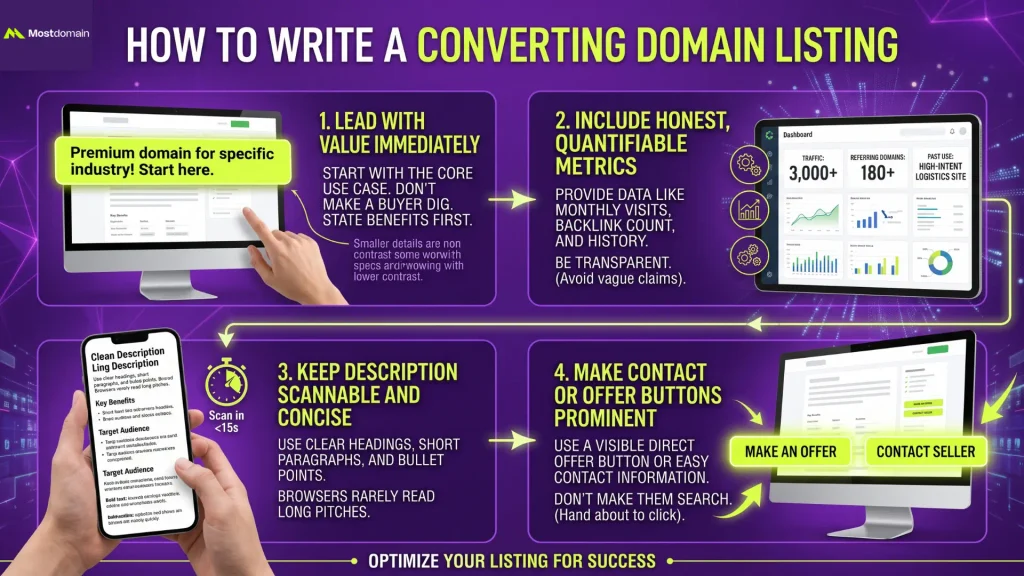
State the value in the first sentence, don’t make a buyer dig for it. That’s really the whole trick behind a listing that actually converts.
- Lead with what the domain is good for, not just its length or letter combination
- Include quantifiable metrics honestly: traffic numbers, referring domain count, notable past use. Vague claims read as filler, buyers can tell
- Keep the description scannable in under 15 seconds; browsing buyers rarely read a long pitch start to finish
- Make contact information or a direct offer button impossible to miss on the page
How to Negotiate Without Undercutting Yourself
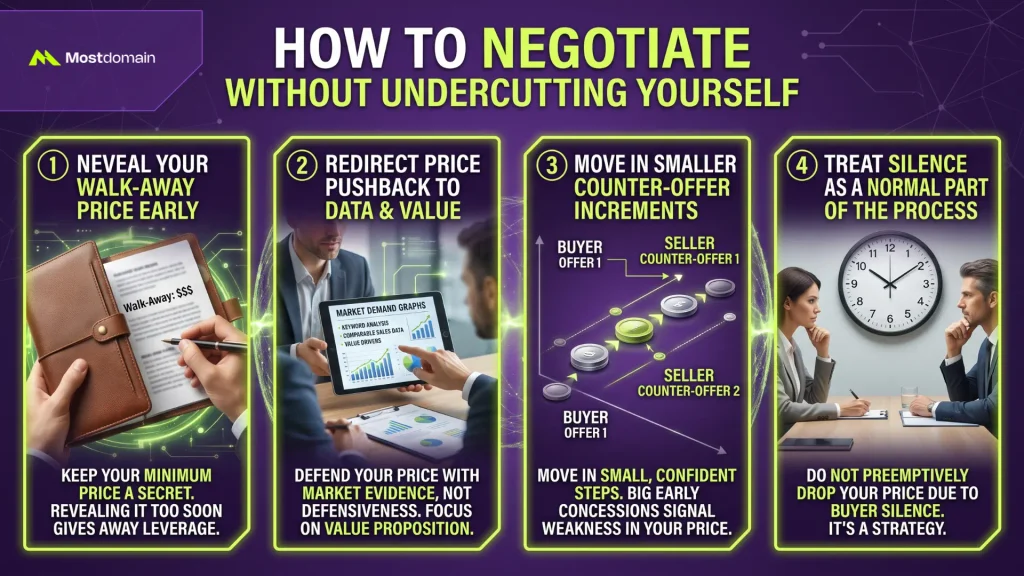
Firm bottom line, genuinely open conversation, holding both at once is what separates a good outcome from an average one at the negotiating table.
- Never reveal your actual walk-away price early in the conversation
- Redirect pricing pushback toward market data and the domain’s specific value drivers, rather than getting defensive about it
- Move in smaller counter-offer increments as things progress; big concessions early read as a lack of confidence in your own asking price
- Treat silence from a buyer as a normal part of the process, not a signal to drop your price preemptively
How to Transfer a Domain Safely After the Sale
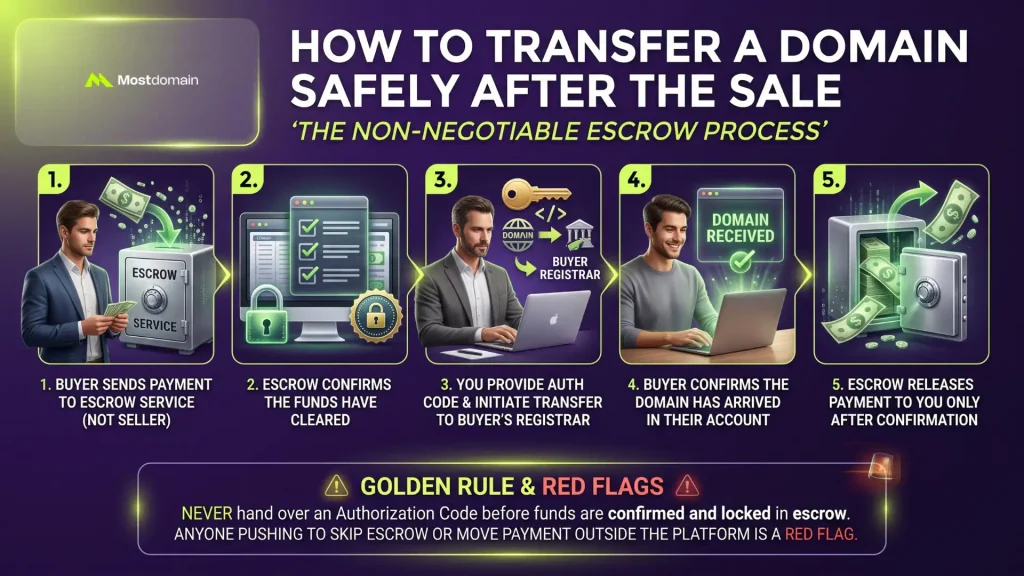
A licensed escrow service belongs between every domain sale and the actual transfer. Doesn’t matter how much you trust the buyer personally, that step stays non-negotiable.
- Buyer sends payment to the escrow service, not directly to you.
- Escrow confirms the funds have cleared.
- You provide the auth code and initiate the transfer to the buyer’s registrar.
- The buyer confirms the domain has arrived in their account.
- Escrow releases payment to you only after that confirmation.
Never hand over an authorization code before funds are confirmed and locked in escrow. Anyone pushing to skip that step, or move payment outside the platform entirely, that’s a red flag worth taking seriously.
FAQ
How long does it take to sell a domain name?
Wildly variable, honestly, hinging on quality, current demand, and where it’s listed. The right asset at the right price can close in 48 hours. Price it above what the market will bear, and it can sit untouched for years, which is usually a pricing problem wearing a demand-problem costume.
What’s a fair price for a domain name?
Nothing fixed here, the market just isn’t uniform enough for that. A dictionary-word .com in a hot category can pull six figures without much argument. A harder-to-market term on a less common extension might land at a few hundred bucks instead. NameBio’s comparable sales data is probably the most reliable anchor for figuring out where yours actually falls.
Do I need a broker to sell my domain?
Depends on the value at stake and how comfortable you are negotiating directly. Brokers tend to earn their commission on complex, high-value transactions, often north of $10,000, where their outreach network and negotiation chops can genuinely push the final price higher. Lower-value domains usually do better listed directly, handling negotiation yourself and keeping more of the sale price.
What’s the safest way to transfer a domain after a sale?
A licensed third-party escrow service, no exceptions worth making here. Funds stay held securely until the transfer is fully confirmed on both sides, protecting buyer and seller alike from the other one bailing partway through.
Does a domain’s age genuinely affect its selling price?
Generally, yes. A long, clean registration history paired with an established backlink profile and relevant terminology tends to carry more perceived trust than a comparable newer domain, mostly because search engines take real time building confidence in anything new, regardless of how good the content actually is. That accumulated history is worth calling out directly in a listing rather than hoping a buyer notices it unprompted. A closer look at how domain age and topical authority interact goes deeper into why that history carries real, quantifiable value.
What makes a domain name attractive to buyers?
Brevity and clarity, hands down. Short, sharp, memorable names without hyphens, numbers, or odd spelling consistently beat out longer or more complicated alternatives, and .com remains the strongest default for commercial buyers specifically. Quick gut check worth running: if you can’t explain what the domain is or does in under five seconds to someone unfamiliar with it, that’s usually a sign the listing needs more context, not that the name’s unsellable.
Where’s the best place to sell a premium, high-value domain?
Depends more on the domain’s own profile than any single “best” answer could cover. High-value or aged assets generally do better on curated marketplaces pre-screening for serious buyer intent, since general auction sites can drown a premium listing in sheer volume of cheaper inventory. A domain with an obvious corporate or niche-specific buyer often does best through direct outreach or a broker instead, skipping public listing entirely.
References
- NameBio, “Domain Name Sales History Database”
- Estibot, “About Estibot: Domain Valuation Tool”
- DomainTools, “WHOIS and DNS Intelligence Platform”
- Escrow.com, “How Domain Name Escrow Works”
- ICANN, “FAQs for Registrants: Transferring Your Domain Name”
- ICANN, “Policy on Transfer of Registrations Between Registrars”
- Domain Name Wire, “2024 in Review: The Domain Aftermarket”