
Mostdomain – Searching for a domain and finding it stuck, with no owner listed? That’s usually a reserved domain, not a taken one. This guide breaks down what that status means. You’ll also see real examples, and how it differs from registered, premium, or restricted names.
What Is a Reserved Domain?
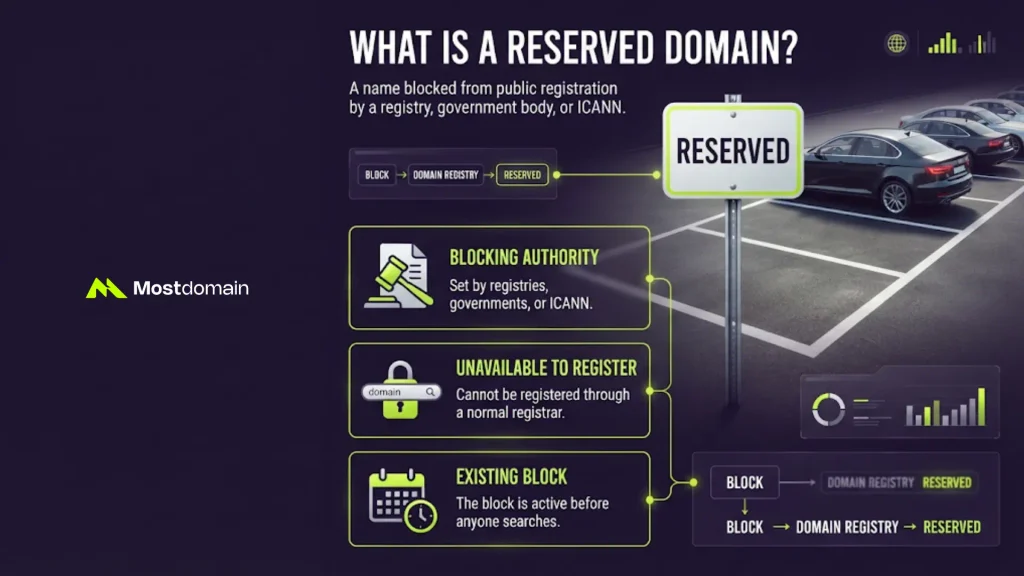
A reserved domain is a name blocked from public registration. A registry, a government body, or ICANN sets that block. You cannot register it through a normal registrar. The block exists before anyone even searches for it.
Picture a parking spot with a sign already on it. The sign says “Reserved” before any car shows up. No one parks there, even on a quiet Sunday. Domain registries run on that exact logic.
What Does “Reserved Domain” Mean in Practice?
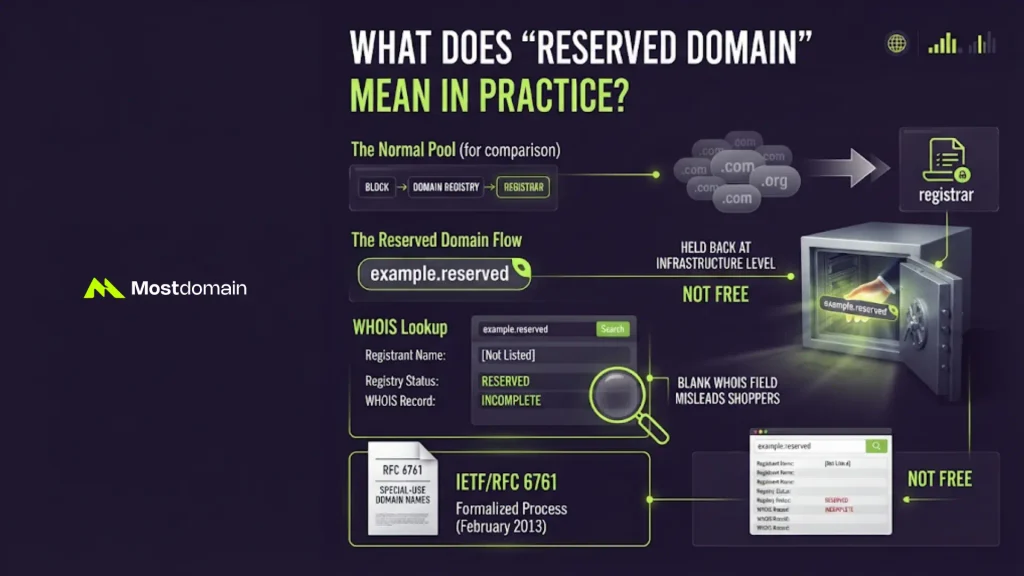
In practice, a reserved domain sits outside the normal registration pool. The registry holds it back at the infrastructure level. This happens before any registrar even sees the name.
A quick WHOIS lookup often shows no listed owner. New domain shoppers see that blank field and assume it’s free. It is not free. The IETF formalized this idea in RFC 6761, published in February 2013. That document gave registries a documented locking process.
How Do Reserved Domains Work?
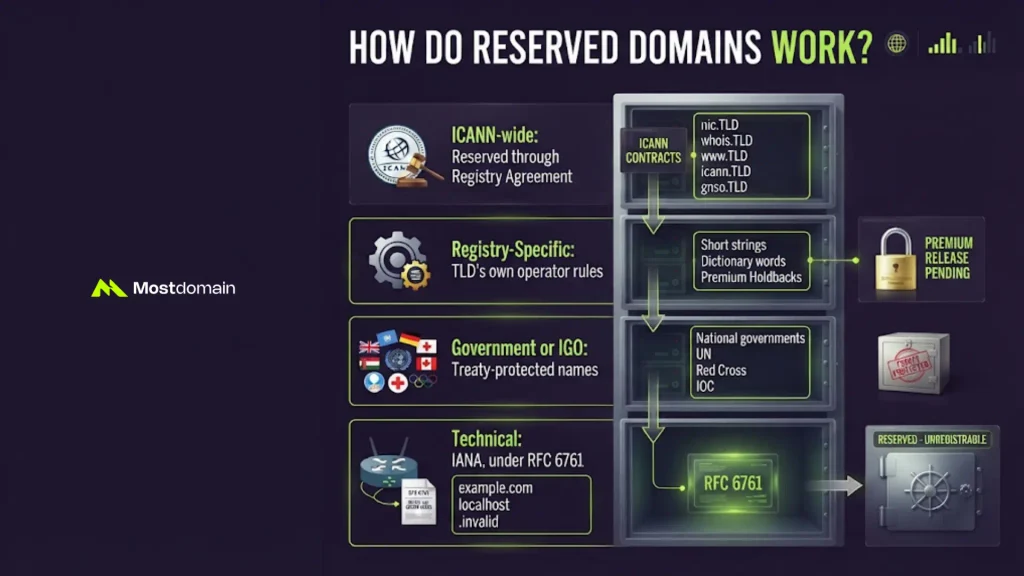
Reserved domains work through rules in each registry’s own agreement. ICANN requires every new gTLD contract to include one.

Country-code registries build their own version of this rule. The .org registry agreement, for instance, permanently reserves names like nic, whois, and www. Those stay locked at the second level under that same ICANN agreement. A ccTLD like .ca or .me can hold back a separate batch of names. Registries often save these for a later, premium release. Short names and dictionary words tend to land on these lists first.
| Reservation layer | Who controls it | Typical names affected |
|---|---|---|
| ICANN-wide | ICANN, through the registry agreement | nic, whois, www, icann, gnso |
| Registry-specific | The TLD’s own registry operator | Short strings, dictionary words, premium holdbacks |
| Government or IGO | National governments, the UN, the Red Cross, the IOC | Treaty-protected and Olympic-related terms |
| Technical | IANA, under RFC 6761 | example.com, localhost, .invalid |
Reserved Domain Examples
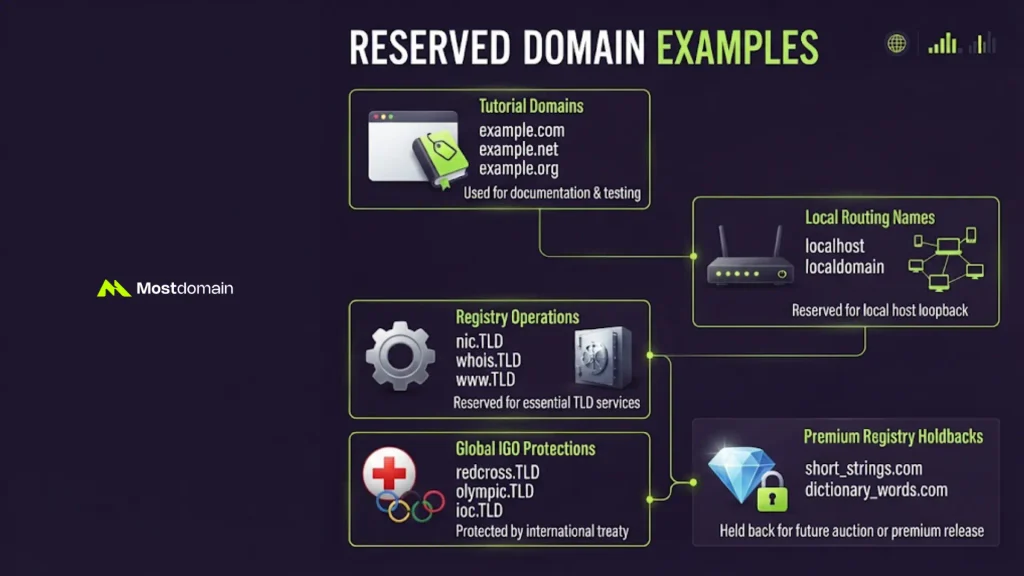
Real reserved domain name examples fall into a few groups. Each group answers to a different authority.
IANA keeps example.com, example.net, and example.org set aside for documentation. You’ll spot them in nearly every tutorial online. “Localhost” never resolves to a live public site. It stays local by design, always. Names like nic, whois, and mail get reserved for registry operations. ICANN’s own identifiers, like icann and gnso, are blocked the same way. Olympic and Red Cross-related terms carry global protection under IGO policy. Some registries, .me included, quietly hold back a short list of premium strings. These get sold later, not given away first-come, first-served.




Why Are Domains Reserved?
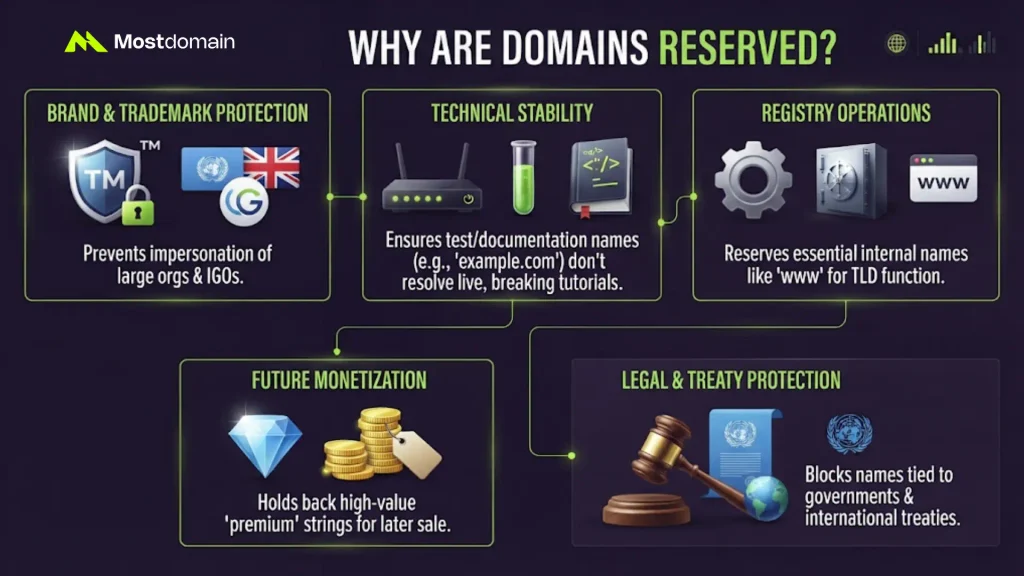
Domains get reserved for a short list of practical reasons. None of it is bureaucratic habit.
Brand and trademark protection comes first. Large organizations and IGOs can’t risk impersonation. Technical stability matters too. Test and documentation names can never resolve live, or tutorials everywhere would break. Registry operations need names like “www” kept out of public hands. Some reservations exist purely for future monetization. A registry holds a premium string back until the price is right. Legal protection covers names tied to governments or treaties. Registries won’t touch those, no matter the demand.
Reserved Domain vs Other Domain Statuses
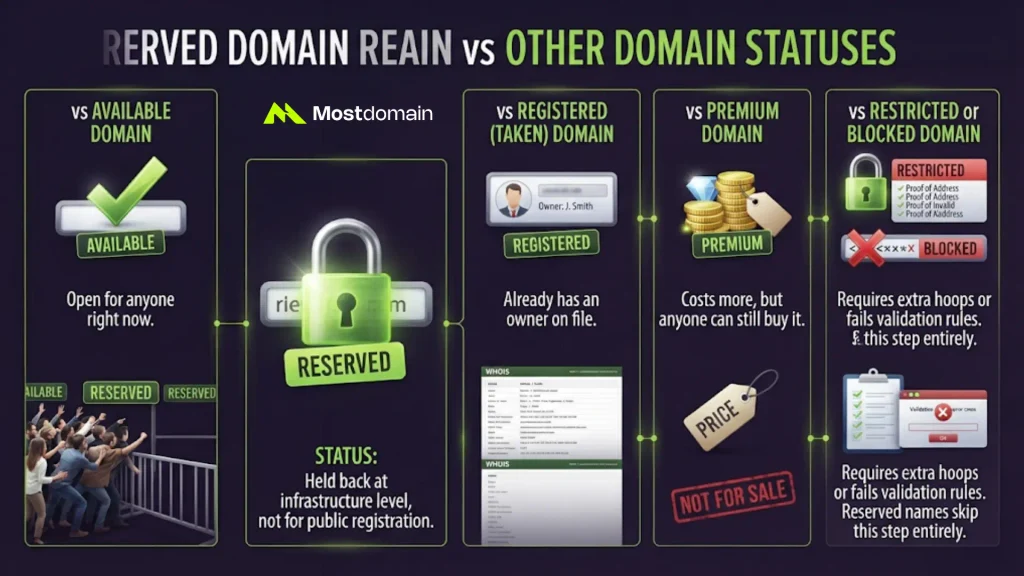
Reserved domains get mixed up with other statuses constantly. The confusion is understandable, honestly.
Reserved vs Available Domain
An available domain sits open for anyone right now. A reserved domain stays closed, no matter who tries or how often.
Reserved vs Registered (Taken) Domain
A registered domain already has an owner on file. A reserved domain usually shows no owner at all. That gap is the real giveaway.
Reserved vs Premium Domain
A premium domain costs more, but anyone can still buy it. A reserved domain isn’t for sale, at least not yet. Some reserved names do cross into premium territory eventually.
Reserved vs Restricted or Blocked Domain
A restricted domain comes with extra hoops, like proof of address. A blocked domain fails validation, often over banned characters in the domain registration rules. Reserved names skip that step entirely. They’re never offered in the first place.
Can You Register or Buy a Reserved Domain?
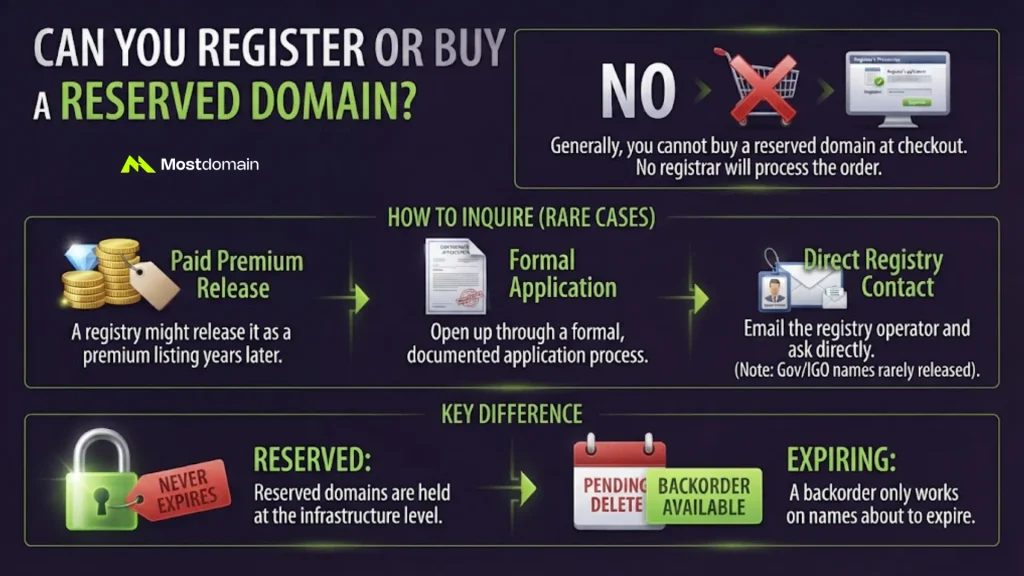
You generally cannot buy a reserved domain at checkout. No registrar will process that order.
Some names do eventually move off the reserved list. A registry might release one as a paid premium listing years later. Others only open up through a formal application. Government and IGO-protected names almost never get released. Genuinely want one? Email the registry operator and ask directly. One note worth flagging here: this differs from a domain backorder. A backorder only works on names about to expire.
How to Check If a Domain Name Is Reserved
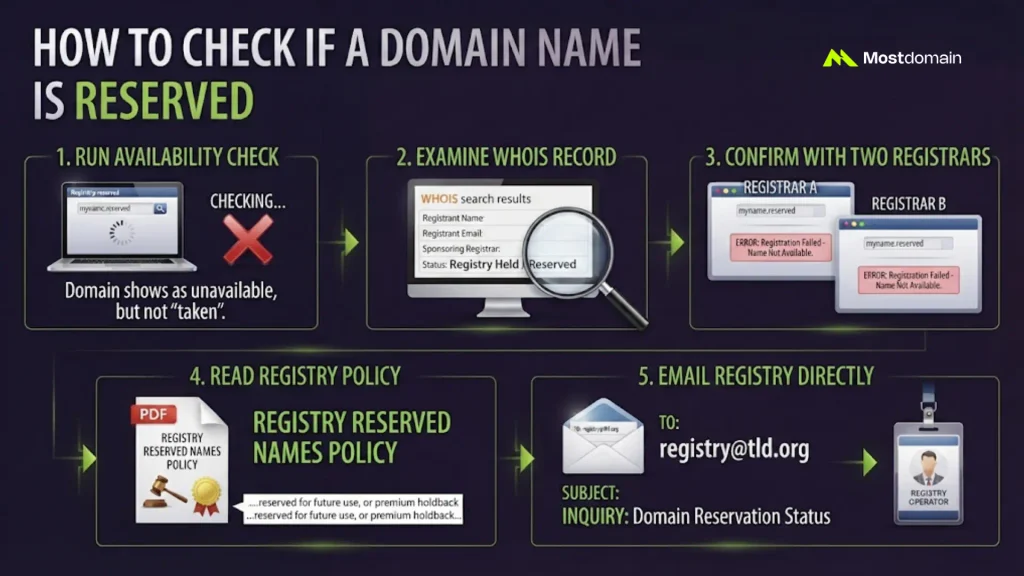
Checking reservation status is quick, usually five steps or fewer.
- Run a domain availability check on the exact spelling you want
- Look for a blank or registry-held owner field in the WHOIS results
- Try registering the same name through two separate registrars, just to confirm
- Read the registry operator’s published reserved names policy, usually a short PDF
- Email the registry directly if the status still doesn’t make sense
FAQ
Can a reserved domain be released?
Sometimes, yes. Registries release certain names later, often as paid premium listings. Government-protected names are the exception. Those stay locked indefinitely.
Why is my domain search showing no result at all?
That name may sit on a reserved list, not be taken. A blank WHOIS field is usually the first clue. Check the registry’s published policy to confirm.
Is a reserved domain the same thing as cybersquatting?
Not even close. A reserved domain gets blocked by the registry itself, before anyone can touch it. Domain squatting is different: a person deliberately claims someone else’s trademark.
How do I find reserved domains for a specific TLD?
Start with that registry’s own public reserved names list. ICANN separately publishes IGO and Olympic reservation lists too.
Does a reserved domain ever show up in a regular domain search tool?
Occasionally, yes, tagged simply as “unavailable.” No real reason gets given there. That’s exactly why checking WHOIS directly matters more.