
Mostdomain – A founder picks a business name on Monday. Registrar screen by Tuesday. The question: must the domain match exactly? It doesn’t. Not legally, anyway. Being allowed to differ isn’t the same as safe to ignore. Here’s what actually decides it.
Does a Domain Name Have to Match Your Business Name?
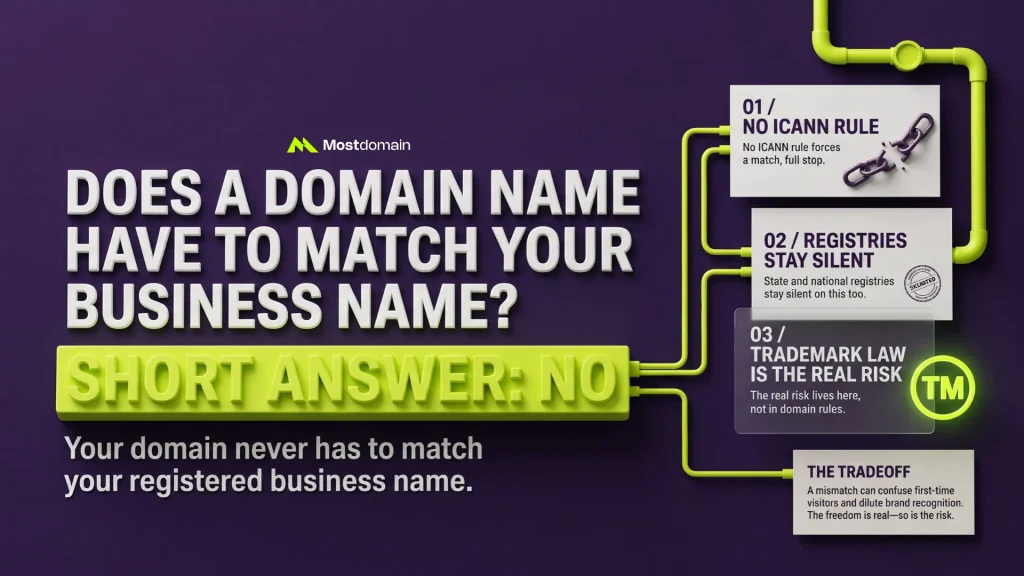
Short answer: no. Your domain never has to match your registered business name. ICANN sets no such rule, and neither does any state registry. Domains and business names sit in two completely separate systems.
Still, not required doesn’t mean not important. A mismatch can confuse a first-time visitor. It can dilute years of brand recognition, too. The freedom’s real. So is the tradeoff.
- No ICANN rule forces a match, full stop
- State and national registries stay silent on this too
- Trademark law, not domain rules, is where the real risk actually lives
Domain Name vs Business Name: Where They Actually Diverge
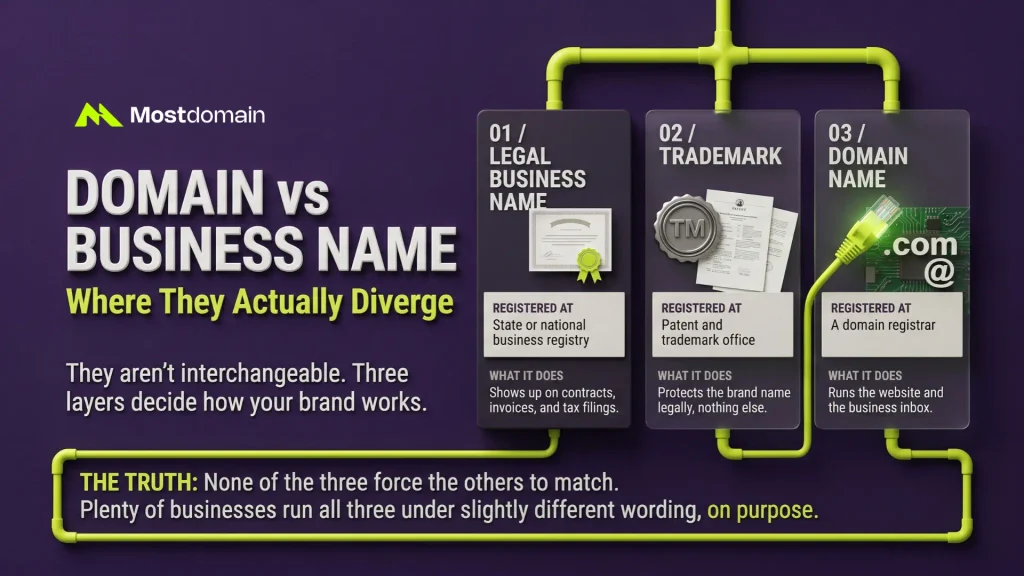
Two different jobs, one easy mix-up. A business name and a domain name aren’t interchangeable. People treat them that way anyway.
Three layers decide how your brand works online, each with its own rules.
| Element | Where It’s Registered | What It Actually Does |
| Legal business name | State or national business registry | Shows up on contracts, invoices, and tax filings |
| Trademark | Patent and trademark office | Protects the brand name legally, nothing else |
| Domain name | A domain registrar | Runs the website and the business inbox |
None of the three force the other two to match. Plenty of businesses run all three under slightly different wording, on purpose.

Why Matching Domain Name and Business Name Still Helps
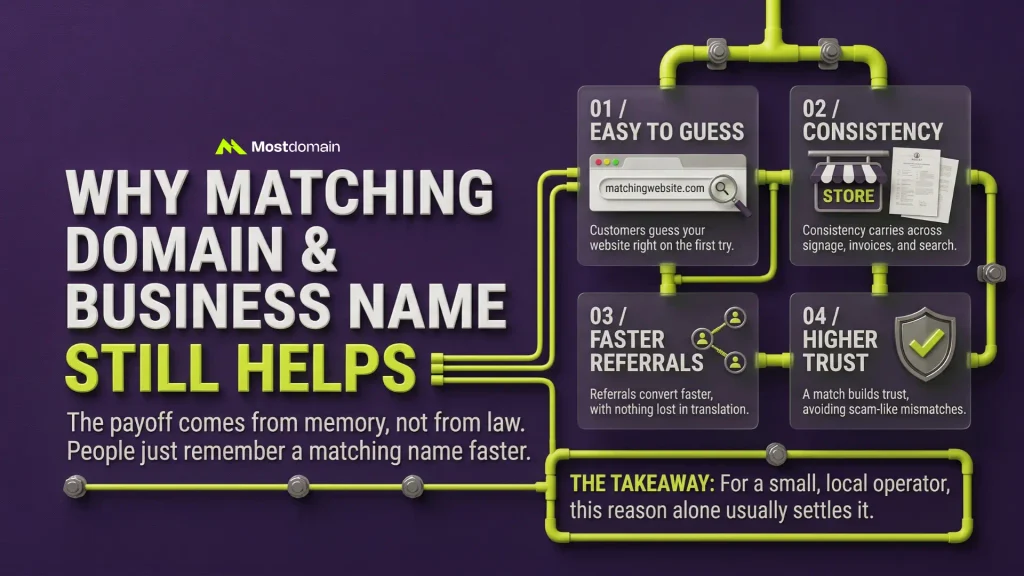
Matching still pays off, even without any rule demanding it. The payoff comes from memory, not from law. People just remember a matching name faster.
- Customers guess the website right, often on the first try
- Consistency carries across signage, invoices, and search results too
- Referrals convert faster, nothing lost in translation
- A matching name builds a little more trust, since mismatches can resemble scam sites
For a small, local operator, that reason alone usually settles it. This small business domain guide walks through the rest.
Business Domain Name Requirements: The Legal Facts
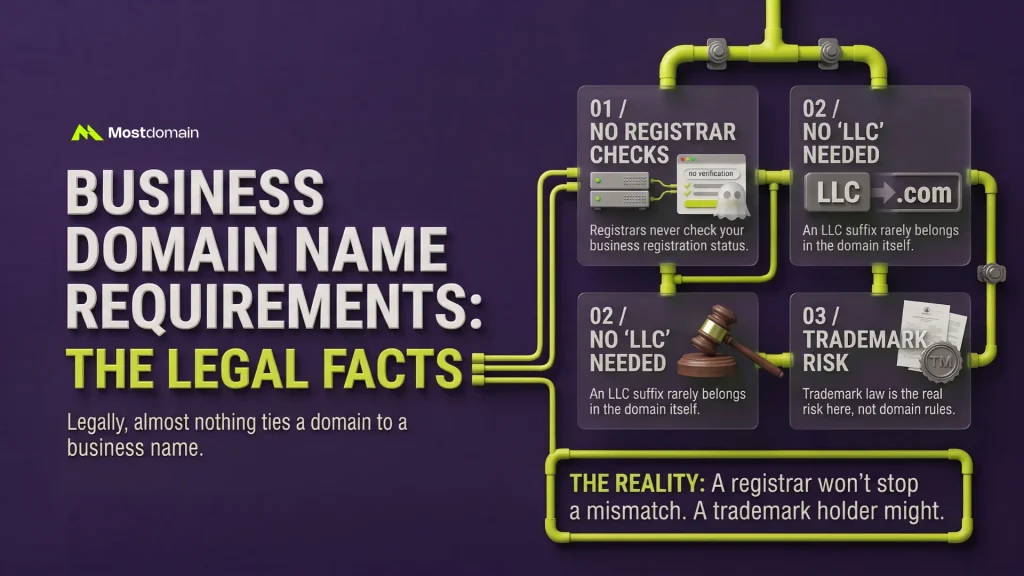
Legally, almost nothing ties a domain to a business name. Three layers are worth knowing before you register anything.




- Registrars like GoDaddy or Namecheap never check your business registration status
- An LLC suffix rarely belongs in the domain itself, see should you put LLC in your domain name
- Trademark law is the real risk here, not domain rules
A registrar won’t stop a mismatch. A trademark holder might.
Should Domain Name Match Business Name? When It Makes Sense
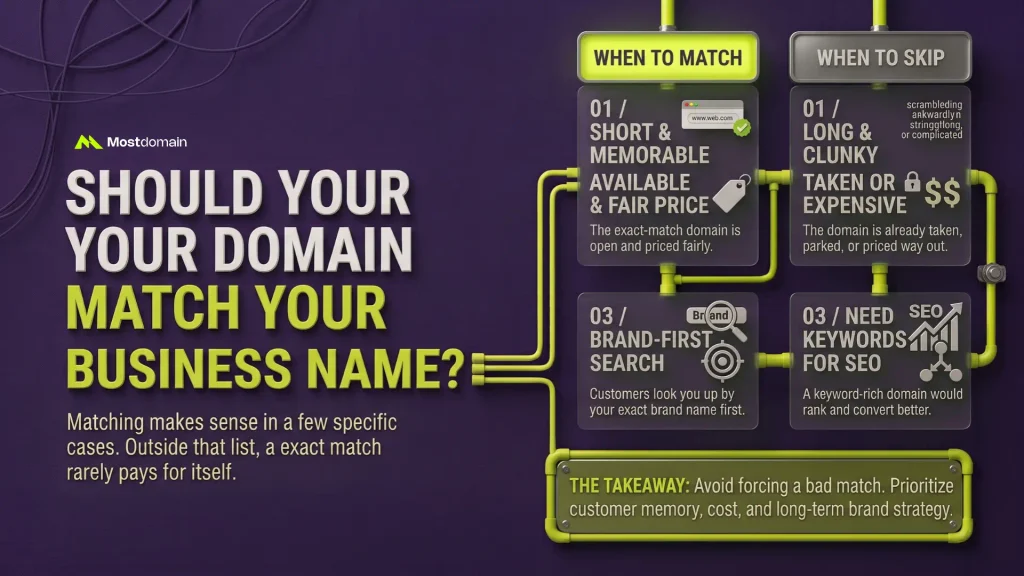
Matching makes sense in a short, specific list of cases. Outside that list, chasing an exact match rarely pays for itself.
- The business name is already short and typo-proof
- An available exact-match domain, priced fairly too
- Customers search by brand name first, not by category
- One brand, no sub-brand plans on the horizon
Still unsure a domain even matters here? This breakdown of why a business needs a domain name settles that first.
When Domain Name Matching Business Name Isn’t the Smart Move
Sometimes forcing the match does more harm than good. These signals usually mean it’s time to let go.
- The business name is long, awkward to spell, or just clunky
- The exact domain, taken or parked or priced way out of range
- Several products, one company, separate sub-brands for each
- A keyword-rich domain would likely rank, and convert, better
- Expansion into a different language market changes the math entirely
Branded vs keyword domains is a useful read before deciding.
Choosing a Domain Name for a Business When the Exact Match Is Taken
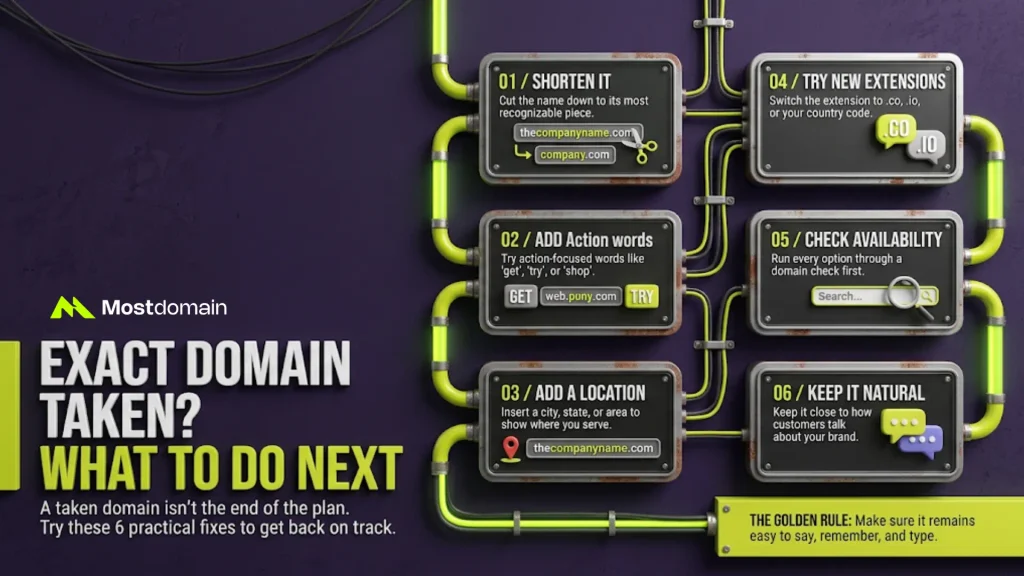
A taken domain isn’t the end of the plan. A handful of fixes usually work, roughly in this order.
- Shorten the name to its most recognizable piece
- Add one clear word, like “get,” “try,” or “shop”
- A location helps too, if the business genuinely serves one area
- Switching the extension is worth trying: .co, .io, or a country code
- Run every option through a domain availability check first
- Keep the final pick close to how customers already talk about the brand
How to choose a domain name covers the rest, step by step.
Company Name and Website Domain: Real Brand Examples
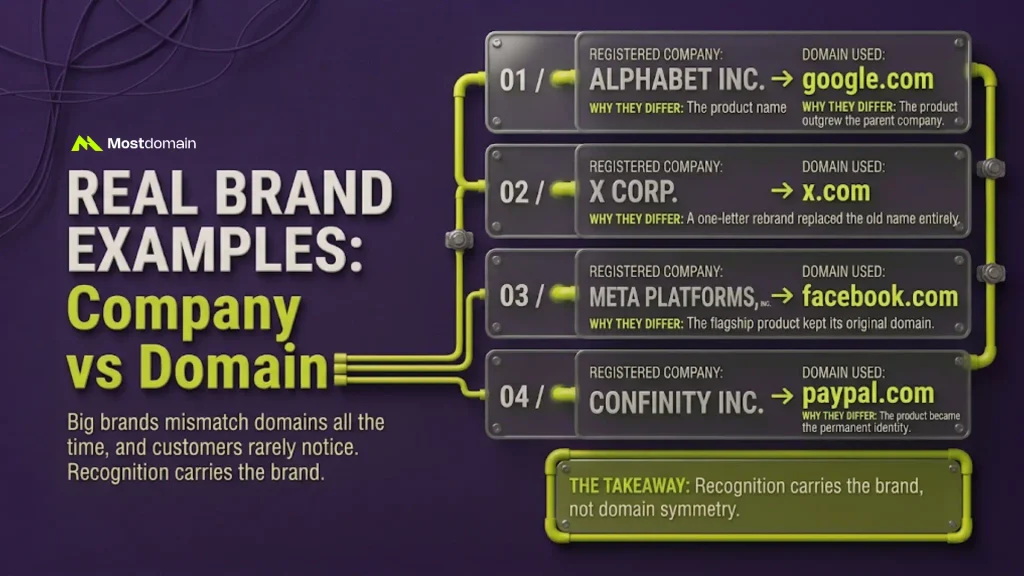
Big brands mismatch their domains all the time, and barely anyone notices. A few familiar names make the point fast. None of this is new, incidentally; trademark lawyers have argued over it for decades.
| Registered Company | Domain Actually Used | Why They Differ |
| Alphabet Inc. | google.com | The product name simply outgrew the parent company |
| X Corp. | x.com | A one-letter rebrand replaced the old name entirely |
| Meta Platforms, Inc. | facebook.com | The flagship product kept its original domain for good |
| Confinity Inc. (original name) | paypal.com | The product name became the permanent identity, name change and all |
None of them lost customers over it. Recognition carried the brand. Not domain symmetry.
Quick Decision Checklist: Should It Match or Not?
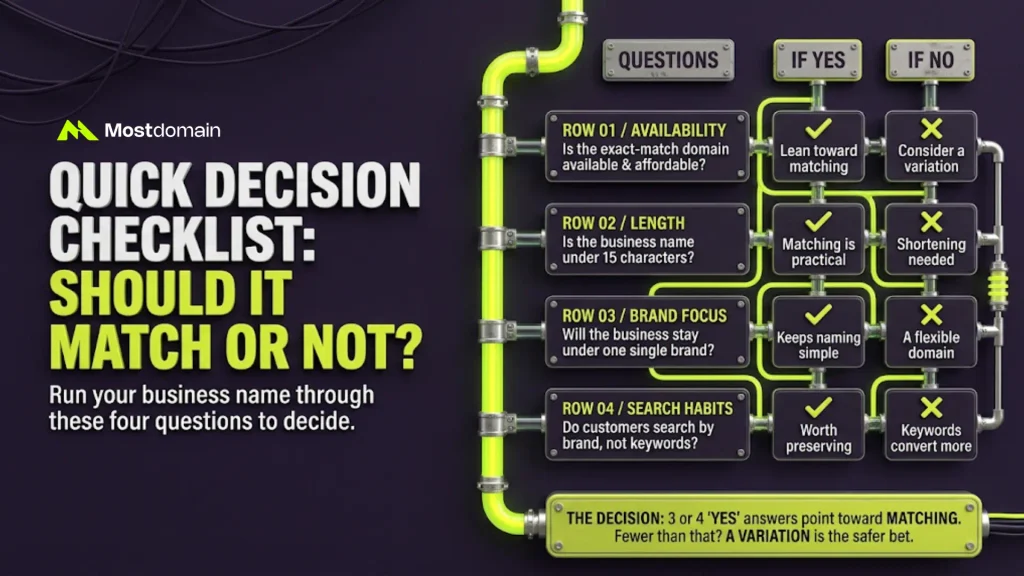
A fast checklist beats an hour of back-and-forth debate. Run the business name through these four questions first.
| Question | If Yes | If No |
| Is the exact-match domain available and affordable? | Lean toward matching | Consider a variation instead |
| Is the business name under 15 characters? | Matching’s still practical at that length | Shortening’s probably needed |
| Will the business stay under one single brand? | One brand, so matching keeps naming simple with no extra layers to manage | A flexible domain may serve better |
| Do customers already search by brand name, not keyword? | Worth preserving | A keyword-led domain may convert more as the catalog grows |
Three or four yes answers usually point toward matching. Fewer than that, a variation is the safer bet. A startup domain strategy overview is worth a look early on.
FAQ
Does my domain name have to match my LLC name exactly?
An LLC filing and a domain live in completely different systems. Matching them, word for word, was never required.
Does an exact-match domain actually help SEO rankings?
Rankings don’t move just because the domain matches. Google’s said as much directly. This domain name and SEO breakdown covers the mechanics. Content quality still carries the weight.
What should I do if my business name’s domain is taken?
Shortening the name usually works first. Adding a keyword or swapping the extension comes next. A direct offer to the current owner, sometimes, works too.
Is a mismatch worse for e-commerce stores specifically?
Online shoppers lean harder on exact recall than most buyers do. This guide to e-commerce domain names explains the gap.
Should a brand-new company always aim for a perfect match?
A short, available domain often beats a long exact one. Exact match domains deserve evaluation on their own terms.
References
- ZenBusiness, Do Your Domain Name & Business Name Have To Match?
- Wix, Does Your Domain Name Have to Match Your Business Name?
- DomainWheel, Does Your Domain Name Have to Match Your Business Name?
- Fabrik Brands, Does Your Domain Name Have to Match Your Business Name?
- Quality Company Formations, Does Your Domain Name Have to Match Your Business Name?