

Mostdomain – A domain lapses on a Tuesday. By Thursday the site’s down, the inbox bounces, and a client is asking why your invoice link stopped working. It happens more often than registrars like to admit. The part most people never learn until it’s too late: an expired domain doesn’t disappear. It sits in a queue. How long it sits, and what it costs to pull it back out, depends entirely on which day you’re reading this on.
What Actually Happens the Moment a Domain Expires
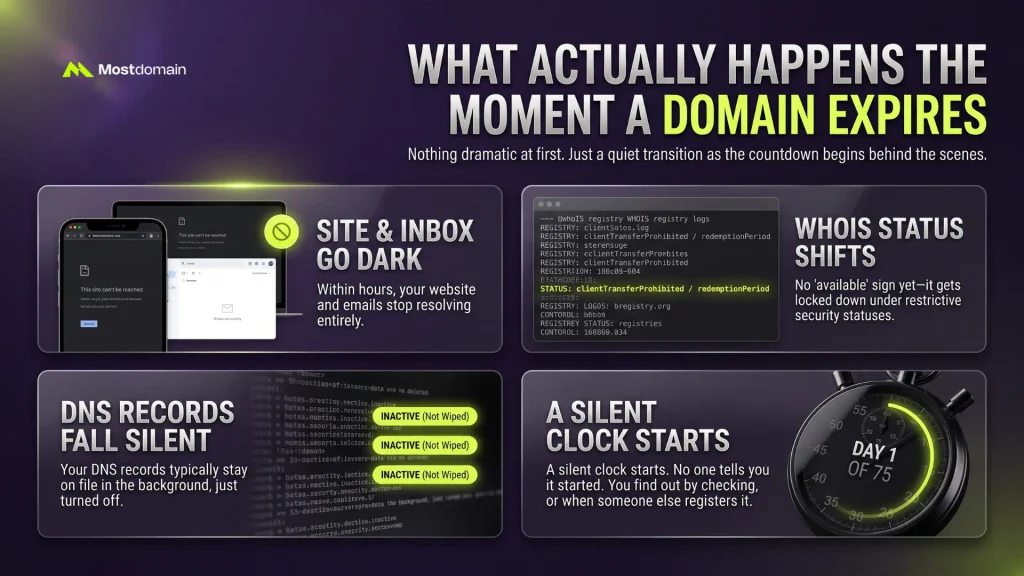
Nothing dramatic, at first. The registrar flips a status flag, your DNS records go quiet, and that’s it. No auction, no countdown banner, no email blast to the world announcing the name is up for grabs.
What changes immediately:
- Your site and inbox stop resolving, usually within hours of the renewal deadline passing
- DNS records typically stay on file, just inactive, not wiped
- The WHOIS status shifts to something like clientTransferProhibited or redemptionPeriod, not “available”
- A clock starts. Nobody tells you it started.
That last point is the one people miss. There’s no notification saying “day 1 of 75.” You find out by checking, or you find out when someone else already registered the name.
The Three Stages Every Expired Domain Moves Through
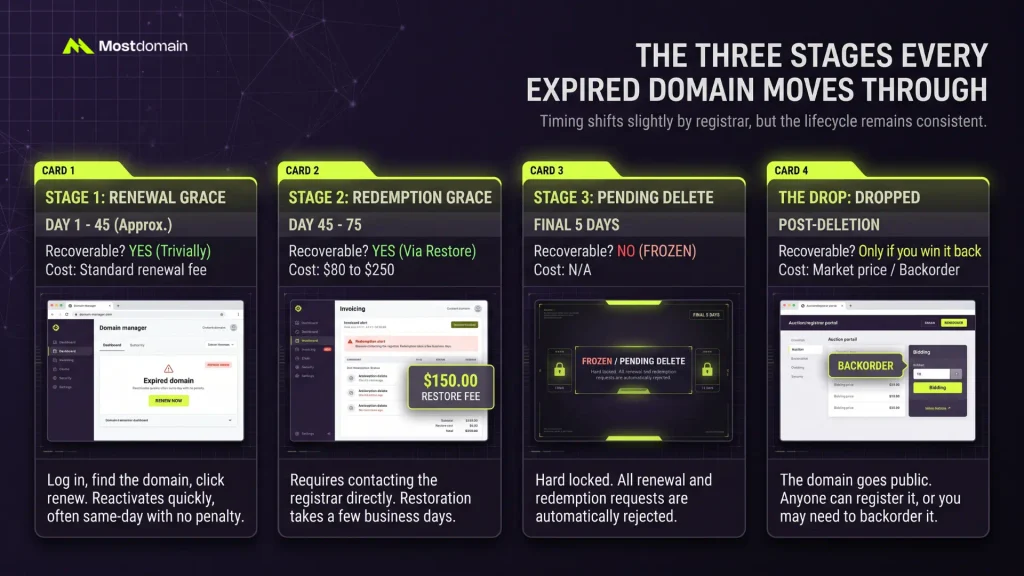
Three stages, roughly. Timing shifts a little by registrar, but the shape is consistent across almost every gTLD.
| Stage | Typical Window | Recoverable? | What It Costs |
| Renewal grace | Day 1 to around 45 | Yes, trivially | Whatever renewal normally costs you |
| Redemption grace | Day 45 to 75 | Yes, but through a restore request | $80 to $250, registrar-dependent |
| Pending delete | Final 5 days | No. Frozen. | Not applicable, nothing to pay for |
| Dropped | After deletion completes | Only if you win it back | Market price, or a backorder fee |
This sequence is laid out in more technical detail in the ICANN domain lifecycle, worth skimming if you manage more than one or two domains.

Still in Grace? This Is the Easy Part
Renewal grace is forgiving on purpose. ICANN built it that way because most expirations are accidents, not abandonment.
- Log in, find the domain, click renew
- Pay the standard rate. No penalty tacked on.
- Reactivation is usually quick, often same-day
Past Grace, Before Deletion
Miss the first window and the domain moves into redemption. It’s still yours to reclaim. The price just changes.
- Contact the registrar directly, not through automated renewal
- Expect somewhere between $80 and $250, depending who you’re registered with
- Processing takes a few business days, rarely instant
Before paying, it’s worth knowing who legally owns a domain after it expires, because the answer isn’t always “nobody yet.”




Pending Delete. Nothing Moves.
The last five days are locked. Hard locked. Registries freeze the record so nobody, including the original owner, can intervene before the drop.
- Renewal requests get rejected automatically
- Redemption requests get rejected too
- Once the window closes, the name goes public
Checking Where Your Domain Actually Stands
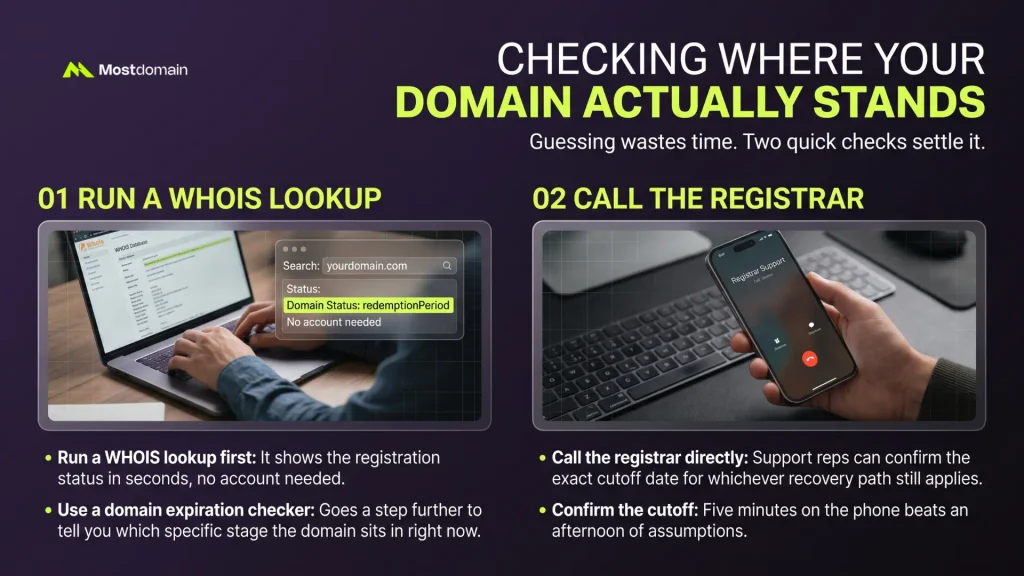
Guessing wastes time you don’t have. Two quick checks settle it.
Run a WHOIS lookup first. It’ll show the registration status in seconds, no account needed. A domain expiration checker goes a step further and tells you which stage, specifically, the domain sits in right now.
Then call the registrar. Support reps can confirm the exact cutoff date for whichever recovery path still applies. Five minutes on the phone beats an afternoon of assumptions.
Renewing While There’s Still Time
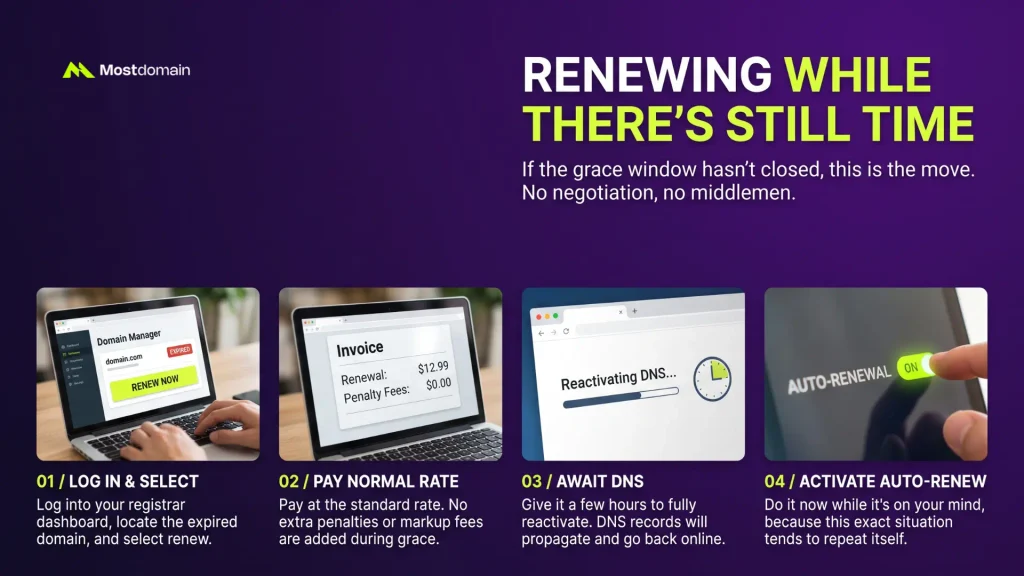
If the grace window hasn’t closed, this is the move. No negotiation, no middlemen, just a renewal.
- Log into the registrar dashboard
- Find the expired domain in the list, select renew
- Pay at the normal rate
- Give it a few hours to fully reactivate across DNS
Turn on auto-renewal the moment it’s back. Not next week. Now, while it’s still on your mind, because this exact situation tends to repeat itself on domains nobody’s actively watching.
Redeeming a Domain After Grace Has Closed
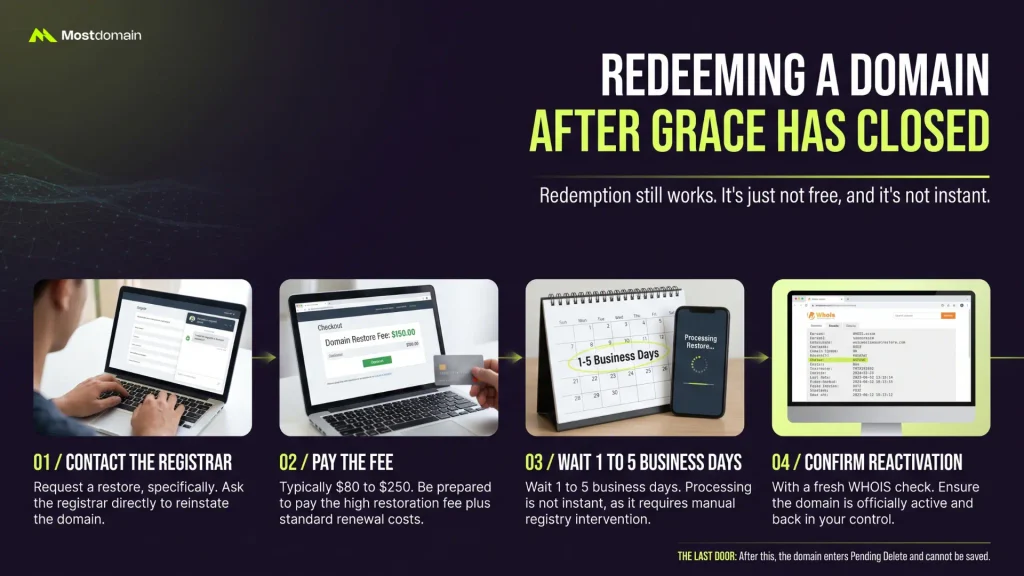
Redemption still works. It’s just not free, and it’s not instant.
- Contact the registrar and request a restore, specifically
- Pay the fee, typically $80 to $250
- Wait one to five business days
- Confirm reactivation with a fresh WHOIS check
This genuinely is the last door before the name goes public. After this, options change entirely.
If the Domain Already Dropped

Dropped means public. Anyone, anywhere, can attempt to register it the second the registry releases it. That sounds worse than it usually plays out.
Watching for It With a Backorder
A backorder service does the waiting for you, around the clock, which matters because drops often happen at odd hours.
- Set up a domain backorder through a provider with a decent track record
- Several services sometimes compete for the same name, which lowers any single one’s odds
- No guarantees. Real chance, not a sure thing.
Auctions and Drop Catchers
Names with real authority rarely drop quietly. They go through formal channels instead.
- Specialized catchers run on infrastructure built specifically to register faster than retail tools can
- Keep an eye on pending delete auctions when there’s meaningful backlink history attached
- Bidding gets competitive fast on short or brandable names
Not every domain is worth the chase. If the backlink profile and history matter more than the exact string, buying a ready-made expired domain with that authority already built in is often less hassle than fighting for the original.
When Someone Else Already Grabbed It
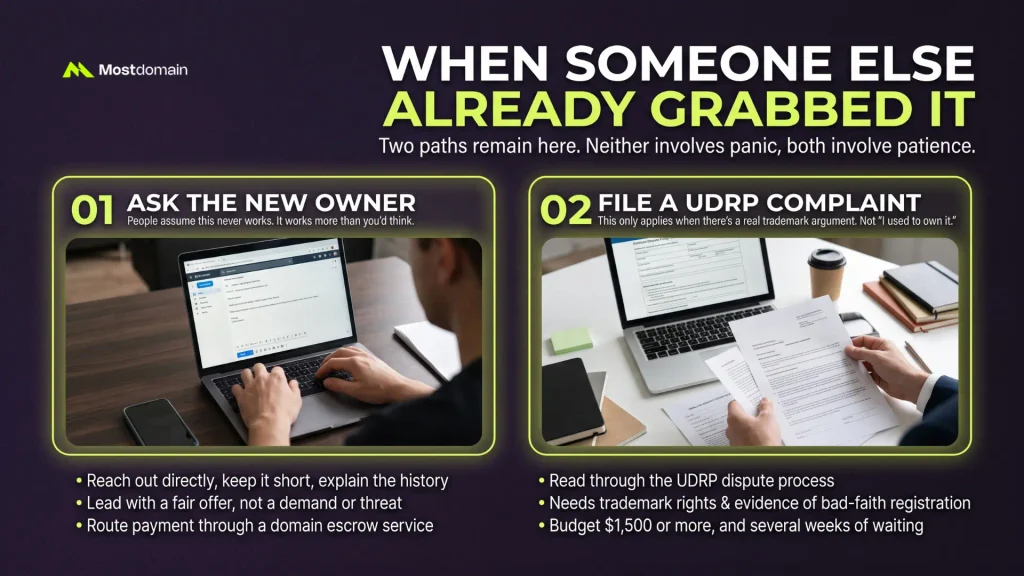
Two paths remain here. Neither involves panic, both involve patience.
Just Asking the New Owner
People assume this never works. It works more than you’d think.
- Reach out directly, keep it short, explain the history
- Lead with a fair offer, not a demand or a threat
- Route payment through a domain escrow service so neither side is exposed during the handoff
Filing a UDRP Complaint
This only applies when there’s a real trademark argument. Not “I used to own it.” A trademark.
- Read through the UDRP dispute process before filing anything official
- You’ll need documented trademark rights plus evidence of bad-faith registration
- Budget $1,500 or more, and several weeks of waiting on a decision
Picking the Right Recovery Path for Your Situation
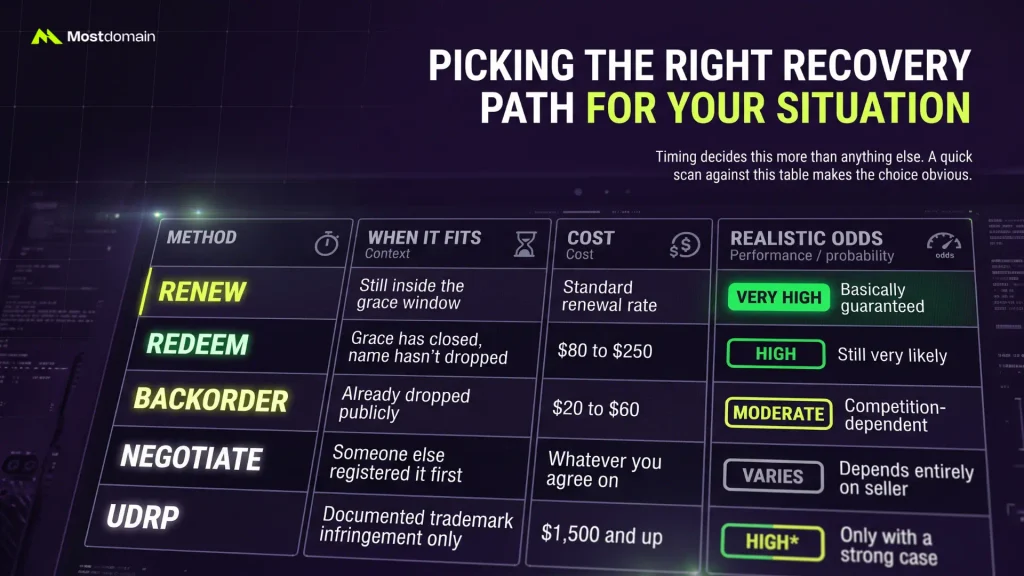
Timing decides this more than anything else. A quick scan against the table below usually makes the choice obvious.
| Method | When It Fits | Cost | Realistic Odds |
| Renew | Still inside the grace window | Standard renewal rate | Very high, basically guaranteed |
| Redeem | Grace has closed, name hasn’t dropped | $80 to $250 | High |
| Backorder | Already dropped publicly | $20 to $60 | Moderate, competition-dependent |
| Negotiate with owner | Someone else registered it first | Whatever you agree on | Depends entirely on the seller |
| UDRP | Documented trademark infringement only | $1,500 and up | High, but only with a strong case |
Making Sure This Doesn’t Happen Again
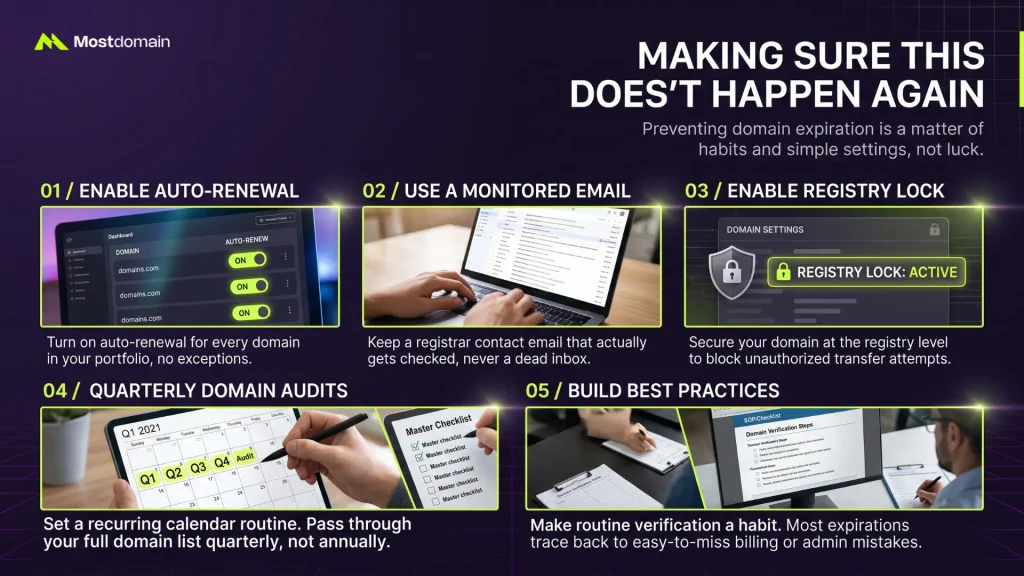
Fixing it once is cheap compared to the time lost fixing it twice.
- Auto-renewal, turned on for every domain in the portfolio, no exceptions carved out
- A registrar contact email that actually gets checked, not a dead inbox nobody opens
- A habit built around domain renewal best practices, since most expirations trace back to the same two or three avoidable mistakes
- Registry lock enabled, which blocks unauthorized transfer attempts
- A quarterly pass through the full domain list. Not annual. Quarterly.
None of this is complicated. It’s just easy to skip until the week you really needed it done.
FAQ
Can a domain still be recovered after it expires?
In most cases, yes, provided the grace or redemption window hasn’t closed yet. Act inside that window and the recovery is usually straightforward.
How much time is there, realistically?
Around 75 days total if both grace periods are counted together. Past that, the domain enters pending delete, and nothing can be done until it releases.
What if another buyer already registered it?
Two routes exist. A direct negotiation for a buyback, or a UDRP complaint if there’s a genuine trademark claim behind it.
Does any of this cost money?
Sometimes nothing, if it’s still inside grace. Past that, fees run up to around $250 for a standard redemption.
Is a dropped domain really gone for good?
Not necessarily. Backorders and auctions still catch a meaningful share of drops, especially names without heavy competition attached.
References
- Identity Digital, How to Get Your Expired .au Domain Name Back
- 1-Grid, How Do I Get My Domain Name Back After It Has Expired?
- DomainWheel, How to Get My Domain Name Back: A Domain Recovery Guide
- OVHcloud, How Do I Acquire a Domain Name?
- NameExperts, How to Get Back a Lost Domain