
A domain backorder refers to a request you submit to a registrar or third-party service to reclaim a domain that you have lost due to non-renewal, expiration, or deletion. This request is activated the moment the domain becomes available again. Typically, you pay in advance, although some services may charge only if you successfully acquire the domain. The service continuously monitors the domain’s status and attempts to register it the instant it becomes available. However, there is no guarantee of success.
That’s the postcard version. Spend real money on this and the fuller picture gets messier fast, since most guides stop right around “place your order and wait.” What actually happens underneath that click, why so many backorders quietly die before the race even starts, and where the legal exposure hides that barely anyone mentions: that’s what the rest of this covers.
How a Domain Backorder Actually Works
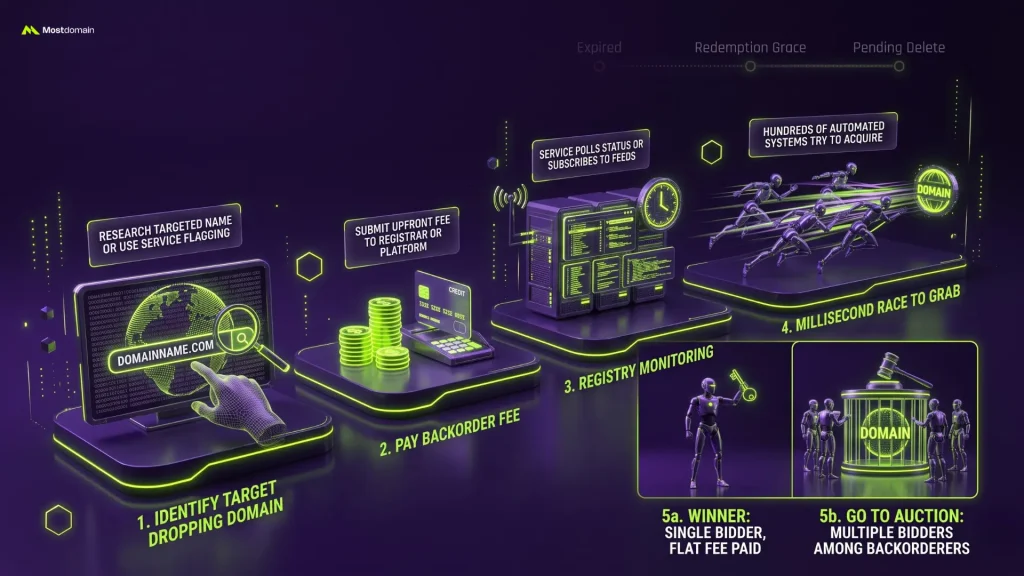
A domain backorder works by monitoring a registered domain’s status at the registry level and submitting an automated registration request within milliseconds of it becoming available. You’re not reserving anything, not really. You’re queuing a bet on a race you’ll never actually watch happen.
Here’s the sequence, stripped down to what actually matters:
- Start with identifying a domain that’s currently taken but might drop, whether that’s your own research or a service flagging it for you.
- Pay the backorder fee next, usually upfront, to a registrar or a dedicated backorder platform.
- Behind the scenes. The service polls the registry. Or for the sharper providers, subscribes to a real-time feed watching for any status change.
- The moment the domain enters its final deletion window, hundreds of automated systems (not just yours) try to grab it in the same fraction of a second.
- Win as the only bidder and you usually pay the flat fee. Win against other bidders and it goes to auction among everyone who backordered that name.
The domain doesn’t just vanish and reappear. Though it’s tempting to picture it that way. It moves through several distinct lifecycle stages first: expired but still renewable, then a redemption window the original owner can use to reclaim it, then a short pending-delete phase before release. Worth checking the exact grace periods before assuming timing, honestly, since registries don’t all run the same clock. Our guide to the complete gTLD domain lifecycle breaks that down stage by stage; this piece stays focused on the backorder side.
Backorder vs Dropcatching vs Sniping vs Pre-Registration
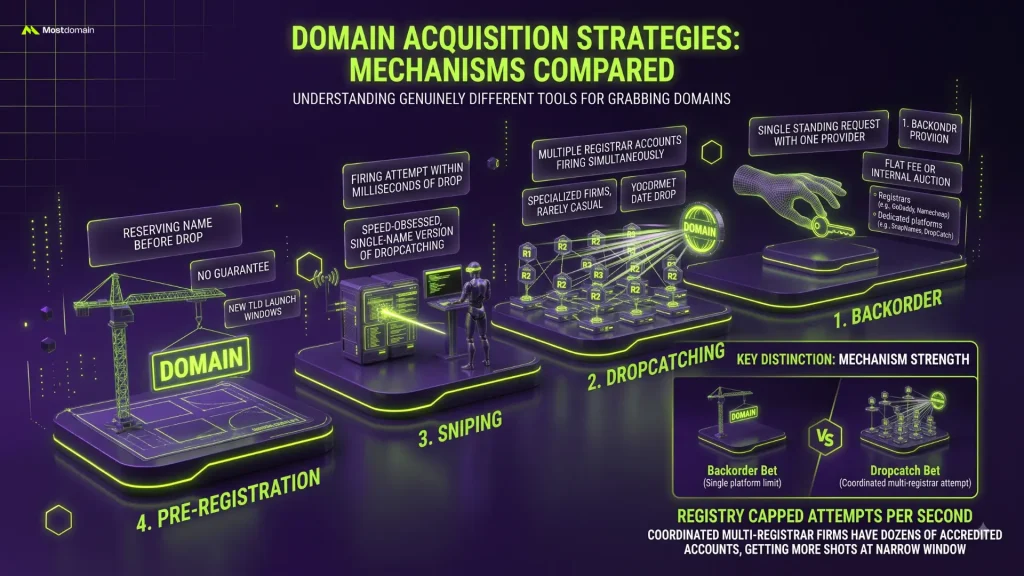
These four terms get used interchangeably by registrars. Even though they describe genuinely different mechanisms rather than different names for the same service. Mix them up, and you end up paying for the wrong tool entirely.

| Term | The Actual Mechanism | Where You’d Actually Find It |
| Backorder | One standing request with a single provider, resolved by flat fee or that provider’s internal auction | Registrars like GoDaddy and Namecheap, plus dedicated platforms such as SnapNames or DropCatch |
| Dropcatching | Multiple registrar accounts firing registration attempts at the exact same moment | Specialized firms with direct registry access; rarely sold to casual buyers |
| Sniping | A speed-obsessed, single-name version of dropcatching | Individual technical buyers running scripts against the registry API, occasionally boutique services |
| Pre-registration | Reserving a name before it’s even dropped, no guarantee it ever will | Registrars during new TLD launch windows |
A backorder placed through a single platform is, almost always, the weaker bet against a coordinated multi-registrar dropcatch attempt. Registries cap how many connection attempts they’ll accept per second, and firms running dozens of accredited registrar accounts simply get more shots at that same narrow window. If that distinction matters to your strategy, the mechanics of running, or beating, a multi-registrar attempt live in our guide to catching pending delete domains.
What You’re Actually Paying For
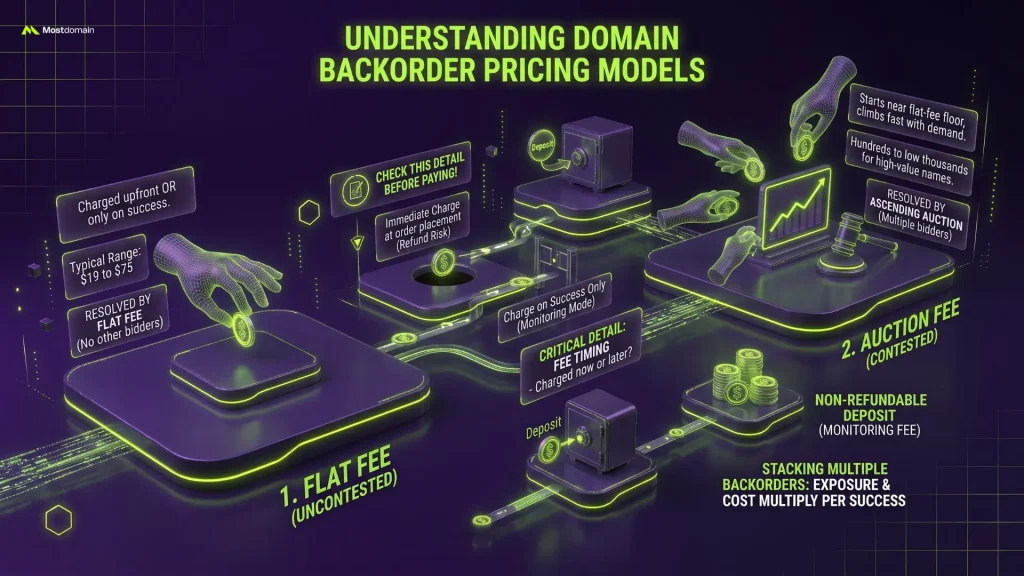
Backorder pricing splits into two models: a flat fee if you’re the only bidder, or an ascending auction if multiple parties backordered the same name. Neither model refunds you consistently once the domain fails to drop at all.
| Pricing Model | How It Works | Typical Range |
| Flat fee (uncontested) | Charged upfront or only on success | $19 to $75 |
| Auction fee (contested) | Starts near the flat-fee floor, climbs fast once demand shows up | Hundreds to low thousands for backlink-rich or brandable names |
| Non-refundable deposit | Charged no matter what happens, functions as a monitoring fee rather than a purchase attempt | Provider-dependent |
| Stacking multiple backorders | Raises your odds, sure, but stacks your exposure too | Cost multiplies per successful win |
One thing worth checking before any money changes hands: is the fee charged the moment you place the order. Or only if the attempt actually succeeds? That single detail changes what “trying” really costs versus “winning,” and providers aren’t always upfront about which model applies until checkout.




Why Backorders Fail More Often Than Providers Admit
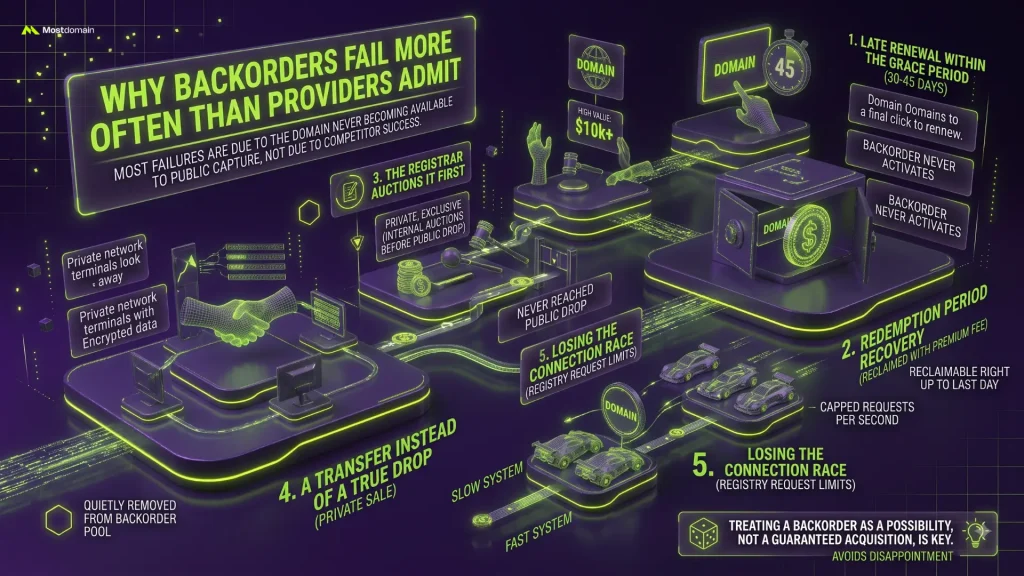
Most backorders do not fail due to a competitor’s success, but rather because the domain was never available to capture in the first place. This nuance is seldom reflected in a provider’s promotional materials.
Late renewal within the grace period
Domain owners often allow their domains to lapse beyond the expiration date. However, they still have the opportunity to renew them within the auto-renew grace period. Which typically lasts between 30 to 45 days, depending on the registry. Consequently, the backorder is never activated.
Redemption period recovery
Even when a domain enters its redemption phase, the original owner can typically pay a premium fee to reclaim it, sometimes right up until the very last day.
The registrar auctions it first
Certain registrars conduct their own internal auctions for desirable expired domains before they ever enter the public drop pool. In such cases, your backorder was competing for a domain that was never intended to be publicly available.
A transfer instead of a true drop
Sometimes a domain changes hands through a private sale instead of expiring. Which quietly removes it from the backorder pool without any notification to those monitoring it. (Redemption fees can be high enough that some owners choose to forfeit their domains rather than pay, which adds a layer of irony.)
Losing the connection race
Even when a domain does drop, registries only process a limited number of registration requests per second during the release window. Slower or less efficient backorder systems will inevitably lose, regardless of how early the order was submitted.
None of this implies that backorders are a poor investment, at least not universally. It simply indicates that treating a backorder as a guaranteed acquisition, rather than a possibility, is where most of the disappointment arises.
Trademark and UDRP Risk When Backordering a Brand Name
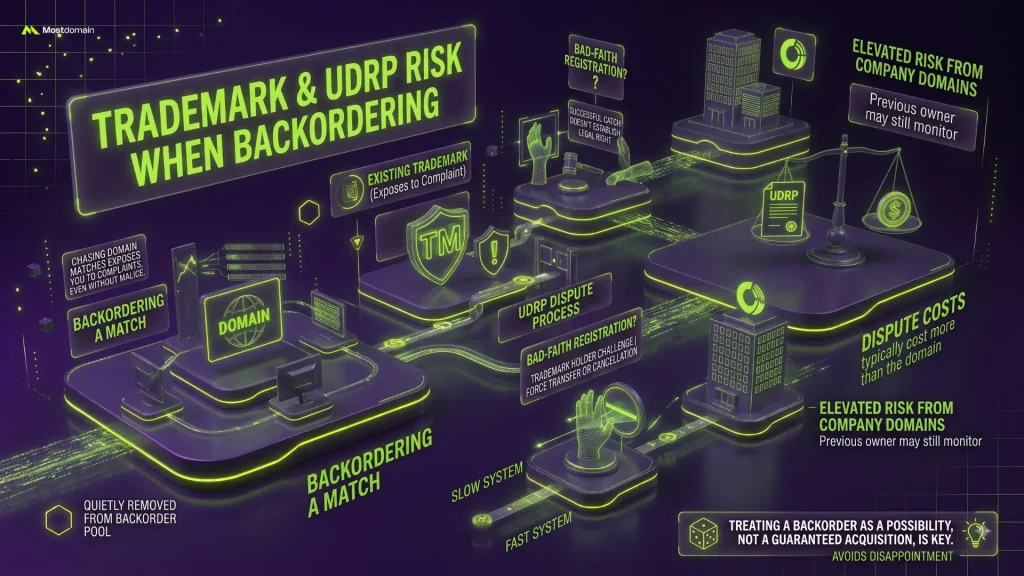
Backordering a domain that matches. Or even closely resembles an existing trademark can expose you to a UDRP complaint. Even if you never registered it maliciously. This is the part almost no backorder guide mentions, and it carries the highest financial downside of anything on this list.
- The Uniform Domain-Name Dispute-Resolution Policy lets a trademark holder challenge your registration. And if they win, force a transfer or cancellation. Regardless of how you acquired the name.
- Successfully catching a backorder doesn’t establish any legal right to the name if a brand can show bad-faith registration. Chasing a name that clearly matches an active trademark can be read exactly that way, at least in the more contested categories.
- Elevated risk tends to sit with domains that previously belonged to a company rather than an individual investor, since the original brand may still be actively monitoring for exactly this kind of drop.
- Filing or defending a UDRP case typically costs more. It cost more than the domain itself. The real exposure isn’t just losing the name. It’s the dispute process wrapped around it.
If you’re backordering a domain purely for its age or backlink profile rather than its brand value, a quick trademark search before committing any money is worth the five minutes it takes.
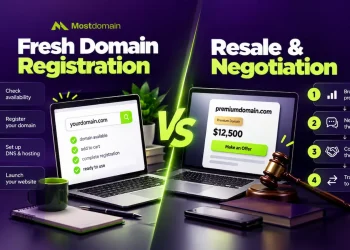
Backorder vs Buying an Already-Registered Domain
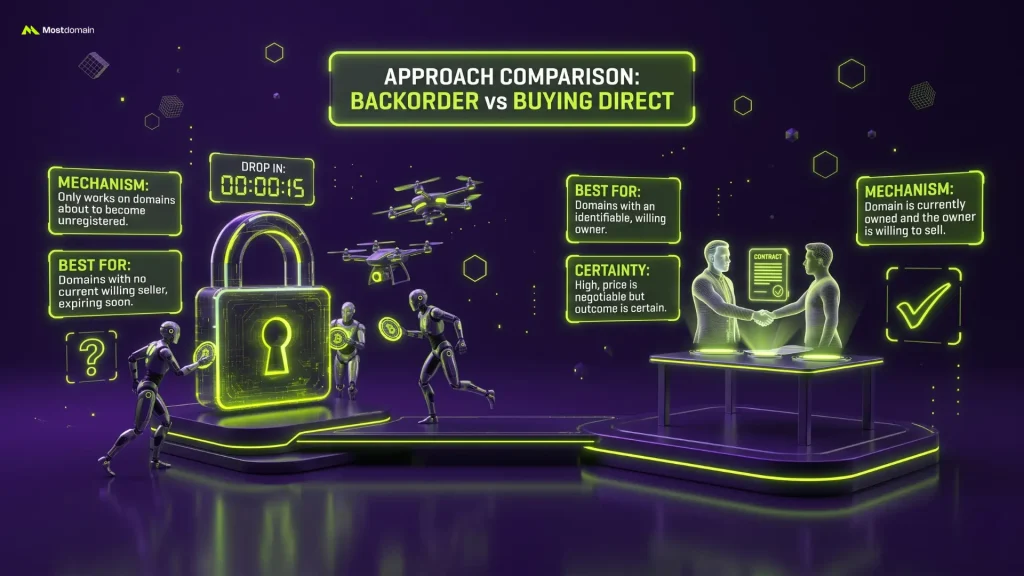
A backorder only works on domains about to become unregistered. If the domain is currently owned and the owner is willing to sell, buying it directly is usually faster and more certain. These two paths solve different problems and shouldn’t be confused.
| Approach | Best For | Certainty |
| Backorder | Domains with no current willing seller, expiring soon | Low, competitive, outcome not guaranteed |
| Direct purchase or marketplace | Domains with an identifiable, willing owner | High, price is negotiable but outcome is certain |
If the domain you want is currently active and the owner might be open to an offer, our walkthrough on how to buy expired and aged domains covers the direct-negotiation route, which sidesteps the entire backorder race altogether.
Should You Backorder This Domain?
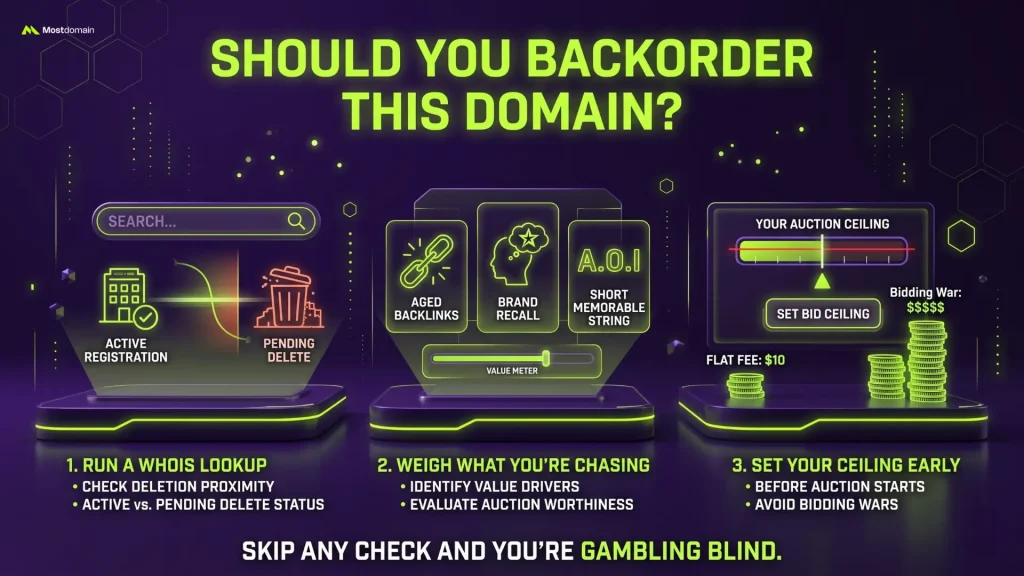
The decision usually comes down to three checks you can run in under ten minutes. First is how close the domain already is to deletion. Then whether a trademark exists on the name. And whether you’d still want it if the price climbed past the flat fee. Skip any of these and you’re gambling blind instead of placing a calculated bet.
- Run a WHOIS lookup first. A domain still deep in active registration is a very different bet than one already sitting in pending delete.
- Weigh what you’re actually chasing, aged backlinks, brand recall, or just a short memorable string, since that changes how far an auction is worth pushing.
- Set your ceiling before the auction starts, not during it. A ten-dollar gap in the flat fee rarely matters; a five-figure bidding war chased for the wrong reason does.
FAQ
Is a domain backorder guaranteed to work?
No. A backorder only gives you a chance to register the domain if and when it actually becomes available, and plenty never reach that point at all.
How much does a domain backorder typically cost?
Uncontested backorders usually run somewhere between $19 and $75, while contested names can climb into an auction that ends up costing hundreds of dollars or more.
Can I backorder a domain with multiple services at once?
Yes, and many experienced buyers do exactly that to raise their odds, though it means potentially owing fees to more than one provider if two attempts both succeed.
What happens if nobody else backorders the same domain?
You typically win it for the flat backorder fee without going through an auction, assuming the domain actually drops and your service wins the registration race.
Is backordering a domain legal?
Yes, backordering itself is a legitimate registrar service, though registering a name that infringes on an existing trademark can still expose you to a UDRP dispute regardless of how you acquired it.
How long does a domain backorder take to resolve?
It depends entirely on the domain’s current status: anywhere from a few days if it’s already near deletion, to several months if it just expired and still has a full redemption period ahead of it.
References
- Internet Corporation for Assigned Names and Numbers, Uniform Domain-Name Dispute-Resolution Policy
- DreamHost, What is a Domain Backorder?
- Network Solutions, What is domain backorder? A complete guide
- WPBeginner, What Is a Domain Backorder? (And How to Properly Place One)