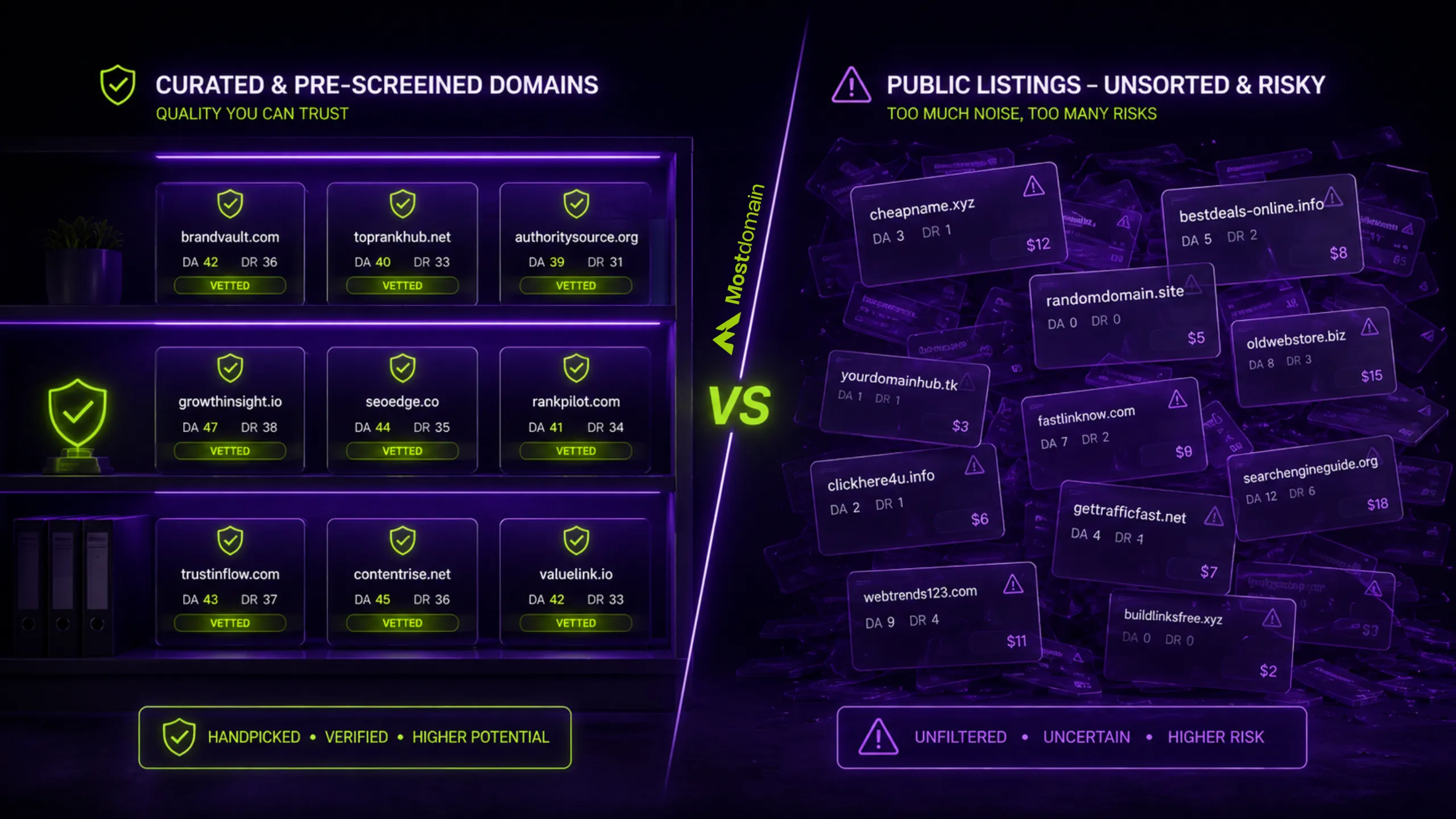
Choosing between a curated vs public drop list comes down to a single question. Do you want a ready to serve? Or you to do it yourself? A curated marketplace hands you inventory that has already screened. A public drop list hands you raw names and leaves the judgment entirely on your side. Both can surface strong aged domains. They ask very different things of your hours and your skill.
A curated marketplace suits buyers who value time and safety over sticker price. While a public drop list suits hands-on buyers. Buyers who have the skill and the hours to vet raw inventory themselves.
What a Curated Marketplace and a Public Drop List Really Are
A curated marketplace is a shop of pre-screened aged domains, where a team filters out penalized or low-quality names before anything gets listed. A public drop list is an open, unfiltered feed of expiring or deleted domains that anyone can search and register on a first-come basis.
These are two ways of sourcing, not two stages in a domain’s life. Whether a name is expired, dropped, or continuously aged is a separate lifecycle question, and it isn’t the thing being decided here.
| How the model works | Curated marketplace | Public drop list |
| Where the inventory comes from | A vetted, hand-picked catalog | Registry drop feeds and aggregators like ExpiredDomains.net, which indexes names across 676 TLDs and refreshes daily |
| Who does the quality filtering | The marketplace, before listing | You, after you find the name |
| How you get access | Browse and buy, often at a fixed price | Search open lists, then race to register or backorder |
| What you are actually paying for | Screened, ready-to-deploy assets | The name itself, plus all the risk that comes attached |
A dropped name only reaches those public feeds after it clears a grace window of roughly 30 to 45 days and a pending-delete phase of about 5 to 7 days. By the time it lands, it is public to everyone at once.
The Effort and Skill Each Model Demands From You
With a curated marketplace the screening work is already finished, so you mostly assess fit and price. With a public drop list you personally carry every check, which in practice means backlink analysis, history review, penalty screening, and trademark checks on each candidate.

That gap in workload is the real difference. One model sells you a filtered result. The other sells you a starting point and a to-do list.
| The work involved | Curated marketplace | Public drop list |
| Finding candidates | Handled for you | Daily searching and filtering, often across thousands of dropping names |
| Checking domain history | Done before listing | On you, using archive tools and backlink software |
| Screening for penalties or spam | Rejected pre-listing | Your responsibility, and easy to get wrong without experience |
| Skill floor to do it safely | Low to moderate | High. Realistically five separate due-diligence checks per name: age, backlink quality, traffic history, past usage, and legal exposure |
Where the Real Risk Actually Sits
The core risk of a public drop list is that its SEO value is unverified. It can be strong, or it can be zero. Or it can even be negative if the domain was penalized or used for spam in a past life. A curated marketplace lowers that exposure by rejecting those names before they reach you. Though no screening ever removes risk completely.
Here is the part people underestimate. On a raw list, a bad domain and a great domain look almost identical until you dig in. Judging whether a specific name is clean is its own discipline, and it belongs to the evaluation stage of buying an aged domain, so we won’t cram the full how-to in here.




- On a public list, the risk transfers to you the moment you buy. There is no safety net.
- With curation, the marketplace absorbs the first layer of that risk on your behalf.
- Neither model is a guarantee. A screened domain can still underperform, just far less often.
The Hidden Cost of a “Free” Drop List
A public drop list looks free, but its true cost includes your working hours, paid analysis tools, drop-catch or backorder fees, and the occasional bad buy that slips through. A curated marketplace folds most of those costs into a higher upfront price instead.
“Free” is doing a lot of quiet work in that sentence. The list itself may cost nothing. Everything around it rarely does.
| What it really costs | Public drop list | Curated marketplace |
| List or catalog access | Often free | Built into the domain price |
| Analysis tools | A paid backlink and history subscription, billed monthly whether you buy or not | Not needed for screening |
| Your time per domain | Real, and it adds up fast when yields are low | Minimal |
| Catch or backorder fees | Roughly 59 to 60 dollars per name on major drop-catch services, and auction commissions that commonly land between 10 and 25 percent | Usually none |
| The cost of a bad buy | Entirely yours | Reduced by pre-screening |
Add those together and the “cheap” route often isn’t. It just moves the bill somewhere you don’t see it on day one.
You Are Racing Everyone Else on a Public List
Every buyer scanning a public drop list sees the same names at the same moment, so genuinely good domains attract competing bids or get caught within hours. Curated inventory is held privately, which removes that race entirely.
There is a subtle trap in open lists that new buyers miss. The domains still available on a public feed are, quite often, the ones everyone else already passed on.
- The same feed reaches thousands of investors simultaneously. Strong names rarely sit there long.
- Competitive names trigger bidding wars or drop-catch fights, and prices climb past what the domain is worth.
- What’s left after the good ones vanish tends to be picked-over inventory.
How to Tell Whether a “Curated” Label Is Real
A genuine curation claim is backed by evidence: published screening criteria, honesty about what gets rejected, and some form of guarantee if a listed domain turns out to carry a penalty. A marketing-only label offers none of that and simply borrows the word.
Not every seller who prints “curated” on the page is actually filtering anything. It’s worth a quick sanity check before you trust the label, at least in this specific sense.
- Look for stated vetting criteria, not just the adjective on its own.
- A real curator will tell you what it rejects, not only what it lists.
- Some kind of penalty guarantee or refund policy is the strongest signal that the screening is more than decoration.
Which Model Fits Which Buyer
The right model depends more on your time, skill, and buying volume than on budget alone. Beginners and time-poor teams lean curated. Experienced, hands-on buyers with proper tooling can genuinely profit from public lists.
There is no universally correct answer, and anyone who tells you otherwise is selling something. Fit is the whole game.
| Type of buyer | Model that usually fits | The reason |
| First-time buyer | Curated | The vetting skill gap is too wide to cross safely on a raw list, and one bad buy can sour the whole experience |
| Experienced solo SEO | Either, often public | Has the tools and the eye to work raw inventory profitably |
| Agency buying at scale | Curated | Time saved across many purchases outweighs the premium, and consistency matters more than squeezing price |
| High-volume domain investor | Both, blended | Runs public lists for volume, leans on curated sources like Mostdomain when clean history and speed matter more than cost |
FAQ
Is a public drop list ever the smarter choice?
Yes, for the right person. If you already own backlink-analysis tools, understand penalty signals, and can spend real hours filtering daily feeds, a public list can deliver domains at a lower cash price. The savings are real. They just come out of your time and expertise instead of your wallet.
Does “curated” guarantee a domain is penalty-free?
No, and any seller claiming a hard guarantee should make you cautious. Curation strongly reduces the odds of inheriting a penalized or spammy domain by screening it out before listing. It doesn’t reduce them to zero. Reputable curated sources back this up with a refund or replacement policy rather than an absolute promise.
Can I use both models at once?
Plenty of experienced buyers do exactly that. They mine public drop lists for volume and opportunistic finds. Then turn to curated inventory when a project needs a clean, ready-to-deploy domain fast. The two models aren’t rivals so much as tools for different jobs.
Why do curated aged domains usually cost more?
You are paying for removed risk and saved time. The price folds in the screening labor, the rejected inventory the curator absorbed, and the confidence that the backlink history has already been checked. Whether that premium is worth it depends on how much your own hours are worth. And how costly a bad domain would be to your project.
How is this different from just choosing between marketplaces?
This decision is about the sourcing model, not the specific vendor. Picking a platform is a separate step, and if you want to compare individual options side by side, that belongs in our guide to the best aged domain marketplaces. Settle on curated or public first, then choose where within that model to buy.
Pick the Model Before You Pick the Domain
Most buyers argue about which domain to buy long before they’ve decided how they want to source it, and that’s backwards. There’s a quieter cost to getting this wrong that rarely gets mentioned: buying off raw public lists over and over builds a kind of vetting fatigue, and tired screening is where penalized domains slip into a portfolio one small mistake at a time. Curation exists to take that pressure off. If your projects can’t afford a bad inheritance, or your calendar can’t spare the hours, a screened catalog like Mostdomain’s aged domain inventory is the calmer place to start. Sort the model first. The right domain gets a lot easier to find after that.
References
- Search Logistics, “Learn How To Find Powerful Expired Domains Step By Step”.
- Bluethings, “How to Find Expired Domains With Ahrefs: A Practical Step-by-Step Workflow”.
- NameSilo Blog, “How to Find Expiring Domains with High SEO Value”.
- Wix Blog, “How to Buy Expired Domains and Gain Instant Traffic”.
- Contactora, “Guide to Buying Expired Domains for SEO: Tips & Tricks to Domain Buying”.
- Bluehost Blog, “Expired Domain Investment Guide 2026: How to Buy Best Domains”.