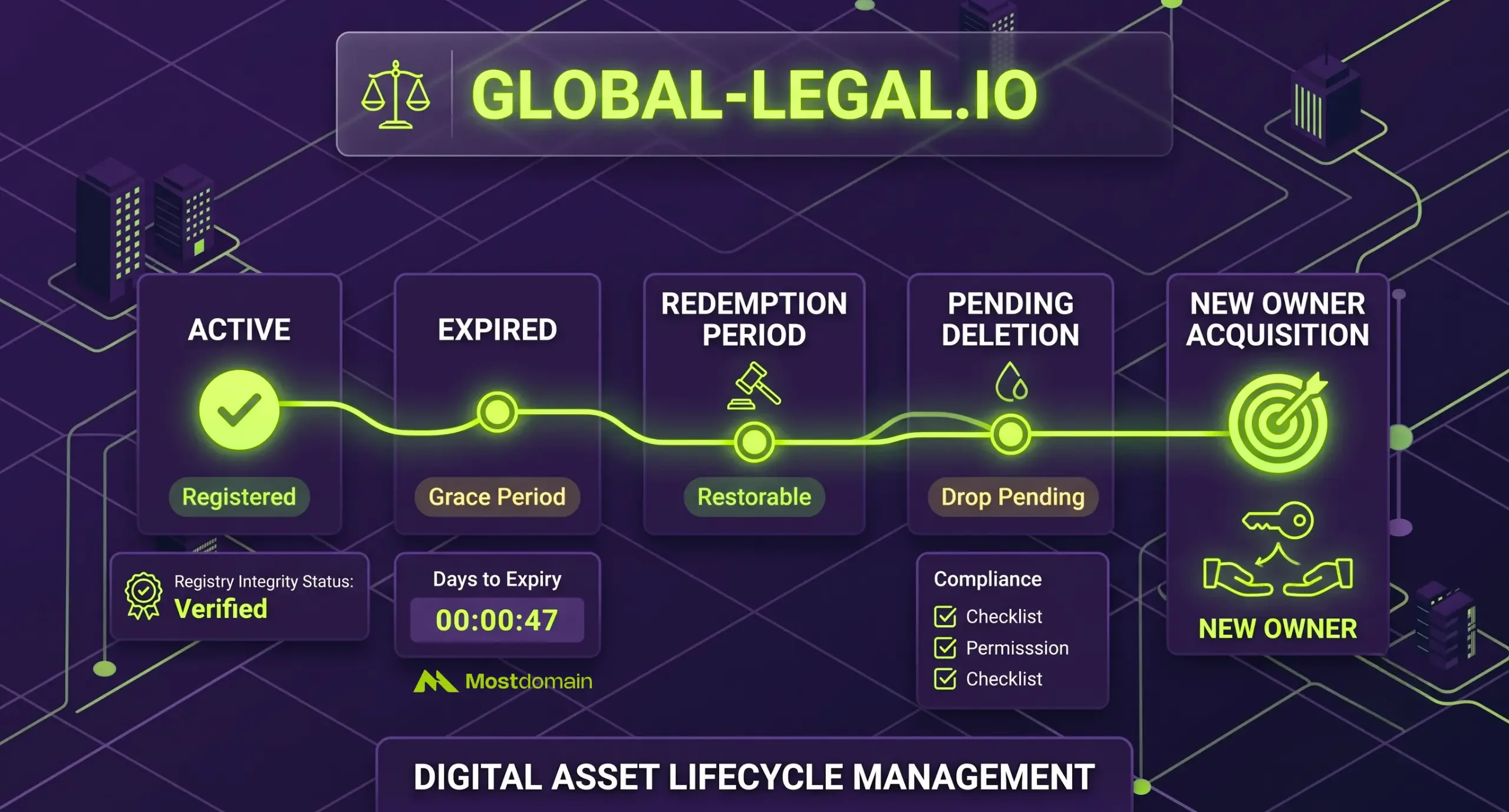
Once a domain clears its grace period and redemption window. Then it’s up to 75 days combined under ICANN policy, the original registrant loses all legal claim. The domain enters a deletion queue, then becomes available for public registration. First valid registrant wins. And the subject to trademark law and ICANN dispute mechanisms.
What Happens When a Domain Expires?
You do not own a domain. You just hold a time-limited license, and when it lapses, a strict three-stage process takes over with no exceptions.
- Registrants hold a license to use a specific name for a defined period, granted by an ICANN-accredited registrar, not outright ownership
- When that period ends without renewal, the license lapses immediately
- What follows is a three-stage process with hard deadlines and escalating consequences at each step
- Country code TLDs (.uk, .au, .de) operate under their own registry rules , not ICANN’s , and some have no grace period at all
The Domain Expiry Timeline: Grace Period, Redemption, and Deletion
Every expiry follows the same four-stage sequence , missing any window costs you the domain permanently.
| Stage | Duration | Who Can Act | Cost | What Happens |
| Grace Period | Up to 45 days | Original registrant only | Standard renewal price | Domain may park or stop resolving; no penalties to renew |
| Redemption Period | 30 days | Original registrant only | Standard price + $50–$250 fee | Domain fully locked; DNS frozen; formal restore request required |
| Pending Delete | ~5 days | Nobody | N/A | Domain sits in deletion queue; no action possible |
| Available | , | Anyone | Standard registration price | Domain released; first registrant acquires control |
Key facts to know:
- Grace period: Registrars may shorten this below the 45-day ICANN maximum , check your registrar’s policy before assuming you have the full window
- Redemption period: ICANN sets no cap on redemption fees; the high cost is intentional and designed to discourage accidental lapses
- Pending delete: When a domain drops, it drops fast , high-value domains are captured within seconds
- ccTLDs: Check each registry individually; some offer zero grace period
Who Legally Owns an Expired Domain?
Nobody owns an expired domain during the deletion window , and after release, the first valid registrant takes control, not the last owner.
| Scenario | Legal Status |
| Domain within grace or redemption period | Original registrant retains rights and can recover the domain |
| Domain in pending delete | No one holds rights; registration and transfer are blocked |
| Domain released after pending delete | First valid registrant acquires control , subject to trademark law |
| Domain incorporates a third-party trademark | New registrant faces UDRP or court challenge regardless of acquisition method |
| UDRP complaint succeeds | Domain transferred away from registrant, even after a legitimate purchase |
The critical distinction:

- Registration gives you control , it does not give you immunity from trademark claims
- A domain expiring does not extinguish any trademark attached to that name
- WIPO adjudicates UDRP complaints; a successful complainant can have your domain transferred away even if you registered it through clean, standard channels
How Expired Domains Enter the Market
Three mechanisms move expired domains into new hands , and each carries a fundamentally different risk profile for the buyer.
| Acquisition Method | How It Works | Risk Level | Best For |
| Drop-catching | Automated services register domains the moment they clear the pending delete queue | High , no pre-screening | Experienced speculators |
| Expired domain auctions | Auctions run through registrars (GoDaddy, Namecheap); bidding often starts before the domain drops | Medium , buyer performs own checks | Buyers comfortable with self-analysis |
| Curated marketplaces (Mostdomain) | Pre-acquired domains listed with verified SEO metrics, spam review, and penalty screening | Lower , baseline vetting already completed | SEO professionals who need reliable, analyzable assets |
What Mostdomain verifies before listing:
- Domain Authority (DA) and Domain Rating (DR)
- Trust Flow and Citation Flow
- Total backlinks and referring domain count
- Spam score and penalty risk signals
- Suspicious ownership patterns or traffic anomalies
Buying Expired Domains Legally Through Mostdomain
Mostdomain compresses the research and risk assessment into a single verified listing , so you spend time deciding, not digging.




| Feature | Detail |
| Inventory size | 4,000+ premium aged and expired domains |
| Transfer speed | Within 24 hours of purchase |
| Metrics provided | DA, DR, Trust Flow, Citation Flow, spam score, backlinks, referring domains, organic traffic, keyword footprint, health score |
| Pre-listing review | Spam history, penalty risks, suspicious patterns |
| Time to meaningful SEO results | 1–3 months (vs. 12–24+ months for new registrations) |
| Support | 24/7 live chat |
The SEO case for aged domains is clear. The legal case needs to be handled separately , Mostdomain’s verification compresses the risk surface, but it does not replace your trademark and UDRP checks.
What Legal Due Diligence Looks Like Before You Buy
Before you buy any expired domain, five checks stand between you and a costly mistake , skip any one of them at your own risk.
| Check | Tool | What You’re Looking For |
| Trademark clearance | USPTO database, WIPO Global Brand Database | Active trademarks matching the domain name or any descriptive component |
| UDRP history | WIPO UDRP decisions database | Prior disputes , even ones the original registrant won signal that a claim was once asserted |
| Spam and penalty history | Moz Spam Score, Google Search Console | Manual actions, link scheme history, thin affiliate content, black-hat SEO signals |
| WHOIS history | WHOIS history tools | Multiple ownership changes in short periods; registration gaps indicating serial abandonment |
| Content history | Wayback Machine | Adult content, pharmaceutical spam, doorway pages, or niche mismatches that break topical continuity |
The hard rule: Due diligence is not optional. A domain with strong backlinks and a clean spam score can still carry trademark exposure that wipes out your investment in a single UDRP proceeding.
Acquire Expired Domains with Confidence
The legal framework is settled , apply it before you buy, not after.
- The original registrant’s rights end when the deletion cycle completes , not before
- First registration after release grants control, not immunity from trademark claims
- Trademark law operates independently of domain registration status
- Mostdomain verifies SEO metrics and screens for spam before listing , the trademark check and UDRP history review remain your responsibility
- Do both. Then buy with clarity.
FAQ
Does the original owner have any legal claim after the expiry cycle ends?
Registration rights end when the domain is released. Not the trademark rights. But a trademark holder can still file a UDRP complaint. Or even pursue court action against the new registrant.
What is the UDRP, and how does it affect expired domain buyers?
UDRP is ICANN’s dispute mechanism that lets trademark holders challenge domain registrations. WIPO adjudicates cases. If the complainant wins, the domain is transferred or cancelled , even if you acquired it legitimately. Always check WIPO’s UDRP decisions database before buying.
How long does the full expiry process take?
For most gTLDs (.com, .net, .org), the full cycle is approximately 80 days. It consist of up to 45 days grace period, 30 days redemption, and 5 days pending delete. Country code TLDs vary , some have no grace period at all.
Is buying through Mostdomain safer than drop-catching?
Yes, for most SEO professionals. Mostdomain reviews spam history, penalty signals, and authority metrics before listing. Drop-catching gives you no pre-screening , you perform every check yourself, often under time pressure. The trade-off is speed for a vetted baseline.
What happens to a domain’s SEO authority after re-registration?
Backlink equity and historical indexation can persist after re-registration. But they are not automatic. You need to rebuild relevant content to signal topical continuity. A domain that was parked or inactive before expiry carries weaker signals than one that was actively maintained. Review Trust Flow, Citation Flow, DR, and spam score on each Mostdomain listing to assess the actual inherited profile.
References
- ICANN – About Renewing an Expired Domain
- ICANN – Expired Domain Deletion Policy
- WIPO – WIPO Overview of Panel Views on Selected UDRP Questions
- Cloudflare – What Is a Domain Name?
- Google Search Central – Site Move with URL Changes