
Semrush vs Ahrefs vs Moz rarely comes down to one platform beating the other two outright. Semrush earns its subscription fee when a team wants SEO, content, and paid search sitting under one login. Meanwhile Ahrefs is what link builders reach for first. Mostly because the backlink numbers hold up under scrutiny. Moz? Solid fundamentals, no enterprise price tag, none of the two-week onboarding headache the other two demand.
Here’s the quieter cost nobody mentions in the sales pages. Pick wrong and it isn’t just a wasted subscription. Months go by. Reports get built, tags get created, habits form around whichever dashboard someone opened first. And then a client asks for a number that simply doesn’t live there. So this isn’t another feature checklist. It’s where each tool actually pulls ahead, where the marketing claims fall apart once you poke at them, and what switching genuinely costs once the original choice turns out wrong.
Semrush vs Ahrefs vs Moz: In Thirty Seconds
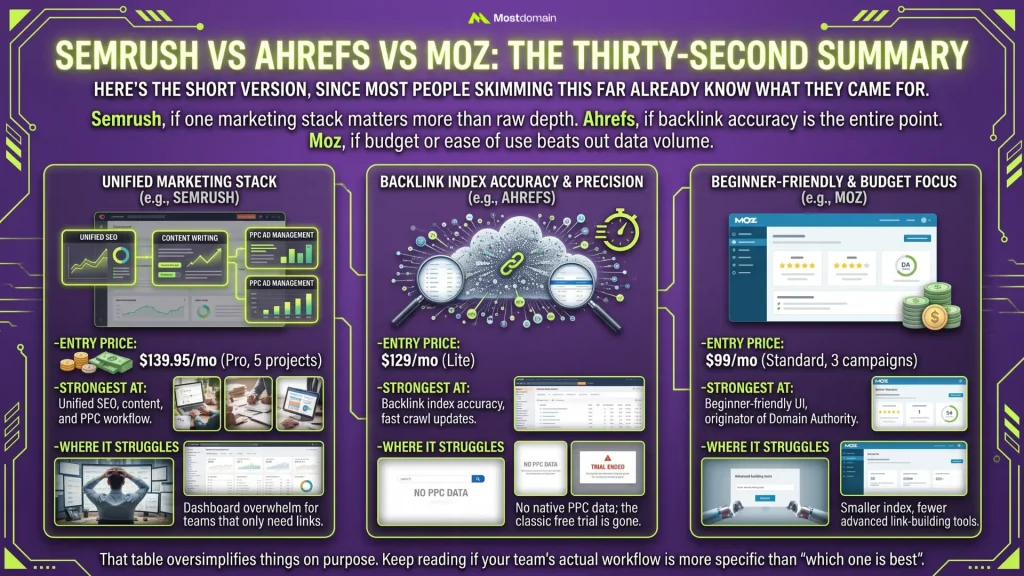
Here’s the short version, since most people skimming this far already know what they came for. Semrush, if one marketing stack matters more than raw depth. Ahrefs, if backlink accuracy is the entire point. Moz, if budget or ease of use beats out data volume.
| Platform | Entry Price | Strongest At | Where It Struggles |
| Semrush | $139.95/mo (Pro, 5 projects) | Unified SEO, content, and PPC workflow | Dashboard overwhelm for teams that only need links |
| Ahrefs | $129/mo (Lite) | Backlink index accuracy, fast crawl updates | No native PPC data; the classic free trial is gone |
| Moz | $99/mo (Standard, 3 campaigns) | Beginner-friendly UI, originator of Domain Authority | Smaller index, fewer advanced link-building tools |
That table oversimplifies things on purpose. Keep reading if your team’s actual workflow is more specific than “which one is best.”
What Each Platform Actually Optimizes For
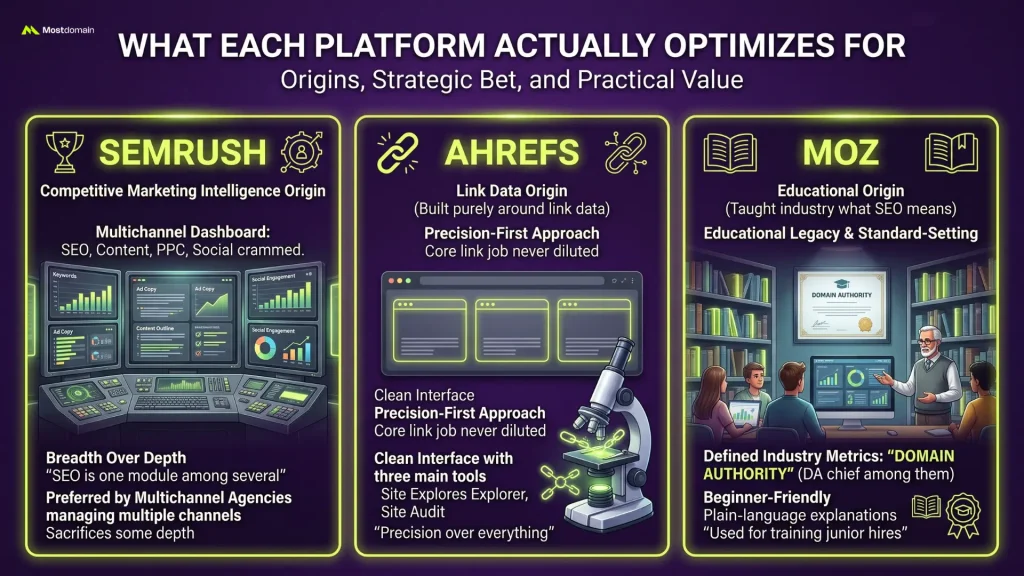
Semrush came out of competitive marketing intelligence, not classic SEO. Ahrefs took the opposite route: built purely around link data from day one, rarely straying from it since. Moz is the odd one here. It still carries the identity of the tool that taught half the industry what SEO even means in the first place. Each company’s roadmap since then basically traces back to that starting point.
Semrush’s All-In-One Bet
Inside Semrush, SEO is one module among several, not the main event. Content planning sits next to PPC research sits next to social tracking, all crammed into the same dashboard. Depth suffers a little for it. Agencies running five channels at once rarely mind that tradeoff; a solo SEO consultant usually does.

Ahrefs’ Precision-First Approach
Reputation-wise, Ahrefs earned its stripes as the most accurate backlink crawler on the internet, and everything since (keyword tools, content research) got bolted on without diluting that core job. Three tools carry the whole interface: Site Explorer, Keywords Explorer, Site Audit. You won’t dig through six layers of navigation looking for a report that should’ve been one click away.
Moz’s Educational Legacy
Several metrics the whole industry now treats as standard trace back to Moz, Domain Authority chief among them, usually the first scoring system any SEO beginner learns. Plain-language explanations ship with nearly every feature. That’s exactly why some agencies keep a lone Moz seat around for training junior hires, long after the “real” work moved to Ahrefs or Semrush.
Backlink Data, How Fresh and How Accurate
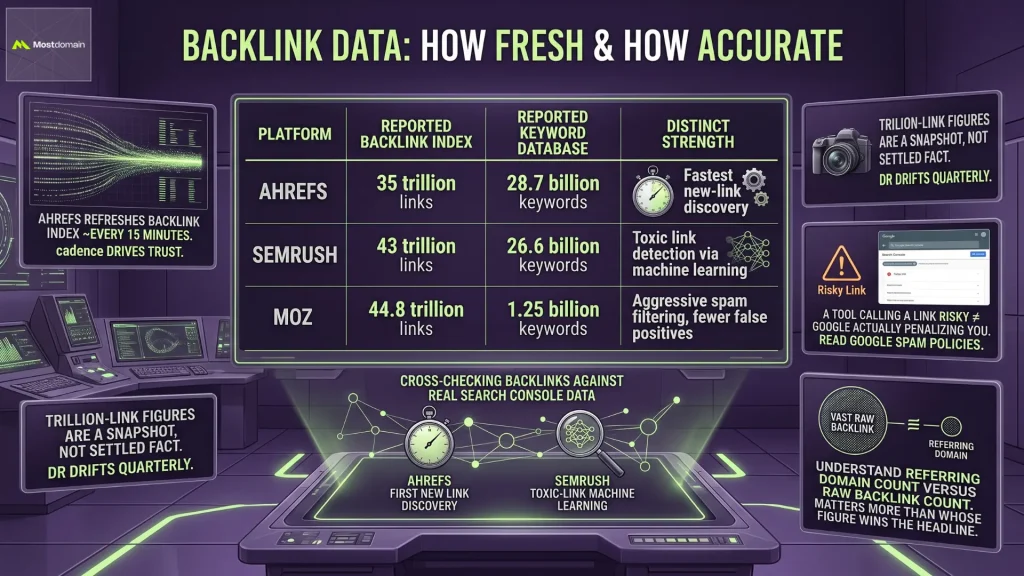
Every 15 minutes or so, Ahrefs refreshes its backlink index, and that update cadence is a big reason working SEOs default to trusting its raw accuracy. Semrush and Moz aren’t nearly as far behind as their headline numbers make it look, not once you factor in what each platform is actually counting.




| Platform | Reported Backlink Index | Reported Keyword Database | Distinct Strength |
| Ahrefs | 35 trillion links | 28.7 billion keywords | Fastest new-link discovery |
| Semrush | 43 trillion links | 26.6 billion keywords | Toxic link detection via machine learning |
| Moz | 44.8 trillion links | 1.25 billion keywords | Aggressive spam filtering, fewer false positives |
Comparison articles throw those trillion-link figures around like settled fact. Treat them as a snapshot instead. Each vendor recrawls on its own internal schedule, so the numbers drift every quarter no matter who’s “winning” this month. What actually holds up over time is the relative pattern, not the raw digit: testers who cross-check flagged backlinks against real Search Console data keep finding that Ahrefs surfaces new links first, while Semrush’s toxic-link scoring flags borderline cases the other two just leave unclassified. None of that replaces reading Google’s own spam policies before deciding a link is worth disavowing. A tool calling a link risky, and Google actually penalizing you for it, are two very different things.
What a referring domain count actually measures, versus a raw backlink count, matters more here than whose trillion-figure wins the headline. It’s worth understanding on its own terms.
Keyword Research Depth
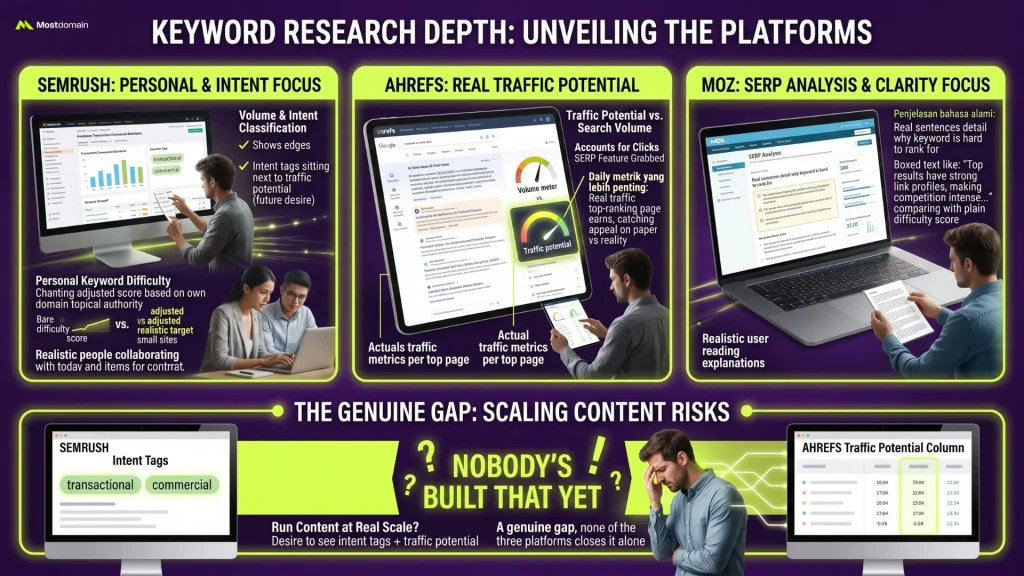
Volume and intent classification, Semrush edges ahead on both. Day to day, though, Ahrefs’ traffic potential metric tends to matter more, since it accounts for clicks a SERP feature already grabbed before any user reaches the organic result.
- Semrush’s Personal Keyword Difficulty adjusts scores based on your own domain’s topical authority instead of a flat industry average, which produces more realistic targets for smaller sites.
- Ahrefs’ traffic potential shows the actual traffic the top-ranking page earns, not just estimated search volume, catching cases where a keyword looks appealing on paper but delivers almost nothing once AI Overviews or featured snippets eat the clicks.
- Plain-language explanations are where Moz’s SERP analysis actually earns its keep: real sentences on why a keyword is hard to rank for, instead of a bare difficulty score and nothing else.
Run content at real scale and you’ll eventually want Semrush’s intent tags sitting right next to Ahrefs’ traffic potential column. Nobody’s built that yet. It’s a genuine gap, and none of the three platforms closes it alone.
AI Overview and AI Visibility Tracking
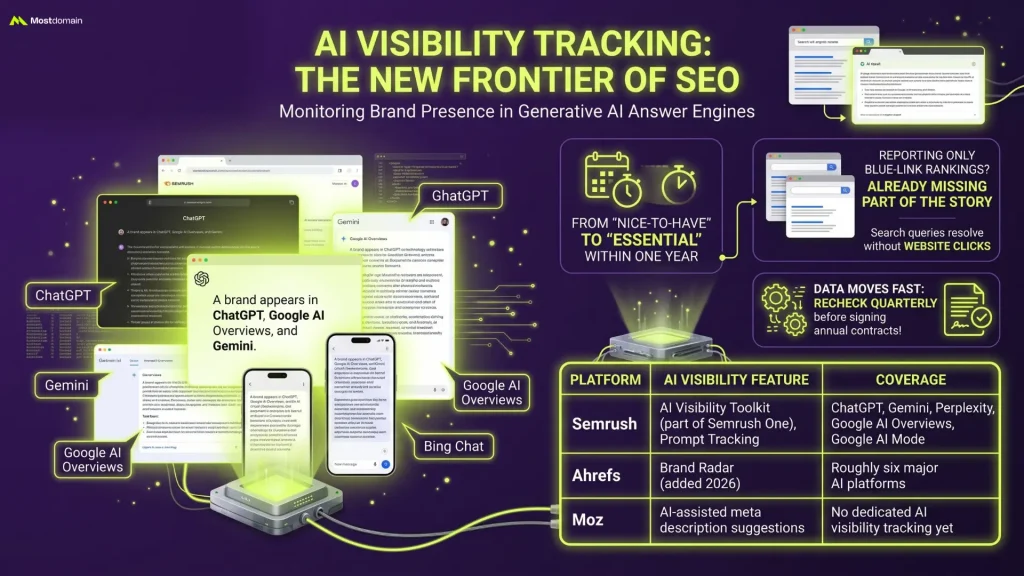
Tracking how often a brand shows up inside ChatGPT, Google AI Overviews, and other AI answer engines, that’s Semrush’s game to lose right now. Moz, by comparison, has barely started building toward this at all.
| Platform | AI Visibility Feature | Coverage |
| Semrush | AI Visibility Toolkit (part of Semrush One), Prompt Tracking | ChatGPT, Gemini, Perplexity, Google AI Overviews, Google AI Mode |
| Ahrefs | Brand Radar (added 2026) | Roughly six major AI platforms |
| Moz | AI-assisted meta description suggestions | No dedicated AI visibility tracking yet |
More and more search queries resolve without a single click landing on any website at all. That’s the whole reason this category stopped being a nice-to-have sometime in the past year. Reporting that still only covers blue-link rankings is already missing part of the story, the part a client eventually asks about. Out of everything covered here, this section moves fastest. Whatever’s accurate this quarter deserves a recheck before anyone signs an annual contract on the strength of it.
The Sticker Platform Price
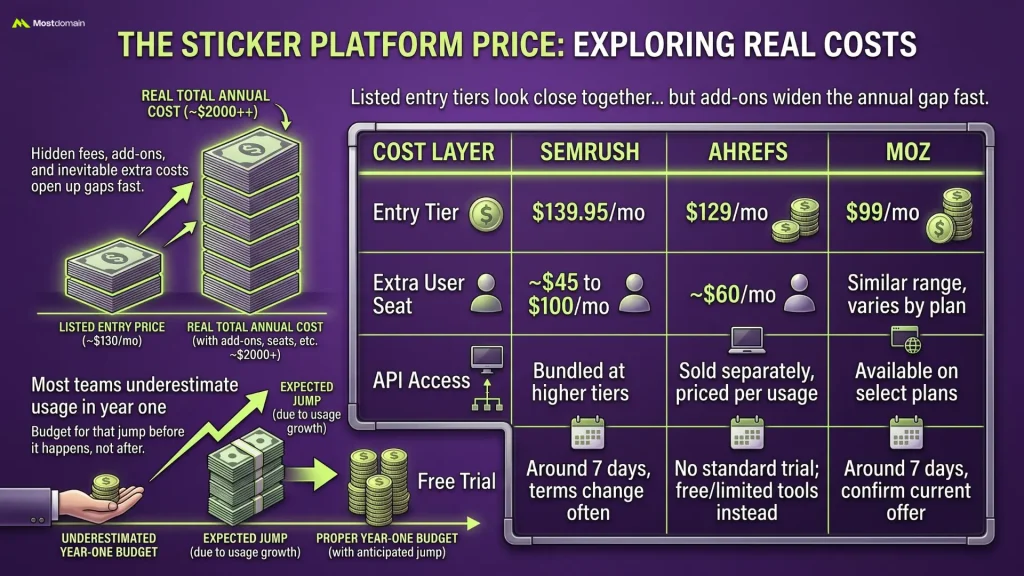
On paper, entry tiers look close together: $139.95 for Semrush, $129 for Ahrefs, $99 for Moz. Add extra seats, API access, and the inevitable add-ons, and the real annual gap opens up fast.
| Cost Layer | Semrush | Ahrefs | Moz |
| Entry tier | $139.95/mo | $129/mo | $99/mo |
| Extra user seat | ~$45 to $100/mo | ~$60/mo | Similar range, varies by plan |
| API access | Bundled at higher tiers | Sold separately, priced per usage | Available on select plans |
| Free trial | Around 7 days, terms change often | No standard trial; free/limited tools instead | Around 7 days, confirm current offer |
Most teams underestimate usage in year one and end up paying for the tier above the one they signed up for. Budget for that jump before it happens, not after.
What You Lose When You Switch
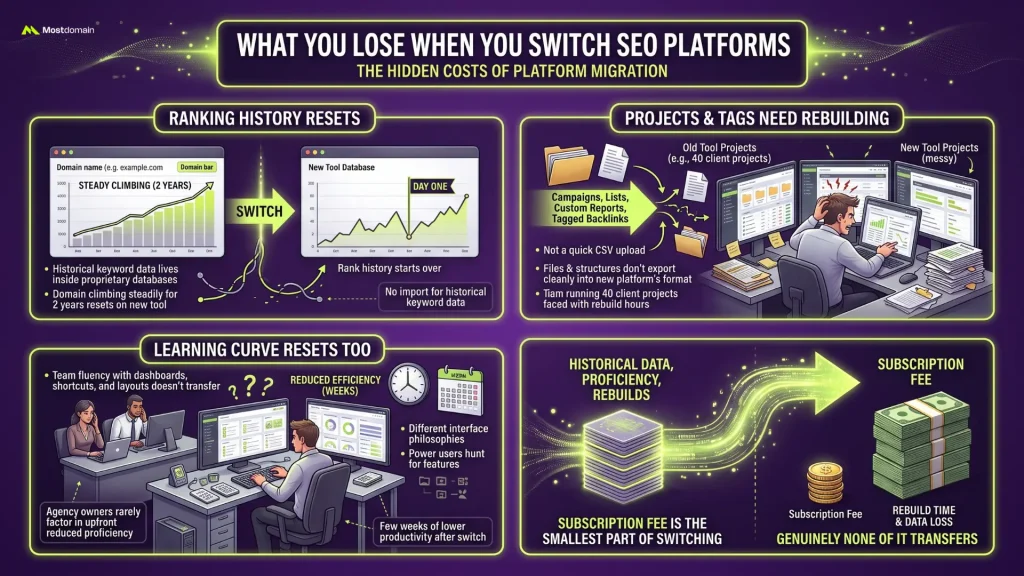
A new subscription fee is the smallest part of switching SEO platforms. Historical rank-tracking data, saved projects, tagged backlink lists, none of it transfers between Semrush, Ahrefs, and Moz. Genuinely none of it.
Rank History Doesn’t Travel With You
Keyword positions live inside each platform’s own proprietary database. Switch from Ahrefs to Semrush and the ranking history resets to day one, even for a domain that’s been climbing steadily for two straight years under the old tool. There’s no import feature for this. You start over.
Projects and Tags Need Manual Rebuilding
Campaigns, tagged competitor lists, and custom report templates live inside each tool’s own structure and don’t export cleanly into a different platform’s format. A team managing forty client projects in Semrush is looking at real rebuild hours, not a quick CSV upload, if it decides Ahrefs fits better going forward.
The Learning Curve Resets Too
Team fluency with keyboard shortcuts, dashboard layout, and where a specific report lives doesn’t transfer either. Ahrefs’ interface philosophy is genuinely different from Semrush’s, and Moz’s simplicity means power users sometimes hunt for features that would’ve been one click away elsewhere. Budget a few weeks of reduced efficiency after any switch, agency owners rarely factor this into the decision upfront.
Which One Matches How Your Team Actually Works
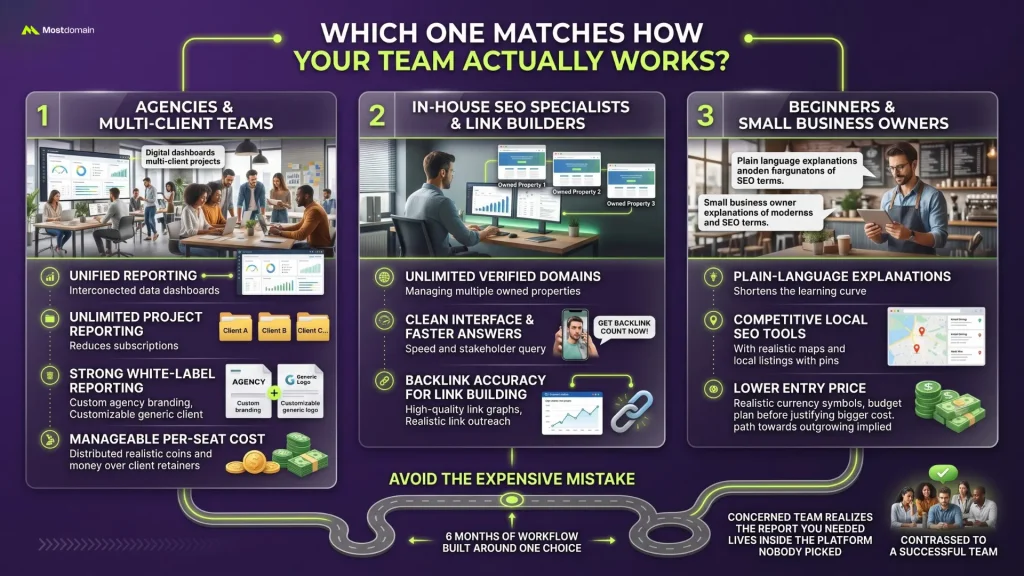
Five-plus clients under one roof, and agencies tend to land on Semrush purely for the unified reporting. Solo specialists and link builders lean Ahrefs instead. Smaller teams and total beginners? Moz usually gets more mileage out of them, at least until they outgrow it.
Agencies and Multi-Client Teams
- Unlimited project reporting on higher Semrush tiers reduces the need for separate tool subscriptions per client
- White-label reporting is stronger on Semrush than either competitor
- Per-seat cost becomes manageable once distributed across several client retainers
In-House SEO Specialists and Link Builders
- Ahrefs’ unlimited verified domains suit anyone managing several owned properties at once
- The clean interface means faster answers when a stakeholder needs a number right now
- Backlink accuracy justifies the premium when link building is the core deliverable
Beginners and Small Business Owners
- Moz’s plain-language explanations shorten the learning curve for someone new to SEO entirely
- Local SEO tools inside Moz genuinely compete with anything Ahrefs or Semrush offers in that specific niche
- Lower entry price keeps the tool viable before a business has the budget to justify Semrush or Ahrefs
None of these three is a wrong answer by itself. The expensive mistake happens later: six months of workflow built around one choice, then the slow realization that the report your team needs every single week lives inside the platform nobody picked.
FAQ
Can I use more than one of these tools at the same time?
Running Ahrefs for link building and Semrush for content and PPC side by side is common enough among agencies past a certain size. Call it redundancy insurance rather than wasted spend. It isn’t cheap, granted, but the combined subscription cost usually comes in smaller than what one blind spot in either tool would cost instead.
Which tool has the most accurate backlink data?
Ahrefs generally wins independent accuracy tests against verified Search Console data, largely because of its 15-minute crawl refresh cycle. Semrush and Moz both catch backlinks Ahrefs misses too, so “most accurate” depends partly on which specific links matter to your case.
Is Moz still relevant in 2026?
Yes, especially for local SEO, and for any team that values plain-language education over raw data volume. Depth is where Moz falls short: advanced link-building work and large-scale technical audits both stretch it thin. Best used as a starting point or a supplementary seat, not the sole platform behind serious agency work.
Do Semrush, Ahrefs, and Moz still offer free trials?
Trial terms shift often enough that any fixed number printed here would go stale within months. Semrush and Moz, as of this writing, typically run short trials around a week long. Ahrefs moved away from that model entirely, offering free but limited-feature tools instead. Check each vendor’s current pricing page before signing up regardless of what’s written here.
Which platform is best for local SEO specifically?
Citation management and local pack tracking, that’s where Moz Local still beats the other two, built specifically for that niche in a way neither Semrush nor Ahrefs prioritizes as heavily. Agencies with a real local SEO client base often keep exactly one Moz seat around for this reason alone, even when Ahrefs or Semrush handles everything else on the account.
What happens to my saved data if I cancel my subscription?
Access to dashboards, saved projects, and historical rank data typically disappears the moment a subscription lapses, not after a grace period. Export anything you might need (backlink lists, keyword rankings, audit reports) before canceling, since none of the three platforms guarantees post-cancellation access to your account history.
References
- Google Search Central, “Spam Policies for Google Web Search”
- Semrush.com, “Semrush Competitors: Compare Semrush vs. Ahrefs, Moz, & More”
- WebbyTemplate, “Semrush vs Ahrefs vs Moz vs Ubersuggest 2026”
- The Blueprint Training, “Ahrefs vs Semrush vs Moz: Which SEO Tool Is Best for Agencies in 2026?”
- StyleFactory Productions, “Ahrefs vs Moz vs Semrush (2026), Which is Best for SEO and AI Visibility Tracking?”