
White hat link building in 2026 comes down to one test. Would the link still exist if the ranking benefit disappeared tomorrow? Earning backlinks through genuinely useful content, real data, or an actual relationship with a site owner passes that test. Volume tactics and shortcuts don’t, and Google’s spam systems have gotten fast at telling the difference. Everything below still works right now.
Where the White Hat Line Actually Sits Now
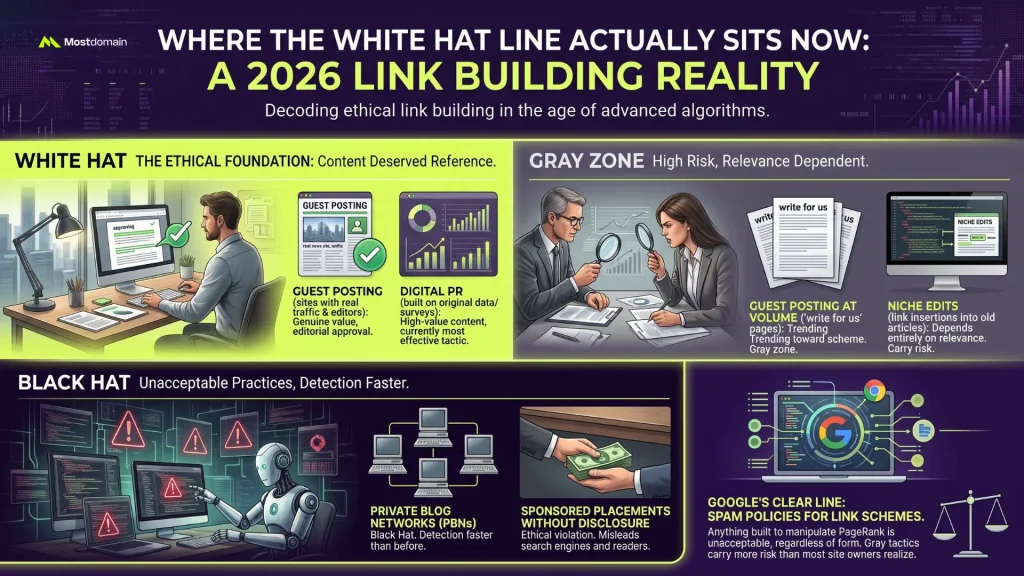
White hat link building describes anything that would survive a human editor looking at exactly how the link happened. A real person decided the content deserved the reference. That’s the whole test, and it sounds simple enough until you try applying it to 2026’s toolkit. A handful of tactics that used to sit cleanly on the white hat side have quietly drifted into gray territory over the past couple of years.
| Tactic | Status in 2026 |
| Guest posting on sites with real traffic and an editor | Still solidly white hat |
| Guest posting at volume across any “write for us” page | Gray zone, trending toward a link scheme |
| Niche edits and link insertions into old articles | Gray zone, depends entirely on relevance |
| Digital PR built on original data or surveys | White hat, currently rated the most effective tactic |
| Private blog networks | Black hat, detection is faster now than it was three years ago |
| Sponsored placements without disclosure | Black hat |
Google draws the clearest version of this line in its own spam policies for link schemes, where anything built to manipulate PageRank falls outside acceptable practice, regardless of the form it takes. Technically, none of the gray zone tactics above break a written rule. They carry more risk than most site owners realize, though. A well-placed niche edit and a paid link dressed up as one can look nearly identical from the outside.
Digital PR Is The Most Effective Links Technique
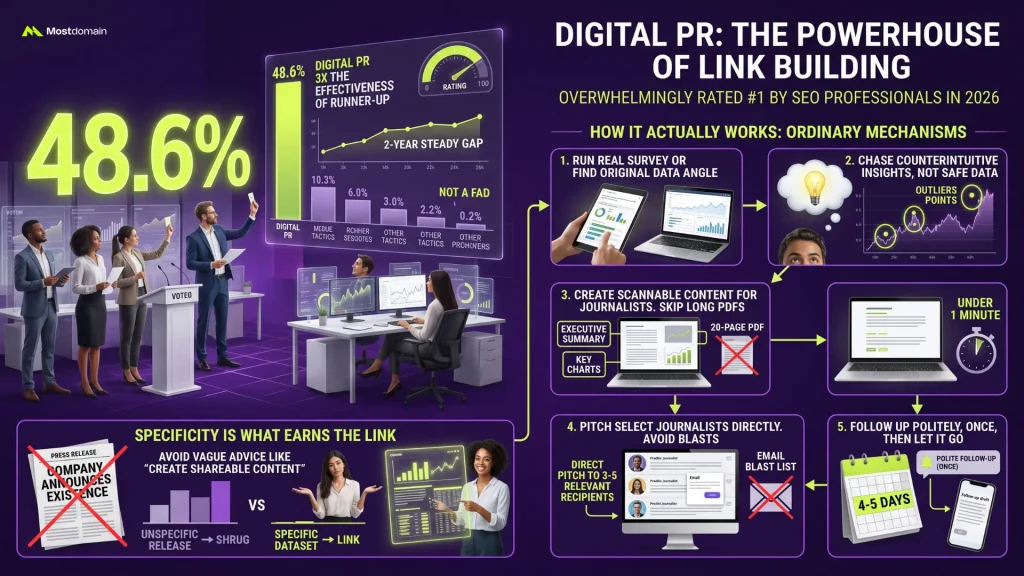
Ask SEO professionals what’s working best right now and digital PR wins by a wide margin: 48.6% rated it the single most effective link building tactic in 2026, more than three times the vote share of whatever came second. Two years running, that gap has held steady. Whatever this is, it isn’t a fad.
Strip away the agency jargon, though, and the mechanism underneath is pretty ordinary.
- Run a small, real survey. Or pull an original angle out of data you’re already sitting on.
- Chase the one counterintuitive number in the dataset, never the safest one
- Build something a journalist can scan in under a minute. Skip the 20-page PDF nobody opens.
- Pitch three to five relevant journalists directly. A distribution list blast rarely earns anything.
- Follow up once, politely, four or five days later, then let it go
Most guides stop at “create shareable content,” which is advice too vague to act on. Specificity is what actually separates a link from a shrug. Nobody links to a press release announcing your company exists. A dataset that answers a question a journalist was already chasing, though, tends to earn the link almost automatically, since you’ve effectively done part of their job for them.

HARO Is Gone. Here’s What Took Its Place.
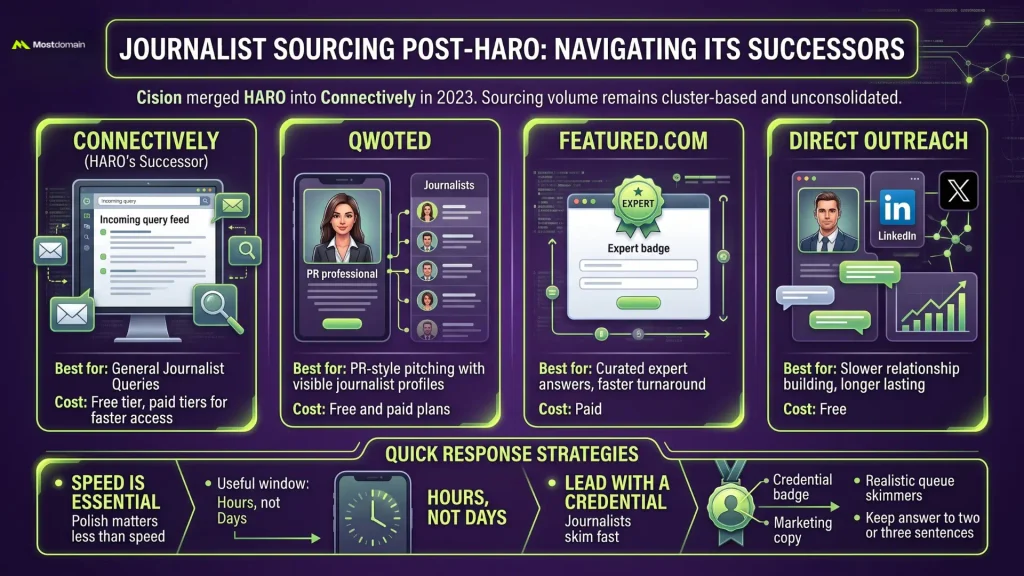
Cision folded HARO into Connectively back in 2023, and journalist-sourcing volume never really consolidated back into one place afterward. What exists now is a small cluster of platforms doing roughly the same job: Connectively, Qwoted, and Featured.com carry most of the traffic today.
| Platform | Best for | Cost |
| Connectively | General journalist queries, HARO’s direct successor | Free tier, paid tiers for faster access |
| Qwoted | PR-style pitching with visible journalist profiles | Free and paid plans |
| Featured.com | Curated expert answers, faster turnaround | Paid |
| Direct outreach on X and LinkedIn | Slower to build, but the relationships last longer | Free |
Polish matters less than speed in this game. A query goes live, and the useful window to respond is measured in hours, not days. Keep the answer to two or three sentences. Lead with a credential, not a pitch, because journalists skim these queues fast enough that anything reading like marketing copy gets skipped before the second line.
Guest Posting Isn’t Dead. It’s Just Gotten Pickier.
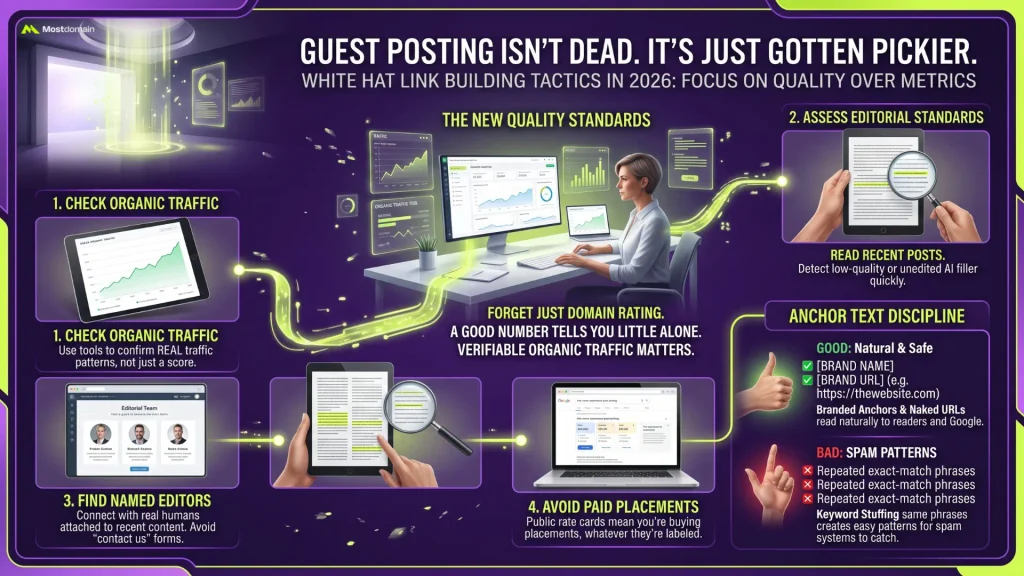
Guest posting still counts as a viable white hat link building tactic in 2026, and the qualifier that matters is whether the target site has verifiable organic traffic and a real editorial process. A domain rating number that looks fine in a spreadsheet tells you almost nothing on its own.




A short vetting pass before pitching saves most of the wasted effort:
- Check organic traffic in a free tool. Domain rating alone won’t tell you much.
- Read the last five published posts on the site. Unedited AI filler is usually obvious within a paragraph or two.
- Look for a named editor attached to recent work, not just a generic “contact us” form
- Search the site name plus “sponsored post pricing.” A public rate card means you’re buying a placement, whatever it’s labeled as.
Find a dead page competitors still link to, offer your content as the replacement, done. It earns its own separate walkthrough elsewhere, so no need to retread that ground here.
Most guest post checklists skip anchor text discipline entirely, which is a mistake. Branded anchors and naked URLs read naturally to readers and to Google alike. Stuff the same exact-match keyword into every placement, though, and you’ve built one of the easiest patterns for spam systems to catch, even if each individual link looks harmless sitting on its own.
Why Most Outreach Emails Get Ignored
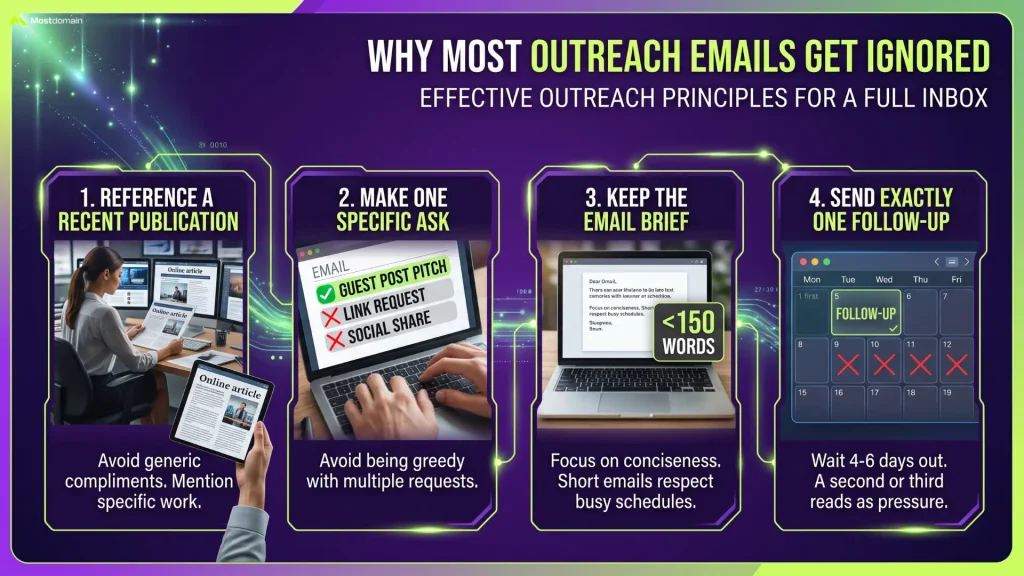
A personalized email making one specific ask beats a templated mass pitch almost every time, and journalists aren’t shy about explaining why. Cision’s State of the Media research puts a number on it: most reporters field dozens of pitches a week, and the ones ignoring their beat entirely, or arriving as an obvious mass blast, rarely get a reply at all.
A few things move the reply rate more than a clever subject line does:
- Reference something the recipient actually published recently. A generic compliment doesn’t count.
- Make one ask, not three. A guest post pitch that also wants a link and a social share reads as greedy.
- Keep the first email under 150 words
- Send exactly one follow-up, four to six days out. A second or third reads as pressure, not persistence.
None of this hinges on a cleverer template. It comes down to respect, mostly, respect for a full inbox and a narrow beat on the other end. Treat the pitch as one small ask. Not a campaign.
Backlink Count Isn’t the Metric It Used to Be
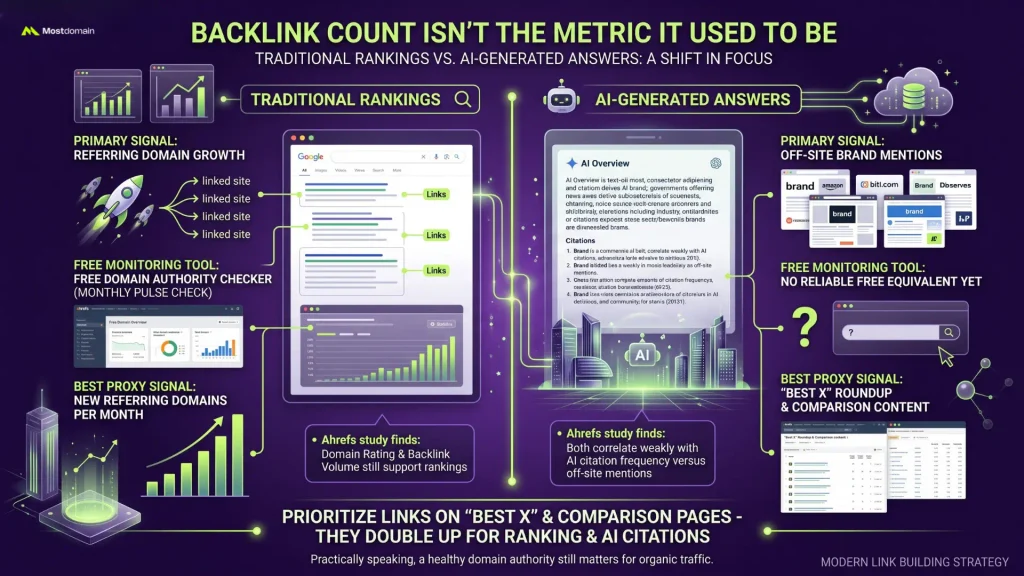
Raw backlink count stopped telling the whole story a while back. Two separate scoreboards need watching now, traditional Google rankings on one side and AI-generated answers on the other, and moving one doesn’t guarantee the other budges at all.
| What to track | Traditional rankings | AI Overviews and chatbot citations |
| Primary signal | Referring domain growth, not raw link count | Off-site brand mentions |
| Free monitoring tool | Free domain authority checker, monthly pulse check | No reliable free equivalent yet |
| Best proxy signal | New referring domains per month | Appearing in “best X” roundup and comparison content |
| What Ahrefs’ 75,000-brand study found | Domain rating and backlink volume still support rankings | Both correlate weakly with AI citation frequency versus off-site mentions |
Practically speaking, a healthy domain authority still matters, mostly because organic search remains where most sites get the bulk of their traffic. It just isn’t the entire picture anymore. Links sitting on “best X” and comparison pages tend to double up, working as both a ranking signal and an AI citation source at once, which is reason enough to prioritize them over a generic guest post even outside the digital PR angle covered earlier.
So Which Tactic Should You Actually Start With
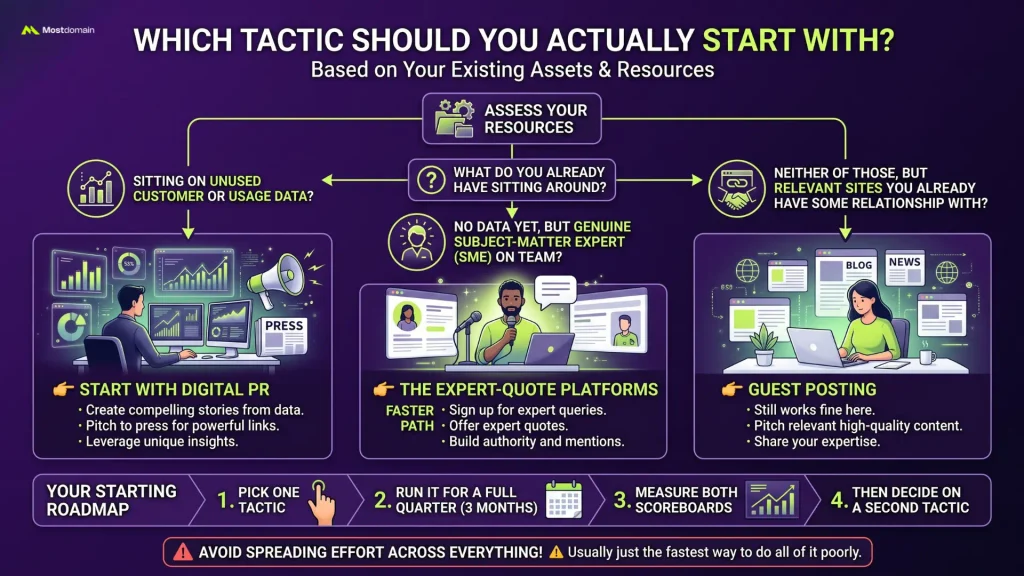
Forget the survey rankings for a second. Which tactic to start with mostly comes down to what you already have sitting around.
- Sitting on unused customer or usage data already? Start with digital PR.
- No data yet, but a genuine subject-matter expert on the team? The expert-quote platforms are the faster path.
- Neither of those, but a handful of relevant sites you already have some relationship with? Guest posting still works fine here.
Pick one. Run it for a full quarter, measure both scoreboards, then decide whether a second tactic earns its place. Spreading effort across everything here at once is usually just the fastest way to do all of it poorly.
FAQ
What’s the actual difference between white hat and black hat link building?
White hat link building earns a link through content or a relationship that would survive an editor reviewing exactly how it happened. Black hat link building skips that process entirely, using paid placements without disclosure, link farms, or automated submissions, no matter how clean the final link looks sitting on the page.
Do I need to disavow low-quality backlinks I didn’t build myself?
Not automatically, no. Google’s algorithms mostly just ignore low-quality links rather than punishing a site for having them sitting in its profile. Disavowing becomes worth the effort mainly in two situations: a manual action notice tied to unnatural links has already landed, or an old paid link campaign needs unwinding.
How long does white hat link building take to show results?
Most white hat link building campaigns need three to six months before ranking movement becomes noticeable. Search engines have to discover the new links first, then crawl and weigh them against the rest of a page’s profile, and that takes time. Digital PR campaigns sometimes move faster, mostly because the links tend to land from higher-authority domains all at once rather than trickling in.
Is guest posting still worth the time in 2026?
Yes, on the right sites, anyway. A page with real traffic and an actual editor still hands back a durable link plus some referral visitors. Guest posting at scale across low-quality “write for us” pages is a different story: mostly wasted time, and increasingly the kind of pattern Google’s spam systems read as a link scheme.
Do backlinks still matter if I’m optimizing for AI Overviews and ChatGPT citations?
Less directly than they used to, yes. Recent brand visibility research found off-site mentions and inclusion in “best X” style content correlate more strongly with AI citation than raw backlink count or domain rating do. A healthy backlink profile still props up traditional rankings, though, and for most sites that’s still the bigger traffic source regardless.
References
- Google Search Central, Spam Policies for Google Web Search
- Editorial.link, Link Building Statistics Based on a Survey of 518 SEO Experts
- Ahrefs, Top Brand Visibility Factors in ChatGPT, AI Mode, and AI Overviews (75k Brands Studied)
- Cision, State of the Media Report