Mostdomain – A domain reseller sells domain names without holding its own ICANN accreditation. It operates through a registrar’s wholesale program instead. Web hosts, agencies, and solo freelancers all run this exact model. This guide explains the meaning, the business model, the real costs, and how a reseller actually differs from a registrar, a broker, and an investor.
What Is a Domain Reseller?
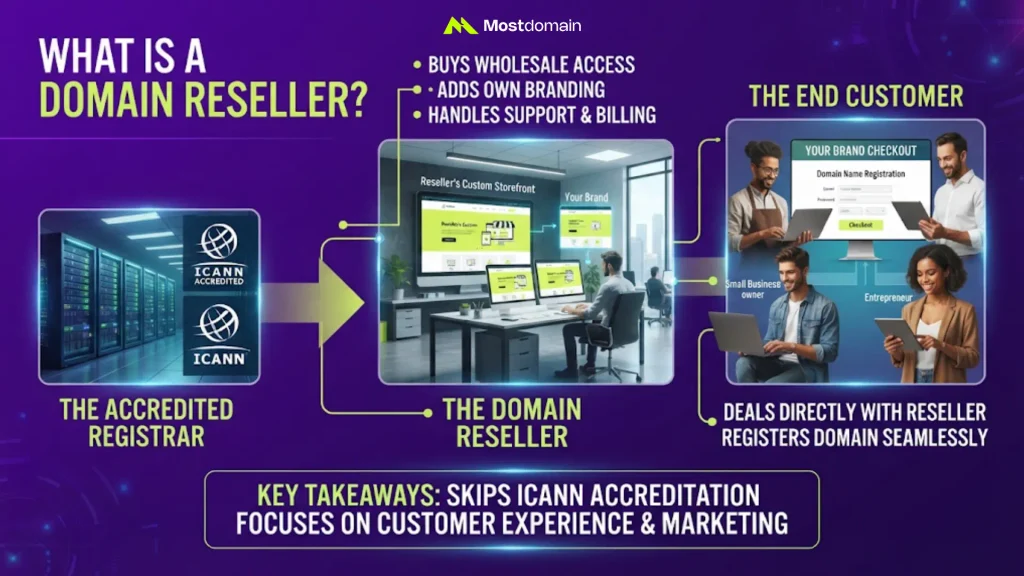
A domain reseller is a business that resells domain registrations under a registrar’s program. It holds no direct ICANN accreditation of its own. Instead, it buys wholesale access and adds its own branding on top.
Think of it like a phone store selling network access it doesn’t own. The reseller just puts its name on the checkout page. Everything behind that page still runs through the real, accredited registrar.
In short, a domain reseller usually:
- Buys wholesale access from an accredited registrar
- Adds its own branding, pricing, and storefront
- Handles customer support and billing directly
- Skips ICANN accreditation entirely
What Does Domain Reseller Meaning Actually Cover?
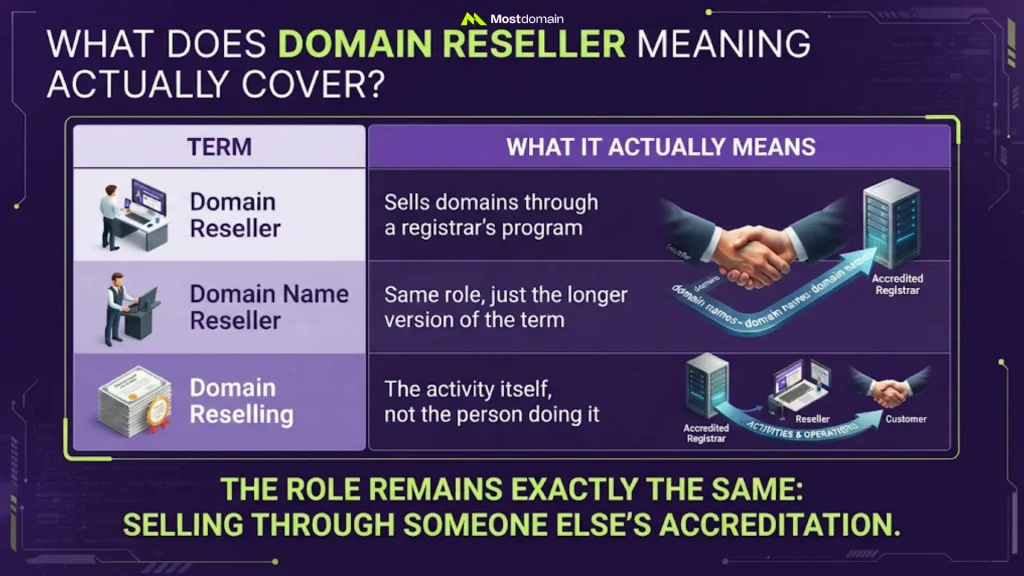
Domain reseller meaning covers one single role, despite a few different names. Domain reseller, domain name reseller, and domain reselling all describe the same business.
Registrars just phrase it differently across their own documentation. Don’t overthink the wording here. The role itself, selling through someone else’s accreditation, stays exactly the same.

| Term | What It Actually Means |
|---|---|
| Domain Reseller | Sells domains through a registrar’s program |
| Domain Name Reseller | Same role, just the longer version of the term |
| Domain Reselling | The activity itself, not the person doing it |
How Does Domain Reselling Work?
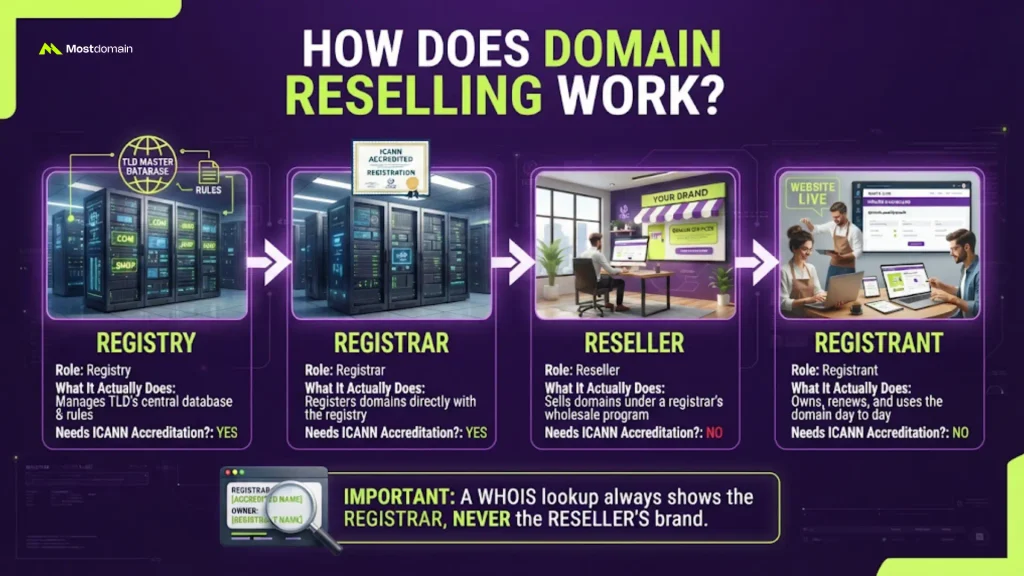
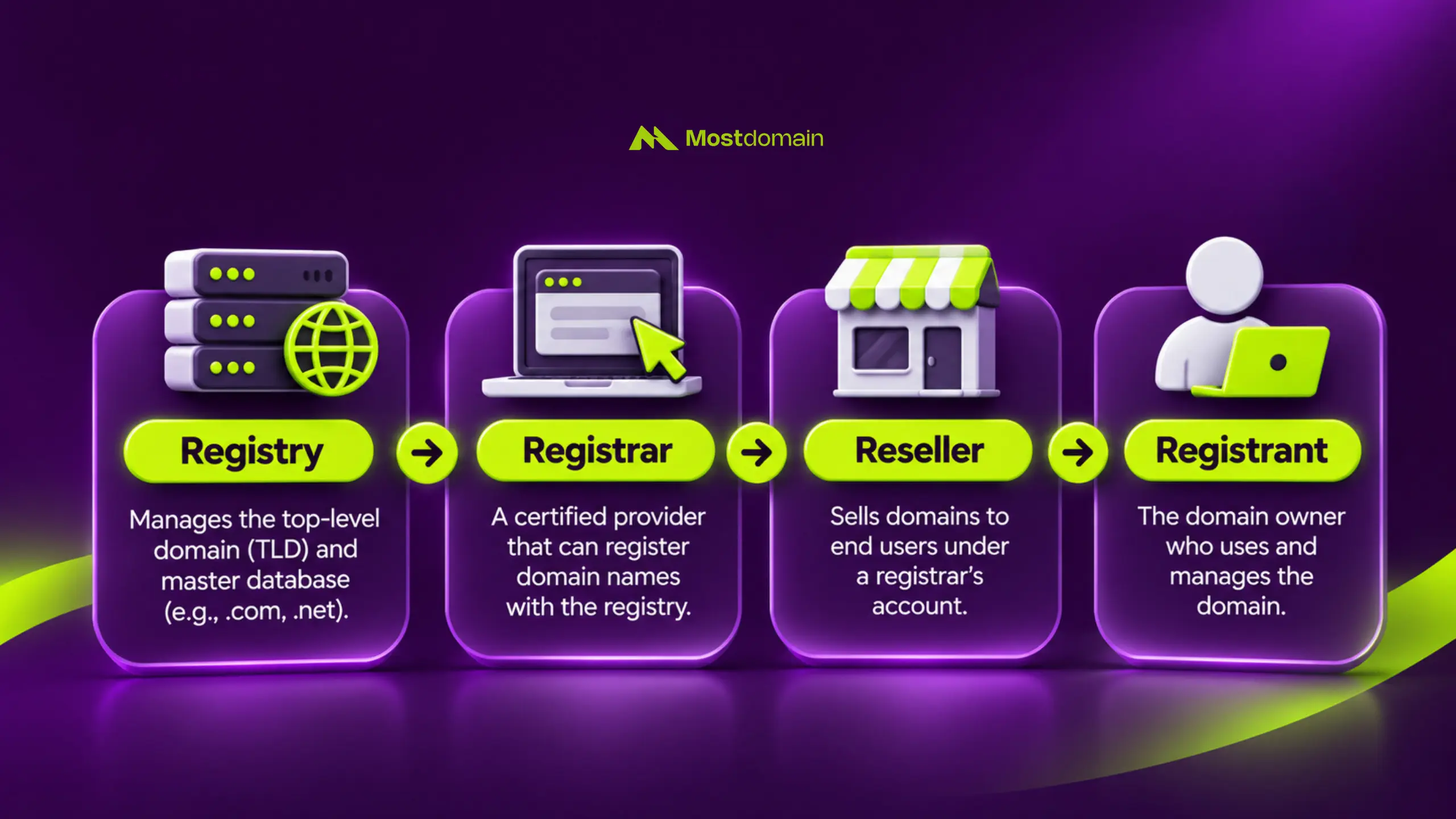
Domain reselling works through a four-party chain. That chain runs from registry, to registrar, to reseller, then registrant.
The registry manages a TLD’s master database, like .com or .shop. The registrar connects directly to that registry. The reseller buys access through the registrar’s program instead of its own.
| Role | What It Actually Does | Needs ICANN Accreditation? |
|---|---|---|
| Registry | Manages the TLD’s central database and rules | Yes |
| Registrar | Registers domains directly with the registry | Yes |
| Reseller | Sells domains under a registrar’s wholesale program | No |
| Registrant | Owns, renews, and uses the domain day to day | No |
One detail trips up most buyers here. A WHOIS or RDAP lookup always shows the registrar, never the reseller’s brand.




What Is the Domain Reseller Business Model?
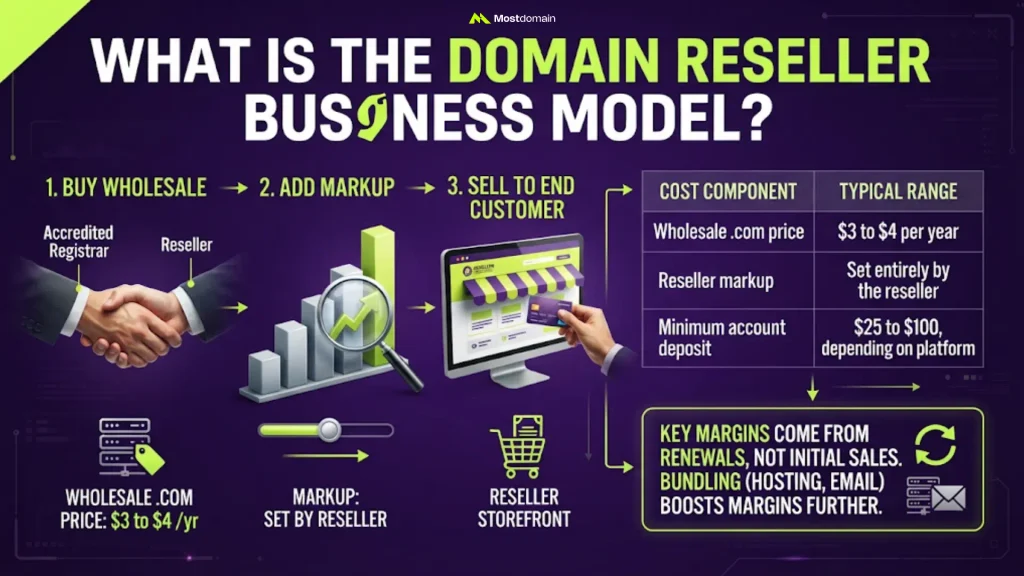
The domain reseller business model runs purely on wholesale pricing plus markup. Resellers buy cheap, then resell at a price they choose themselves.
Margins come mostly from renewals, not the very first sale. Bundling domains with hosting or email usually boosts that margin further.
| Cost Component | Typical Range |
|---|---|
| Wholesale .com price | $3 to $4 per year |
| Reseller markup | Set entirely by the reseller |
| Minimum account deposit | $25 to $100, depending on platform |
What Services Do Domain Reseller Platforms Offer?
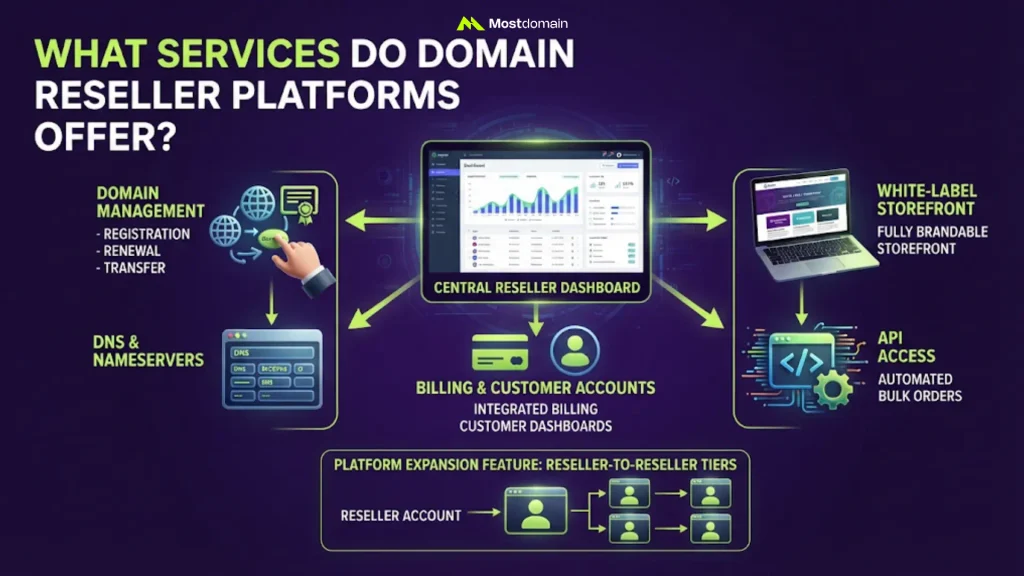
Domain reseller platforms typically bundle registration, renewal, transfer, and DNS management together. Most also include a white-label storefront by default.
A domain reseller account gives one dashboard for every customer domain. Some platforms even let resellers sell reseller accounts themselves, creating a second tier.
Most domain reseller services include:
- Domain registration, renewal, and transfer tools
- DNS and nameserver management
- A white-label, fully brandable storefront
- An API for automated bulk orders
- Billing and customer account dashboards
What Are the Requirements for a Domain Reseller Program?
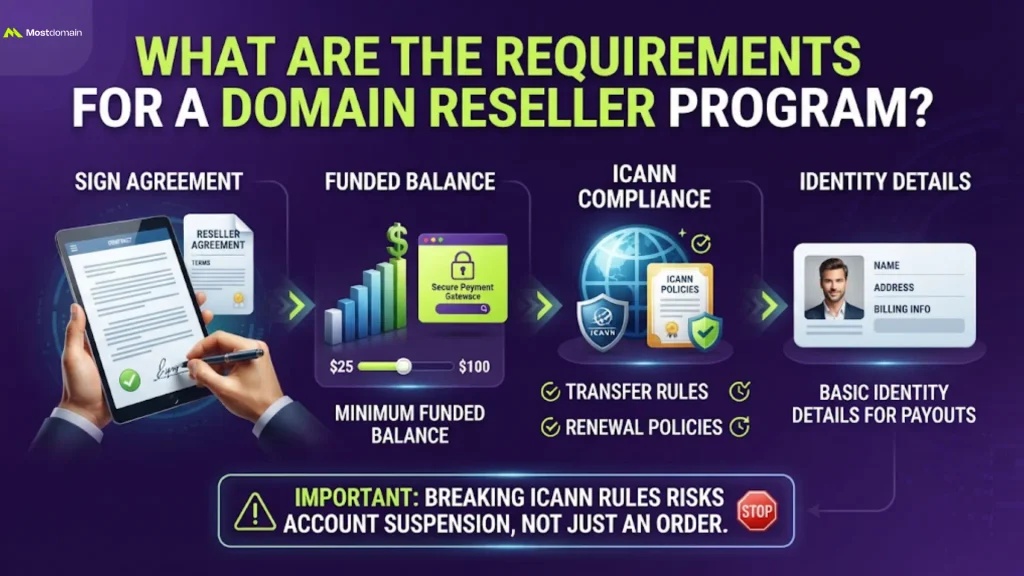
Domain reseller requirements stay light compared to becoming a full registrar. Most programs just need a signup and a funded balance.
The reseller agreement still binds you to ICANN’s core policies. Breaking those rules risks your whole account, not one order.
Typical domain reseller requirements include:
- Signing the registrar’s reseller agreement
- A minimum funded balance, often $25 to $100
- Compliance with ICANN transfer and renewal policies
- Basic identity details for billing and payouts
What Are the Benefits and Responsibilities of a Domain Reseller?
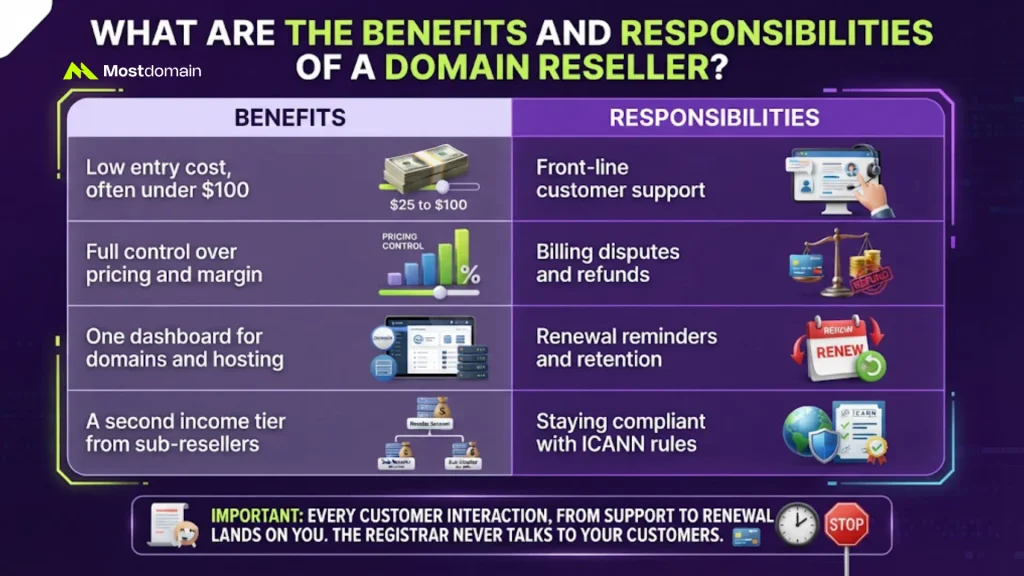
Domain reseller benefits include low startup cost and full pricing control. The main responsibility is handling customer support yourself, always.
The registrar never talks to your customers directly. Every support ticket, refund, and renewal reminder lands on you instead.
| Benefits | Responsibilities |
|---|---|
| Low entry cost, often under $100 | Front-line customer support |
| Full control over pricing and margin | Billing disputes and refunds |
| One dashboard for domains and hosting | Renewal reminders and retention |
| A second income tier from sub-resellers | Staying compliant with ICANN rules |
Domain Reseller vs Registrar, Registry, Broker, and Investor
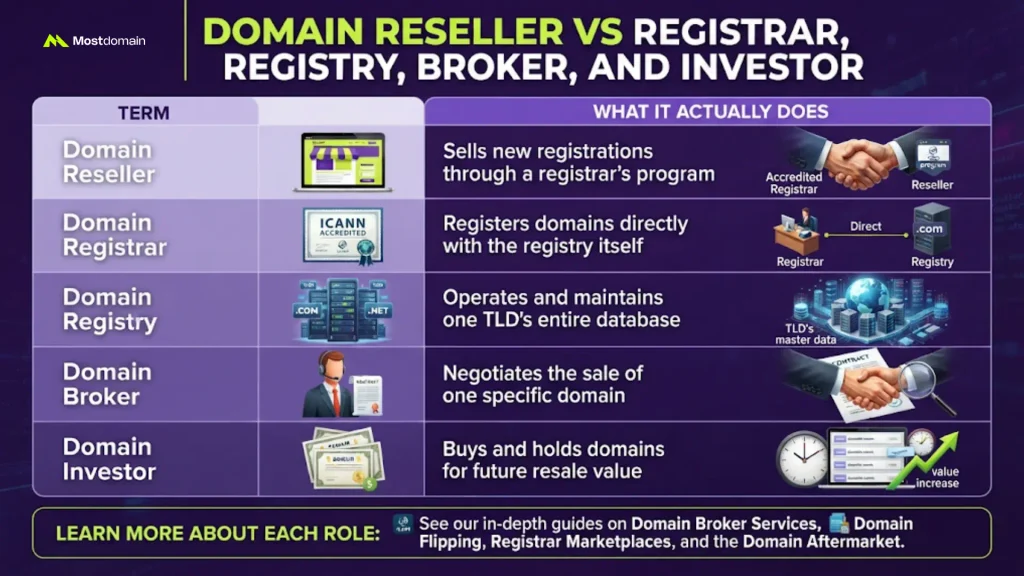
A domain reseller sells through someone else’s accreditation. A registrar holds that accreditation directly. A registry runs the TLD itself. A broker negotiates one specific sale. An investor buys domains to hold, then possibly flip.
| Term | What It Actually Does |
|---|---|
| Domain Reseller | Sells new registrations through a registrar’s program |
| Domain Registrar | Registers domains directly with the registry itself |
| Domain Registry | Operates and maintains one TLD’s entire database |
| Domain Broker | Negotiates the sale of one specific domain |
| Domain Investor | Buys and holds domains for future resale value |
Curious how a broker’s role plays out day to day? Our guide on how a domain broker service works walks through that process step by step. Weighing a reseller account against flipping instead? See what domain flipping actually involves first.
For registrar-led versus marketplace-led buying, check domain registrar vs domain marketplace. Investors often work through the aftermarket instead; see what a domain aftermarket is and how it works for that side of things.
How Do You Check If a Domain Came From a Reseller?
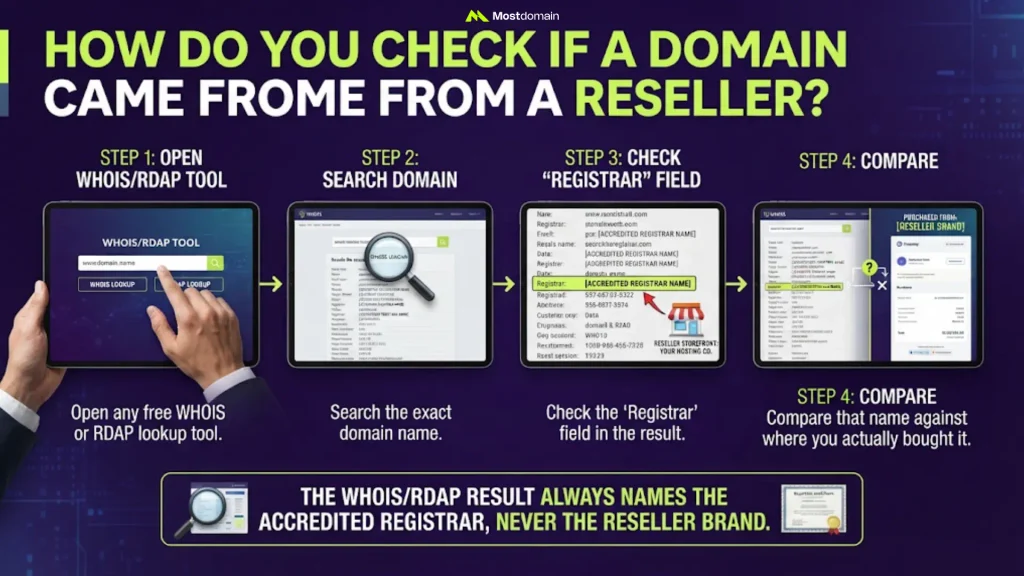
Run a WHOIS or RDAP lookup to check this. The result always names the actual registrar, never the reseller.
Hosting companies selling domains at checkout are almost always resellers. Knowing the real registrar matters most once support gets complicated.
Quick steps to check this yourself:
- Open any free WHOIS or RDAP lookup tool
- Search the exact domain name
- Check the “Registrar” field in the result
- Compare that name against where you actually bought it
Is Becoming a Domain Reseller Worth It?
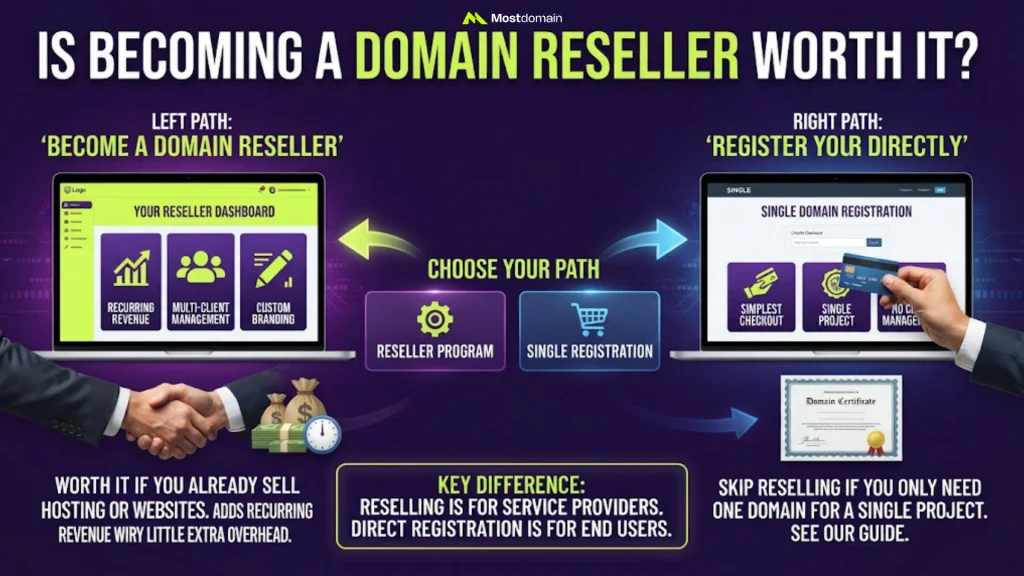
Becoming a domain reseller is worth it if you already sell hosting or websites. It adds recurring revenue with very little extra overhead.
Only need one domain for a single project? Skip reselling and register directly instead. Our guide on how to register a domain name covers that simpler path.
Skip reselling and just register one domain if you:
- Only need a single domain for one project
- Don’t plan to manage domains for clients
- Want the fastest, simplest checkout possible
FAQ
Is a domain reseller the same as a domain registrar?
No. A registrar holds direct ICANN accreditation. A reseller operates through that registrar’s program instead.
Do domain resellers need ICANN accreditation?
No. Resellers skip accreditation entirely. They rely on an already-accredited registrar’s infrastructure.
How much does it cost to become a domain reseller?
Many programs start free or under $100. Final cost depends on the platform and funding minimum.
Can a domain reseller also be a domain investor?
Yes. Nothing stops a reseller from buying and holding domains too.
Who shows up as the registrar on a WHOIS lookup?
The accredited registrar always shows there, never the reseller. That holds true even on resold domains.
References
- OpenSRS, “Understanding the Domain Registry vs Registrar vs Reseller vs Registrant Hierarchy”
- Namecheap, “Registries, Registrars and Registrants: What’s the Difference?”
- Dynadot, “The 3 R’s of the Domain Industry: Registry, Registrar, & Reseller”
- DreamHost, “What Is a Domain Reseller?”