
Mostdomain – Someone else owns the name you need. They’re not selling, at least not publicly. That’s the exact moment most buyers give up. A domain broker service works differently. It steps in as a paid intermediary. The broker finds the owner and opens negotiations. It then carries the deal through to a secure transfer. Who’s really behind the offer stays hidden.
What Is a Domain Broker Service?

A domain broker service is a professional intermediary. It buys or sells domain names on a client’s behalf. Think of it less like a listing. It’s more like a dedicated agent working one deal at a time.
- Private buyers: finds and approaches owners of unlisted domains
- Private sellers: markets a domain and screens serious offers
- Both sides: protects identity and handles the final paperwork
Industry terms, broker, agent, intermediary, get used loosely. A domain marketplace glossary clears up the vocabulary fast.
How Domain Brokerage Works, Step by Step
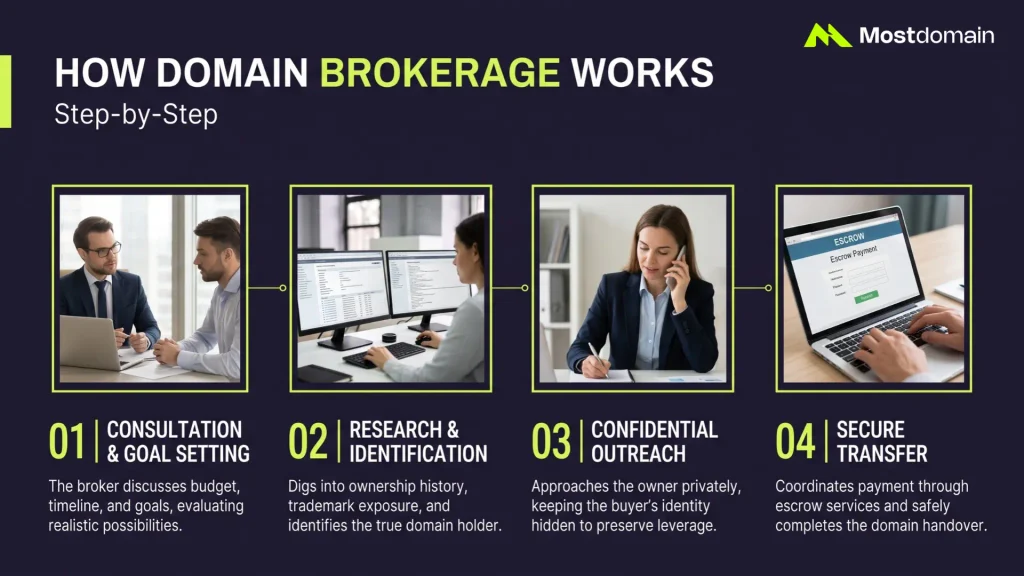
Domain brokerage follows a repeatable four-step process. The exact order shifts slightly by broker. The shape stays consistent across the industry.
Step 1: Consultation and Goal Setting
- The broker asks about budget, timeline, and why this name matters
- A serious broker pushes back if a goal looks unrealistic
Step 2: Research and Owner Identification
- Digs into ownership history, trademark exposure, and current market value
- Locates who actually holds the domain, not always obvious from WHOIS
Step 3: Confidential Outreach and Negotiation
- Contacts the owner without revealing the client’s identity
- Keeps leverage intact; a known brand asking directly almost always pays more
Step 4: Secure Transfer
- Coordinates payment once both sides agree on price
- Routes funds through domain escrow services until the transfer completes
Domain Acquisition Broker vs. Domain Sales Broker
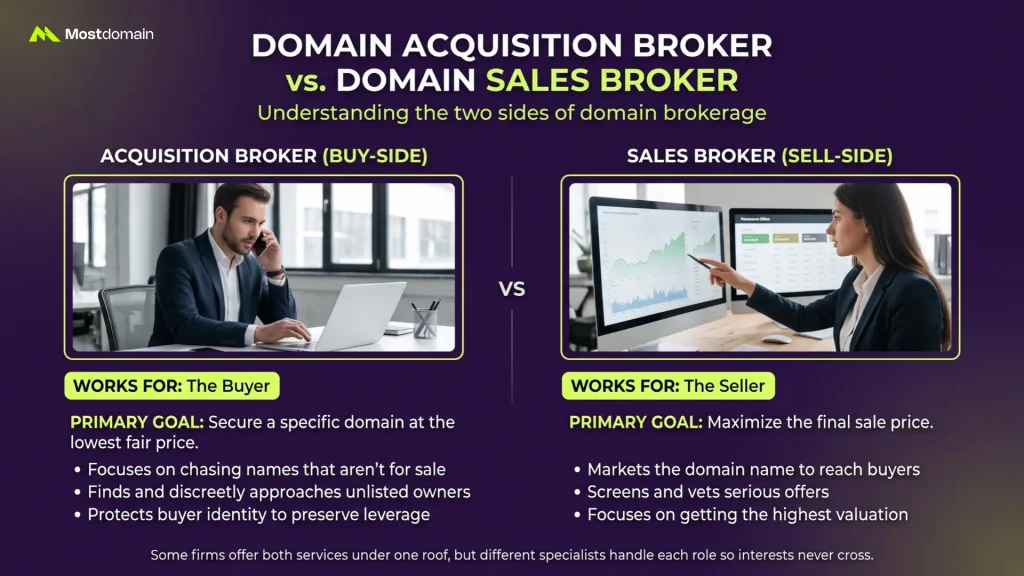
Brokers typically specialize in one side of the table. Buying and selling rarely get handled equally well. A domain acquisition broker works exclusively for buyers, chasing names that aren’t for sale. A domain sales broker represents the owner instead, marketing the name and vetting offers.
| Broker Type | Works For | Primary Goal |
| Acquisition (buy-side) | The buyer | Secure a specific domain at the lowest fair price |
| Sales (sell-side) | The seller | Maximize the final sale price |
Some firms offer both services under one roof. A different specialist handles each role, so interests never cross.

What a Domain Broker Responsibilities Actually Cover
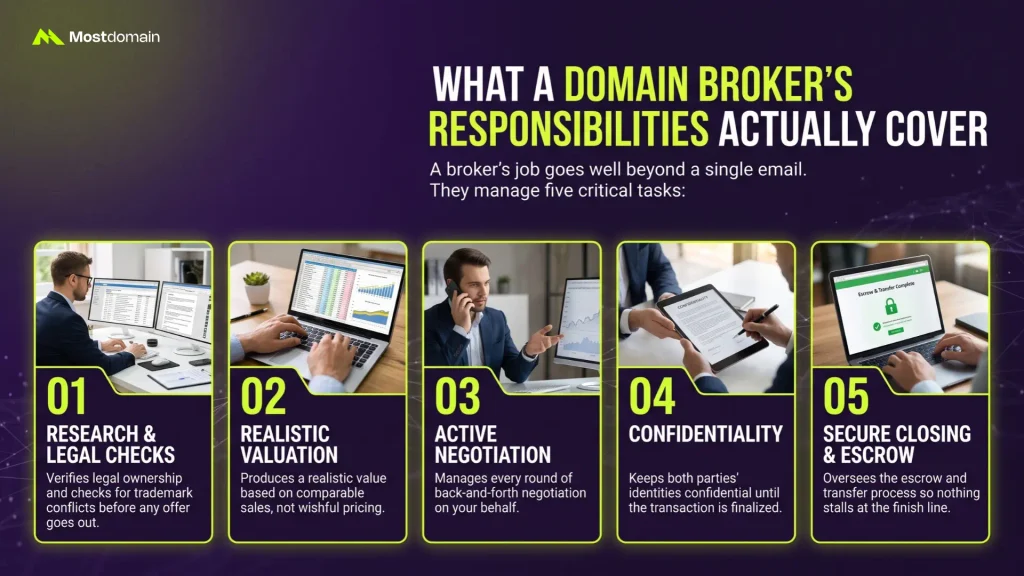
A domain broker’s responsibilities cover five things: research, valuation, outreach, negotiation, and closing. The job goes well beyond one email and a wait.
- Verifying legal ownership and checking for trademark conflicts before any offer goes out
- Producing a realistic valuation based on comparable sales, not wishful pricing
- Managing every round of back-and-forth negotiation so the client never has to
- Keeping both parties’ identities confidential until a deal is actually signed
- Overseeing the escrow and transfer process so nothing stalls at the finish line
How Much Does a Domain Broker Service Cost?
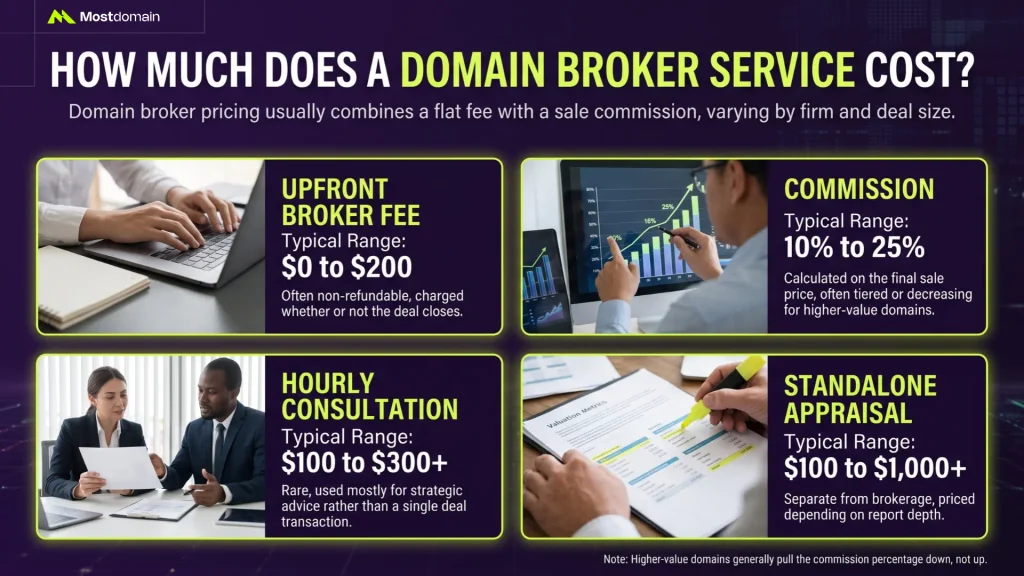
Domain broker pricing usually combines a flat fee with a sale commission. The exact split varies a lot by firm and deal size.
| Fee Type | Typical Range | Notes |
| Upfront broker fee | $0 to $200 | Often non-refundable, charged whether or not the deal closes |
| Commission | 10% to 25% | Calculated on the final sale price, tiered by some brokers |
| Hourly consultation | $100 to $300+ | Rare, used mostly for strategy work rather than a single deal |
| Standalone appraisal | $100 to $1,000+ | Separate from brokerage, priced by report depth |
Higher-value domains generally pull the commission percentage down, not up. A $500,000 name rarely carries a 25% cut. Understanding what is domain value helps you judge a fair quote.




Domain Broker vs. Domain Marketplace: Which Fits You?
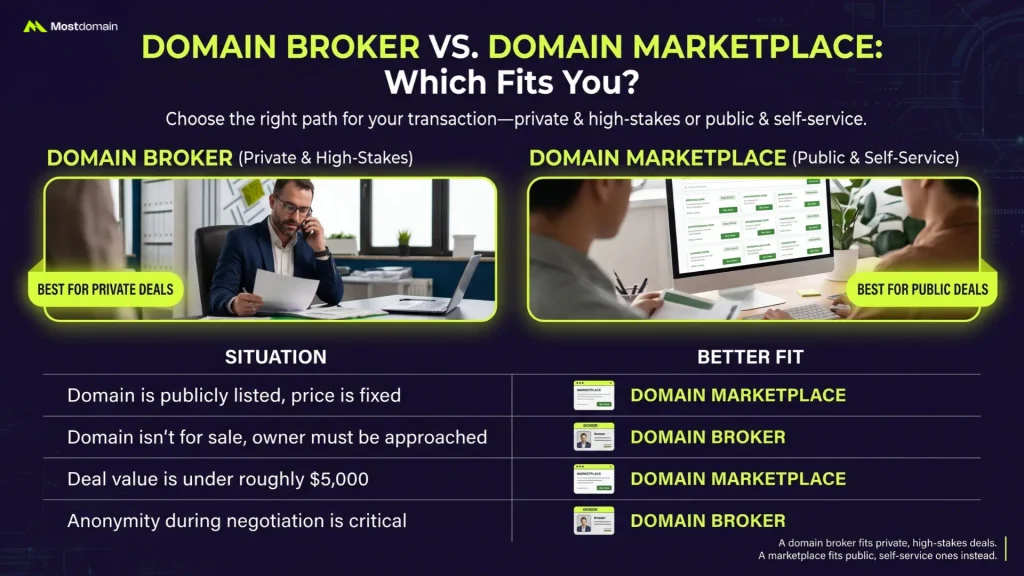
A domain broker fits private, high-stakes deals. A marketplace fits public, self-service ones instead. Neither replaces the other; they solve different problems.
| Situation | Better Fit |
| Domain is publicly listed, price is fixed | Domain marketplace |
| Domain isn’t for sale, owner must be approached | Domain broker |
| Deal value is under roughly $5,000 | Domain marketplace |
| Anonymity during negotiation is critical | Domain broker |
The line between a registrar, a marketplace, and a broker confuses many first-time buyers. A full breakdown lives in domain registrar vs domain marketplace. If browsing public listings sounds closer to your need, see domain name marketplace instead. The broader primary market vs aftermarket domains comparison shows where brokered deals fit in. New to the aftermarket itself? Start with what is a domain aftermarket first.
How to Choose a Professional Domain Broker
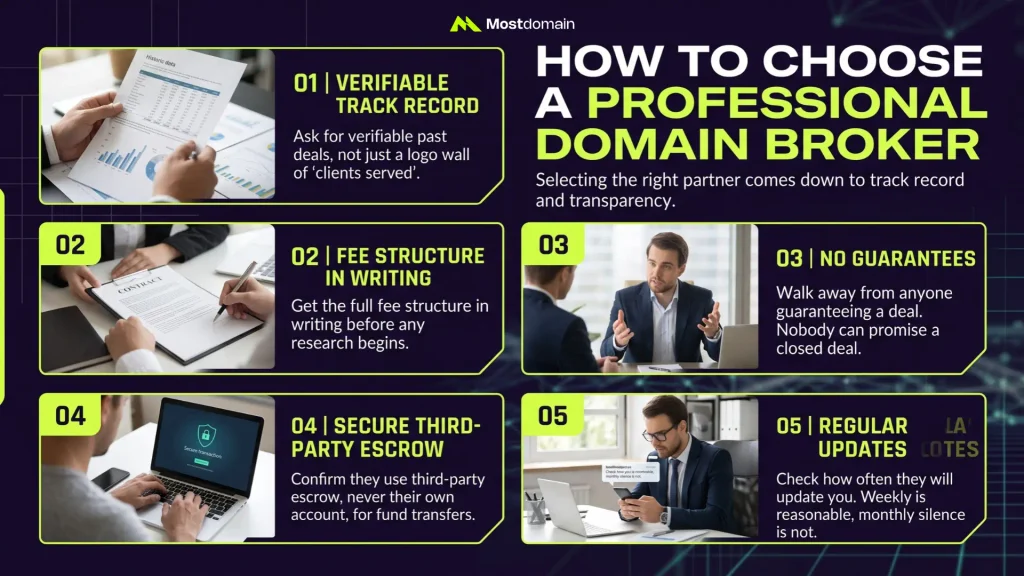
Choosing a professional domain broker comes down to track record and transparency. Watch how they talk about risk, too. Anyone can call themselves a broker; nothing licenses the title.
- Ask for verifiable past deals, not just a logo wall of “clients served”
- Get the full fee structure in writing before any research begins
- Walk away from anyone guaranteeing a deal closes, nobody can promise that
- Confirm they use third-party escrow, never their own account, for fund transfers
- Check how often they’ll update you, weekly is reasonable, silence for a month isn’t
When Hiring a Domain Broker Makes Sense
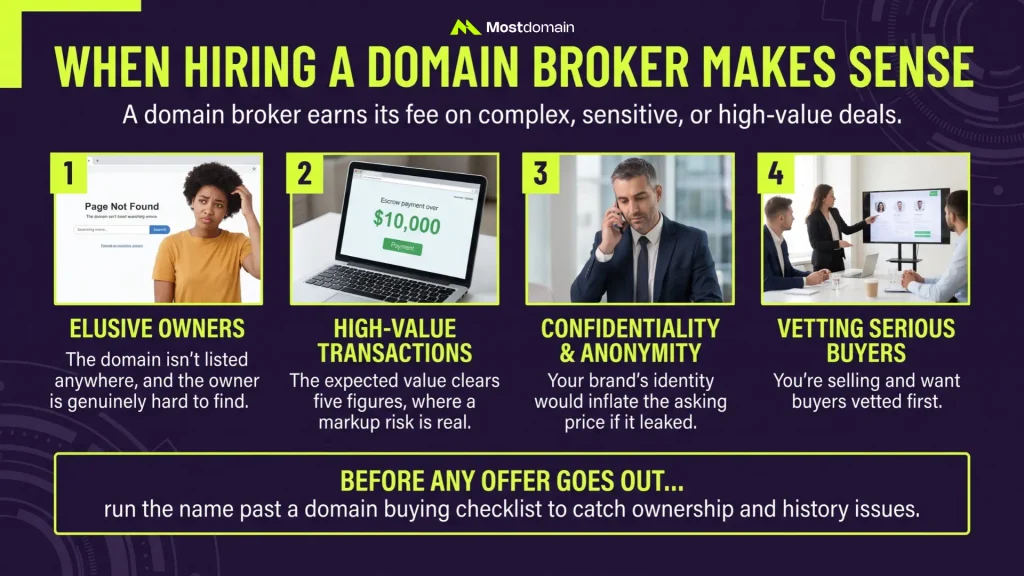
A domain broker earns its fee on complex or sensitive deals. High-value names fit here too.
- The domain isn’t listed anywhere, and the owner is genuinely hard to find
- The expected value clears five figures, where a markup risk is real
- Your brand’s identity would inflate the asking price if it leaked
- You’re selling and want buyers vetted first; see how to sell a domain name
Before any offer goes out, run the name past a domain buying checklist. It catches ownership and history issues a broker’s report might gloss over.
FAQ
Is hiring a broker worth it for a cheap domain?
Usually not. Broker fees make sense once deal value climbs into the thousands.
How long does a brokered deal typically take?
Anywhere from two weeks to several months. Owner responsiveness drives the timeline more than anything else.
Can a broker guarantee they’ll get the domain?
No legitimate broker can. Some owners simply refuse to sell, no matter the offer.
Do brokers ever represent both the buyer and seller?
Occasionally, within one firm, but a serious broker discloses that conflict upfront.
Is a broker the same thing as a trademark dispute?
No. A broker negotiates a purchase. A UDRP dispute is a legal route for trademark claims instead.
References
- Wix, How Does a Domain Broker Service Work
- CIRA, The Quick Guide to Domain Brokers
- Dynadot, The Role of Domain Brokers in Acquisitions and Sales
- Media Options, Direct Seller vs. Open Marketplace vs. Domain Broker
- NameExperts, Domain Broker Essentials