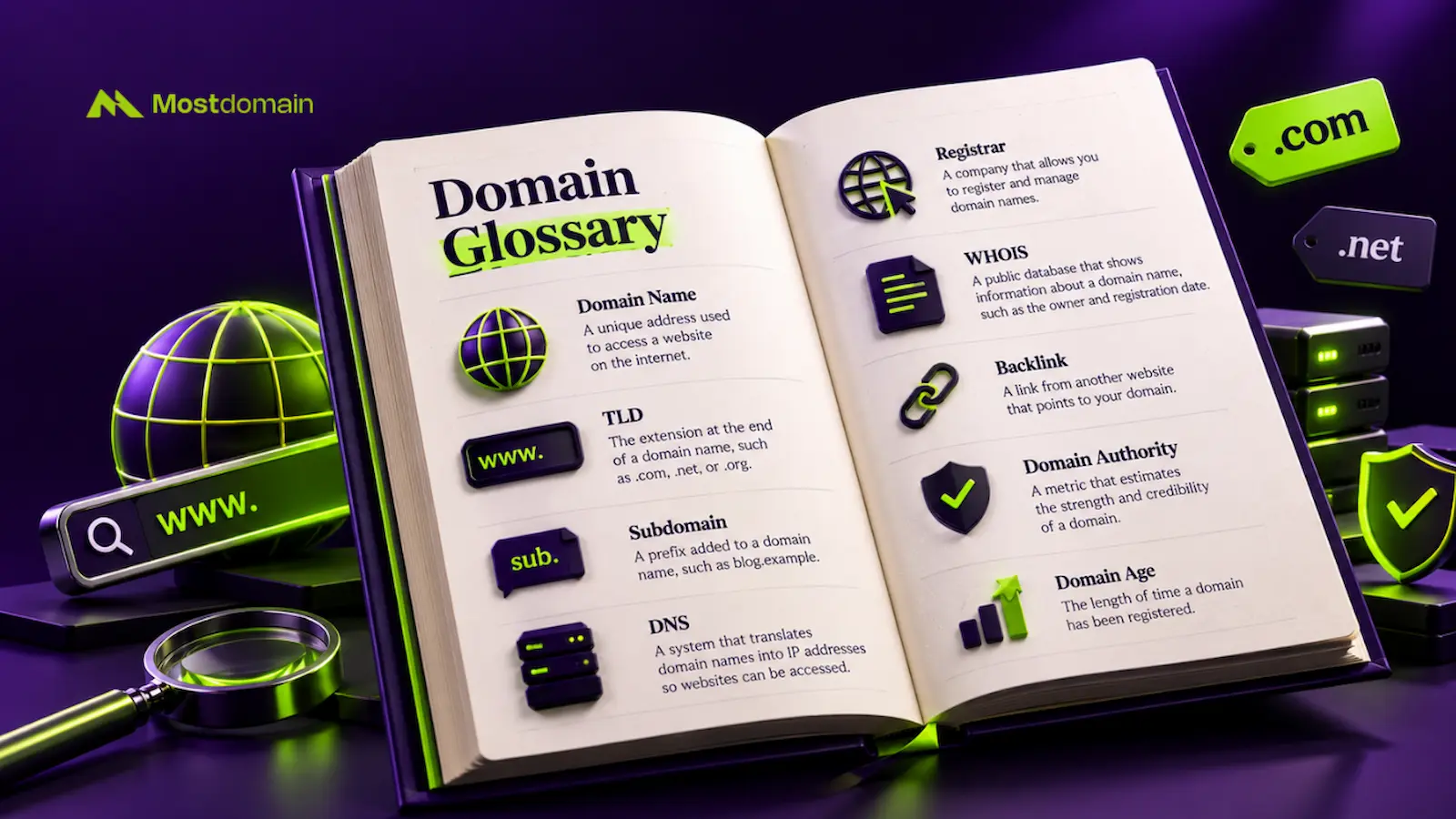
Forty terms cover nearly everything a buyer runs into when shopping for a domain. Plain language, grouped by where each one actually shows up.
A few of these already have a full guide elsewhere on the site. Those get a link, not a repeat.
What This Glossary Covers
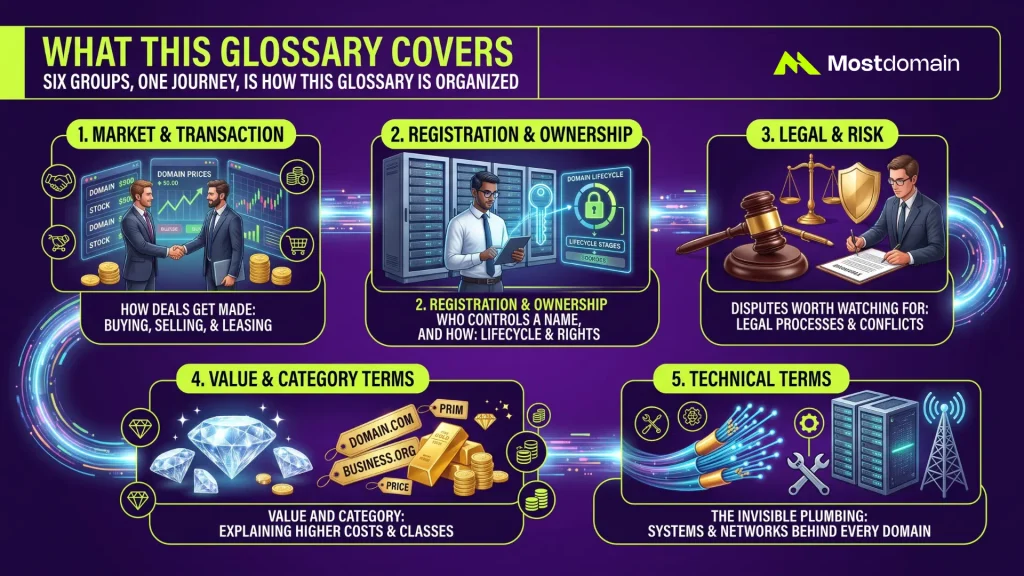
Six groups, one journey, is how this glossary is organized.
- How deals get made: that’s the market and transaction group.
- Who controls a name, and how: registration and ownership.
- Disputes worth watching for live under legal and risk.
- Value and category terms explain why some names cost more than others.
- The invisible plumbing behind every domain falls under technical terms.
Quick Jump: Find a Term Fast
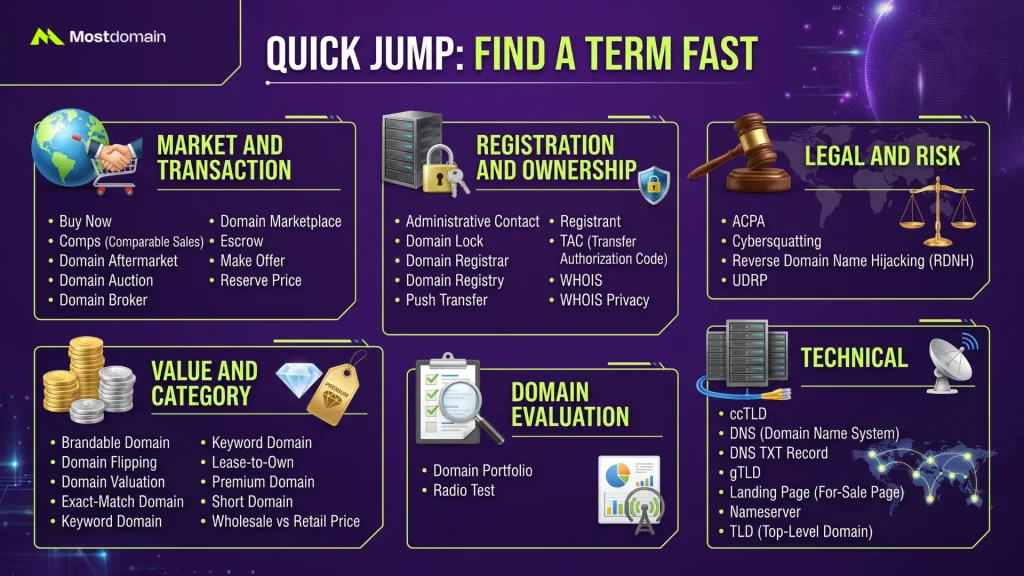
Find your term fast by scanning its category group below.
- Market and transaction covers: Buy Now, Comps (Comparable Sales), Domain Aftermarket, Domain Auction, Domain Broker, Domain Marketplace, Escrow, Make Offer, Reserve Price.
- Under registration and ownership: Administrative Contact, Domain Lock, Domain Registrar, Domain Registry, Push Transfer, Registrant, TAC (Transfer Authorization Code), WHOIS, WHOIS Privacy.
- Legal and risk holds four: ACPA, Cybersquatting, Reverse Domain Name Hijacking (RDNH), and UDRP.
- Value and category, the biggest group: Brandable Domain, Domain Flipping, Domain Valuation, Exact-Match Domain, Keyword Domain, Lease-to-Own, Premium Domain, Short Domain, Wholesale vs Retail Price.
- Just two sit under domain evaluation: Domain Portfolio and Radio Test.
- Technical wraps things up with ccTLD, DNS (Domain Name System), DNS TXT Record, gTLD, Landing Page (For-Sale Page), Nameserver, and TLD (Top-Level Domain).
Market and Transaction Terms
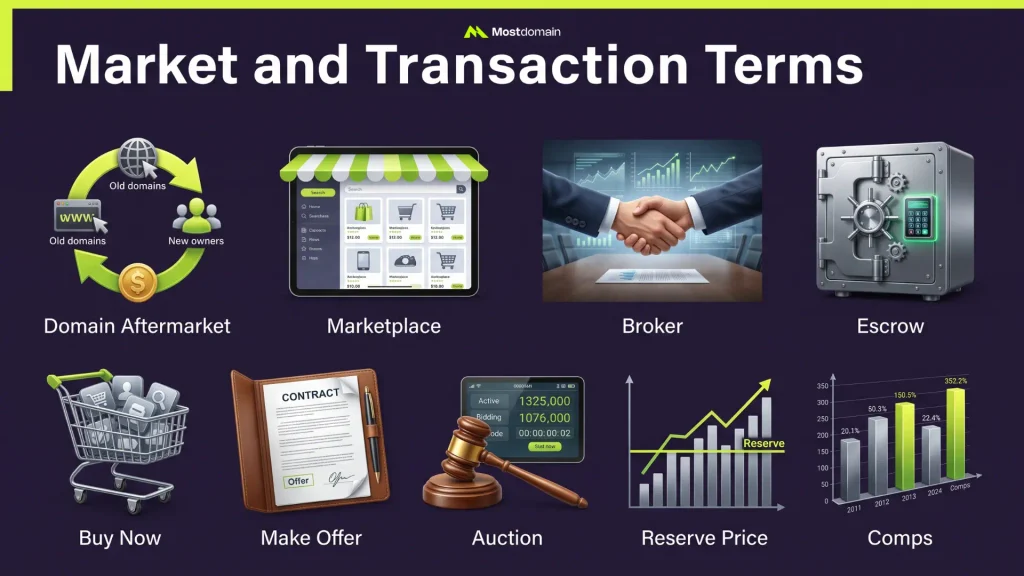
These nine terms describe how a domain changes hands, from listing to closed deal.
Domain Aftermarket
The aftermarket is the resale market for domain names someone already owns.

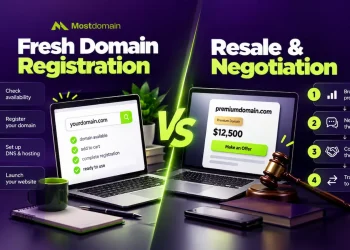
- Buyers negotiate directly with an existing owner, instead of registering a fresh name.
- Prices here run far higher than a standard registration fee.
- Full mechanics: our guide on what the domain aftermarket is and how it works.
Domain Marketplace
A domain marketplace is a platform where owners list already-registered names for sale.
- The marketplace hosts the listing. The seller, not the platform, usually owns the name.
- Sedo, Afternic, and Atom are commonly cited examples in this space.
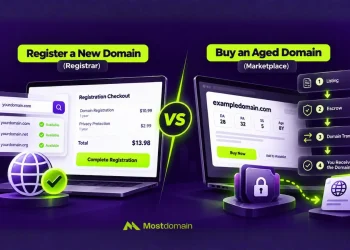
- We break down the distinction fully in domain registrar vs domain marketplace.
Domain Broker
A domain broker negotiates privately for a buyer or seller, for a fee.
Brokers are common for high-value names, especially ones not publicly listed for sale. Their fee usually comes as a commission on the final price.


Escrow
Escrow is a service that holds a buyer’s payment until the domain transfer confirms.
- Neither side gets what they want until both sides deliver.
- Fake escrow sites are a common scam. Visit the provider directly, never through a link.
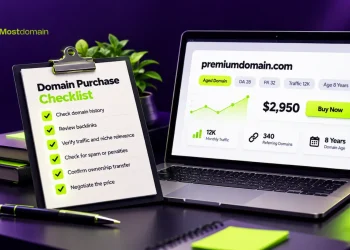
- We walk through escrow verification in the domain buying checklist.
Buy Now
Buy Now is a fixed price a seller sets. The first buyer to pay wins.
No negotiation happens with a Buy Now listing. Whoever pays first gets the name.
Make Offer
Make Offer lets a buyer propose a price. The seller decides: accept, counter, or decline.
This format suits names without a clear market price. Some back-and-forth is normal here.
Domain Auction
A domain auction lets multiple buyers bid. The highest bid wins at a set end time.
- Auction fever can push prices well past what comparables would suggest.
- Decide your ceiling before the first bid, not during the bidding.
Reserve Price
The minimum a seller will accept, no matter how bidding goes. That’s a reserve price.
Fall short of it, and most platforms let the seller walk away.
Comps (Comparable Sales)
Short for comparable sales, comps are recent sales of similar domains.
- Match by length, extension, and wording for the closest comparison.
- Pricing plays out in more depth in primary market vs aftermarket domains explained.
Registration and Ownership Terms
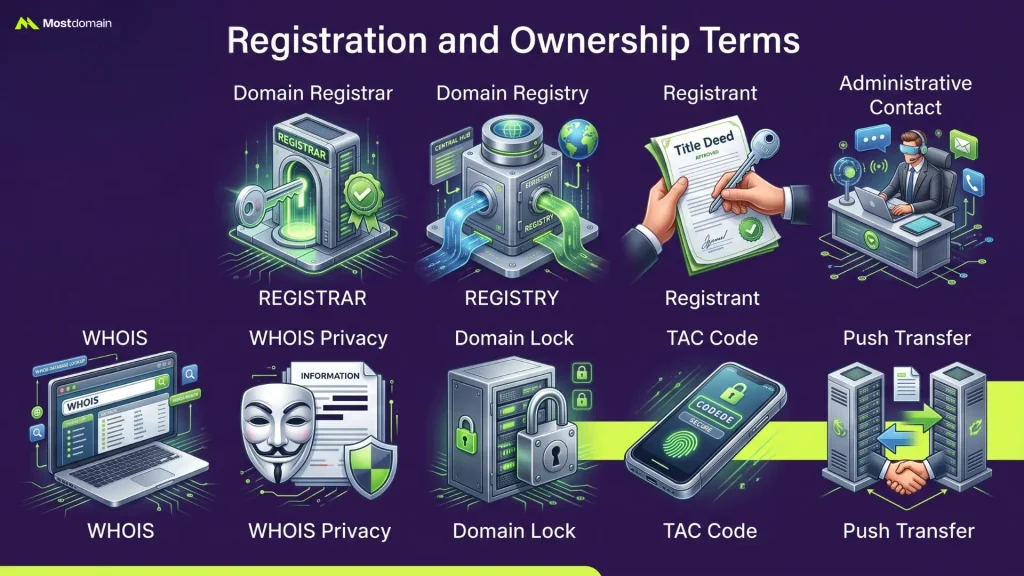
These nine terms cover who controls a domain, and the paperwork that proves it.
Domain Registrar
An accredited company that sells and manages domain registrations. That’s the whole job.
- Think Namecheap, Dynadot, or GoDaddy.
- Our domain registrar vs domain marketplace comparison goes deeper.
Domain Registry
A registry runs the master database for one entire extension, like .com or .io.
Registries never sell directly to buyers. Everything routes through an accredited registrar instead.
Registrant
Whoever’s name sits on the registration is the registrant, plain and simple.
That’s the legal owner of record, regardless of what WHOIS shows publicly.
Administrative Contact
Someone’s got to handle a domain’s day-to-day account details. That’s the administrative contact.
This role handles things like updating contact information, often separate from billing.
WHOIS
The WHOIS is the public record system showing a domain’s registration details.
- Owner name, registrar, and registration dates typically appear here, unless privacy is active.
- See our full guide on reading a WHOIS record.
WHOIS Privacy
Public lookups see a proxy service’s details instead of yours. That’s WHOIS privacy.
Your registrar still knows exactly who owns the name. Only public visibility is hidden.
Domain Lock
A domain lock is a registrar setting that blocks an unauthorized transfer attempt.
- ICANN also imposes automatic locks after registration or a recent transfer.
- Our buying checklist explains current lock windows and timing.
TAC (Transfer Authorization Code, Formerly EPP Code)
A TAC, once called an EPP code, unlocks a domain for a registrar transfer.
Only the current registrar can generate this code. Without it, no transfer can begin.
Push Transfer
A push transfer moves a domain between two accounts at the same registrar.
This is often faster than a full inter-registrar transfer, sometimes completing in minutes.
Legal and Risk Terms
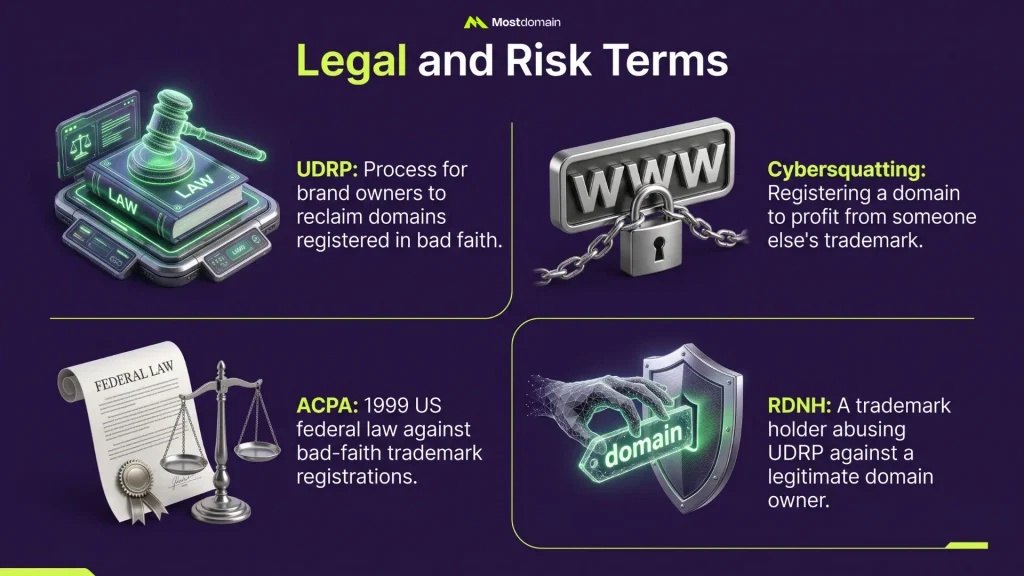
Four terms cover the disputes and bad-faith behavior worth knowing before you buy.
UDRP
UDRP is the process brand owners use to reclaim domains registered in bad faith.
- A complainant must prove trademark rights, no legitimate interest, and bad faith.
- Our domain aftermarket safety guide covers dispute risk in more depth.
Cybersquatting
Cybersquatting means registering a name that copies someone’s trademark, hoping to profit from it.
This practice is what both UDRP and formal legislation were built to address.
ACPA (Anticybersquatting Consumer Protection Act)
A 1999 US federal law aimed at bad-faith, trademark-based domain registration, the ACPA.
Plenty of sources get the name wrong, dropping words or reordering them. This is the real one.
Reverse Domain Name Hijacking (RDNH)
This describes a trademark holder abusing UDRP against a legitimate owner.
Panels can rule against a complainant for this. It can hurt their future UDRP credibility.
Domain Value and Category Terms
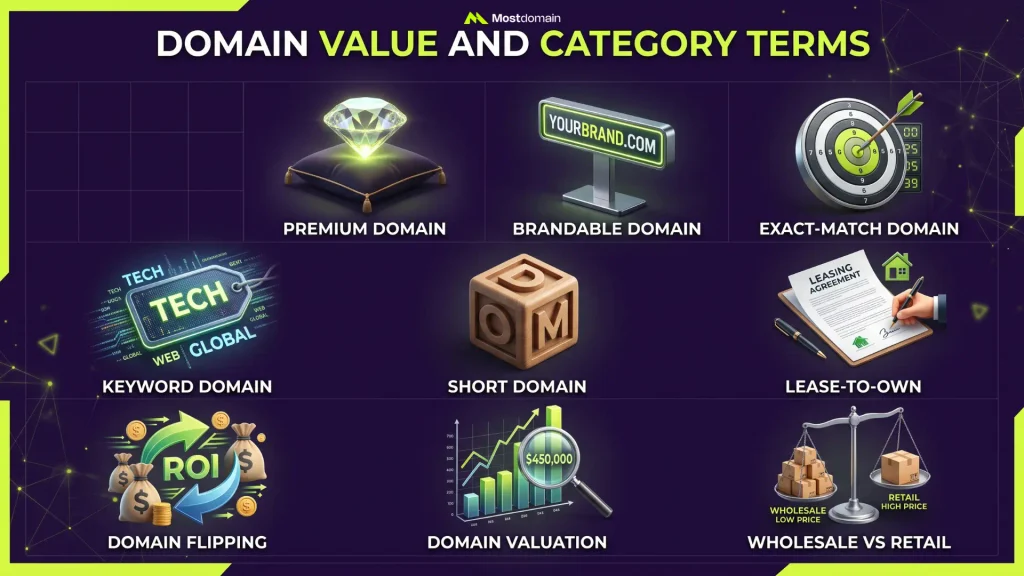
These nine terms explain why names in the same extension cost wildly different amounts.
Premium Domain
A premium domain is priced above the standard registration fee, for its perceived value.
- Registries sometimes hold these back and price them higher at registration.
- Full details in our premium domain names guide.
Brandable Domain
A brandable domain sounds like a real brand name, even with no dictionary meaning.
Think invented, catchy words built for memorability rather than literal keyword meaning.
Exact-Match Domain
The precise phrase someone might type or search for, contained in the domain itself. That’s exact-match.
- These once carried heavier SEO weight than they do today.
- See our exact-match domains guide for current context.
Keyword Domain
A keyword domain includes a word tied to an industry, not an exact phrase.
Our branded vs keyword domains comparison covers when each style fits better.
Short Domain
A short domain typically runs under six characters, valued for being fast to type.
Shorter names are scarcer by nature, which usually pushes their price higher. See our guide to buying short domains.
Lease-to-Own
Lease-to-own lets a buyer pay in installments, gaining full ownership after the final one.
Our premium brandable domains for lease guide walks through how these deals actually run.
Domain Flipping
Domain flipping means buying a name specifically to resell it later for a profit.
Our what is domain flipping guide covers the practice in full.
Domain Valuation
Domain valuation estimates what a name is worth, based on comparable sales and demand.
No valuation tool is perfectly accurate. Treat any number as a starting point only.
Wholesale vs Retail Price
Wholesale prices are what investors pay each other. Retail prices are what end users pay for the same names.
| Price level | Typical buyer | What drives it |
| Wholesale | Domain investors | Bulk trading between people in the industry |
| Retail | Businesses and end users | What the name is worth to their specific brand |
Domain Evaluation Terms
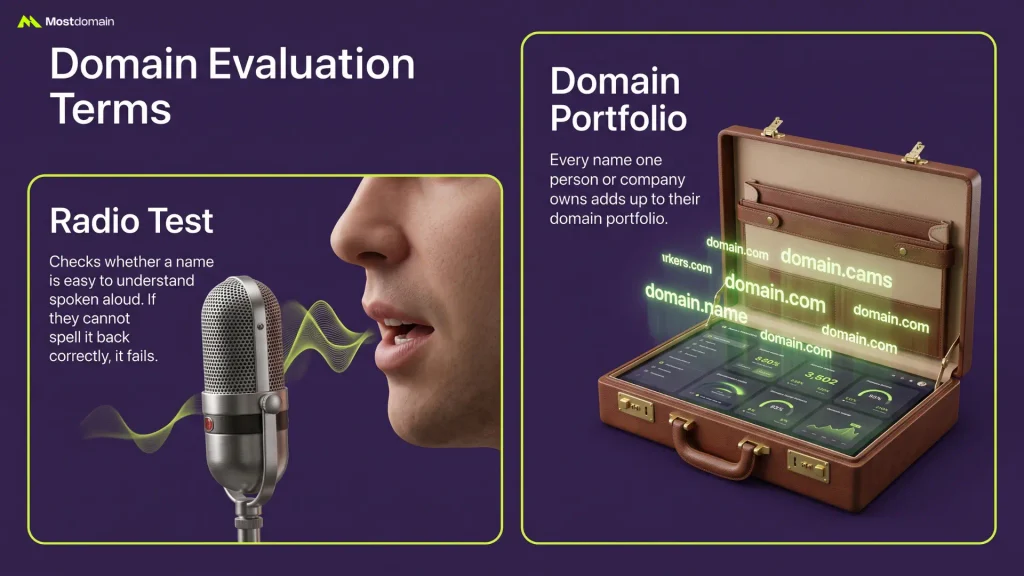
These two terms describe informal methods buyers use to judge a name before committing.
Radio Test
The radio test checks whether a name is easy to understand spoken aloud.
Say the domain out loud to someone. If they can’t spell it back correctly, it likely fails this test.
Domain Portfolio
Every name one person or company owns adds up to their domain portfolio.
Some investors juggle dozens of names. Others manage into the hundreds.
Technical Terms Every Buyer Should Know
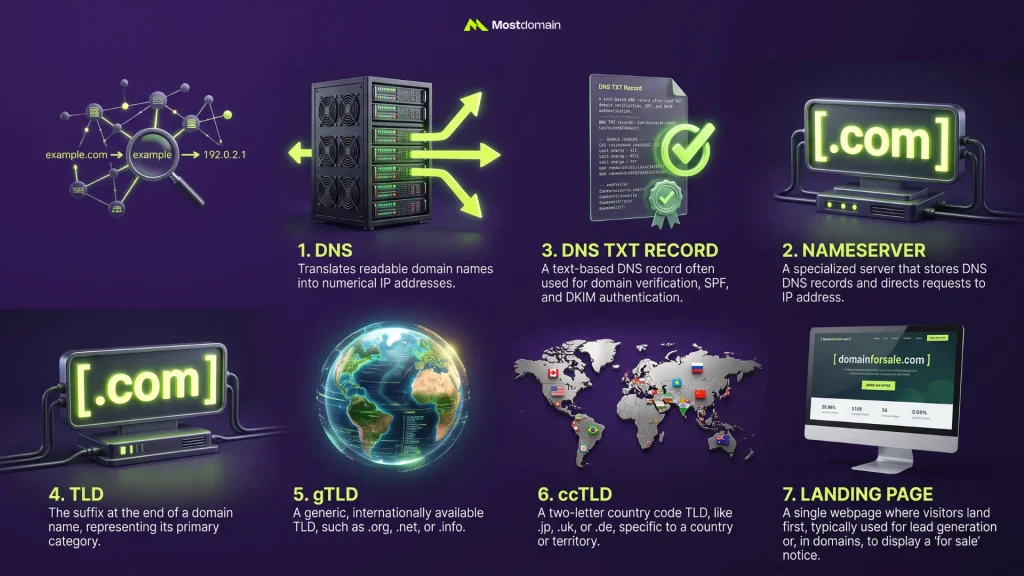
Seven terms cover the infrastructure running quietly behind every working domain.
DNS (Domain Name System)
Translating a domain name into the numeric address computers actually use, that’s DNS.
Skip DNS, and you’re memorizing number strings for every site you visit.
Nameserver
A nameserver holds a domain’s DNS records and points traffic where it should go.
Updating nameservers is usually the last step once a domain transfer wraps up.
DNS TXT Record
Text data tucked into a domain’s DNS settings. That’s a TXT record, often used for verification.
Some marketplaces lean on a TXT record to confirm a seller controls the name.
TLD (Top-Level Domain)
Everything after the final dot, .com or .io included, counts as the TLD.
| Type | Example | Meaning |
| gTLD | .com, .net, .org | Open for broad, general use |
| ccTLD | .uk, .de, .jp | Tied to one specific country |
gTLD
Not tied to any one country. That’s what makes a TLD generic, or a gTLD.
.com, .net, and .org are the most established names in this category.
ccTLD
Assigned to one specific nation or territory. That’s a ccTLD.
.uk, .de, and .jp are familiar ones, though some travel well beyond home borders.
Landing Page (For-Sale Page)
In this context, a landing page just tells visitors the domain is for sale.
You’ll usually find a price, an inquiry form, or a link to the seller.
FAQ
What’s the difference between a registrar and a registry?
One deals directly with customers. The other runs an entire extension behind the scenes.
- You deal with a registrar directly. The registry stays invisible to you.
- Verisign, for example, is the registry behind every .com domain.
Is WHOIS privacy the same as anonymous ownership?
No. It only hides your details from public lookups, nothing more.
- Your registrar still knows exactly who owns the domain.
- Law enforcement and legal processes can still reach the actual registrant.
Do I need to know all 40 terms to buy a domain safely?
No, but a handful matter for nearly every purchase.
- Escrow, WHOIS, and transfer codes come up in almost every deal.
- Our domain buying checklist walks through the essentials in order.
What’s the difference between cybersquatting and reverse domain hijacking?
One’s a bad-faith registration. The other’s a bad-faith complaint against a legitimate owner.
- Cybersquatting goes after a trademark holder’s rights.
- RDNH twists the very process meant to protect those rights.
Why do some glossaries define aftermarket and marketplace as the same thing?
They’re closely related, but not identical in a strict sense.
- The aftermarket is the broader resale market itself.
- A marketplace is one specific type of platform operating inside that market.
Is a premium domain always a brandable domain?
No. The two can overlap, though neither one requires the other.
- A premium domain can be a plain, descriptive word priced high for demand.
- A brandable domain can register at a standard fee if nobody’s claimed it yet.
How often do domain industry terms change?
Rarely for core concepts, though specific terminology does shift occasionally.
- EPP code, for instance, is increasingly called a TAC these days.
- What’s here reflects current terminology, as of 2026.
Keep This Glossary Handy
Most first-time buyers hit two or three unfamiliar terms before they’re done.
- Pull this up during your next domain search or negotiation.
- The linked guides cover any term that needs more depth.
- Give it one real transaction. Most of this vocabulary sticks after that.
References
- GoDaddy, Domain Glossary: Terms to Know for Starter Domain Investors
- NameGulf, Understanding Domain Terms: Registry, Registrar, WHOIS, ICANN, and Aftermarket
- NameGulf, Radio Test: An Essential Tool for Domain Buyers and Sellers
- Wikipedia, Domain aftermarket
- Wikipedia, Anticybersquatting Consumer Protection Act
- WIPO, Uniform Domain Name Dispute Resolution Policy