
Deciphering Types of Domain Names requires moving beyond the jargon. Registration logic, structural positioning, and tactical intent define your online footprint. Beginners often conflate these concepts, mistakenly weighing a subdomain against a parked page as if they occupied the same category. They don’t. Each serves a distinct function.
This breakdown categorizes Types of Domain Names by their anatomy, strategic purpose, and operational status. It ignores the specific TLD debates found elsewhere. If you need to pit .com against a niche extension, look elsewhere. This guide addresses the foundational layers governing your digital identity.
Types of Domain Names by Structural Position
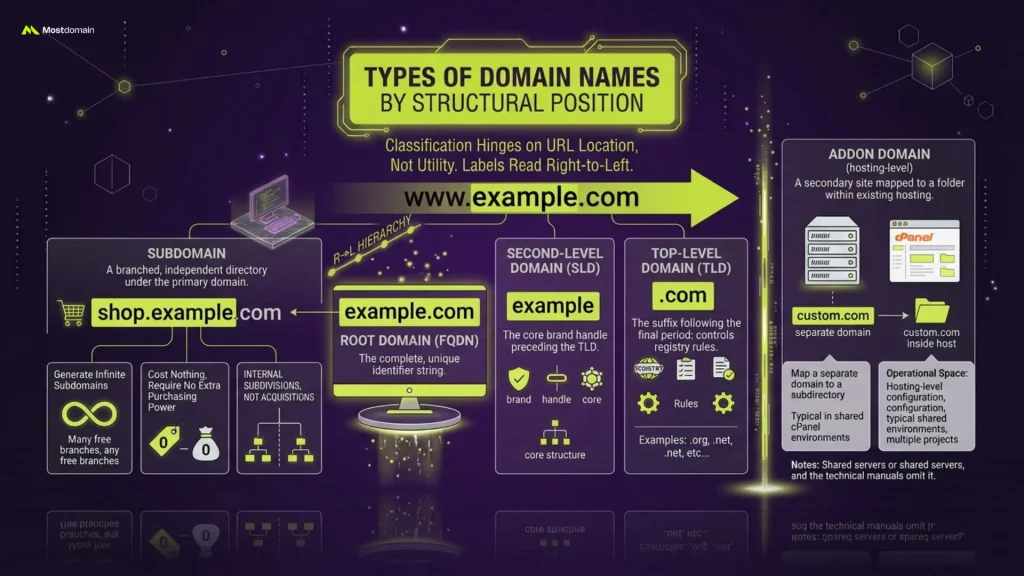
A domain’s classification frequently hinges on its URL location rather than its utility. Primary structural categories include the root, the TLD, the SLD, subdomains, and the hosting-specific addon domain.
| Type | Function | Illustration |
| Root domain (FQDN) | The complete, unique identifier string | www.example.com |
| Top-Level Domain (TLD) | The suffix following the final period; controls registry rules | .com, .org, .net |
| Second-Level Domain (SLD) | The core brand handle preceding the TLD | example in example.com |
| Subdomain | A branched, independent directory under the primary domain | shop.example.com |
| Addon domain | A secondary site mapped to a folder within existing hosting | custom.com inside host |
Hierarchy dictates that labels read right-to-left. You can generate infinite subdomains from a single registration; these cost nothing and require no extra purchasing power. Confusion often stems from this distinction. Subdomains are internal subdivisions, not new acquisitions.
Addon domains, however, occupy a different operational space. These are hosting-level configurations, typical in shared cPanel environments, where you map a separate domain to a subdirectory. While technical manuals often omit this, anyone juggling multiple projects on one server will encounter it immediately.
Types of Domain Names by Purpose and Branding
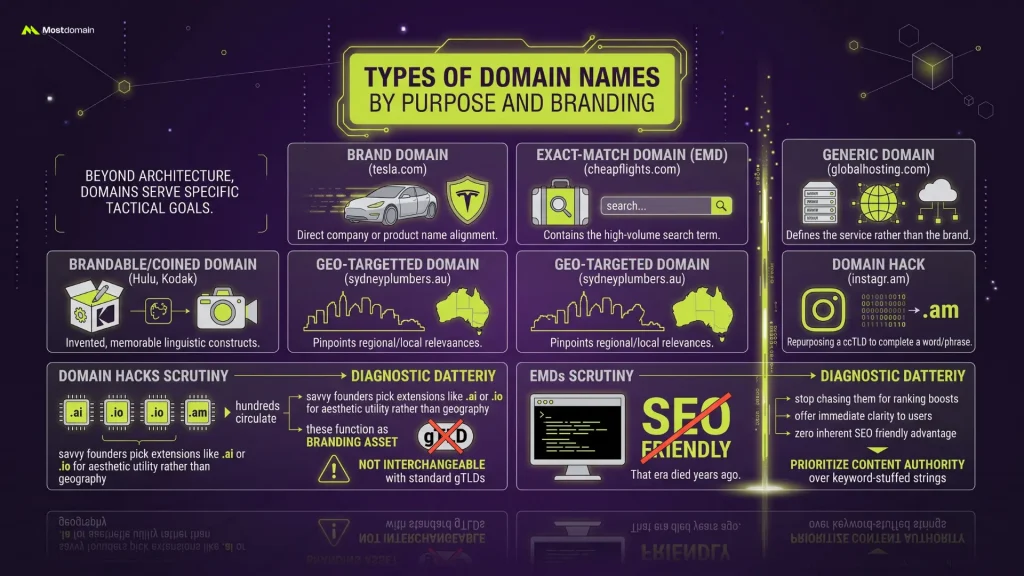
Beyond architecture, domains serve specific tactical goals. From rigid brand alignment to creative hacks, these six archetypes dominate naming conventions.

| Type | Function | Illustration |
| Brand domain | Direct company or product name alignment | tesla.com |
| Exact-Match Domain (EMD) | Contains the high-volume search term | cheapflights.com |
| Generic domain | Defines the service rather than the brand | globalhosting.com |
| Brandable/coined domain | Invented, memorable linguistic constructs | Hulu, Kodak |
| Geo-targeted domain | Pinpoints regional/local relevance | sydneyplumbers.au |
| Domain hack | Repurposing a ccTLD to complete a word/phrase | instagr.am |
Domain hacks warrant scrutiny. With hundreds of ccTLDs circulating, savvy founders often pick domain extensions like .ai or .io domain for their aesthetic utility rather than geographic ties. These function as branding assets. If you choose this path, recognize that they are not interchangeable with standard gTLDs.
Regarding EMDs: stop chasing them for ranking boosts. That era died years ago. While they offer immediate clarity to users, they provide zero inherent SEO friendly advantage. Prioritize content authority over keyword-stuffed strings.
Types of Domain Names by Registration and Usage Status
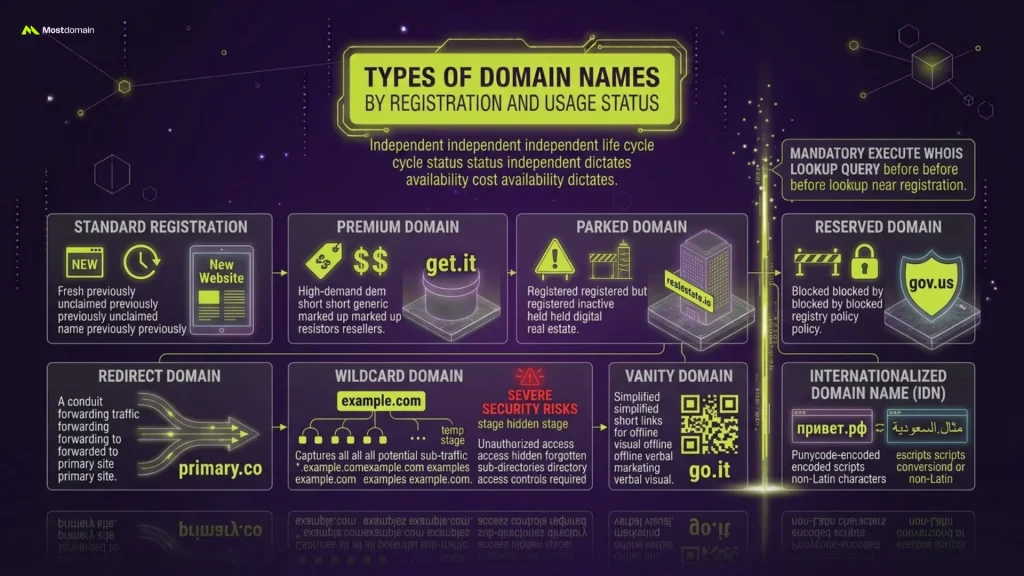
A domain’s current life cycle status, independent of its name, dictates its availability and cost.




- Standard Registration: A fresh, previously unclaimed name.
- Premium Domain: High-demand, short, or generic names marked up by registries or resellers.
- Parked Domain: Registered but inactive; held as digital real estate.
- Reserved Domain: Blocked by registry policy.
- Redirect Domain: A traffic conduit forwarding to a primary site.
- Wildcard Domain: Captures all potential sub-traffic (*.example.com).
- Vanity Domain: Simplified, short links for offline/verbal marketing.
- Internationalized Domain Name (IDN): Punycode-encoded scripts or non-Latin characters.
Global demand has commoditized short, clean names. Consequently, many are trapped in premium or parked status. Always execute a WHOIS lookup query before planning; you must verify that your desired label isn’t caught in a registration lockout.
Exercise caution with wildcard domains. They present severe security risks. An improperly configured wildcard allows unauthorized access to hidden staging servers or forgotten sub-directories. Access controls are mandatory, not optional.
Turning Domain Type Knowledge Into a Registration Decision
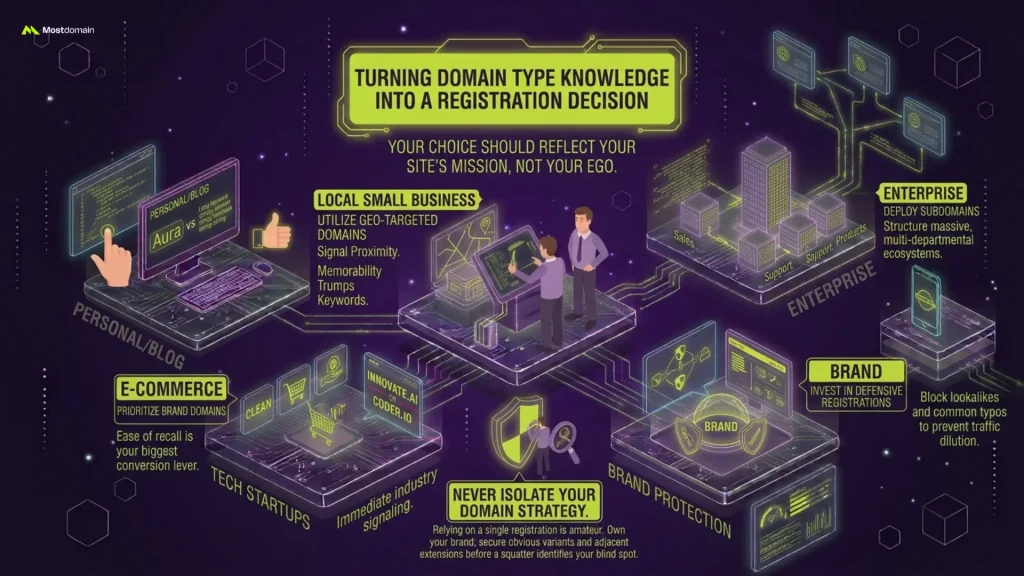
Your choice should reflect your site’s mission, not your ego.
- Personal/Blog: Use brandable domains. Memorability trumps keywords.
- Local Small Business: Utilize geo-targeted domains to signal proximity.
- Enterprise: Deploy subdomains to structure massive, multi-departmental ecosystems.
- E-commerce: Prioritize brand domains. Ease of recall is your biggest conversion lever.
- Tech Startups: Leverage domain hacks for immediate industry signaling.
- Brand Protection: Invest in defensive registrations. Block lookalikes and common typos to prevent traffic dilution.
Never isolate your domain strategy. Relying on a single registration is amateur. Own your brand; secure a domain name the obvious variants and adjacent extensions before a squatter identifies your blind spot.
FAQ
Is a subdomain the same as a separate domain name?
No. Subdomains are free, internal branches created via DNS. They require no additional registration fees.
Does registering an EMD still help SEO in 2026?
No. Keyword matching provides no ranking authority. User perception of clarity is the only benefit.
What separates a premium domain from a standard one?
Scarcity and price. Premium domains are short, high-value assets with inflated price tags set by registries or secondary markets.
Can a wildcard domain create a security risk?
Yes. It exposes everything beneath your domain to the public if configured poorly.
Should a business register more than one type of domain?
Yes. Defensive registration of typos and competitors’ TLDs prevents brand erosion.
References
- MDN Web Docs, “What Is a Domain Name?”
- Domain Smoke, “Complete List of Domain Extensions: All 1,437 TLDs (2026)”
- Wikipedia, “List of Internet Top-Level Domains”
- Verisign, “Domain Name Industry Brief”