Choosing between domain auction platforms is where most aged-domain SEO plays are quietly won or lost, well before the bidding ever starts. Some venues are built for last-second wars over expired .com inventory. Others simply hand you a name if nobody else backordered it. A few barely touch expired domains at all, and instead sell curated premium names at a set price.
This guide skips the “what is an auction” primer, since that lives in the parent aged domain guide. It goes straight to the part SEO buyers actually need: which platform to open when you already have a name, a budget, and a use case in mind.
Where each auction platform actually plays in 2026
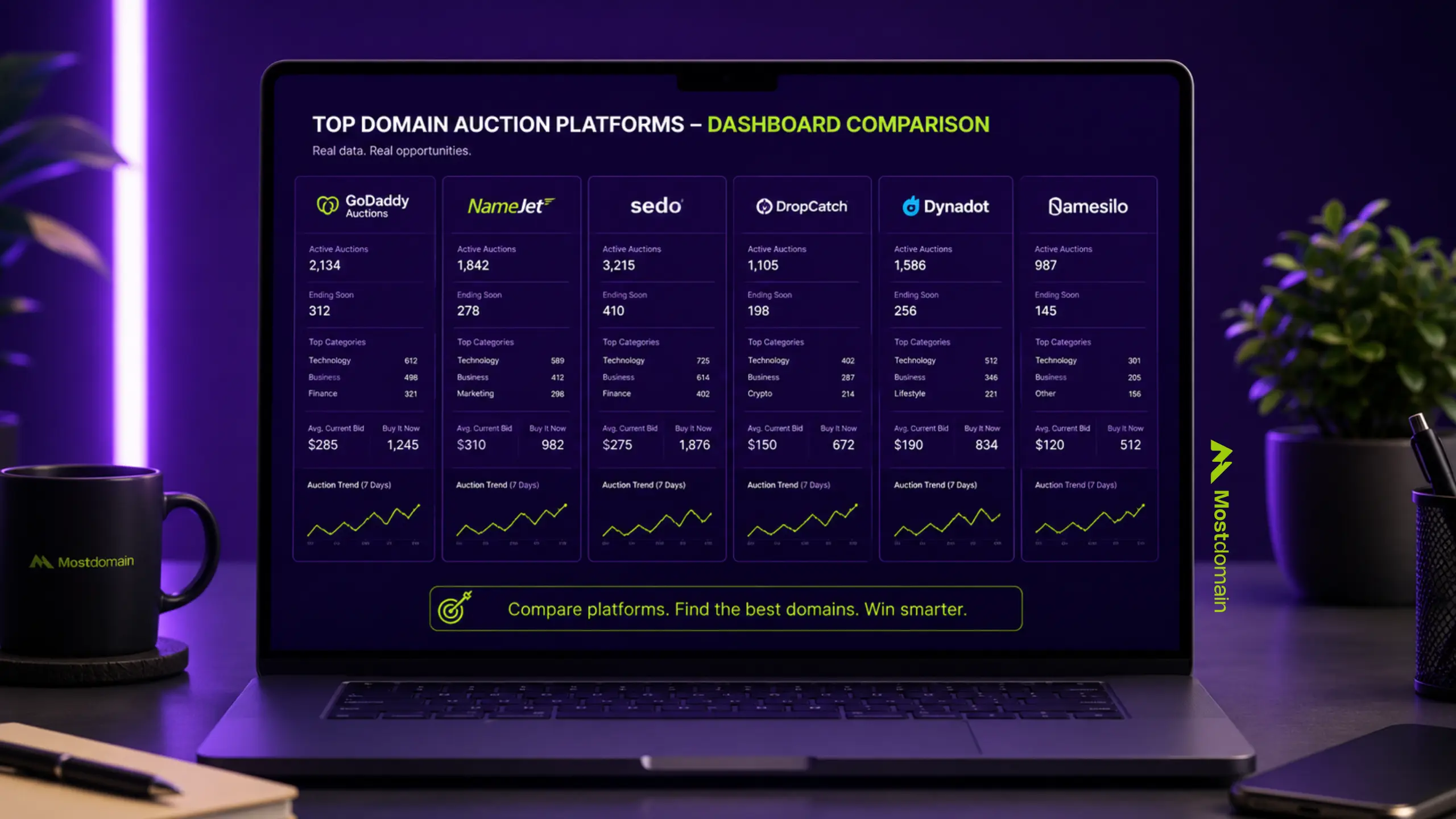
This is six venues most SEO buyers use. They are GoDaddy, NameJet/SnapNames, DropCatch, Dynadot, Sedo, and Namecheap. Each one covers a different slice of the aged domain market. So the “best” platform depends entirely on where your target name lives.
Not every platform fights over the same inventory. Here’s who does what:
GoDaddy Auctions
They runs the largest pool of expired, direct-transfer domains. If a name expired at GoDaddy, this is usually where it surfaces first. One catch worth knowing: GoDaddy retired its own backorder service back in 2025, so it now leans buy-side for expired names.
NameJet and SnapNames
They share a single backend (both sit under Newfold Digital) and specialize in premium expired names from legacy registrars such as Network Solutions and Register.com. Some domains appear here and nowhere else.

DropCatch
DropCatch is the drop-catching heavyweight. It runs over 1,200 registrar accounts to grab names the instant they hit pending delete.
Dynadot
They sells expired names from its own registrar base and has become a favorite among .ai and .io hunters working on a tight budget.
Sedo
Based in Germany, is less about expired inventory and more about the global aftermarket: millions of listed names, deep ccTLD coverage, escrow baked in.




Namecheap Market
For cheap transfers, curated brandables, niche TLD drops.
One habit saves money before you even start. Never place the same backorder on both NameJet and SnapNames, because they draw from identical inventory and you would risk paying twice for a single race.
Head-to-head comparison of the major platforms
Across the major domain auction platforms, buyer entry cost ranges from a $5 minimum at Dynadot to $59–$69 per backorder at DropCatch. Seller commissions run 10% to 25%, and only Sedo ships with true built-in escrow on every sale.
The table below is the core of this comparison. It focuses only on what changes your decision.
| Platform | What it costs a buyer to start | Commission model | Auction type |
| GoDaddy Auctions | $4.99/yr membership plus your bid; expired names add a mandatory 1-year renewal and ICANN fee | Seller pays 15%–25%; no direct buyer percentage | Public 7-day expired, plus fixed-price via Afternic |
| NameJet / SnapNames | Backorder roughly $19–$79 | About 15% on won auctions | Private, limited to backorderers |
| DropCatch | $59–$69 per backorder | Flat backorder fee, no percentage on solo catches | Public if contested, yours outright if you’re the only backorder |
| Dynadot | $5 minimum account spend; a 10% deposit kicks in on bids of $2,000 or more | Low buyer cost, no heavy percentage | Public 7-day expired |
| Sedo | Just the domain price; wire transfer adds nothing | Seller pays 10%–20%, tiered | Marketplace, Make Offer, Direct Auction, and bi-monthly GreatDomains |
A quick read of that grid: DropCatch charges the most just to try, yet it’s the one most likely to land a fiercely contested name. Dynadot is the cheapest door in. Sedo is the only platform where the escrow question is already answered for you.
The real landed cost, not the sticker price
The true landed cost of an aged domain stacks several add-ons on top of the winning bid: a mandatory 1-year renewal on expired names, ICANN fees, backorder or membership fees, currency conversion, and sometimes a deposit. Together these can add $15 to $80 before the domain is actually yours.
Sticker price is the trap. What you really pay tends to look more like this:
- GoDaddy expired names add a full 1-year renewal counted from the previous registration date, plus the ICANN fee, plus the $4.99 annual membership. Pay by US check and there’s a $25 processing fee on top, so don’t.
- DropCatch front-loads everything. The $59 to $69 backorder is spent whether the eventual auction runs cheap or expensive, and a contested name still heads to public bidding after that.
- Dynadot asks for a 10% deposit once your bid crosses $2,000, tying up cash mid-auction even on a bid you end up losing.
- Sedo is the cleanest math for a buyer. Pick wire transfer and you pay the domain price, nothing else, with transfer service included.
Then comes the line item nobody prints. For anyone paying in rupiah, pesos, or euros, every one of these platforms bills in USD regardless of your card’s home currency. A 2% to 4% foreign-exchange markup rides along on each purchase.
Which platform fits which SEO play
For SEO-driven buying, match the platform to the play. DropCatch or NameJet for high-authority expired .com names. Dynadot for budget aged domains and tech TLDs. GoDaddy for sheer volume. And Sedo for premium exact-match brandables with a clean history.
Budget and TLD alone won’t route you correctly. The use case does.
Chasing a specific expiring .com with strong backlinks
Place backorders at DropCatch first, since its catch rate on contested pending-delete names is the best in the field. If the name sat at a legacy registrar, add NameJet. This is the one scenario where spending $59 up front is rational. You’re buying probability, not just a listing.
Building a volume portfolio of aged domains on a budget
Dynadot’s $5 floor and declining closeout pricing make it a low-risk sandbox. GoDaddy’s volume helps here too, especially when you’re filtering by domain metrics rather than hunting a single trophy name.
Buying an exact-match or brandable name for a money site
Sedo is the natural home. Its inventory skews premium, escrow protects a five-figure spend, and the international seller base means more exact-match options across more languages. Expect reserve prices, though. A “reserve not met” result shows up often, even after real bids land.
Buyer protection and trust scorecard
On buyer protection, Sedo leads with mandatory escrow on every transaction. Dynadot and the drop-catchers hold funds through the registrar, while GoDaddy sits lowest after its February 2026 terms reclassified all customers as business users, stripping consumer cooling-off protections.
Trust is not uniform across these platforms. Here’s the honest ranking:
| Platform | What protects you | Where it falls short |
| Sedo | Escrow on 100% of sales; funds held until the transfer confirms | High-value escrow can take 7 to 14 days to clear |
| Dynadot | Registrar-held balance, clear public rules, transparent deposit thresholds | Smaller expired pool than the giants |
| DropCatch / NameJet / SnapNames | No catch, no pay; your fee is refunded if the drop fails | DropCatch requires ID and selfie verification, which frustrates plenty of buyers |
| GoDaddy Auctions | Full refund if the original registrant reclaims during the redemption window | The February 2026 terms treat every buyer as a business, and “Transaction Assurance” is explicitly not escrow |
That GoDaddy change deserves a flag of its own. Under the updated terms, its services are described as not intended for private or personal use, which means region-specific consumer cooling-off and refund rights may no longer apply to individuals. For a hobbyist buying a single aged domain, that’s a real downgrade in recourse.
What non-US and Indonesian buyers should watch
Buyers outside the US, Indonesia included, hit three recurring frictions on these domain auction platforms: USD-only billing with a 2% to 4% currency markup, identity-verification hurdles on the drop-catchers, and thinner consumer protection whenever a platform treats every buyer as a business.
Bidding from Jakarta, or anywhere outside the US, a few things bite harder.
- Currency and card friction. Every price shows in USD. Your bank adds its own FX spread, and some local cards get declined on their first run at a foreign domain platform. Verify the card before an auction closes, not while it’s ticking down.
- KYC on drop-catchers. DropCatch has asked international users for ID uploads and selfies. Budget time for that step. Getting verified mid-auction simply isn’t an option.
- Escrow as a trust bridge. For any cross-border spend above a few hundred dollars, Sedo’s built-in escrow or a third-party service like Escrow.com earns its small fee. It’s the closest thing to a safety net when chasing a US small-claims process isn’t realistic.
- ccTLD eligibility. Some country extensions require local presence. Check the registry rules before you bid, because winning a name you can’t legally register just burns the fee.
Indonesian buyers in particular tend to do best on platforms with proper wire-transfer support and multi-currency comfort. That’s part of why Sedo’s 150-country reach reads differently from here than it does for a US-based investor.
Direct registrar, aggregator, or curated fixed-price
The three ways to buy an aged domain are direct registrar auctions (GoDaddy, Dynadot), aggregators and drop-catchers (NameJet, DropCatch), and curated fixed-price marketplaces. The fixed-price route trades a higher sticker price for zero bidding risk.
Each route carries a different kind of cost, and it isn’t only money.
Direct registrar auctions
You bid on the platform that controls the expiring name. Fees are lower, but you’re exposed to last-minute proxy wars and the auction extensions specifically designed to stop sniping.
Aggregators and drop-catchers
They cast a wide net across many registrars. Better odds on hard names, higher entry fees, and a private auction waiting if you weren’t the only one who wanted it.
Curated fixed-price marketplaces
No bidding at all. You see a price, you pay it, you own the name. The premium is real, and so is the certainty, which matters a lot when a domain is feeding a client’s money site on a deadline.
There’s a fourth option that sidesteps the whole bidding apparatus. Platforms like Mostdomain curate pre-vetted aged domains at fixed prices, with the backlink profile and history already checked. For SEO teams that value a clean, verified name over the adrenaline of an auction, skipping the bid can turn out cheaper once you count the hours lost to proxy wars you didn’t win.
FAQ
Which domain auction platform has the largest inventory?
GoDaddy Auctions carries the deepest pool of expired, direct-transfer domains, adding thousands of names every day. For raw volume and variety of aged domains, nothing casts a wider net. Widest doesn’t always mean best for one specific target, though.
What’s the cheapest platform to start bidding on?
Dynadot wins on entry cost. It asks for a $5 minimum account balance before you can bid on expired auctions. That makes it a low-stakes place to build a portfolio or just learn the process, without committing the $59 up front that DropCatch requires.
Do buyers pay commission on these platforms?
Mostly, no. On GoDaddy and Sedo the seller carries the commission (15% to 25% and 10% to 20% respectively). Buyers still pay add-ons, though, like GoDaddy’s mandatory renewal on expired names or DropCatch’s flat backorder fee, so “no commission” rarely means “no extra cost.”
Which platform is safest for a high-value purchase?
Sedo, because escrow is built into every transaction. Funds sit held until the transfer confirms, then release to the seller minus commission. For any aged domain purchase running past a few hundred dollars, that structure beats platforms where escrow is absent or optional.
Can I buy the same expiring domain on multiple platforms at once?
Backordering across DropCatch, NameJet, and others is fine, and only the platform that actually catches the drop charges you. One warning holds though: NameJet and SnapNames share inventory, so ordering on both just pays twice for a single race with no added odds.
Is GoDaddy still safe for individual buyers after the 2026 terms change?
It still works, but the recourse narrowed. Since February 2026, GoDaddy’s terms classify all customers as business users, which can strip consumer cooling-off and refund protections from individuals in some regions. Domains still transfer fine. The legal safety net is simply thinner than it used to be.
A closing thought before you bid
The platform question rarely resolves to a single answer, because most serious aged domain buyers end up rotating two or three depending on where a name lives and how contested it is. What separates the buyers who net a profit from the ones who overpay isn’t platform loyalty. It’s knowing the landed cost before the clock starts, and walking away the moment a proxy war pushes a name past the number where its backlinks still pay for themselves. Set that ceiling first. The venue comes second.
References
- GoDaddy, “What is GoDaddy Auctions” and Auctions Membership Agreement
- Domain Name Wire, “New GoDaddy Terms of Service: we no longer serve consumers,” February 2026
- Sedo, “Price list for domain buyers and sellers” and Domain Auctions overview
- Dynadot Help, “What is an Expired Domain Auction” and participation requirements, updated 2026
- DomainDetails Knowledge Base, “Expired Domain Auctions Compared: GoDaddy vs NameJet vs DropCatch,” 2026
- Notify.domains, “Domain Auctions Explained: GoDaddy, NameJet, Sedo, DropCatch, SnapNames,” 2026
- Name Experts, “The Best Places to Buy and Sell Domain Names in 2026”