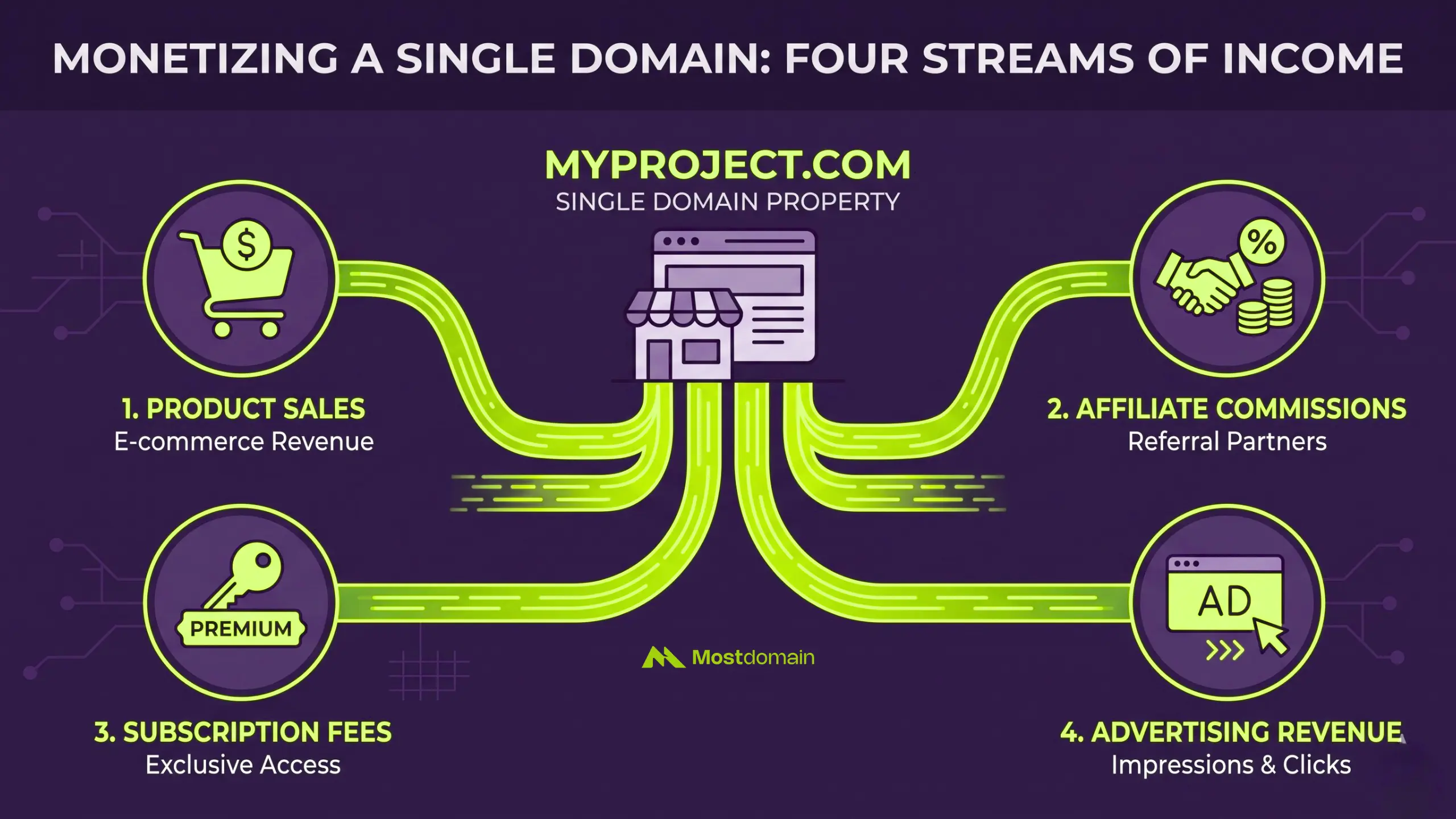
You can monetize an aged domain in four practical ways. Of course while keeping ownership intact. You can:
- park it for pay-per-click ads
- lease it to a business for monthly rent
- develop a small site that earns from ads or affiliates
- 301 redirect its authority into a money site you already run.
Each route trades effort for income differently. None of them require you to hand over the name.
The scope of this page is narrow. It covers how to pull cash from a domain you are holding, not whether the overall play pays off and not the mechanics of selling. Which is a separate exit decision. The aged domain explainer defines it in one place.
How to monetize an aged domain?
You monetize an aged domain by turning its existing traffic, keywords, or backlink history into income without transferring the name to anyone. The four methods below is on a spectrum from nearly passive to fairly hands-on. And the right one depends almost entirely on what the domain already brings to the table.
| Method | What it earns from | Effort level | Where it actually fits |
| Parking / PPC | Type-in traffic clicking displayed ads | Set and forget | Generic keyword names with real direct-navigation visitors |
| Leasing | A business paying to use the name | Low, once the contract is signed | Premium, brandable, or geo-keyword names |
| Develop + ads/affiliate | A small content site built on the domain | High and ongoing | Names with a clear product or niche angle baked into the keyword |
| 301 redirect | Backlink equity passed to your money site | One-time setup | Non-brandable names carrying strong, topically relevant links |
A caveat before the detail. Most idle domains earn close to nothing no matter which lever you pull, simply because they have no traffic to begin with. The few names that were already pulling visitors or links are the ones worth the effort.
Domain parking and PPC ads
Parking is the lowest-effort way to monetize an aged domain. But it only pays when the name already pulls type-in traffic. You point the nameservers at a parking service, it loads the page with ads, and you take a share of every click. Since Google retired AdSense for Domains in 2025, the easy money has thinned: most investors report parking income down 30 to 60 percent year over year, and the average name now earns just $5 to $20 across an entire year.

What you can realistically expect tracks almost entirely with traffic.
| Daily type-in traffic | Realistic parking income | Reading the number |
| None, which is most idle domains | Effectively $0 | No visitors, no clicks, nothing to collect |
| 10 to 50 visitors on a generic keyword name | $2 to $20 per month | Renewal money at best, rarely actual profit |
| 100 or more visitors | $50 to $200 per month | The uncommon name that genuinely earns its keep |
A few operational notes are worth holding onto:
- Clear $20 a month and the domain has covered its own annual renewal. That bar, not profit, is what most parked names are realistically chasing.
- Sedo, Bodis, and ParkingCrew are the platforms still standing after the 2025 shakeout, and each splits revenue on its own terms.
- Running one name across two providers for a month is the only dependable way to see which pays better for your particular traffic.
Leasing the domain for monthly income
Leasing earns you recurring rent while you keep legal ownership the entire time. A business uses the name, points it wherever it needs to go, and pays you monthly or annually. When the lease ends, the domain returns to you, often worth more because someone spent a year building traffic on it.




This is the most underused method to monetize an aged domain, and arguably the best fit for a strong name you would rather not sell yet. Premium domains can command $500 to $2,000 per month from a company that wants the name without a six-figure outlay. Pricing structures vary across the market.
Periodic installments
A flat monthly or quarterly fee for the lease term. Simplest to administer, and the income is predictable. Atom, for instance, prices rentals at 2 percent of the buy-it-now price per month for names above $5,000, and a flat $100 a month below that line.
Lease-to-own
Payments accumulate toward an eventual purchase. Which lowers the buyer’s barrier while still locking them in. It is one of the faster-growing structures in 2026. Platforms like Dan and Unstoppable build it in directly, with seller commissions hovering around 3 percent.
Profit share or royalty
Less common, though useful when the lessee’s business rides heavily on the exact name. You take a slice of revenue instead of a fixed fee, betting on their growth.
Protect yourself on one point: put DNS control and transfer terms in writing. If the leased site grows into something big, you do not want a vague handshake governing who controls the asset.
Developing a small site for ads or affiliate income
Developing a site is the most practical way to monetize an aged domain. And usually the most lucrative. You build a real page on it so the name earns from display ads or affiliate commissions instead of sitting as a bare parked page, and affiliate commissions typically dwarf what parking pays. The catch is that it only suits a few strong names, not a whole portfolio.
Here is what the approach involves in practice:
- The setup is easy to describe and harder to sustain: take the keyword baked into the name, build a tight “best [product]” page, and place two or three relevant affiliate links where the traffic lands.
- A product-category .com is the natural candidate, because the keyword does half the targeting before you write a single word.
- The cost is genuine work. Content, hosting, and ongoing upkeep all fall on you, which is exactly why it pays off only on names worth that attention.
- Mind the boundary. Turning a domain into a full, maintained website is a deployment project of its own, and the build, technical, and content side belongs to the deploying an aged domain guide. Here, development is one income channel among four.
301 redirects to channel authority into your money site
A 301 redirect monetizes the domain indirectly. Instead of earning on the name itself, you pour its backlink equity straight into a money site you already own, and done properly a 301 passes most of the accumulated link authority, with studies putting the figure at 90 to 99 percent. The receiving page inherits trust that would otherwise take months to build.
The mechanics and the math come down to a handful of points:
- Relevance is the gate. The redirect only helps when the old domain’s topic closely matches the page you point it at, and a mismatched redirect either dilutes the equity or gets quietly ignored.
- The upside, executed well, can be large. One documented case by Glen Allsopp traced a health-niche Amazon affiliate site earning roughly $28,000 a month, built in eight months on just 3 to 5 expired-domain redirects sourced from major news outlets.
- The equity is not permanent. As the backlinks on the old domain decay and their host pages age or vanish, the flow thins out over the years.
- This leans closer to an SEO tactic than to passive cash, so the “is it worth the risk” question is really a profitability one, handled in full by the profitability breakdown.
Which method fits your domain?
The right method follows from a single input: what the domain already has. Traffic steers you toward parking or development, a strong brandable name steers you toward leasing, and a powerful but awkward backlink profile steers you toward a redirect. Match the lever to the asset and you stop burning effort on names that were never going to pay.
| If your domain has… | Best first move | The reasoning |
| Steady type-in traffic on a generic keyword | Parking or a developed page | Existing visitors can be monetized almost immediately |
| A premium, brandable name | Leasing | Recurring rent without surrendering an appreciating asset |
| A clear product or service niche | Develop with affiliate links | Keyword-matched traffic converts far better than generic ads |
| Strong, relevant backlinks but a clumsy name | 301 redirect | The equity is worth more pointed at a money site than sitting idle |
| No traffic and weak links | List it for sale instead | There is simply too little here to monetize profitably |
Whether any of this clears the cost of holding is a returns question, not a methods one. Selling outright is the other path, and the choice between holding for income and cashing out rests on the same profitability math rather than the techniques here.
FAQ
Can you monetize an aged domain with no traffic?
Not at all. Parking and redirects both lean on existing visitors or backlinks, so a name with neither has almost nothing to extract. The most realistic move for a dead name is a for-sale landing page, which still captures buyer inquiries even when it earns zero ad revenue.
How much can a parked aged domain actually earn?
For most names, a few dollars a month or less. Average per-domain parking revenue has slipped to the $5 to $20 annual range. Although a domain with genuine type-in traffic can clear $50 to $200 monthly. Once it clears $20 a month, the name is covering its own renewal.
Is leasing better than selling an aged domain?
That hinges on whether you expect the name to appreciate. Leasing hands you monthly income now plus the option to sell later, often at a higher price once traffic is built on it. A sale gives you the lump sum today. They are less rivals than different timelines for the same asset.
Does a 301 redirect from an aged domain still work in 2026?
Yes, when relevance is tight. A 301 passes most link equity, but only a topically matched redirect holds up over time. Sending an unrelated domain at your money site wastes the authority and can read as manipulative, and the equity itself fades gradually as the old backlinks age.
Which monetization method needs the least work?
Parking, by a wide margin. Once the nameservers are pointed, it runs on its own. The catch is that low effort matches low return for most names, so passive parking suits large portfolios recouping renewal fees more than anyone chasing meaningful income.
Do I lose ownership if I lease or park my domain?
No. Both leasing and parking keep the name firmly in your control. Only an outright sale or a completed lease-to-own transfers ownership, and even lease-to-own withholds the transfer until the final payment clears.
References
- Nameslink, Domain Parking Monetization Guide (2026)
- Openprovider, What Is Domain Parking and How to Earn Money
- NectarNames, Domain Monetization Guide
- NameSilo, Passive Rental Income for Domain Investors
- DomainGang, Atom Launches Domain Rentals for Recurring Portfolio Income
- SEO.Domains, Aged Domain SEO Use Cases with Documented Outcomes
- Elementor, How to Redirect a Domain Without Losing SEO